
Recent from talks
May 1985 lunar eclipse
Knowledge base stats:
Talk channels stats:
Members stats:
May 1985 lunar eclipse
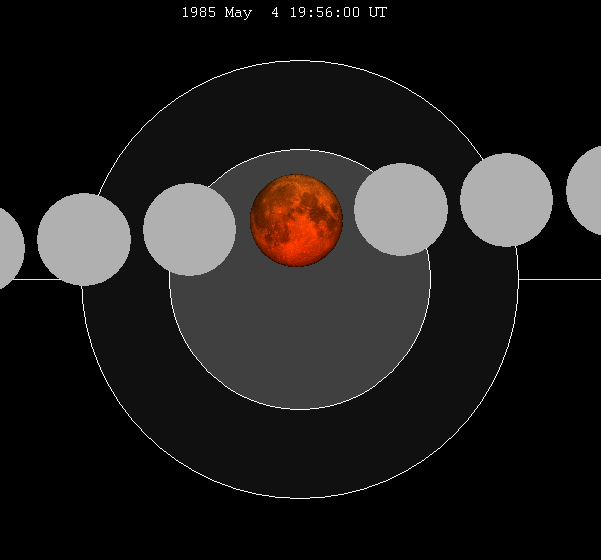
A total lunar eclipse occurred at the Moon's descending node of orbit on Saturday, May 4, 1985, with an umbral magnitude of 1.2369. A lunar eclipse occurs when the Moon moves into the Earth's shadow, causing the Moon to be darkened. A total lunar eclipse occurs when the Moon's near side entirely passes into the Earth's umbral shadow. Unlike a solar eclipse, which can only be viewed from a relatively small area of the world, a lunar eclipse may be viewed from anywhere on the night side of Earth. A total lunar eclipse can last up to nearly two hours, while a total solar eclipse lasts only a few minutes at any given place, because the Moon's shadow is smaller. Occurring only about 13.5 hours after perigee (on May 4, 1985, at 6:20 UTC), the Moon's apparent diameter was larger.
This lunar eclipse was the first of a tetrad, with four total lunar eclipses in series, the others being on October 28, 1985; April 24, 1986; and October 17, 1986.
The eclipse was completely visible over central and east Africa, eastern Europe, the western half of Asia, western Australia, and Antarctica, seen rising over much of South America, west Africa, and western Europe and setting over east and northeast Asia and much of Australia.
Shown below is a table displaying details about this particular solar eclipse. It describes various parameters pertaining to this eclipse.
This eclipse is part of an eclipse season, a period, roughly every six months, when eclipses occur. Only two (or occasionally three) eclipse seasons occur each year, and each season lasts about 35 days and repeats just short of six months (173 days) later; thus two full eclipse seasons always occur each year. Either two or three eclipses happen each eclipse season. In the sequence below, each eclipse is separated by a fortnight.
This eclipse is a member of a semester series. An eclipse in a semester series of lunar eclipses repeats approximately every 177 days and 4 hours (a semester) at alternating nodes of the Moon's orbit.
The penumbral lunar eclipse on June 13, 1984 occurs in the previous lunar year eclipse set.
The metonic cycle repeats nearly exactly every 19 years and represents a Saros cycle plus one lunar year. Because it occurs on the same calendar date, the Earth's shadow will in nearly the same location relative to the background stars.
Hub AI
May 1985 lunar eclipse AI simulator
(@May 1985 lunar eclipse_simulator)
May 1985 lunar eclipse
A total lunar eclipse occurred at the Moon's descending node of orbit on Saturday, May 4, 1985, with an umbral magnitude of 1.2369. A lunar eclipse occurs when the Moon moves into the Earth's shadow, causing the Moon to be darkened. A total lunar eclipse occurs when the Moon's near side entirely passes into the Earth's umbral shadow. Unlike a solar eclipse, which can only be viewed from a relatively small area of the world, a lunar eclipse may be viewed from anywhere on the night side of Earth. A total lunar eclipse can last up to nearly two hours, while a total solar eclipse lasts only a few minutes at any given place, because the Moon's shadow is smaller. Occurring only about 13.5 hours after perigee (on May 4, 1985, at 6:20 UTC), the Moon's apparent diameter was larger.
This lunar eclipse was the first of a tetrad, with four total lunar eclipses in series, the others being on October 28, 1985; April 24, 1986; and October 17, 1986.
The eclipse was completely visible over central and east Africa, eastern Europe, the western half of Asia, western Australia, and Antarctica, seen rising over much of South America, west Africa, and western Europe and setting over east and northeast Asia and much of Australia.
Shown below is a table displaying details about this particular solar eclipse. It describes various parameters pertaining to this eclipse.
This eclipse is part of an eclipse season, a period, roughly every six months, when eclipses occur. Only two (or occasionally three) eclipse seasons occur each year, and each season lasts about 35 days and repeats just short of six months (173 days) later; thus two full eclipse seasons always occur each year. Either two or three eclipses happen each eclipse season. In the sequence below, each eclipse is separated by a fortnight.
This eclipse is a member of a semester series. An eclipse in a semester series of lunar eclipses repeats approximately every 177 days and 4 hours (a semester) at alternating nodes of the Moon's orbit.
The penumbral lunar eclipse on June 13, 1984 occurs in the previous lunar year eclipse set.
The metonic cycle repeats nearly exactly every 19 years and represents a Saros cycle plus one lunar year. Because it occurs on the same calendar date, the Earth's shadow will in nearly the same location relative to the background stars.
Recent media