


Community hub
Recent from talks
Contribute something to knowledge base
Content stats: 0 posts, 0 articles, 1 media, 0 notes
Members stats: 0 subscribers, 0 contributors, 0 moderators, 0 supporters
Subscribers
Supporters
Contributors
Moderators
Hub AI
May Thirtieth Movement AI simulator
(@May Thirtieth Movement_simulator)
Hub AI
May Thirtieth Movement AI simulator
(@May Thirtieth Movement_simulator)
May Thirtieth Movement
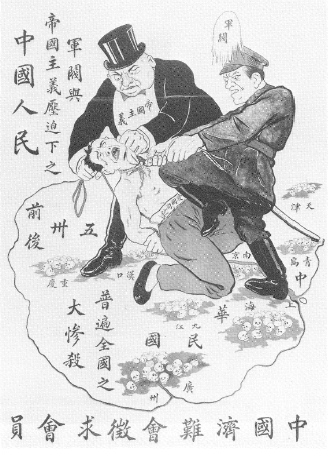
The May Thirtieth Movement (simplified Chinese: 五卅运动; traditional Chinese: 五卅運動; pinyin: Wǔsà Yùndòng) was a major labor and anti-imperialist movement during the middle-period of the Republic of China era. It began when the Shanghai Municipal Police opened fire on Chinese protesters in Shanghai's International Settlement on 30 May 1925. The shootings sparked international censure and nationwide anti-foreign demonstrations and riots such as the Hands Off China protests in the United Kingdom.
In the aftermath of the 1924 Second Zhili–Fengtian War, China found itself in the midst of one of the most destructive periods of turmoil since 1911. The war had involved every major urban area in China, and badly damaged the rural infrastructure. As a result of the conflict the Zhili-controlled government, backed by varied Euro-American business interests, was ousted from power by pro-Japanese warlord Zhang Zuolin, who installed a government led by the generally unpopular statesman Duan Qirui in November 1924. Though victorious, the war left Zhang's central government bankrupt and Duan exercised little authority outside Beijing. Authority in the north of the country was divided between Zhang and Feng Yuxiang, a Soviet Union-backed warlord, and public support for the northern militarists soon hit an all-time low, with southerners openly disparaging provincial governors as junfa (warlords). With his monarchist leanings and strong base in conservative Manchuria, Zhang represented the far right in Chinese politics and could claim few supporters. Meanwhile, the KMT (Nationalist) and CCP (Communist) parties, allied as the First United Front, were running a diplomatically unrecognized Soviet-backed administration in the southern province of Guangdong.[citation needed]
Alongside public grief at the recent death of China's Republican hero Sun Yat-sen (12 March 1925), the KMT and CCP were particularly involved in unionizing in Shanghai through the far-left Shanghai University. Shanghai's native Chinese were strongly unionised compared to other cities and better educated, and recognised their plight as involving lack of legal factory inspection, recourse for worker grievances or equal rights. Educated Chinese were also offended by the council's plan to introduce a new censorship law, forcing all publications in the Settlement to use the publisher's true name and address.[citation needed]
In early months of 1925, strikes on those matters intensified. Japanese-owned cotton mills were a source of contention, and disputes between Japanese owners and Chinese employees around the #8 Cotton Mill became regular occurrences. In early May, workers at Shanghai Naga Wata Kaisha company began striking again in an effort to force company management to negotiate. On 15 May, a Japanese guard employed by the company shot and killed a worker named Gu Zhenghong. The killing resulted in public outrage. The Shanghai Students Union began fundraising campaigns and delivered speeches condemning the killing.
A week after the killing, a group of students, heading for Gu's public "state" funeral and carrying banners, were arrested while traveling through the International Settlement. With their trial set for 30 May, various student organisations convened in the days before and decided to hold mass demonstrations across the International Settlement and outside the Mixed Court.[citation needed]
On 30 May 1925, the Communist Party organized an anti-imperialist protest in which thousands of workers, students, and others marched towards the British concession on Nanjing road.
Just after the trial of the arrested students began, Shanghai Municipal Police arrested 15 ringleaders of a student protest being held on and around Nanjing Road, in the foreign controlled International Settlement. The protesters were held in Louza (Laozha) police station, which by 2:45 pm was facing a "huge crowd" of Chinese that had amassed outside. The demonstrators demanded the arrested ringleaders be returned to them. Police on Nanking Road reported the crowd, which was between 1,500 and 2,000 strong, started good-naturedly but became more aggressive as arrests were made.[citation needed]
A picket of police (there was only a skeleton staff of approximately two dozen officers overall, predominantly Sikh and Chinese, with three white officers) was set up to prevent demonstrators from entering the station. Inspector Edward Everson, station commander and the highest-ranking officer on the scene (as the police commissioner K.J. McEuen had not let early warnings of public demonstrations interfere with his attendance at the city's Race Club) eventually shouted, "Stop! If you do not stop I will shoot!" in Wu. A few seconds later, at 3:37 pm, and as the crowd was within six feet of the station entrance, he fired into the crowd with his revolver. The Sikh and Chinese policemen then also opened fire, discharging some 40 rounds. At least four demonstrators were killed at the scene, with another five dying later of their injuries. At least 14 injured were hospitalized, with many others wounded.
May Thirtieth Movement
The May Thirtieth Movement (simplified Chinese: 五卅运动; traditional Chinese: 五卅運動; pinyin: Wǔsà Yùndòng) was a major labor and anti-imperialist movement during the middle-period of the Republic of China era. It began when the Shanghai Municipal Police opened fire on Chinese protesters in Shanghai's International Settlement on 30 May 1925. The shootings sparked international censure and nationwide anti-foreign demonstrations and riots such as the Hands Off China protests in the United Kingdom.
In the aftermath of the 1924 Second Zhili–Fengtian War, China found itself in the midst of one of the most destructive periods of turmoil since 1911. The war had involved every major urban area in China, and badly damaged the rural infrastructure. As a result of the conflict the Zhili-controlled government, backed by varied Euro-American business interests, was ousted from power by pro-Japanese warlord Zhang Zuolin, who installed a government led by the generally unpopular statesman Duan Qirui in November 1924. Though victorious, the war left Zhang's central government bankrupt and Duan exercised little authority outside Beijing. Authority in the north of the country was divided between Zhang and Feng Yuxiang, a Soviet Union-backed warlord, and public support for the northern militarists soon hit an all-time low, with southerners openly disparaging provincial governors as junfa (warlords). With his monarchist leanings and strong base in conservative Manchuria, Zhang represented the far right in Chinese politics and could claim few supporters. Meanwhile, the KMT (Nationalist) and CCP (Communist) parties, allied as the First United Front, were running a diplomatically unrecognized Soviet-backed administration in the southern province of Guangdong.[citation needed]
Alongside public grief at the recent death of China's Republican hero Sun Yat-sen (12 March 1925), the KMT and CCP were particularly involved in unionizing in Shanghai through the far-left Shanghai University. Shanghai's native Chinese were strongly unionised compared to other cities and better educated, and recognised their plight as involving lack of legal factory inspection, recourse for worker grievances or equal rights. Educated Chinese were also offended by the council's plan to introduce a new censorship law, forcing all publications in the Settlement to use the publisher's true name and address.[citation needed]
In early months of 1925, strikes on those matters intensified. Japanese-owned cotton mills were a source of contention, and disputes between Japanese owners and Chinese employees around the #8 Cotton Mill became regular occurrences. In early May, workers at Shanghai Naga Wata Kaisha company began striking again in an effort to force company management to negotiate. On 15 May, a Japanese guard employed by the company shot and killed a worker named Gu Zhenghong. The killing resulted in public outrage. The Shanghai Students Union began fundraising campaigns and delivered speeches condemning the killing.
A week after the killing, a group of students, heading for Gu's public "state" funeral and carrying banners, were arrested while traveling through the International Settlement. With their trial set for 30 May, various student organisations convened in the days before and decided to hold mass demonstrations across the International Settlement and outside the Mixed Court.[citation needed]
On 30 May 1925, the Communist Party organized an anti-imperialist protest in which thousands of workers, students, and others marched towards the British concession on Nanjing road.
Just after the trial of the arrested students began, Shanghai Municipal Police arrested 15 ringleaders of a student protest being held on and around Nanjing Road, in the foreign controlled International Settlement. The protesters were held in Louza (Laozha) police station, which by 2:45 pm was facing a "huge crowd" of Chinese that had amassed outside. The demonstrators demanded the arrested ringleaders be returned to them. Police on Nanking Road reported the crowd, which was between 1,500 and 2,000 strong, started good-naturedly but became more aggressive as arrests were made.[citation needed]
A picket of police (there was only a skeleton staff of approximately two dozen officers overall, predominantly Sikh and Chinese, with three white officers) was set up to prevent demonstrators from entering the station. Inspector Edward Everson, station commander and the highest-ranking officer on the scene (as the police commissioner K.J. McEuen had not let early warnings of public demonstrations interfere with his attendance at the city's Race Club) eventually shouted, "Stop! If you do not stop I will shoot!" in Wu. A few seconds later, at 3:37 pm, and as the crowd was within six feet of the station entrance, he fired into the crowd with his revolver. The Sikh and Chinese policemen then also opened fire, discharging some 40 rounds. At least four demonstrators were killed at the scene, with another five dying later of their injuries. At least 14 injured were hospitalized, with many others wounded.
Recent media
Recent media