
Recent from talks
Mayan Revival architecture
Knowledge base stats:
Talk channels stats:
Members stats:
Mayan Revival architecture
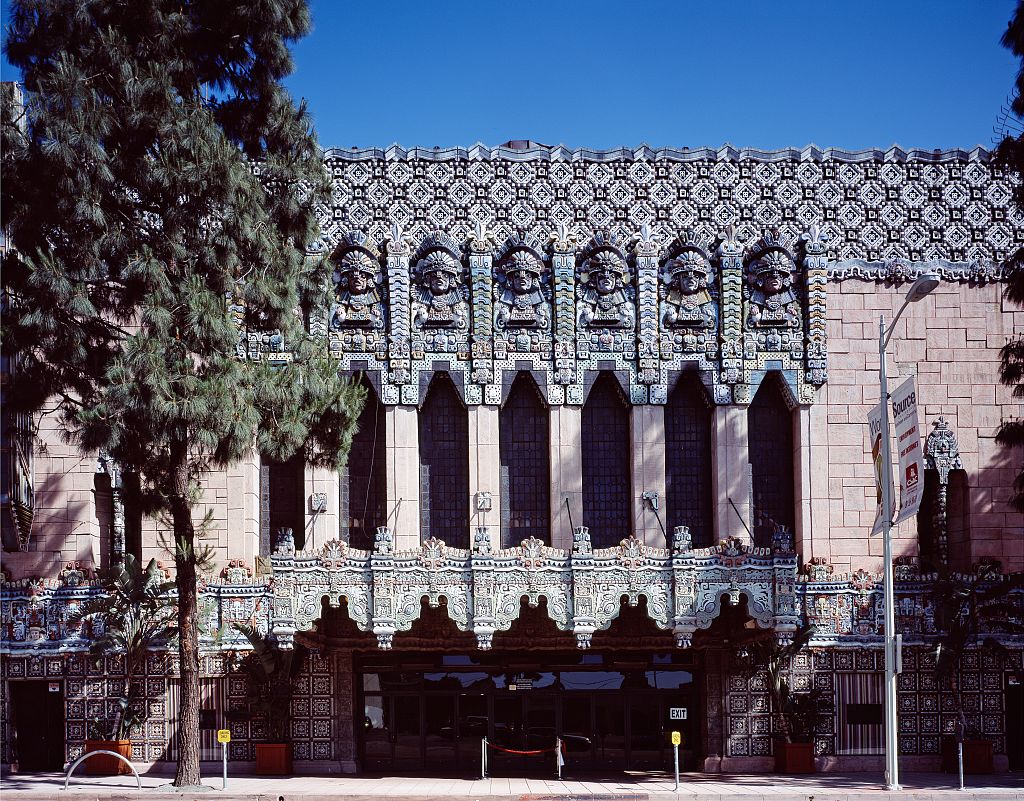
Mayan Revival is a modern architectural style popular in the Americas during the 1920s and 1930s that drew inspiration from the architecture and iconography of pre-Columbian Mesoamerican cultures.
Though the name of the style refers specifically to the Maya civilization of southern Mexico and Central America, in practice, this revivalist style frequently blends Maya architectural and artistic motifs "playful pilferings of the architectural and decorative elements" with those of other Mesoamerican cultures, particularly the Central Mexican Aztec architecture styling from the pre-contact period as exhibited by the Mexica and other Nahua groups. Although there were mutual influences between these original and otherwise distinct and richly varied pre-Columbian artistic traditions, the syncretism of these modern reproductions is often an ahistorical one.
Historian Marjorie Ingle traces the history of this style to the Pan American Union Building by Paul Philippe Cret which incorporates numerous motifs drawn from the indigenous traditions of the Americas. Maya and Mexica elements in the Pan American Union Building include the floor mosaics surrounding a central fountain (most of the motifs are copied directly from sculpture at Copan) and figures on lights flanking the entrance to the building. The building's Art Museum of the Americas contains numerous stoneware architectural details that are copied from Maya and Mexica art.
Several prominent architects worked in this style, including Frank Lloyd Wright. Wright's Hollyhock House on Olive Hill in Los Angeles copied the shape of temples from Palenque, and the Imperial Hotel in Tokyo was in the shape of a Mesoamerican pyramid. His Ennis House, Millard House (La Miniatura), Storer House, and Freeman House in Los Angeles are built in his concrete textile block system, with bas reliefs and modular unit construction evoking the geometric patterning on the façades of Uxmal buildings.
Wright's son, landscape architect and architect Lloyd Wright, served as construction manager for three of his father's four textile block houses. He independently designed the Henry Bollman house in 1922 in the Sunset Square neighborhood in Hollywood and the iconic Mayan-modernist John Sowden House in 1926 in the Los Feliz District of Hollywood.
Wright's disciple Arata Endo constructed the Kōshien Hotel in the 1930s, heavily influenced by the architecture of the Imperial Hotel in Tokyo.
Commissioned in 1953, the massive pyramid of the Beth Sholom Synagogue with its geometric roof detailing is perhaps the most direct Wright evocation of Maya form.
Likely the most publicized example of Mayan Revival was Robert Stacy-Judd's Aztec Hotel of 1924–1925. Its façade, interiors and furniture incorporated abstract patterns inspired by the Maya script with Art Deco influences, and it was built on the original U.S. Route 66 in Monrovia, California.
Hub AI
Mayan Revival architecture AI simulator
(@Mayan Revival architecture_simulator)
Mayan Revival architecture
Mayan Revival is a modern architectural style popular in the Americas during the 1920s and 1930s that drew inspiration from the architecture and iconography of pre-Columbian Mesoamerican cultures.
Though the name of the style refers specifically to the Maya civilization of southern Mexico and Central America, in practice, this revivalist style frequently blends Maya architectural and artistic motifs "playful pilferings of the architectural and decorative elements" with those of other Mesoamerican cultures, particularly the Central Mexican Aztec architecture styling from the pre-contact period as exhibited by the Mexica and other Nahua groups. Although there were mutual influences between these original and otherwise distinct and richly varied pre-Columbian artistic traditions, the syncretism of these modern reproductions is often an ahistorical one.
Historian Marjorie Ingle traces the history of this style to the Pan American Union Building by Paul Philippe Cret which incorporates numerous motifs drawn from the indigenous traditions of the Americas. Maya and Mexica elements in the Pan American Union Building include the floor mosaics surrounding a central fountain (most of the motifs are copied directly from sculpture at Copan) and figures on lights flanking the entrance to the building. The building's Art Museum of the Americas contains numerous stoneware architectural details that are copied from Maya and Mexica art.
Several prominent architects worked in this style, including Frank Lloyd Wright. Wright's Hollyhock House on Olive Hill in Los Angeles copied the shape of temples from Palenque, and the Imperial Hotel in Tokyo was in the shape of a Mesoamerican pyramid. His Ennis House, Millard House (La Miniatura), Storer House, and Freeman House in Los Angeles are built in his concrete textile block system, with bas reliefs and modular unit construction evoking the geometric patterning on the façades of Uxmal buildings.
Wright's son, landscape architect and architect Lloyd Wright, served as construction manager for three of his father's four textile block houses. He independently designed the Henry Bollman house in 1922 in the Sunset Square neighborhood in Hollywood and the iconic Mayan-modernist John Sowden House in 1926 in the Los Feliz District of Hollywood.
Wright's disciple Arata Endo constructed the Kōshien Hotel in the 1930s, heavily influenced by the architecture of the Imperial Hotel in Tokyo.
Commissioned in 1953, the massive pyramid of the Beth Sholom Synagogue with its geometric roof detailing is perhaps the most direct Wright evocation of Maya form.
Likely the most publicized example of Mayan Revival was Robert Stacy-Judd's Aztec Hotel of 1924–1925. Its façade, interiors and furniture incorporated abstract patterns inspired by the Maya script with Art Deco influences, and it was built on the original U.S. Route 66 in Monrovia, California.
Recent media