Hubbry Logo
Ancient Maya artAncient Maya artMain
Open search
Ancient Maya art
Community hub
Ancient Maya art
logo
7 pages, 0 posts
0 subscribers
Be the first to start a discussion here.
Ancient Maya art
Ancient Maya art
from Wikipedia

Ancient Maya art comprises the visual arts of the Maya civilization, an eastern and south-eastern Mesoamerican culture made up of a great number of small kingdoms in what is now Mexico, Guatemala, Belize and Honduras. Many regional artistic traditions existed side by side, usually coinciding with the changing boundaries of Maya polities. This civilization took shape in the course of the later Preclassic Period (from c. 750 BC to 100 BC), when the first cities and monumental architecture started to develop and the hieroglyphic script came into being. Its greatest artistic flowering occurred during the seven centuries of the Classic Period (c. 250 to 950 CE).

Maya art forms tend to be more stiffly organized during the Early Classic (250-550 CE) and to become more expressive during the Late Classic phase (550-950 CE). In the course of history, influences of various other Mesoamerican cultures were absorbed. In the late Preclassic, the influence of the Olmec style is still discernible (as in the San Bartolo murals), whereas in the Early Classic, the style of central Mexican Teotihuacan made itself felt, just as that of the Toltec in the Postclassic.

After the demise of the Classic kingdoms of the central lowlands, ancient Maya art went through an extended Postclassic phase (950-1550 CE) centered on the Yucatan peninsula, before the upheavals of the sixteenth century destroyed courtly culture and put an end to the Maya artistic tradition. Traditional art forms mainly survived in weaving, pottery, and the design of peasant houses.

Maya art history

[edit]

The nineteenth- and early-twentieth-century publications on Maya art and archaeology by Stephens, Catherwood, Maudslay, Maler and Charnay for the first time made available reliable drawings and photographs of major Classic Maya monuments.

Studying a ruin at Izamal, Catherwood engraving

Following this initial phase, the 1913 publication of Herbert Spinden's A Study of Maya Art laid the foundation for all later developments of Maya art history (including iconography).[1] The book gives an analytical treatment of themes and motifs, particularly the ubiquitous serpent and dragon motifs, and a review of the 'material arts', such as the composition of temple facades, roof combs and mask panels. Spinden's chronological treatment of Maya art was later (1950) refined by the motif analysis of the architect and specialist in archaeological drawing, Tatiana Proskouriakoff, in her book A Study of Classic Maya Sculpture.[2] Kubler's 1969 inventory of Maya iconography, containing a site-by-site treatment of 'commemorative' images and a topical treatment of ritual and mythical images (such as the 'triadic sign'), concluded a period of gradual increase of knowledge that was soon to be overshadowed by new developments.

Starting in the early 1970s, the historiography of the Maya kingdoms – first of all, Palenque – came to occupy the forefront. Art-historical interpretation joined the historical approach pioneered by Proskouriakoff as well as the mythological approach initiated by M.D. Coe, with an archaeological illustrator, Merle Greene Robertson, and a professor of art, Linda Schele, serving as driving forces. Schele's seminal interpretations of Maya art are found throughout her work, especially in The Blood of Kings, written together with art historian M. Miller.[3] Maya art history was also spurred by the enormous increase in sculptural and ceramic imagery, due to extensive archaeological excavations, as well as to organized looting on an unprecedented scale. From 1973 onwards, M.D. Coe published a series of books offering pictures and interpretations of unknown Maya vases, with the Popol Vuh Twin myth for an explanatory model.[4] In 1981, Robicsek and Hales added an inventory and classification of Maya vases painted in codex style,[5] thereby revealing even more of a hitherto barely known spiritual world.

As to subsequent developments, important issues in Schele's iconographic work have been elaborated by Karl Taube.[6] New approaches to Maya art include studies of ancient Maya ceramic workshops,[7] the representation of bodily experience and the senses in Maya art,[8] and of hieroglyphs considered as iconographic units.[9] Meanwhile, the number of monographs devoted to the monumental art of specific courts is growing.[10] A good impression of recent Mexican and North American art historical scholarship can be gathered from the exhibition catalogues Courtly Art of the Ancient Maya (2004)[11] and Lives of the Gods: Divinity in Maya Art (2022).[12]

Architecture

[edit]
Copan, 'Reviewing Stand' with simian musicians
Labna, Palace, vaulted passage

The layout of the Maya towns and cities, and more particularly of the ceremonial centers where the royal families and courtiers resided, is characterized by the rhythm of immense horizontal stucco floors of plazas often located at various levels, connected by broad and often steep stairs, and surmounted by temple pyramids.[13] Under successive reigns, the main buildings were enlarged by adding new layers of fill and stucco coating. Irrigation channels, reservoirs, and drains made up the hydraulic infrastructure. Outside the ceremonial center (especially in the southern area sometimes resembling an acropolis) were the structures of lesser nobles, smaller temples, and individual shrines, surrounded by the wards of the commoners. Dam-like causeways (sacbeob) spread from the 'ceremonial centers' to other nuclei of habitation. Fitting in with the concept of a 'theatre state', more attention appears to have been given to aesthetics than to solidity of construction. Careful attention, however, was placed on directional orientation.

Among the various types of stone structures should be mentioned:

  • Ceremonial platforms (usually less than 4 meters in height)
  • Courtyards and palaces
  • Other residential buildings, such as a writers' house[14] and a possible council house in Copan
  • Temples and temple pyramids, the latter often containing burials and burial chambers in their base or fill, with sanctuaries on top; outstanding example are the many clustered dynastic burial temples of Tikal North Acropolis
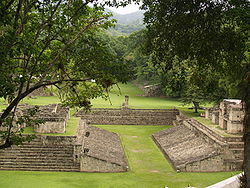
  • Ball courts
  • Sweat baths, particularly those of Piedras Negras and Xultun, the latter one with remains of stucco decoration.

Among the structural ensembles are:

  • 'Triadic pyramids' consisting of a dominant structure flanked by two smaller inward-facing buildings, all mounted upon a single basal platform;
  • 'E-groups' consisting of a square platform with a low four-stepped pyramid on the west side and an elongated structure, or, alternatively, three small structures, on the eastern side;
  • 'Twin pyramid complexes', with identical four-stepped pyramids on the east and west sides of a small plaza; a building with nine doorways on the south side; and a small enclosure on the north side housing a sculpted stela with its altar and commemorating the king's performance of a k'atun-ending ceremony.

In the palaces and temple rooms, the 'corbelled vault' was often applied. Though not an effective means to increase interior space, as it required thick stone walls to support the high ceiling, some temples utilized repeated arches, or a corbelled vault, to construct an inner sanctuary (e.g., that of the Temple of the Cross at Palenque).

The northern Maya area (Campeche and Yucatan) shows architectural characteristics of its own. Its Classic regional styles, called Puuc ('Hills'), Chenes ('Sources'), and Rio Bec,[15] are characterized by mosaic facades in stone; geometrical reduction of realistic decoration; stacking of rain god snouts to build facades; use of portals shaped like serpent mouths; and, in the southernmost or Rio Bec area, the use of solid pseudo temple-pyramids. The most important Puuc site is Uxmal. Chichen Itza, dominating Yucatán from the Late Classic to well into the Post-Classic, features Classic buildings in Chenes and Puuc style as well as Post-Classic building types of Mexican derivation, such as the radial four-staircase pyramid, the colonnaded hall, and the circular temple. The latter features were inherited by the succeeding kingdom of Mayapan.

Far to the South, the Guatemalan Highlands had their own longstanding building traditions. However, by the Classic period, settlements did by and large not participate in the great artistic traditions of the Lowland area. In the Postclassic period, the architecture of relatively young hilltop sites, such as the Quiché capital Q'umarkaj, shows strong Toltec influences, not unlike the architecture of Chichén Itzá and Mayapán to the north.[16] No significant murals or sculptures have been preserved from the Postclassic Highlands.

Stone sculpture

[edit]
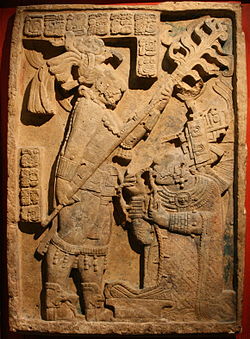
Cancuen, panel 3, seated king with two subordinates. Second half 8th century.
Copan stela A, Maudslay cast

The main Preclassic sculptural style from the Maya area is that of Izapa, a large site on the Pacific coast where many stelas and (frog-shaped) altars were found showing motifs also present in Olmec art.[17] The stelas, mostly without inscriptions, often show mythological and narrative subjects, some of which appear to relate to the Twin myth of the Popol Vuh. However, next to nothing is known about the settlement's former ethnic composition. Artistically, Izapa is closely related to Kaminaljuyú, a huge and almost completely destroyed site once dominating the Guatemalan Highlands.[18] Among its scattered remains are highlights of Late Preclassic sculpture, such as an altar with an intricate figural relief accompanied by a long inscription (Monument 10).

For the Classic Period of the central Maya area, the following major classes of stone sculpture (usually executed in limestone) may be distinguished.

  • Stelas. These are large, elongated stone slabs usually covered with carvings and inscriptions, and often accompanied by round altars. Typical of the Classical period, most of them depict the rulers of the cities they were located in, often disguised as gods. Although the rulers' faces, particularly during the later Classic Period, are naturalistic in style, they usually do not show individual traits; but there are notable exceptions to this rule (e.g., Piedras Negras, stela 35). The most famous stelas are from Copan and nearby Quirigua. These are outstanding for their intricateness of detail, those of Quirigua also for sheer height (stela E measuring over 7 metres above ground level and 3 below). Both the Copan and Tonina stelas approach sculptures in the round. From Palenque, otherwise a true Maya capital of the arts, no significant stelae have been preserved.
  • Lintels, spanning doorways or jambs. Particularly Yaxchilan is renowned for its long series of lintels in deep relief, some of the most famous of which show meetings with ancestors or, perhaps, local deities.[19]
  • Panels and tablets, set in the walls and piers of buildings and the sides of platforms. This category is particularly well represented at Palenque, with the large tablets adorning the inner sanctuaries of the Cross Group temples, and with refined masterworks such as the 'Palace Tablet', the 'Tablet of the Slaves', and the multi-figure panels of the temple XIX and XXI platforms.[20] King Pakal's carved sarcophagus lid—without equal in other Maya kingdoms—might also be included here.
  • Relief columns flanking doorways in public buildings from the Puuc region (northwestern Yucatan) and similar in decoration to stelas.[21]
  • Altars, rounded or rectangular, sometimes resting on three or four boulder-like legs. They may be wholly or partly figurative (e.g., Copan turtle altar) or have a relief image on top, sometimes consisting of a single Ahau day sign (Caracol, Tonina).[22]
  • Zoomorphs, or large boulders sculpted to resemble supernatural creatures and covered with highly complicated figurative relief ornamentation. These seem to be restricted to the kingdom of Quirigua during the Late Classic period.[23]
  • Ball court markers, or relief roundels placed in the central axis of the floors of ball courts (such as those of Copan, Chinkultic, Tonina), and usually showing royal ball game scenes.
  • Monumental stairs, most famously the giant hieroglyphic stairway of Copan. The hewn stone blocks of hieroglyphic stairways together constitute an extensive text. Stairways can also be decorated with a great variety of scenes (La Corona), particularly the ball game. Sometimes, the ball game becomes the stairs' chief theme (Yaxchilan), with a captive depicted inside the ball, or, elsewhere (Tonina), a full-figure captive stretched out along the step.
  • Thrones and benches, the thrones with a broad, square seat, and a back sometimes iconically shaped like the wall of a cave and worked open to show human figures. Benches, covered with relief on the front, tend to be incorporated into the surrounding architecture; they are more elongated, and lack a back support. Examples from Palenque and Copan have supports showing cosmological carriers (Bacabs, Chaaks).
  • Stone sculpture in the round is especially known from Copan and Toniná. It is represented by statuary, such as a seated Copan scribe as well as captive figures and small stelas from Toniná; by certain figurative architectural elements, such as the twenty maize deities from the façade of Copan Temple 22;[24] and by giant sculptures such as the symmetrically-positioned jaguars and simian musicians of Copán, that were integral parts of architectural design.

Wood carving

[edit]
Possible mirror bearer; 6th century (Metropolitan Museum of Art)

It is believed that carvings in wood were once extremely common, but only a few examples have survived. Most 16th-century wood carvings, considered objects of idolatry, were destroyed by the Spanish colonial authorities. The most important Classic examples consist of intricately worked lintels, mostly from the main Tikal pyramid sanctuaries,[25] with one specimen from nearby El Zotz. The Tikal wood reliefs, each consisting of several beams, and dating to the 8th century, show a king on his seat with a protector figure looming large behind, in the form of a Teotihuacan-style 'war serpent' (Temple I lintel 2), a jaguar (Temple I lintel 3), or a human impersonator of the jaguar god of terrestrial fire (Temple IV lintel 2). Other Tikal lintels depict an obese king wearing a jaguar dress and standing in front of his seat (Temple III lintel 2); and most famously, a victorious king, dressed as an astral death god, and standing on a palanquin underneath an arching feathered serpent (Temple IV lintel 3). A rare utility object is a tiny lidded box from Tortuguero with hieroglyphic text all around. Free sculpture in wood, dating back to the 6th century, is represented by a dignified seated man possibly functioning as a mirror bearer.

Stucco modeling

[edit]
Stucco mask panels, Early Classic, Kohunlich
Stucco portrait of K'inich Janaab Pakal I, 615–683 CE (National Museum of Anthropology (Mexico)

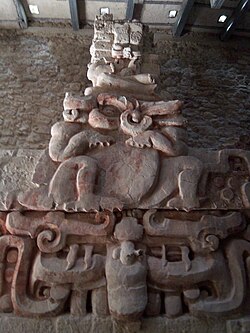
At least since Late Preclassic times, modeled and painted stucco plaster covered the floors and buildings of the town centers and provided the setting for their stone sculptures. Often, large mask panels with the plastered heads of deities in high relief (particularly those of sun, rain, and earth) are found attached to the sloping retaining walls of temple platforms flanking stairs (e.g., Kohunlich). Stucco modeling and relief work can also cover the entire building, as shown by Temple 16 of Copan, in its 6th-century form (known as 'Rosalila'). Dedicated to the first king, Yax K'uk' Mo', this early temple has preserved plastered and painted facades. The stuccoed friezes, walls, piers, and roof combs of the Late Preclassic and Classic periods show varying and sometimes symbolically complicated decorative programs.

Several solutions for dividing up and ordering the stuccoed surfaces of buildings were applied, serialization being one of them. The Early Classic walls of the 'Temple of the Night Sun' in El Zotz consist of a series of subtly varied deity mask panels, whereas the frieze of a Balamku palace, also from the Early Classic, originally had a series of four rulers enthroned above the open ophidian mouths of four different animals (a toad among them) associated with symbolic mountains. Conversely, friezes may be centered on a single ruler again sitting on a symbolic (maize) mountain, such as a frieze from Holmul, with two feathered serpents emanating from below the ruler's seat, and another one from Xultun, on which the ruler carries a large ceremonial bar with emerging jaguar-like figures.[26] An Early-Classic temple frieze from Placeres, Quintana Roo, has the large mask panel of a young lord or deity in the middle, with two lateral 'Grandfather' deities extending their arms.

Often, a frieze is divided into compartments. Late Preclassic friezes of El Mirador, for example, show the intervening spaces of an undulating serpent's body filled out with aquatic birds, and the sections of an aquatic band with swimming figures.[27] Similarly, a Classic palace frieze in Acanceh is divided into panels holding different animal figures[28] reminiscent of wayob, while a wall in Tonina has lozenge-shaped fields suggesting a scaffold and presenting continuous narrative scenes that relate to human sacrifice.[29]

Plastered roof combs are similar to some of the friezes above in that they usually show large representations of rulers, who may again be seated on a symbolic mountain, and also, as on Palenque's Temple of the Sun, set within a cosmological framework. Further examples of Classic stucco modeling include the piers of the Palenque Palace, embellished with a series of lords and ladies in ritual dress, and the 'baroque', Late-Classic Chenes-style stucco entrance, beset with naturalistic human figures, on the Acropolis (Str. 1) of Ek' Balam.

Unique in Mesoamerica, Classic Period stucco modeling includes realistic portraiture of a quality equalling that of Roman ancestral portraits, with the lofty stucco heads of Palenque rulers and portraits of dignitaries from Tonina as outstanding examples. The modeling recalls that of certain Jaina ceramic statuettes. Some, but not all, of these portrait heads were once part of life-size stucco figures adorning temple crests.[30] In the same way, one finds stucco glyphs that were once a part of stuccoed texts.

Mural painting

[edit]
Bonampak mural, room 1, east wall: Musicians
San Bartolo mural: The king as Hunahpu

Although, due to the humid climate of Central America, relatively few Maya paintings have survived to the present day integrally, important remnants have been found in nearly all major court residences. This is especially the case in substructures, hidden under later architectural additions. Mural paintings may show more or less repetitive motifs, such as the subtly varied flower symbols on walls of House E of the Palenque Palace; scenes of daily life, as in one of the buildings surrounding the central square of Calakmul and in a palace of Chilonche; or ritual scenes involving deities, as in the Post-Classic temple murals of Yucatán's and Belize's east coast (Tancah, Tulum, Santa Rita).[31] The latter murals betray a strong influence of the so-called 'Mixteca-Puebla style' once widely spread across Mesoamerica.

Murals may also evince a more narrative character, usually with hieroglyphic captions present. The colourful Bonampak murals, for example, dating from 790 AD, and extending over the walls and vaults of three adjacent rooms, show spectacular scenes of nobility, battle and sacrifice, as well as a group of ritual impersonators in the midst of a file of musicians.[32] At San Bartolo, murals dating from 100 BCE relate to the myths of the Maya maize god and the hero twin Hunahpu, and depict a double inthronization; antedating the Classic Period by several centuries, the style is already fully developed, with colours being subtle and muted as compared to those of Bonampak or Calakmul.[33] Outside the Maya area, in a ward of East-Central Mexican Cacaxtla, murals painted in a predominantly Classic Maya style, with often stark colors, have been found, such as a savage battle scene extending over 20 meters; two figures of Maya lords standing on serpents; and an irrigated maize and cacao field visited by the Maya merchant deity.[34]

Wall painting also occurs on vault capstones, in tombs (e.g., Río Azul), and in caves (e.g., Naj Tunich),[35] usually executed in black on a whitened surface, at times with the additional use of red paint. Yucatec vault capstones often show a depiction of the enthroned lightning deity as a god of agricultural plenty (e.g., Ek' Balam).

A bright turquoise blue colour—'Maya Blue'—has survived through the centuries due to its unique chemical characteristics; this color is present in Bonampak, Cacaxtla, Jaina, El Tajín, and even in some Colonial convents. The use of Maya Blue survived until the 16th century, when the technique was finally lost.[36]

Writing and bookmaking

[edit]
Madrid Codex

The Maya writing system consists of about 1000 distinct characters or hieroglyphs ('glyphs'), and like many ancient writing systems is a mixture of syllabic signs and logograms. This script was in use from the 3rd century BCE until shortly after the Spanish conquest in the 16th century. As of now (2021), a considerable proportion of the characters has a reading, but their meaning and configuration as a text is not always understood. The books were folded and consisted of bark paper or leather leaves with an adhesive stucco layer on which to write; they were protected by jaguar skin covers and, perhaps, wooden boards.[37] Since every diviner probably needed a book, there must have existed large numbers of them.

Today, three Maya hieroglyphic books, all from the Post-Classic period, are still in existence: the Dresden, Paris, and Madrid codices. A fourth book, the Grolier, is Maya-Toltec rather than Maya and lacks hieroglyphic texts; fragmentary and of very poor draughtsmanship, it shows many anomalies, reason for which its authenticity has long remained in doubt.[38] These books are largely of a divinatory and priestly nature, containing almanacs, astrological tables, and ritual programs, the Paris Codex also katun-prophecies. Great attention was paid to a harmonious balance of texts and (partly coloured) illustrations.

Besides the codical glyphs, there existed a cursive script of an often dynamic character, found in wall-paintings and on ceramics, and imitated in stone on panels from Palenque (such as the 'Tablet of the 96 glyphs'). Often, written captions are enclosed in square 'boxes' of various shapes within the representation. Wall paintings may also entirely consist of texts (Ek' Balam 'Mural of the 96 glyphs', Naj Tunich cave), or, more rarely, contain astrological computations (Xultun); sometimes, written on a white stuccoed surface, and executed with particular care and elegance, these texts are like enlargements of book pages.

Hieroglyphs are ubiquitous and were written on every available surface, including the human body. The glyphs themselves are highly detailed, and particularly the logograms are deceivingly realistic. As a matter of fact, from an art-historical point of view, they should also be viewed as art motifs, and vice versa.[9] Sculptors at Copan and Quirigua have consequently felt free to convert hieroglyphic elements and calendrical signs into animated, dramatic miniature scenes ('full figure glyphs').[39]

Ceramics and 'ceramic codex'

[edit]
Codex style cylinder vessel, presentation to the king of a baby with jaguar ear
Jaina, nobleman

Unlike utility ceramics found in such large numbers among the debris of archaeological sites, most of the decorated pottery (cylinder vessels, lidded dishes, tripod plates, vases, bowls) once was 'social currency' among the Maya nobility, and, preserved as heirlooms, also accompanied the nobles into their graves.[40] The aristocratic tradition of gift-giving feasts[41] and ceremonial visits, and the emulation that inevitably went with these exchanges, goes a long way towards explaining the high level of artistry reached in Classical times.

Made without a potter's wheel, decorated pottery was delicately painted, carved into relief, incised, or - chiefly during the Early Classic period - made with the Teotihuacan fresco technique of applying paint to a wet clay surface. The precious objects were manufactured in numerous workshops distributed over the Maya kingdoms, some of the most famous being associated with the 'Chama-style', the 'Holmul-style', the so-called 'Ik-style'[42] and, for carved pottery, the 'Chochola-style.'[43]

Vase decoration shows great variation, including palace scenes, courtly ritual, mythology, divinatory glyphs, and even dynastical texts taken from chronicles, and plays a major role in reconstructing Classical Maya life and beliefs. Ceramic scenes and texts painted in black and red on a white underground, the equivalents of pages from the lost folding books, are referred to as being in 'Codex Style' (e.g., the so-called Princeton Vase). The overlap with the three extant hieroglyphic books is (at least up to now) relatively small.

Sculptural ceramic art includes the lids of Early Classic bowls mounted by human or animal figures; some of these bowls, burnished black, are among the most distinguished Maya works of art ever created.

Ceramic sculpture also includes incense burners and burial urns. Best known are the profusely decorated Classic burners from the kingdom of Palenque, which have the modeled face of a deity or of a king attached to an elongated hollow tube. The deity most frequently depicted, the jaguar deity of terrestrial fire, is cognate with the jaguar deity often adorning large Classic burial urns from the Guatemalan department of El Quiché.[44] The elaborate Post-Classic, mold-made effigy incense burners especially associated with Mayapan represent standing deities (or priestly deity impersonators) often carrying offerings.[45]

Finally, figurines, often mold-made,[46] and of an amazing liveliness and realism, constitute a minor but highly informative genre. Apart from deities, animal persons, rulers and dwarfs, they show many other characters as well as scenes taken from daily life.[47] Some of these figurines are ocarinas and may have been used in rituals. The most impressive examples stem from Jaina Island.

Precious stone and other sculpted materials

[edit]
Marble belt assemblage with celt pendants, from the tomb of king Pakal, Palenque

It is remarkable that the Maya, who had no metal tools, created many objects from a very hard and dense material, jade (jadeite), particularly all sorts of (royal) dress elements, such as belt plaques, Celts, ear spools, pendants, and also masks. Celts (i.e., flat, axe-shaped ornaments) were sometimes engraved with a stela-like representation of the king (e.g., the Early-Classic 'Leyden Plate'). The best-known example of a mask is probably the death mask of the Palenque king Pakal, covered with irregularly-shaped jade plaques and having eyes made from mother-of-pearl and obsidian; another death mask, belonging to a Palenque queen, consists of malachite plaques. Similarly, certain cylindrical vases from Tikal have an outer layer of square jade discs. Many stone carvings had jade inlays.

Among other sculpted and engraved materials are flint, chert, shell, and bone, often found in caches and burials. The so-called 'eccentric flints' are ceremonial objects of uncertain use, in their most elaborate forms of elongated shape with usually various heads extending on one or both sides, sometimes those of the lightning deity, but more often of an anthropomorphic lightning probably representing the Tonsured Maize God.[48] Shell was worked into disks and other decorative elements showing human, possibly ancestral heads and deities; conch trumpets were similarly decorated.[49] Human and animal bones were decorated with incised symbols and scenes. A collection of small and modified, tubular bones from an 8th-century royal burial under Tikal Temple I contains some of the most subtle engravings known from the Maya, including several scenes with the Tonsured maize god in a canoe.[50]

Applied arts and body decoration

[edit]

Textiles from the Classic period, made of cotton, have not survived, but Maya art provides detailed information about their appearance and, to a lesser extent, their social function.[51] They include delicate fabrics used as wrappings, curtains and canopies furnishing palaces, and garments. Among the dyeing techniques may have been ikat. Daily costume depended on social standing. Noblewomen usually wore long dresses, noblemen girdles and breechcloths, leaving legs and upper body more or less bare, unless jackets or mantles were worn. Both men and women could wear turbans. Costumes worn on ceremonial occasions and during the many festivities were highly expressive and exuberant; animal headdresses were common. The most elaborate costume was the formal apparel of the king, as depicted on the royal stelae, with numerous elements of symbolic meaning.[52]

Wickerwork, only known from incidental depictions in sculptural and ceramic art,[53] must once have been ubiquitous; the well-known pop ('mat') motif testifies to its importance.[54]

Body decorations often consisted of painted patterns on face and body, but could also be of a permanent character marking status and age differences. The latter type included artificial deformation of the skull, filing and incrustation of the teeth, and tattooing of the face.[55]

Museum collections

[edit]
The Museo Nacional de Arqueología y Etnología, in Guatemala City

There are a great many museums across the world with Maya artifacts in their collections. The Foundation for the Advancement of Mesoamerican Studies lists over 250 museums in its Maya Museum database,[56] and the European Association of Mayanists lists just under 50 museums in Europe alone.[57]

In Mexico City, the Museo Nacional de Antropología contains an especially large selection of Maya artifacts.[58] An increasing number of regional museums in Mexico hold important collections, including Museo Amparo in Puebla, with its famous throne back from Chiapas; the Museo de las Estelas "Román Piña Chan" in Campeche;[59] the Museo Regional de Yucatán "Palacio Cantón" and the "Gran Museo del mundo maya", both in Mérida; and the Museo Regional de Antropología "Carlos Pellicer Camera" in Villahermosa, Tabasco.[60]

In Guatemala, the most important museum collections are those of the Museo Popol Vuh and the Museo Nacional de Arqueología y Etnología, both in Guatemala City.[58] The Ruta Maya Foundation regularly organizes exhibitions from its own collection of retrieved art objects, part of which were formerly held by the private 'El Príncipe maya' museum of Cobán. In Belize, Maya artefacts can be found in the Museum of Belize and the Bliss Institute; in Honduras, in the Copan Sculpture Museum and in the Galería Nacional de Arte, Tegucigalpa.

In the United States, almost every major art museum has a collection of Maya artifacts, often including stone monuments. Among the more important east coast collections are those of the Metropolitan Museum of Art in New York; the Museum of Fine Arts, Boston; the Princeton University Art Museum; the Peabody Museum of Archaeology and Ethnology in Cambridge, Massachusetts; the Dumbarton Oaks collection;[61] and the University of Pennsylvania Museum of Archaeology and Anthropology, with its famous inaugural stela 14 of Piedras Negras. On the west coast, the De Young Museum of San Francisco and the Los Angeles County Museum of Art (LACMA), with its large collection of painted Maya ceramics, are important. Other notable collections include the Cleveland Museum of Art in Ohio and the Art Institute of Chicago.

In Europe, the British Museum in London exhibits a series of famous Yaxchilan lintels, and the Museum der Kulturen in Basel, Switzerland, a number of wooden lintels from Tikal. The Ethnologisches Museum in Berlin holds a broad selection of Maya artifacts, including an incised Early-Classic vase showing a king lying in state and awaiting post-mortem transformation. The Museo de América in Madrid hosts the Madrid Codex as well as a large selection of artifacts from Palenque.[60] Other notable European museums are the Musée du Quai Branly, Paris; the Musées royaux d'art et d'histoire, Brussels; the Rijksmuseum voor Volkenkunde in Leiden, Netherlands, second home to the Leyden Plate; [59] and the Rietberg Museum in Zürich, Switzerland.[60]

Maya performative arts

[edit]

See also

[edit]

Footnotes

[edit]

References

[edit]
[edit]
Revisions and contributorsEdit on WikipediaRead on Wikipedia
from Grokipedia
Ancient Maya art encompasses the rich visual culture produced by the indigenous of , spanning from the Preclassic period (c. 2000 BCE–250 CE) through the (c. 250–900 CE) and Postclassic (c. 900–1500 CE) periods, until the arrival of European colonizers in the . This art form integrated hieroglyphic writing with imagery across diverse media, including monumental stone sculptures, painted ceramics, wall murals, ornaments, and architectural elements, reflecting the civilization's complex social, religious, and political structures. Centered in the Maya heartland of southern , , , western , and , it emphasized elite patronage and served to legitimize rulership, commemorate historical events, and invoke divine forces. The Preclassic period laid foundational developments in Maya art, with early evidence of ceramic figurines and stucco decorations emerging around 1000 BCE, evolving into more elaborate motifs by 300 BCE that foreshadowed later complexity. During the Classic period, considered the zenith of Maya artistic achievement, artists produced iconic works such as intricately carved limestone stelae depicting rulers in ritual poses, often dated with Long Count calendar inscriptions to mark accessions or victories. Ceramics from this era, particularly painted vases from 250–900 CE, featured narrative scenes of courtly life and mythology, analyzed through to reveal social networks and artistic workshops. Murals, like those at from the late 8th century CE, utilized vibrant pigments including on stucco walls to depict dynamic scenes of warfare, sacrifices, and royal ceremonies. Maya artists employed a distinctive stylistic vocabulary, favoring profile views of figures with elongated torsos, elaborate headdresses signifying identity and status, and symbolic elements like the representing cosmic renewal. Materials were sourced locally and traded regionally, including for , clay for fired in , jade for elite jewelry symbolizing and power, and shell for inlays in and ornaments. Themes recurrently explored cosmology, with deities such as the rain god Chahk (often shown with jade celts) and the facilitating supernatural access, alongside portrayals of human activities like ball games and rituals to ensure agricultural cycles. In the Postclassic period, artistic styles shifted toward more portable forms like codices—foldable bark-paper books illustrated with scenes of and history—preserved in only four known examples due to colonial destruction. Overall, Ancient Maya art's integration of text and image created a unique semiotic system, where hieroglyphs not only narrated events but also enhanced the sacred potency of depictions, influencing modern understandings of Maya worldview through ongoing archaeological and epigraphic studies. Its legacy endures in the artistic traditions of contemporary Maya communities, bridging ancient expressions of identity with present-day cultural resilience.

Historical Development

Preclassic Period (c. 2000 BCE–250 CE)

The Preclassic Period (c. 2000 BCE–250 CE) represents the formative stage of Ancient Maya art, characterized by the gradual adoption of Olmec-inspired motifs amid the transition from small villages to emerging urban centers in the lowlands and Pacific coast. Early artistic expressions drew heavily from Olmec styles, evident in were-jaguar figures—supernatural hybrids symbolizing shamanic transformation—depicted on ceramics and artifacts at sites like La Blanca and Cuello. At Cuello in northern , excavations reveal Early Preclassic (c. 1200–900 BCE) with resist-decorated surfaces and Olmec-like motifs, including slit-eyed were-jaguar representations on vessels and small carvings, indicating cultural exchange and the initial development of symbolic in Maya communities. Similarly, at La Blanca in Guatemala's Pacific piedmont, Middle Preclassic artifacts (c. 1000–600 BCE) feature were-jaguar motifs carved in greenstone, reflecting Olmec influence on adornments and objects that would evolve into distinctly Maya forms. During the Middle Preclassic (c. 1000–400 BCE), artistic innovations included the production of painted ceramics and clay figurines that emphasized human forms and narrative elements. Initial ceramic vessels from this phase, such as those at Nakbe and Cuello, featured slipped and painted surfaces with incised or zoned designs akin to early codex-style , marking the onset of pictorial traditions in . Complementary to these were anthropomorphic figurines, often depicting pregnant women, elites, or performers in naturalistic poses, crafted from fired clay to convey social roles and cosmological beliefs; these objects, widespread across lowland sites, highlight the period's focus on human-centered representation over abstract symbolism. styles further diversified with the emergence of Usulutan wares, employing resist techniques to create fine, multiple wavy-line patterns on slipped surfaces, a hallmark of Middle to Late Preclassic assemblages in southern , including Maya territories like the . Monumental architecture and site-specific arts underscored the era's shift toward complexity, with Olmec precedents informing Maya experimentation. The pyramid at (c. 900 BCE), though primarily Olmec, exerted influence on nearby Maya developments despite ongoing debates over direct affiliation, as seen in shared earthwork techniques. At Nakbe in the Mirador Basin, massive stucco masks—measuring up to 5 meters tall and portraying deities like the Principal Bird Deity—adorned temple facades by c. 600 BCE, representing the earliest known large-scale architectural in the and signaling patronage of . Key sites further illustrate proto-Maya iconography: the polychrome murals at San Bartolo (c. 100 BCE) vividly render creation myths, including the Maize God's emergence and sacrificial offerings, in red, black, and yellow pigments on plaster walls, blending Olmec legacies with emerging Maya narrative conventions. Chalchuapa in yields petroglyphs and ceramics from this phase, with incised depicting human and zoomorphic figures that link highland traditions to lowland Maya stylistic developments. The Late Preclassic (c. 400 BCE–250 CE) witnessed a surge in scale and permanence, exemplified by massive earthworks at the complex, where the La Danta pyramid—built atop a natural hill with layered platforms—reached 72 meters in height and 2.8 million cubic meters in volume by c. 100 BCE–100 CE, making it the largest ancient structure in the by construction mass. This period also introduced carved stelae as commemorative monuments, with on the Pacific slope producing the first true examples, such as Stela 2 (dated to the Long Count 7.6.0.0.0–7.16.0.0.0, ca. 100–25 BCE), featuring elite figures and rudimentary hieroglyphs that anticipated Classic period dynastic and writing systems.

Classic Period (c. 250–900 CE)

The Classic Period marked the zenith of Maya artistic production in the southern lowlands, where city-states such as , , and reached their peak of political and cultural influence. This era is characterized by the widespread erection of dated stone monuments, beginning with Tikal Stela 29 in 292 CE, which initiated a long tradition of commemorative stelae cycles recording dynastic histories and astronomical events. These sites flourished through intricate and monumental construction, emphasizing the divine authority of rulers who commissioned art as tools of dynastic . during this time focused heavily on ruler portraits, accession rites, and ritual ballgames, portraying kings as intermediaries between the human and supernatural realms. A prime example is the series of lintels from (c. 700–800 CE), which vividly depict rituals, such as Lady Xoc drawing a thorny cord through her tongue in the presence of her husband, Shield Jaguar II, to invoke visionary experiences and affirm royal power. Architectural achievements reached sophisticated heights, with corbel vaulting enabling the construction of multi-roomed palaces and towering temples that symbolized cosmic order. At Palenque, the (c. 683 CE), a nine-tiered dedicated to the , served as the burial monument for K'inich Janaab' Pakal I, containing his adorned with a jade mosaic death mask and hieroglyphic texts detailing his 68-year reign. Sculpture advanced in form and detail, incorporating round altars for offerings, zoomorphic thrones depicting creatures, and pierced jade earspools symbolizing elite status and ritual perforation. Reliefs at Piedras Negras exemplified narrative complexity, as seen in Panel 12 (c. 550 CE), which illustrates bound from rival polities presented to the local ruler, underscoring themes of warfare, subjugation, and political dominance. Painting attained remarkable vibrancy, particularly in the murals of (c. 790 CE), which cover the walls of Structure 1 and depict scenes of battle, human sacrifice, and opulent court life among nobles and musicians. These employed durable pigments, including —a synthetic indigo-clay compound—and vivid reds derived from , applied in wet technique to capture dynamic processions and ritual dances. As the period waned, indicators of collapse emerged in the southern lowlands after 800 CE, including a sharp decline in monument production and stelae erection at major centers like and , signaling sociopolitical fragmentation and a gradual shift of artistic activity northward.

Postclassic Period (c. 900–1521 CE)

The Postclassic period marked a significant northward shift in Maya artistic production, particularly to Yucatán sites like (c. 900–1200 CE), where influences manifested in monumental sculptures such as the columns supporting the Temple of the Warriors and the expansive Great Ballcourt complex. These elements, including the reclining figures and plumed serpent motifs, blended local Maya with central Mexican styles, emphasizing militaristic and ritual themes in public architecture. This artistic adaptation followed the dynastic decline of southern centers, prompting migrations and cultural syntheses in the north. At Mayapán (c. 1200–1450 CE), the artistic scale diminished compared to grandeur, reflecting a more decentralized political landscape marked by factional rivalries among ruling lineages. The site's Round Temple exemplifies this with its modest circular design and symbolic evocation of earlier Itzá traditions, while painted murals in structures like the Temple of the Niches (Q80) depict repetitive temple motifs and Mixteca-Puebla-style reptiles, hinting at ritual alliances and amid internal strife. production evolved with the prominence of Fine Orange ware, a thin-paste traded widely and often decorated with incised or molded motifs, alongside Puuc-style mold-made figurines that continued Late aesthetic traditions in smaller, more portable forms. On Jaina Island, clay figures of elites, characterized by elaborate headdresses and shell ornaments, served as grave offerings, capturing status and ritual roles in coastal society. Among the few surviving Postclassic manuscripts, the (c. 11th–12th century CE) features detailed astronomical tables tracking cycles, eclipses, and lunar series, alongside ritual scenes of deities and ceremonies. The and Codices complement this with almanacs illustrating daily life activities, such as , , and agricultural cycles, as well as prophetic elements tied to and historical reckonings. Coastal trade networks influenced art at sites like Santa Rita Corozal, where shell gorgets incised with plumed motifs and serpentine designs reflect elite exchange and ritual adornment. Similarly, Tulum's temple frescoes (c. 1200–1500 CE) vividly portray descending gods in inverted poses, symbolizing celestial descent and amid bustling maritime commerce. The Spanish conquest profoundly disrupted Maya art from the early 16th century, with conquistadors systematically destroying idols and codices as part of evangelization efforts, as documented in accounts of ritual purges. However, some murals endured, notably at Tancah near , where Postclassic paintings of deities and scenes survived colonial , offering rare glimpses into pre-conquest .

Materials and Techniques

Stone, Stucco, and Modeling

Ancient Maya artists primarily utilized , a soft abundant in the and northern Petén regions, sourced from local quarries within 10 kilometers of construction sites for ease of transport and carving. This material, with a Mohs of 3–4 and ranging from 4,000 to 20,000 psi, was ideal for intricate sculptural work due to its workability when freshly quarried, hardening upon exposure to air. , harder at Mohs 4 and more resistant to weathering, was employed in areas like southern for enhanced durability in exposed positions. Carving techniques involved incising fine details with chisels, pecking surfaces using hammers to rough out forms, and with abrasives like sand or for smooth finishes. These methods relied on simple, locally available tools such as stone picks, axes, and levers for initial block extraction via checkerboard grooving. In highland regions, volcanic provided a finer-grained alternative, as seen in 's quarries, which supported large-scale production of around 60 documented stelae between approximately 400 and 800 CE through organized community labor. Regional variations reflected local , with and dominating in the Valley for its carvability and availability. Stucco, a lime-based composed of up to 95 wt% derived from burnt , was mixed with organic binders such as from tree barks like chukum or jiote to enhance plasticity and . Applied in multiple layers—coarse bases for followed by finer pinkish finishes—the material air-dried through , converting to without firing, allowing for detailed modeling over armatures of wood or coiled rope. Post-modeling, surfaces were painted with mineral pigments, such as red layers approximately 100 μm thick, to add color and protection. Sourcing for stucco mirrored stone practices, with limestone kilns near sites producing slaked lime for plasters, as evidenced by residues at centers like . These inorganic media contributed to the permanence of Classic period , contrasting with the rapid decay of organic wood in the same environment. Despite their robustness, stone and works faced from the humid , including dissolution and biological growth, though in collapse debris aided preservation, as with the giant masks at dating to around 300 CE. The organic additives in notably improved resistance to cracking and , enabling survival over 1,200 years in such conditions.

Wood and Organic Media

The Ancient Maya employed a variety of perishable organic materials in their art, with wood serving as a primary medium for carvings due to its availability and workability. Artists favored durable species such as cedar (Cedrela odorata) and (Swietenia macrophylla), sourced from highland forests, to create lintels, panels, and ritual objects that could withstand tropical conditions better than softer woods. These timbers were shaped using flint and tools, allowing for intricate low-relief carvings, and often enhanced with inlays of , shell, or to symbolize elite status and cosmological themes. To prepare wooden surfaces for painting, craftsmen applied a gesso-like coating made from mixed with organic binders, creating a smooth base for vibrant pigments that depicted rulers, deities, and mythological scenes. Organic media extended beyond wood to include fibers and feathers, integral to textiles and adornments that reflected Maya cosmology and social hierarchy. (Gossypium hirsutum) and ( spp.) fibers were woven into fabrics on backstrap looms, producing textiles for clothing, banners, and ritual items, then dyed using natural sources like insects (Dactylopius coccus) for brilliant reds symbolizing blood and vitality. Featherwork, particularly with iridescent plumes (Pharomachrus mocinno), formed mosaics and headdresses glued onto wooden or textile bases using natural tree resins like , as evidenced in depictions of figures at sites such as . These feathers, traded across , not only served in body adornment but also evoked divine qualities, often combined with armatures for added dimensionality in sculptures. Preservation of these organic works poses significant challenges, as high humidity, infestation, and decay have destroyed most examples, leaving only rare survivals in protected temple interiors. Cedar's natural resistance to aided longevity, yet widespread by the Late Classic period (c. 600–900 CE) further limited material availability. A notable exception is the carved wooden lintels from Tikal's Temple I, dated to approximately 695 CE, which portray the ruler Jasaw Chan K'awiil I in ritual contexts and demonstrate the finesse of Maya wood artistry despite environmental degradation. Symbolism in such carvings often featured the tree (), revered as the connecting the , , and heavens, embodying cosmic renewal and royal authority.

Ceramics, Pigments, and Firing

Ancient Maya potters sourced clay primarily from alluvial deposits in river valleys and coastal regions, where fine-grained sediments provided suitable plasticity for shaping. These clays were often tempered with materials such as ground or crushed to enhance durability and reduce cracking during drying and firing, a practice evident in analyses of ceramics from sites like Nakum, . Vessel forms were constructed using hand-building techniques, including or slab methods, without the use of a , allowing for precise control over thickness and shape in both utilitarian and elite wares. The palette for drew from locally available minerals and organic materials, with slips—liquid clay mixtures colored with s—applied before firing to create durable polychrome decorations. A hallmark was , produced by combining from the plant with clay, then heating the mixture to 150–200°C to fix the color through chemical bonding within the clay's structure. Red hues were derived from () sourced from iron-rich soils and outcrops, ground into fine powders for incorporation into slips. Black s were obtained from carbon-based sources, such as from controlled burning of , mixed with clay to achieve opaque tones. These s, similar to those used in paintings, were selected for their stability under firing conditions. Firing techniques relied on low-technology methods suited to the tropical environment, primarily open-pit or clamp kilns constructed from temporary arrangements of and vessels. Temperatures typically ranged from 700–900°C, achieved by stacking wood, dung, or charcoal around inverted pots in shallow pits or mounds, allowing for oxidation that produced the bright reds and blacks characteristic of wares. Polychrome slips were applied to leather-hard vessels prior to firing, with multiple layers built up and burnished for even color distribution and sheen. At specialized sites like Jaina Island during the Late Classic period (c. 600–900 CE), burial urns and figurines were fired to achieve glossy surfaces through careful control of atmosphere and temperature, often using finer pastes that vitrified slightly for a polished finish. Key decorative techniques evolved over time, reflecting technological refinements in pigment application and surface treatment. In the Preclassic period, the Usulutan resist method involved coating vessels with wax or organic resists before applying slips, then removing the resists post-firing to reveal incised wavy lines in contrasting colors. During the Classic period, fine-line painting emerged as a sophisticated technique, using brushes made from animal hair or plant fibers to apply thin, precise lines of over cream-colored slips, enabling intricate narrative scenes on elite ceramics. For figurines, mold-making was prevalent, particularly in the Late Classic, where press-molded clay was joined at seams and detailed by hand, allowing of ritual objects while maintaining stylistic consistency. techniques in ceramics paralleled those in work, emphasizing malleability before firing to achieve three-dimensional forms.

Architectural Arts

Monumental Structures and Urban Planning

Ancient Maya cities were characterized by nucleated civic-ceremonial centers featuring aggregated arrangements of pyramids, platforms, palaces, and plazas that served as hubs for political, religious, and social activities. These urban layouts often centered on , elevated complexes that housed elite residences, temples, and administrative structures, with temples positioned atop stepped pyramids to symbolize connections between the earthly realm and the divine. Causeways known as sacbeob, elevated white limestone roads, linked these plazas and architectural groups, facilitating processions, , and resource movement while integrating the urban landscape. A prominent example is Tikal's North , developed from around 300 BCE to 900 CE, which functioned as a focal point for ancestral through layered temple platforms and royal burials, underscoring its role in dynastic legitimacy and ritual continuity. Key structural forms in Maya monumental architecture included stepped pyramids, which rose in tiers to support summit temples, employing corbel arches to create vaulted interiors without true domes. These arches involved stones projecting inward from opposite walls until meeting at a capstone, allowing for taller, more stable buildings despite limitations in spanning wide spaces. Triadic groups—comprising a central pyramid flanked by two smaller ones—were common arrangements symbolizing the Maya creation myth, particularly the three hearthstones of the cosmic fire or the resurrection of the Maize God atop a sacred mountain. Ballcourts, elongated I-shaped enclosures with vertical stone markers, integrated into urban planning as venues for the ritual ballgame pitz, which embodied cosmological struggles between life and death, reinforcing elite authority through public spectacles. Urban planning incorporated profound symbolism, with many structures aligned to cardinal directions and celestial events to reflect Maya cosmology of the four world directions and sacred center. For instance, at , the Pyramid of El Castillo (built around 900–1000 CE) features precise orientations where, during the spring and fall equinoxes, shadows cast by the sun create the illusion of a descending along its balustrades, merging with stone serpent heads at the base to evoke the god Kukulkán and mark seasonal agricultural cycles. Such alignments connected human activities to divine order, with drainage systems and layouts often oriented to solstices and equinoxes for ritual timing. The scale of Maya monumental structures demonstrated advanced engineering, as seen in El Mirador's La Danta pyramid, reaching 72 meters in height with Preclassic origins around 600–400 BCE but incorporating Classic period modifications for continued use. Water management was integral to urban sustainability in the lowlands, where reservoirs (aguadas) captured and stored seasonal rainfall, supporting populations through dry periods; for example, Tikal's system held over 900,000 cubic meters, sustaining around 80,000 inhabitants from 600–800 CE via filtration with imported sands and clay linings. These features, often placed near elite zones, symbolized royal control over vital resources. Construction integrated local materials efficiently, with buildings featuring rubble or stone cores for stability, veneered with cut blocks and coated in lime-based for a smooth, paintable surface that enhanced durability and aesthetic unity. This technique, evolving from Preclassic earth fills to Late Classic veneers, allowed for massive volumes while minimizing visible seams, as in the tiered platforms of acropolises.

Architectural Sculpture and Facades

Architectural in Ancient Maya art encompassed a range of carved and modeled elements integrated directly into building surfaces, transforming structures into symbolic representations of cosmology and power. These decorations, often executed in low-relief on or modeled in , served to animate facades, doorways, and rooflines, blurring the boundaries between and . Such integrations emphasized the temple or as a living entity, embodying deities and supernatural forces central to Maya worldview. In the Preclassic period, facade elements prominently featured giant stucco masks on pyramid structures, particularly at sites like Cerros and Uaxactún. At Cerros, Structure 5C-2nd (c. 100 BCE) displayed massive modeled masks depicting long-lipped giant figures, interpreted as celestial or watery deities associated with creation and fertility, covering the temple's terraces in vibrant, oversized forms up to several meters high. Similarly, at Uaxactún's Group H-North, Preclassic masks (c. 100–50 BCE) portrayed the rain god Chaak, with exaggerated features like axe-like noses and elements, symbolizing control over and ; these were constructed from layered over a core armature and painted in bold reds, blues, and yellows post-modeling. These masks not only adorned but also mythically activated the building, evoking the emergence of deities from the earth's surface. During the Classic period, carved stone elements shifted focus to doorways and upper facades, exemplified by zoomorphic jambs at . Structure 10L-22 (c. 700 CE) featured doorways framed by low-relief carvings of giant serpent heads on the jambs, their open jaws forming the entrance as a symbolic portal into the or , complete with hieroglyphic bands recording royal accessions and rituals. Roof combs, perforated stone crests rising above temple roofs, further enhanced this symbolism; at Palenque's Temple of the Cross (c. 692 CE), the comb's evoked the sky band or celestial scaffold, pierced to allow divine vision and representing the structure as a connecting earth and heavens. Techniques involved incising shallow reliefs into fine-grained using stone tools for precision, followed by application of mineral-based paints to heighten visibility and sacred potency, often in reds from and blues from pigment. Symbolically, these architectural sculptures positioned portals and facades as mountain or entrances in Maya cosmology, where buildings mimicked sacred landscape features to facilitate ritual passage between realms. Doorways, like those at , embodied the maw of the earth monster, allowing rulers to access ancestral powers, while masks and combs reinforced the temple as a microcosm of creation. This integration distinguished facade art from free-standing stelae, emphasizing the building's role in cosmic renewal rather than isolated commemoration.

Sculpture

Stone Monuments and Reliefs

Stone monuments and reliefs represent a cornerstone of Ancient Maya artistic expression, particularly during the Classic period (c. 250–900 CE), where freestanding sculptures served as durable public records of political, historical, and ritual events. Primarily crafted from locally quarried , these works include tall, upright stelae—slabs often exceeding 3 meters in height and reaching up to 10.6 meters, as seen in Quiriguá's Stela E—and low, circular or rectangular altars designed for offerings. Stelae typically feature low-relief carvings on one or more faces, depicting rulers in rigid, frontal poses adorned with towering headdresses, jewelry, and symbolic that conveyed divine authority and lineage. Accompanying hieroglyphic inscriptions, carved into the stone surfaces using chisels and abrasives, recorded Long Count dates, accessions, victories, and rituals, transforming the monuments into both artistic and archival objects. The stelae tradition emphasized royal portraiture to legitimize power, with early examples showcasing the evolution of this form. Stela 31, erected around 445 CE, stands as a pivotal Early Classic monument at 2.7 meters tall, bearing one of the longest known inscriptions that details dynastic history and alliances, marking a shift toward more narrative artistry. In contrast, altars complemented stelae as paired installations, often placed at their bases for ceremonial use; Copán's Altar Q, dedicated in 776 CE, exemplifies this with its rectangular form (1.2 meters high) featuring relief portraits of the site's 16 successive rulers seated on glyphs, symbolizing the unbroken dynasty and its founding myths. Quiriguá's monuments highlight regional stylistic variations, including zoomorphic stelae like Stela C (c. 775 CE), where the ruler K'ak' Tiliw Chan Yoaat is portrayed as a hybrid serpent-jaguar form over 3.5 meters tall, blending human and elements to evoke cosmological power. These reliefs employed fine-line incision and rounded modeling to create depth, with motifs drawn from mythology and astronomy. A recent discovery in 2025 during construction of the Maya Train in unearthed a 2,000-year-old depicting an elderly man, likely marking the entrance to a sacred Preclassic building and providing new insights into early Maya sculptural traditions. Erection of these monuments followed ritual cycles tied to the , particularly in the southern lowlands, where stelae and altars were raised every 20 years to commemorate k'atun endings—periods marking temporal renewal and cosmic alignment. Dedication ceremonies involved elite , where rulers pierced their bodies to offer blood to ancestors and deities, ensuring and political stability; such rites are referenced in inscriptions, like those on Tikal's later stelae. This cyclical practice peaked in the Late Classic (c. 600–800 CE), with hundreds of monuments produced across sites like and , reinforcing urban hierarchies through public display. The production of stone monuments declined precipitously after 889 CE, coinciding with the Terminal Classic collapse that saw the abandonment of major centers and disruption of craft networks. While a few dated stelae appeared into the early 900s CE at northern sites like , the lowland tradition effectively ended, with no new erections after Stela 20 (909 CE), reflecting broader societal fragmentation, warfare, and resource scarcity. Surviving examples, now housed in museums or , preserve this artistic legacy through conservation efforts.

Wood and Stucco Sculptures

Wood sculptures in Ancient Maya art were crafted primarily from hardwoods like sapodilla or , employed in architectural and funerary contexts due to their perishable nature in the humid lowland environment. These works typically featured shallow low-relief carvings on flat surfaces such as or panels, allowing for detailed hieroglyphic texts and scenes of royal rituals, accessions, and mythological events. Artisans often enhanced the wood with inlays of shell, , or for visual emphasis on key figures, and surfaces were painted with mineral-based pigments including and blue , though many colors have faded over time. Surviving examples are limited to protected settings like temple interiors or sealed , where they served as throne backs, spans over doorways, or tomb guardians symbolizing divine protection for the deceased. Prominent wood examples include the lintels from , dated to approximately 725 CE, which depict rituals and political alliances involving rulers and their consorts, sometimes inlaid with shell to highlight symbolic elements like serpents or deities. Similarly, the panels from Palenque's Temple of the Foliated Cross, around 692 CE, illustrate cosmological narratives of divine birth and accession ceremonies, carved in wood to fit architectural doorways and emphasize the site's sacred landscape. At , wooden beams from Structure 1, circa 790 CE, bear traces of carved battle scenes showing victorious warriors and captives, aligning with the site's renowned mural program and underscoring martial themes in Late Classic Maya iconography. These pieces highlight the intimacy of wood as a medium for interior elite spaces, contrasting the monumental permanence of stone. Stucco sculptures complemented wood by providing a durable, moldable overlay, often applied directly over wooden armatures or clay cores to create full-round figures or masks for tombs and temple facades. Techniques involved mixing lime plaster with organic binders like vegetable gum, then modeling in high relief or three dimensions, followed by incising details and painting for lifelike portraits of elites or deities. In the Late Classic period (c. 600–900 CE), Jaina Island off the Yucatán coast yielded numerous hybrid clay-stucco figurines of seated elites in elaborate attire, such as jade necklaces and feathered headdresses, likely representing noble burials or ceremonial dedications. Earlier, at Uaxactún in the Preclassic era (c. 300 CE), massive stucco masks adorned building corners, portraying the Long-Lipped God or sun deities with zoomorphic features to invoke supernatural forces at urban gateways. The scarcity of wood and stucco sculptures stems largely from organic decay accelerated by tropical moisture and insects, with preservation often limited to anaerobic tomb environments or arid caves; traces at , including fragmented wooden figurines from ritual cave deposits, attest to their widespread use in religious practices despite poor survival rates. Post-Classic examples (c. 900–1521 CE) increasingly favored ochre-based earth tones in stucco painting, shifting toward more abstracted forms in portable tomb guardians, though precedents set the stylistic foundation for these intimate, narrative-driven works.

Painted Arts

Mural and Fresco Painting

Mural and painting in ancient represented a sophisticated form of large-scale artistic expression, primarily executed in elite and public spaces such as temples, palaces, and caves to convey narratives of mythology, ritual, and daily life. These works employed the technique, where pigments mixed with organic binders were applied to dry surfaces, allowing for detailed layering and vibrant colors that have endured in some cases due to the stable chemical properties of the plaster base. Early examples, such as the murals at San Bartolo in dating to approximately 100 BCE, demonstrate advanced Preclassic methods involving multiple layers of fine white prepared from burned , onto which red, black, yellow, and blue pigments were applied to depict processions of deities and creation scenes involving the Maize God. Among the most renowned examples are the murals in Structure 1 at , , , painted around 790 CE during the Late Classic period, which vividly illustrate courtly and martial activities across three interconnected rooms. In Room 1, scenes depict preparations for battle, including warriors donning quetzal feather headdresses and dignitaries in elaborate attire, emphasizing the ruler's authority and alliances. Room 2 features dynamic portrayals of musicians playing trumpets and drums, dancers in feathered costumes, and a chaotic battle sequence with captives being bound, all rendered with a sense of movement through overlapping figures and expressive gestures. Room 3 focuses on a of and , showing bound prisoners amid a gathering of elites, with the central figure of the ruler and his heir undergoing ceremonial piercing, highlighting themes of power consolidation and divine sanction. These murals prominently incorporate , a durable synthetic pigment created by heating with clay, used for clothing and backgrounds to symbolize prestige and otherworldliness. Other significant sites reveal diverse thematic emphases in Maya mural art. At Mulchic in the region of Yucatan, , around 800 CE, murals in a palace structure illustrate military processions of warriors armed with atlatls and spears, capturing the intensity of conflict and tactical formations typical of Late Classic warfare narratives. In contrast, the cave paintings at Naj Tunich, , spanning the Late Classic period c. 600–900 CE, explore ritual and supernatural themes within an context, including depictions of music, dance, decapitation rites, and erotic encounters such as embracing figures interpreted as part of passage rituals, often accompanied by hieroglyphic texts naming participants or deities. Postclassic examples, like those at on the Yucatan coast dating to around 1200 CE, shift toward divine interventions, with murals in the Temple of the Frescoes showing sequences of descending gods—elongated figures with headdresses—emerging from the heavens to interact with mortals, underscoring cosmological beliefs in celestial descent and renewal. Common motifs across these works include courtly ceremonies, warfare triumphs, and ritual offerings, serving to legitimize rulership and invoke forces in communal spaces. Pigment sources, such as mineral-based reds from and blues from , were locally sourced and processed to achieve lasting adhesion on . Preservation challenges arose from intentional overpainting with lime wash to ritually seal or repurpose structures, as well as , but many murals were rediscovered through systematic excavations, such as in 1946 and San Bartolo in 2001, revealing intact sections protected by collapsed roofs or burial layers.

Ceramic Painting and Decoration

Ceramic painting in Ancient Maya art primarily adorned vessels and figurines produced during the Classic period (c. 250–900 CE), employing slips derived from iron-rich clays and minerals to create durable, vibrant designs that conveyed mythological, , and narratives. These paintings were applied to slipped surfaces before firing, allowing for intricate details that highlighted the Maya's advanced aesthetic and symbolic sensibilities. Unlike broader traditions, ceramic decorations emphasized portable, intimate expressions suited to contexts. A prominent style emerged in the Late Classic period (c. 600–800 CE), known as fine-line black-on- painting, characterized by delicate, calligraphic lines in black-brown slip on a cream background, often framed by red bands. This codex-style pottery mimicked the folded pages of Maya books through continuous, narrative scenes that unfolded around the vessel's circumference, depicting supernatural beings and mythic episodes such as journeys or divine interactions. For instance, the Metropolitan Vase (c. 700 CE), a codex-style from the Petén region, illustrates a mythological procession involving the rain god Chac and associated deities, underscoring themes of cosmic renewal. Motifs in painting frequently blended the with glimpses of daily life, including deities enthroned in otherworldly realms, performers, and occasional dynastic references integrated with hieroglyphic texts. entities like the Maize God or skeletal lords dominated compositions, often in dynamic poses that evoked , while rarer scenes captured musicians or attendants in ceremonial settings. These elements served to invoke spiritual potency, transforming vessels into conduits for dialogue between the living and divine spheres. Techniques for decoration included the application of fine mineral slips—primarily , , and —to create a smooth base, with incising used to etch outlines or details before firing to ensure permanence. In unslipped Usumacinta River wares from the Late Classic, potters favored bolder - palettes on natural clay surfaces, producing high-contrast designs without the creamy underlayer typical of Petén styles. These methods shared basic pigments, such as iron-based reds and carbon s, with mural painting traditions, though adapted for smaller-scale firing processes. Regional variations highlighted diverse artistic expressions across the and highlands. In the , polychrome wares featured elaborate, multi-hued scenes with up to five colors, emphasizing narrative complexity in elite contexts. Highland gray wares, such as those from the western highlands, contrasted with matte or polished slate-gray slips and simpler, bold graphic motifs, reflecting localized production and less emphasis on figural intricacy. On Jaina Island off the coast, figurines depicting elites—warriors, nobles, or deities—were painted in ochers, blues, and reds to accentuate , elaborate headdresses, and attire, capturing individualized portraits for . Functionally, painted ceramics functioned as elite serving vessels in rituals and feasting, holding sacred beverages like cacao or foods such as tamales during ceremonies that reinforced social hierarchies and cosmic order, rather than for mundane domestic use. These objects, often customized for royal or noble patrons, circulated as diplomatic gifts or grave offerings, embodying the Maya's where artistry intertwined with spiritual efficacy.

Writing and Codices

Hieroglyphic Inscriptions in Art

The Maya hieroglyphic script, a logosyllabic combining logograms for words and syllabograms for phonetic sounds, evolved over centuries and incorporated more than 800 distinct signs by the Classic period (c. 250–900 CE). These signs were artistically integrated into sculptures, architectural elements, and paintings, often framed in elaborate cartouches or panels on stone stelae to enhance their visual and symbolic prominence. This fusion of text and image transformed inscriptions into dynamic artistic features, where glyphs not only conveyed information but also contributed to the overall aesthetic composition of monuments. Hieroglyphs were strategically placed on art objects to assert political and historical authority, such as emblem glyphs that denoted specific city-states and their rulers. For instance, the emblem glyph, reading "Mutal," first appears in inscriptions around 317 CE, marking the site's emerging dynastic identity on early stelae. Similarly, throne names were inscribed on altars, as seen in 's Altar Q (c. 775 CE), where the 16 kings are depicted seated upon glyphs forming their personal name cartouches, blending portraiture with textual nomenclature. Artistically, Maya scribes employed calligraphic flourishes and intricate detailing to embed hieroglyphs within larger portraits and scenes, creating a seamless interplay between writing and depiction. Full-figure glyphs, often anthropomorphic or zoomorphic, added narrative depth, as in the Postclassic Dresden Codex where elegant captions accompany astronomical and ritual illustrations. These stylistic choices emphasized the script's visual elegance, with flourishes like scrolling lines and infilled motifs elevating inscriptions to sculptural or painterly elements. Major breakthroughs in decipherment occurred after the 1950s, when Yuri Knorozov's phonetic approach unlocked the script's syllabic components, enabling readings of historical narratives in artistic contexts. This progress revealed the content of Palenque's tablets, dedicated in 683 CE, which detail King K'inich Janaab' Pakal's accession and divine lineage. Such insights demonstrated how inscriptions served as royal , intertwining art with recorded events. Symbolically, hieroglyphic writing was viewed as a sacred, divine act originating from the creator god , credited with inventing the script and linking it to cosmic order and scribal patronage. This association imbued artistic inscriptions with ritual potency, portraying scribes and rulers as intermediaries between the human and supernatural realms.

Bookmaking and Surviving Codices

The ancient Maya produced codices as folded books using paper derived from the inner bark of the wild fig tree ( spp.), which was stripped, soaked, boiled in lime water, beaten flat, and dried to create thin sheets. These sheets were then coated with a ground made from and to provide a smooth, white surface suitable for and writing. The prepared pages were folded in an accordion style, typically forming 8 to 13 leaves, and bound between wooden covers, often depicted in Maya art as wrapped in jaguar skin to signify prestige and protection. Painting techniques involved fine brushes made from animal hair or soft fibers, applied with mineral-based pigments such as red from , blue from or , and black from carbon, allowing for intricate line work and vibrant colors on the surface. Production of these codices occurred primarily in the Postclassic period (c. 900–1500 CE), with evidence suggesting specialized workshops at sites like in Yucatán, where scribes and artists collaborated on these sacred texts. The hieroglyphic script integrated seamlessly with the illustrations, forming a narrative medium akin to painted ceramics but in a portable, form. Only four pre-conquest Maya codices survive, each a fragment of what was once a vast library of such books. The Dresden Codex, housed in the Saxon State Library in Germany and dated to around 1200 CE, features detailed Venus tables alongside astronomical and ritual almanacs, showcasing cyclical calculations for planetary movements. The Madrid Codex, divided between the Museum of America in Madrid and the National Museum of Anthropology in Mexico City, consists of almanacs and horoscopes focused on agricultural and divinatory cycles. The Paris Codex, held at the Bibliothèque de l'Institut de France, emphasizes rituals, prophecies, and astronomical observations related to the Maya calendar. The Grolier Codex, a partial manuscript with 11 pages now in Mexico City's National Museum of Anthropology, depicts eclipse tables and deity imagery; its authenticity was confirmed through radiocarbon dating, multispectral imaging, and stylistic analysis in 2018. These codices served as repositories of astronomical and divinatory knowledge, recording celestial events, ritual calendars, and mythological narratives essential to Maya cosmology and daily life. Most were destroyed during the Spanish conquest, notably in the 1562 auto-da-fé ordered by Franciscan friar at Maní, Yucatán, where he burned dozens of codices as part of an Inquisition-style campaign against perceived , lamenting later that "we found a large number of books... and... many of them we burned." Artistically, the codices feature exquisite miniature scenes that rival the complexity of Maya murals, with precise deity portraits, dynamic figures in ritual poses, and symbolic motifs rendered in a codified style emphasizing symmetry and narrative flow. These illustrations, often depicting gods like or Chak, blend hieroglyphs with pictorial elements to convey layered meanings, highlighting the as a pinnacle of Maya portable .

Other Materials

Jade, Gems, and Precious Stones

, the primary precious stone valued in ancient Maya art, was sourced exclusively from the Motagua Valley in , where geological conditions produced the vivid green material central to elite symbolism and craftsmanship. This , often misidentified historically as , formed through metamorphic processes along fault zones and was quarried from outcrops in the Middle Motagua region, supporting widespread production workshops from the Preclassic period onward. Other gems like from highland sources, clear crystals, and green stones mimicking emerald's hue—such as or altered —complemented jade in carvings, though jadeite dominated as the most prestigious material. Maya artisans employed sophisticated techniques to shape these hard stones, including string-saw cutting using abrasive and bow-driven cords to slice raw boulders into slabs, a method effective for creating flat forms like and pendants dating from around 1000 BCE to 900 CE. with tubular tools, often made of harder stone or reed reinforced with , produced beads and perforations for suspension, while with finer abrasives achieved the lustrous finish symbolizing vitality. These methods allowed for intricate forms such as earflares, scepters serving as batons of office, and representing axes or ceremonial tools, all portable markers of elite status. Among the most elaborate creations were mosaic masks assembled from hundreds of cut and drilled jadeite tesserae, as seen in the burial of K'inich Janaab' Pakal I at (ca. 683 CE), where a and belt ornament showcased the ruler's divine transformation. Such pieces were worn as pectorals or integrated into body adornment, underscoring jade's role in ritual display. Recent excavations, such as the 2024 discovery of a jade mask from a king's tomb at Chochkitam, , continue to reveal the material's significance in royal burials. Symbolically, embodied the human heart, plant, and vital breath, linking rulers to cosmological renewal and agricultural abundance in Maya worldview. Its green color evoked fertile earth and life force, positioning it as a for power and divine essence. Trade networks extended far beyond Maya territories, with artifacts appearing in contexts by the Early period, facilitating exchange of prestige goods alongside and feathers. This circulation reinforced political alliances and economic ties across .

Shell, Bone, and Miscellaneous Media

The Ancient Maya utilized marine shells, particularly (thorny oyster) sourced from the , to create intricate ornaments and ritual objects, reflecting elite status and long-distance trade networks active from approximately 300 BCE to 1200 CE. These vibrant red shells were carved into pendants, beads, and components for mosaics, often depicting symbolic motifs and integrated into elite alongside jade elements. shells ( sp.), also imported via coastal trade routes to inland sites like and Cancuén, were modified into ceremonial trumpets and containers, with evidence of production debitage indicating specialized crafting techniques such as filing and piercing to shape and perforate the material. At sites like , dominated marine shell artifacts in elite contexts, underscoring their prestige value in burials and caches during the Late Classic period (c. 550–850 CE). Bone artifacts, primarily from deer and human sources, served both utilitarian and artistic purposes, with examples including flutes, needles, and incised pieces that featured scenes from daily life or . Techniques involved reductive processes like cutting, filing, and polishing, as evidenced by manufacturing at Classic Maya sites such as Ucanal and Aguateca, where bone tools were produced in workshops spanning the Preclassic to Postclassic periods (c. 1000 BCE–1500 CE). At Cancuén (c. 800 CE), incised bone objects, including needles and possible flutes, were recovered from elite deposits, illustrating their role in ritual music and crafting, often traded or sourced locally from faunal remains. These items highlight the Maya's resourceful adaptation of accessible materials for multifunctional , contrasting with rarer media like . Miscellaneous media encompassed obsidian mirrors used for divination and hematite-based pigments, alongside copal resin molded into incense figures for ceremonial burning. Polished obsidian or hematite mosaics, backed with slate, were crafted in the Guatemalan Highlands and traded to lowland centers like El Perú-Waka', where they appeared in royal tombs (e.g., Burial 61, Late Classic) to facilitate scrying rituals invoking underworld deities. Hematite served as a reflective surface and pigment source, applied in artistic contexts requiring metallic sheen, while copal, derived from tree resin, was shaped into small anthropomorphic figures burned as incense in rituals across Maya sites from the Preclassic onward. Postclassic examples from Isla Cerritos include shell gorgets carved with plumed serpent motifs, demonstrating coastal trade influences and iconographic continuity in miscellaneous media working.

Applied and Decorative Arts

Body Adornment and Modification

Body adornment and modification among the ancient Maya encompassed a range of intentional practices that altered the physical form to signify social identity, status, and cosmological connections, spanning from the Preclassic period (c. 2000 BCE–250 CE) through the Postclassic (c. 900–1500 CE). These modifications included permanent alterations such as dental inlays, shaping, tattoos, and , as well as temporary applications like , often depicted in artistic representations to emphasize and roles. Dental modifications were prevalent, particularly among elites, involving the filing of teeth into pointed or notched shapes and the inlaying of precious materials like or into drilled cavities, a practice documented from the Middle Preclassic period (c. 1000 BCE) through the Postclassic (c. 1500 CE). These alterations, performed using or quartz tools, symbolized beauty, divine affiliation, and high rank, with evidence from skeletal remains showing procedures often conducted in adolescence or early adulthood to minimize health risks like abscesses. Jaina Island figurines, small sculptures from the Late Classic period (c. 600–900 CE) representing elite individuals, frequently depict filed teeth with stylized inlays, illustrating how such modifications were idealized in art as markers of and ritual purity. Cranial modification, achieved by binding infants' heads with cloth or wooden boards during the first years of life, elongated or flattened the to emulate deities or ancestral ideals, predominantly among classes to denote lineage and social distinction. This practice, common in the Classic period (c. 250–900 CE), reflected beliefs in the head as a sacred vessel for the , with archaeological evidence from high-status burials confirming its association with power and status. Tattoos and scarification provided permanent bodily inscriptions, created using obsidian blades for incisions and plant-based pigments rubbed into wounds, often representing motifs of rank, warfare, or divine protection. Murals at (c. 790 CE) depict warriors and nobles with striped body paint and implied tattoos, using temporary dyes that foreshadowed more enduring modifications like cicatrization, where raised scars formed symbolic patterns. In May 2025, archaeologists identified the first known ancient Maya tattooing tools—obsidian blades with pigment residues—in Actun Uayazaba Kab cave, , confirming the techniques for creating such permanent . Genipap (Genipa americana) sap served as a key material for temporary black body paint, applied in ritual contexts and lasting up to two weeks, while cicatrization involved repeated irritation of incisions to produce scars for lifelong adornment. Scholarship highlights gender-specific dimensions, with analyses of highland Maya art revealing female figurines bearing marks that denoted roles and matrilineal status, distinct from male warrior emphases. These practices, embedded in performative s, underscored the body's role as a for social negotiation and spiritual embodiment across .

Jewelry, Textiles, and Feathers

Ancient Maya jewelry encompassed a variety of crafted items designed for elite adornment, often incorporating metals, , and shell in elaborate assemblages that signified status and ritual importance. Postclassic period (ca. 900–1500 CE) examples include bells, an of and , which were produced through long-distance exchange networks and found in sites like Mayapán, reflecting Mesoamerican metallurgical influences from lower . These bells, typically small and spherical, were attached to clothing or headdresses for auditory effects during ceremonies. beads, prized for their vibrant green hue symbolizing life and , were commonly strung on cords to form necklaces and belts, as evidenced in burial contexts across the lowlands. Techniques for metal jewelry were primarily hammered to create thin sheets and foils for decorative overlays, with used more rarely for intricate forms like bells, often imported rather than locally produced in Maya territories. Textiles in ancient Maya art served both utilitarian and symbolic purposes, with weaving techniques producing garments and accessories that conveyed social identity and cosmology. Women primarily used the backstrap loom, a portable device tensioned by a belt around the weaver's waist and anchored to a fixed point, to create fabrics with supplementary weft brocading for raised, embroidered-like patterns depicting motifs such as geometric designs, animals, and glyphs. Evidence of these textiles appears in figurines from Classic period sites (ca. 250–900 CE), which depict women weaving or wearing huipil blouses with intricate borders, and in codices illustrating elite attire with patterned sashes. Dyeing enhanced these textiles using natural pigments like (), which provided durable red-orange hues applied through boiling and mordanting processes to fix colors on fibers. Feathers, particularly from the resplendent quetzal (Pharomachrus mocinno), held sacred value in Maya culture as emblems of divinity and royalty, often incorporated into mosaics for ceremonial objects. Quetzal plumes, with their iridescent green tails, were assembled into featherwork mosaics glued onto shields and headdresses, as depicted in Late Postclassic codices like the Madrid Codex (ca. 1200 CE), where figures wield shields adorned with flowing feather designs symbolizing celestial power. These mosaics were crafted by layering feathers over a substrate of cotton or leather, sometimes dyed with annatto for added vibrancy, and reserved exclusively for elite contexts to evoke the attributes of the feathered serpent deity (Kukulkan in Maya tradition). In burial assemblages, such as Late Classic Tomb 116 at Tikal (ca. 700 CE), shell necklaces interspersed with jade and pearl elements highlight the integration of organic and inorganic materials for posthumous display, underscoring jewelry's role in elite funerary practices.

Iconography and Themes

Religious and Cosmological Motifs

Ancient Maya art extensively featured religious and cosmological motifs that reflected the civilization's complex worldview, emphasizing the interplay between divine forces and the structure of the universe. Central to these representations were depictions of key deities such as , the supreme creator god associated with the invention of writing, divination, and the heavens, often portrayed as an elderly figure in codices and architectural reliefs. Similarly, Chaak, the rain god wielding a lightning axe symbolizing thunder and fertility, appeared recurrently in stucco masks on temple facades and painted scenes in codices, underscoring his vital role in agricultural sustenance and invocations. These divine figures were not isolated but integrated into broader narratives of cosmic order, appearing across media like ceramics, murals, and monumental sculpture to invoke protection and prosperity. Numerical elements, such as the 13 levels of the heavens and 9 levels of the underworld (), often structured these depictions, alongside animal symbols like the representing earthly power and nocturnal journeys. The Maya cosmology, structured around three interconnected realms—the sky (upperworld), earth (middleworld), and underworld (Xibalba)—was vividly symbolized by the world tree, often depicted as a ceiba tree with roots in the underworld, trunk on earth, and branches piercing the heavens. This motif paralleled creation accounts in the Popol Vuh, such as the emergence of humanity from maize, as seen in the Preclassic murals of San Bartolo (c. 100 BCE), where scenes of divine assembly and world formation illustrate the heroic twins' trials and the planting of the cosmic tree. Recurring motifs included the resurrection of the Maize God, symbolizing agricultural renewal and cyclical rebirth, frequently shown emerging from the earth's cracked surface or the jaws of the Celestial Monster, a sky-bearing entity with reptilian features representing the vault of heaven. Celestial monsters, often bicephalic and adorned with the quadripartite badge denoting otherworldly power, framed these resurrection scenes in lintels and vessels, linking mortal rulers to divine regeneration. Monumental integrations of these motifs highlighted their ritual significance, as evidenced by the 2025 interpretation of Aguada Fénix's landscape-wide cosmogram (c. 1050 BCE), a vast platform complex in , , aligned with solstice sunrises and shaped as nested crosses evoking the and watery primordial landscape. At , the Cross Group temples (dedicated c. 692 CE) featured motifs explicitly as the , with the central axis rising from an portal to bear celestial symbols, integrating maize foliation and divine patrons in relief panels. Over time, these motifs evolved from Preclassic emphases on a watery teeming with serpentine monsters and earth caimans, as in early platform art, to Postclassic Venus cults in codices, where the planet's dual morningstar/eveningstar aspects merged with feathered serpents and warrior gods, reflecting intensified astronomical observations and militaristic ideologies.

Royal, Historical, and Social Narratives

Ancient Maya art frequently depicted royal figures to assert dynastic legitimacy and power, with stelae serving as primary monuments for such . These carvings often portrayed in elaborate attire, emphasizing their divine right and achievements during accessions or military campaigns. For instance, Stela A from , erected in 731 CE, features a full-length of the known as 18-Rabbit (Waxaklajuun Ub'aah K'awiil), shown standing in ceremonial with hieroglyphic texts recording his accomplishments and the date of the monument's dedication. Historical narratives in Maya art highlighted political alliances, conflicts, and conquests, often through scenes of warfare and captive presentation on stelae and panels. A notable example is the defeat of 's 18-Rabbit by the ruler of , K'ak' Tiliw Chan Yopaat (Cauac Sky), in 738 CE, which reversed the relationship between the two polities and led to 's ; this event is commemorated in 's Stela E, erected around 770 CE, depicting Cauac Sky in a pose of triumph with inscriptions detailing the capture and sacrifice of the king. Similarly, Piedras Negras Panel 3, dated to 757 CE, illustrates the accession of Ruler 4 (Itzam K'an Ahk II) alongside historical references to genealogical lineages and diplomatic interactions, providing a detailed view of dynastic continuity and courtly events in the Late Classic period. Social narratives in Maya art extended beyond elite concerns, capturing aspects of daily life, gender dynamics, and societal roles through pottery and murals that reflected broader community structures. Murals from Calakmul's Chiik Nahb complex, dated 620–700 CE, depict non-elite individuals—including women and elders—engaged in transporting goods with tumplines, serving maize-based foods, and handling salt and , highlighting gendered divisions of labor and social interactions in what appear to be settings. Recent analyses of these representations, including 2023 studies on figures in political art, suggest that women occasionally assumed or roles, as seen in depictions of women overseeing captives or alliances, challenging traditional views of exclusivity in . Narrative themes in Maya art also intertwined social events with symbolic motifs, such as the ballgame, which served as a metaphor for the sun's cyclical journey through the , reinforcing communal bonds and royal ideology. Pottery and reliefs from sites like and Yaxchilán portray ballgame scenes where players embody solar heroes battling primordial forces, linking historical victories to cosmological renewal and social hierarchy. Interpretations from highland reliefs reveal inclusive portrayals of commoners alongside elites, underscoring the ballgame's role in fostering societal cohesion across class lines. These depictions occasionally reference cosmological backdrops, such as stellar alignments, to frame historical triumphs within a broader framework.

Performative Arts

Depictions of Dance and Music

In ancient Maya art, musical instruments are frequently depicted in ritual contexts, highlighting their role in ceremonial performances. Turtle-shell drums, often struck with deer antlers or hooves, appear in polychrome ceramics and murals as idiophones symbolizing the earth's surface, with their resonant tones evoking thunder and cosmic stability. Conch shell trumpets, crafted from marine shells, are shown in vase paintings and architectural reliefs as aerophones used for signaling and invoking divine presence, their blasts representing communication with supernatural entities. Clay flutes and ocarinas, molded in various shapes including animal forms, feature prominently in figurines and codices, producing melodic tones integral to ensemble music. The Bonampak murals, dated to circa 790 CE, vividly illustrate these instruments in a courtly procession, including maracas and rattles held by musicians in elaborate attire, underscoring the organized nature of Maya musical ensembles. Depictions of dance emphasize dynamic, acrobatic poses that convey ritualistic energy and divine interaction. Figures in ceramics and stone carvings often exhibit bent knees, outstretched arms, and twisted torsos, suggesting fluid movements akin to contemporary Maya dances. Feather costumes, adorned with plumes and shells, appear on dancers in vase scenes, symbolizing transformation into avian or supernatural beings during performances. illustrations, such as those in the , portray the Hero Twins engaging in ritual dances before underworld lords, their synchronized steps reenacting mythological triumphs and ensuring cosmic balance. These artistic representations occur primarily in contexts of accession ceremonies and rain petitions, where music and dance mediated royal legitimacy and agricultural fertility. In accession rites, musicians and dancers flanked rulers on stelae and murals, their performances affirming the new sovereign's divine mandate. Rain petitions featured processions with flutes and drums to invoke the rain god Chaak, as seen in Late Classic ceramics linking sonic rituals to seasonal renewal. Gender-specific roles are evident, with women occasionally depicted playing idiophones like gongs or turtle carapaces in elite ensembles, reflecting their participation in sacred sound-making despite predominantly male instrumentalists. Symbolically, embodied cosmic , with instruments' sounds mirroring the ordered vibrations of the and facilitating communication between and divine realms. The turtle drum, in particular, represented the monster's , its beats simulating the heartbeat of creation and tying performers to foundational myths of world emergence. Archaeological evidence includes ceramic figurines from circa 600 CE, such as those from Jaina Island, featuring articulated or poseable arms that allowed manipulation to simulate dance gestures, likely used in household rituals to mimic performative arts.

Ritual and Ballgame Representations

Ancient Maya art frequently depicted ritual practices central to their religious and social life, including and heart extraction, which were performed to communicate with deities and ancestors. involved piercing the body—often the tongue, ears, or genitals—with stingray spines or blades to offer as a nourishing substance to supernatural entities, a practice documented in monumental sculptures and inscriptions from the Classic period (ca. 250–900 CE). Heart extraction, a more extreme form of , targeted captives or volunteers, with the still-beating heart removed to symbolize the release of vital essence for cosmic renewal; taphonomic analysis of skeletal remains from sites like Cancuén reveals cut marks on the chest consistent with incisions to access the organ, underscoring the ritual's anatomical precision and symbolic importance in feeding the gods. These acts were not mere violence but structured ceremonies invoking visions and divine favor, as seen in artistic representations that blend human suffering with supernatural emergence. A prominent example is Lintel 24, depicting an event from 709 CE (carved c. 723–726 CE), which illustrates , wife of Shield Jaguar III, kneeling and drawing a thorny cord through her tongue in a rite, her blood collected on paper strips to summon the —a double-headed, feathered reptile embodying ancestral spirits and deities. The captures the moment of trance, with the serpent rising from a of tools, its jaws parting to reveal a warrior ancestor, emphasizing how such rituals bridged the living and the divine. This artwork, installed over a temple doorway, served to legitimize royal and political authority through public display of elite . The , or pitz, also featured prominently in Maya art as a ritual enactment of cosmic struggle, played on rubber ball courts with a solid rubber ball struck using hips, elbows, and knees, symbolizing the sun's perilous journey through the . Protective gear, including hip pads fashioned from leather or wood and reinforced with stone yokes—U-shaped belts worn at the waist to absorb impacts—along with palmate hachas (ceremonial stone carvings attached to the yoke's rear, often depicting skulls or deities), equipped players in elaborate suits that transformed them into ritual actors. Iconographically, these elements evoked the defeat of underworld forces, with the ball representing the sun or moon captured and propelled against demonic entities, mirroring myths of Hero Twins battling lords of ; ballplayer figures in art often bear serpentine motifs or solar symbols, reinforcing the game's role in maintaining celestial order. At Chichén Itzá, relief panels from the Great Ballcourt, dating to circa 900 CE, vividly portray the game's sacrificial climax, showing a decapitated ballplayer with blood streaming as serpents from his neck, held aloft by the victor in a scene of ritual offering that linked victory to divine appeasement and renewal. These carvings, executed in low relief on the court's walls, highlight the game's deadly stakes, where losers—often captives—faced execution to ensure fertility and political stability. Similarly, Copán's ballcourt markers from around 730 CE, circular stone disks set into the playing alley of Ballcourt A-III, depict paired ballplayers in dynamic poses, clad in yokes and hachas, capturing the physical intensity and ritual posture of the contest as a metaphor for royal prowess. Postclassic murals at Santa Rita Corozal, Belize (ca. 1200–1500 CE), further illustrate ritual ballgame elements amid broader ceremonial scenes, with figures in protective gear engaging in processions that blend sport with sacrifice, reflecting the game's enduring integration into community rites. Beyond recreation, the ballgame fostered political alliances among Maya city-states, serving as a diplomatic arena where rulers hosted rivals for matches that resolved disputes or sealed pacts without open warfare, as evidenced by inscriptions tying game outcomes to tribute agreements and marital ties. In 2025, excavations in Actun Uayazba Kab cave, , uncovered ancient tattooing tools—two chert burin spalls—used in ritual piercing akin to . These chert tools, dating to the period (c. 250–900 CE), provide the first direct archaeological evidence of Maya tattooing, likely used in contexts for , linking these implements to artistic depictions of body modification in Maya lintels and ceramics, and suggesting continuity in sacrificial practices from Classic to modern indigenous contexts. These representations underscore the ballgame's performative depth, occasionally accompanied by to heighten the ritual drama, while tying into broader royal narratives of conquest and legitimacy.

Collections and Preservation

Major Museum Holdings

The National Museum of Anthropology in houses one of the world's premier collections of ancient Maya art, including the original sarcophagus lid from the at , dating to circa 683 CE, which depicts the ruler K'inich Janaab' Pakal ascending to the in a cosmological scene carved from a single massive slab. The museum also features life-size replicas of the Bonampak murals, painted by artist Rina Lazo between 1964 and 1967 based on the original Late Classic period frescoes (circa 790 CE) from , , illustrating ritual dances, musicians, and elite processions in vibrant pigments. In the United States, the in New York maintains significant Maya holdings, exemplified by its codex-style ceramic vases from the Late Classic period (circa 650–800 CE), such as a vessel painted with mythological scenes of deities and ancestors in fine-line black slip on cream clay, evoking the narrative style of Maya books. The at preserves fragments of stelae from , , including pieces of Stela 8 (circa 700 CE), which bear hieroglyphic inscriptions and carved figures documenting royal lineages and events from the Classic period. Additionally, the in , displays a or panel from the Valley (circa 785 CE), depicting the presentation of bound captives to a seated ruler, highlighting themes of warfare and tribute in low-relief with traces of original pigments. European institutions also hold notable Maya artifacts, with the in featuring a jadeite mask from the Late Classic period (circa 600–900 CE), carved with glyphs on the reverse and representing a deified or , symbolizing the elite's connection to the divine through precious greenstone. The Saxon State and University Library in safeguards the , a bark-paper from the Postclassic period (circa 11th–12th century CE), comprising 78 pages of astronomical tables, rituals, and illustrations in vivid colors, one of only four surviving pre-Columbian Maya books. The in includes jade pendants and ornaments from broader Pre-Columbian contexts, though specific Maya attributions from the Classic period (circa 250–900 CE) remain under study in its Arts of Africa, Asia, , and the department. Many of these holdings face ongoing challenges due to widespread of Maya sites during the 19th and 20th centuries, which fueled the illicit and led to debates over following the 1970 Convention on the Means of Prohibiting and Preventing the Illicit and Transfer of Ownership of . The convention, ratified by over 140 countries, mandates the return of stolen cultural objects exported after 1970 and has prompted U.S. and European museums to investigate acquisitions, resulting in restitutions like the 2021 return of a looted Mayan from a private U.S. collection to . These efforts underscore the ethical imperative to contextualize artifacts within their original sites amid calls for greater collaboration with Maya descendant communities, including a May 2025 repatriation of eight illegally exported artifacts by U.S. and Customs Enforcement.

Recent Discoveries and Conservation

In 2024, archaeologists utilizing technology uncovered a previously unknown Maya city named in the dense jungle of , , revealing a sprawling complex with multiple pyramids, ballcourts, causeways, and over 6,500 associated structures dating to the Classic period. This accidental discovery, stemming from the reanalysis of existing data, highlights the city's role as a significant regional center, complete with monumental architecture that underscores the Maya mastery of and landscape modification. Earlier in 2023, excavations at the site of Chochkitam in yielded a rare , unearthed from a royal tomb dating to around 300 CE, providing new insights into elite religious iconography and divine kingship symbolism. The artifact, part of a larger assemblage of ceremonial objects, illustrates the intricate craftsmanship of early Maya sculptors in rendering supernatural figures central to ritual practices. In 2025, researchers at in , , identified the site's layout as a massive cosmogram—the largest known structure—spanning over 2 square kilometers and symbolizing the Maya worldview of cosmic order through aligned platforms, causeways, and earthworks constructed around 1000 BCE. This 3,000-year-old complex, built without evidence of hierarchical coercion, challenges traditional narratives of centralized power and emphasizes communal ritual architecture in early . Also in 2025, a vast city complex in the Petén region of , featuring 3,000-year-old pyramids and ceremonial platforms, was documented through ongoing surveys, revealing an early urban network that predates many known Maya centers. A Late Classic royal tomb at the site of Nakum in , discovered in 2011, contains high-status burials that enrich understanding of in elite contexts. Further excavations in 2025 uncovered the Maya Cave of Blood (Cueva de Sangre) in the Petén region of , adorned with ritual art including painted glyphs and sacrificial motifs on stalactites, offering direct evidence of underworld ceremonies and symbolic bloodletting practices from the Terminal period. In the same year, ongoing work at El Zotz, , has revealed pyramids associated with royal lineages and astronomical alignments from the period. Conservation efforts have integrated extensively, as seen in 2024 Mexican surveys that identified thousands of previously undocumented Maya structures across . However, these sites face escalating threats from , including intensified hurricanes and rising humidity that accelerate deterioration of stone carvings and murals, as well as unregulated that causes physical damage through foot traffic and . To counter these risks, initiatives like digital 3D modeling of the murals have advanced, creating high-resolution virtual replicas that facilitate remote study and minimize on-site handling of fragile pigments. These discoveries have prompted revisions to Maya timelines, notably through a 2025 study in Science Advances that analyzes non-kingly rituals at , suggesting a more egalitarian phase in Preclassic society before the rise of divine rulers.

References

Add your contribution
Related Hubs
User Avatar
No comments yet.