Hubbry Logo
MayrhofenMayrhofenMain
Open search
Mayrhofen
Community hub
Mayrhofen
logo
8 pages, 0 posts
0 subscribers
Be the first to start a discussion here.
Mayrhofen
Mayrhofen
from Wikipedia
Zillerbrücke

Key Information

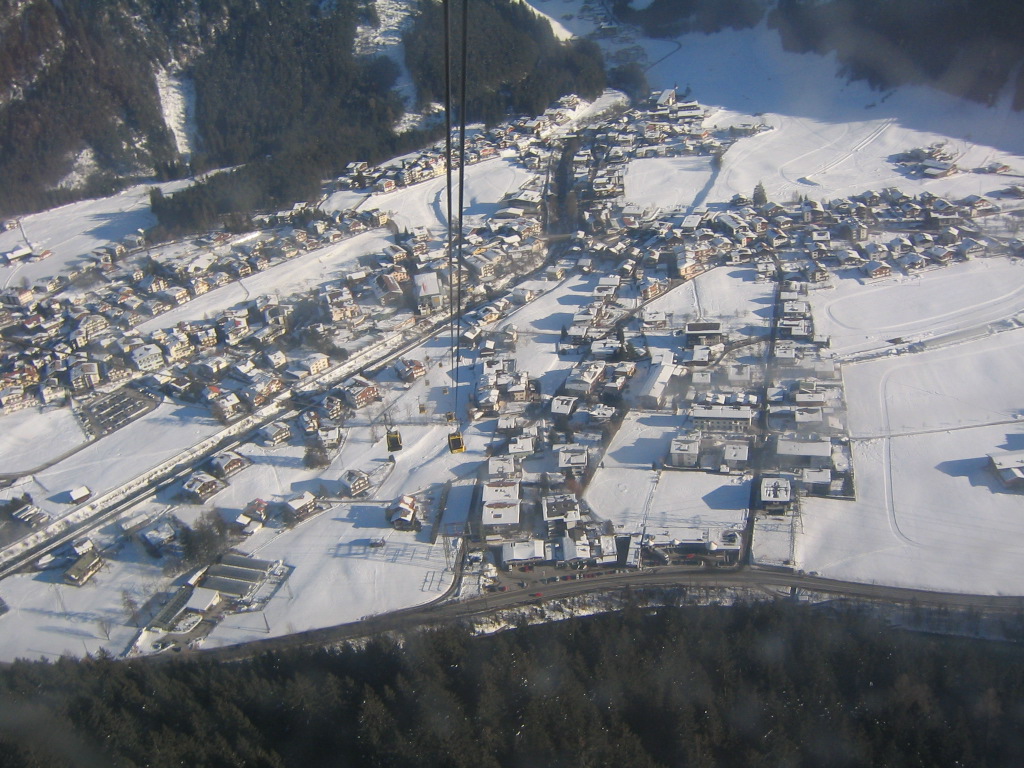
Mayrhofen is a town in the Zillertal (Ziller river valley) in the Austrian state of Tyrol. It is located approximately an hour from the Tyrolean capital city of Innsbruck.

Population

[edit]
Historical population
YearPop.±%
18691,172—    
18801,114−4.9%
18901,094−1.8%
19001,096+0.2%
19101,218+11.1%
19231,514+24.3%
19341,928+27.3%
19392,076+7.7%
19512,351+13.2%
19612,523+7.3%
19713,175+25.8%
19813,270+3.0%
19913,679+12.5%
20013,751+2.0%
20113,833+2.2%
20213,916+2.2%

Tourism

[edit]

The town offers a variety of summer and winter sports including skiing, hiking, mountain biking and paragliding. Mayrhofen is situated near the Hintertux glacier, which, at 3,250 metres (10,660 feet) above sea level, is above the snowline.[3] Skiing is available all year round here. Mayrhofen sits between the Penken and the Ahorn mountains which provide ski runs in the winter and mountain biking, hiking and paragliding in the summer. The Ahorn offers mainly easy and intermediate runs, but also has a long, steep black run (formerly red) which was once on the World Cup Downhill circuit but was removed as it was deemed too dangerous. The Penken mountain offers Austria's steepest piste, named Harakiri, as well as a large range of ski runs at different levels of difficulty. It is connected by lifts with the villages of Finkenberg, Lanersbach and Schwendau.

Tricable detachable gondola lift Penkenbahn and its stations

The Penken is reached by a Gondola system, the Penkenbahn [de], which is located on the main street next to the Sport Hotel Strass, in the centre of the village, while the Ahorn Cable car or Ahornbahn [de], which with a capacity of 160 passengers is the largest cable car in Austria,[4] is situated at the southern end of the town. Mayrhofen is a snowboard-minded village with a funpark sponsored by Vans, and the snowboardhotel Gasthof Zillertal owned by the Dutch organisation 'SAIKO expeditions'. Mountaineer Peter Habeler and Downhill Racer Uli Spiess both come from Mayrhofen.[5][6]

The town also provides an excellent base for walkers, as Mayrhofen is home to many trails touring the mountains and nearby Ziller valley.[7]

Events

[edit]

Since 2005, each spring (usually early April), Mayrhofen hosts the Snowbombing music festival. Since the initial event in 2000 (held in Risoul, France), snowbombing has gathered much notoriety and respect in the electronic dance music world as one of the major festivals. The event has been hosted by Mayrhofen since 2005.[8]

Snowbombing piste-side music venue

Climate

[edit]
Mayrhofen
Climate chart (explanation)
J
F
M
A
M
J
J
A
S
O
N
D
 
 
55
 
 
1
−4
 
 
46
 
 
4
−3
 
 
63
 
 
10
0
 
 
74
 
 
14
3
 
 
97
 
 
20
8
 
 
131
 
 
22
11
 
 
149
 
 
24
13
 
 
131
 
 
23
12
 
 
97
 
 
19
9
 
 
65
 
 
14
5
 
 
75
 
 
6
0
 
 
62
 
 
1
−3
Average max. and min. temperatures in °C
Precipitation totals in mm
Source: ZAMG
Imperial conversion
JFMAMJJASOND
 
 
2.2
 
 
34
25
 
 
1.8
 
 
39
27
 
 
2.5
 
 
50
32
 
 
2.9
 
 
57
37
 
 
3.8
 
 
68
46
 
 
5.2
 
 
72
52
 
 
5.9
 
 
75
55
 
 
5.2
 
 
73
54
 
 
3.8
 
 
66
48
 
 
2.6
 
 
57
41
 
 
3
 
 
43
32
 
 
2.4
 
 
34
27
Average max. and min. temperatures in °F
Precipitation totals in inches
Climate data for Mayrhofen (1971–2000)
Month Jan Feb Mar Apr May Jun Jul Aug Sep Oct Nov Dec Year
Record high °C (°F) 16.0
(60.8)
17.0
(62.6)
24.0
(75.2)
27.0
(80.6)
31.0
(87.8)
32.6
(90.7)
36.0
(96.8)
35.0
(95.0)
31.2
(88.2)
26.0
(78.8)
21.6
(70.9)
19.0
(66.2)
36.0
(96.8)
Mean daily maximum °C (°F) 1.1
(34.0)
4.3
(39.7)
9.6
(49.3)
14.1
(57.4)
19.7
(67.5)
21.7
(71.1)
23.8
(74.8)
23.2
(73.8)
19.3
(66.7)
13.9
(57.0)
6.0
(42.8)
1.4
(34.5)
13.2
(55.8)
Daily mean °C (°F) −2.1
(28.2)
−0.4
(31.3)
3.6
(38.5)
7.6
(45.7)
12.7
(54.9)
15.2
(59.4)
17.1
(62.8)
16.5
(61.7)
12.9
(55.2)
8.3
(46.9)
2.3
(36.1)
−1.3
(29.7)
7.7
(45.9)
Mean daily minimum °C (°F) −4.4
(24.1)
−3.4
(25.9)
0.0
(32.0)
3.3
(37.9)
7.8
(46.0)
10.6
(51.1)
12.5
(54.5)
12.3
(54.1)
9.2
(48.6)
4.9
(40.8)
−0.1
(31.8)
−3.4
(25.9)
4.1
(39.4)
Record low °C (°F) −22.0
(−7.6)
−16.4
(2.5)
−16.2
(2.8)
−5.0
(23.0)
−4.0
(24.8)
1.8
(35.2)
1.0
(33.8)
4.0
(39.2)
0.0
(32.0)
−5.7
(21.7)
−13.2
(8.2)
−18.0
(−0.4)
−22.0
(−7.6)
Average precipitation mm (inches) 54.7
(2.15)
46.4
(1.83)
63.2
(2.49)
74.0
(2.91)
96.9
(3.81)
130.9
(5.15)
148.9
(5.86)
130.7
(5.15)
97.0
(3.82)
64.7
(2.55)
74.6
(2.94)
61.7
(2.43)
1,043.7
(41.09)
Average snowfall cm (inches) 28.0
(11.0)
25.3
(10.0)
16.4
(6.5)
4.5
(1.8)
0.4
(0.2)
0.0
(0.0)
0.0
(0.0)
0.0
(0.0)
0.0
(0.0)
0.8
(0.3)
10.2
(4.0)
20.8
(8.2)
106.4
(41.9)
Average precipitation days (≥ 1.0 mm) 8.4 7.9 9.9 10.6 11.4 15.0 15.4 14.2 10.7 8.3 9.7 9.2 130.7
Average relative humidity (%) (at 14:00) 79.7 65.6 55.5 50.7 47.9 53.4 54.6 56.3 58.6 63.6 76.5 85.9 62.4
Mean monthly sunshine hours 2.4 69.0 130.3 124.1 183.5 164.4 183.6 176.9 138.4 87.4 19.5 11.2 1,290.7
Source: Central Institute for Meteorology and Geodynamics[9]

Transport

[edit]
The railway station at Mayrhofen im Zillertal.

Mayrhofen has one railway station, which is located next to the Zillertaler Bundestrasse. The station is a terminus for all Train services operated by the Zillertalbahn, the valley's main public transport operator.[10] The railway runs between Jenbach and Mayrhofen itself, and there are several intermediate stations, which provide access to many of the valley's well known ski areas, namely Zell am Ziller (Zillertal 3000), Fügen (Spieljoch) and Uderns (for the Hochfügen and Kaltenbach ski areas). The railway operates year-round, although in summer additional 'special' services operate, such as a steam train service.

The Zillertalbahn also run bus routes in the valley, which are regular and cover an extensive area.[11] Additional services also operate during the winter, to cater for the skiing season.

Statistics

[edit]
  • Elevation: Top: 2,500 metres (8,200 feet) (with ski-lift)[12]
  • Lifts: 48
  • Terrain: 157 kilometres (98 miles) of groomed slopes in the region

Twin towns

[edit]

References

[edit]
[edit]
Revisions and contributorsEdit on WikipediaRead on Wikipedia
from Grokipedia
Mayrhofen is a prominent and alpine resort town in the Valley of Tyrol, , situated at an elevation of 630 meters above and serving as a gateway to the surrounding Tux and with peaks exceeding 3,000 meters. With a population of approximately 3,979 residents (as of 2025) and an area of 178.8 square kilometers, it is one of the largest municipalities in Tyrol by land area, encompassing diverse hamlets, subsidiary valleys, and natural reservoirs like the Schlegeis Reservoir. Renowned as the "flagship" of Austrian alpine tourism, Mayrhofen has evolved from a traditional farming and community into a year-round destination, particularly celebrated for its extensive facilities in the Mountopolis ski area, which includes 142 kilometers of groomed pistes across the Ahorn, Penken, Rastkogel, and Eggalm sectors, connected by 61 modern lifts. The features Austria's steepest slope, the Harakiri on Penken with a 78% incline, alongside attractions like the Ahorn Eagle’s Stage—the highest bird of prey station in at over 2,000 meters—and the Erlebnisbad adventure pool. In summer, Mayrhofen shifts focus to outdoor pursuits such as hiking the extensive network of trails in the Alps Nature Park, mountain biking via the Tyrol Mountain Bike Safari, and cultural experiences including the Zillertal Show Dairy and traditional distillery tours at sites like Stiegenhaushof. The town's infrastructure blends Tyrolean heritage with modern amenities, offering luxury hotels alongside preserved farms, and it hosts events like the annual Snowbombing music festival, drawing international visitors to its scenic, tradition-rich setting.

Geography

Location and Setting

Mayrhofen is situated in the valley within the state of Tyrol, , at coordinates 47°10′N 11°52′E. It lies approximately 70 km east of the regional capital . Administratively, Mayrhofen forms part of the Schwaz District, with its municipal boundaries covering an area of 178.79 km² and incorporating villages such as Ginzling and Brandberg. The town center sits at an elevation of 633 m above , while the surrounding terrain rises dramatically to peaks exceeding 3,000 m, including the Ahornspitze at 2,973 m, with ski lifts extending access up to 2,500 m. Nestled at the confluence of the Ziller River and its tributaries like the Zemmbach, the area is bordered to the south and east by the prominent Penken and Ahorn mountains. The landscape encompasses dense forests, expansive alpine meadows, and lies in close proximity to the Hintertux Glacier, approximately 15 km to the south. This alpine setting shapes local climate patterns and facilitates through its mountainous access points.

Climate

Mayrhofen experiences a classified as Köppen Dfb, characterized by cold, snowy winters and mild summers influenced by its alpine location. Average monthly temperatures range from a high of 1.1°C in to 23.8°C in , with corresponding lows of -5.5°C in and 11.2°C in . Winters are marked by sub-zero temperatures that support extensive snow accumulation, while summers remain comfortable without extreme heat. The surrounding alpine terrain contributes to these patterns by channeling moist air from the north, enhancing orographic precipitation. Annual precipitation averages 1,043.7 mm, with the heaviest rainfall occurring in summer, particularly 140 mm in . Snow cover typically persists from to , with average depths of 100-200 cm in the surrounding mountains, providing reliable winter conditions. The town's high of around 630 meters fosters microclimates, where valley can form during cold periods and occasional pose risks in steeper areas during heavy snowfall. Year-round is enabled by the nearby Hintertux Glacier, which maintains perpetual snow at elevations above 3,000 meters.

History

Early Settlement

Mayrhofen, situated in the fertile valley of the Austrian Tyrol, was first documented in 1200 as a modest farming settlement under the jurisdiction of the Archbishopric of within the . The valley's location provided natural advantages for early habitation, including along the Ziller River and access to alpine pastures, supporting initial population growth from small communities of settlers engaged in . By the medieval period, the settlement had developed into a rural outpost with roots in the , though records indicate steady expansion tied to the region's agrarian . During the medieval era, Mayrhofen's growth centered on enduring structures from the , including the original parish church, which served as a focal point for community life and represents some of the oldest surviving buildings in the area. The local economy revolved around agriculture, with crops and livestock rearing supplemented by forestry activities in the surrounding Alps, where timber harvesting was essential for construction and fuel. River trade along the Ziller facilitated the transport of goods, particularly logs floated downstream, connecting the isolated valley to broader Tyrolean markets and enhancing economic stability through limited commerce. In the , Mayrhofen saw infrastructural advancements with the establishment of a postal station around the early 1700s at the Gasthof zur Post, which functioned as a key relay point for and travelers crossing the Tyrolean passes. This development bolstered and communication networks, positioning the settlement as a vital node in regional amid the Habsburg domains. The inn's role underscored Mayrhofen's integration into wider Alpine routes, promoting exchanges of goods and information without altering its predominantly agrarian character. Mayrhofen's history intertwined with broader Tyrolean events, including the 1837 emigration wave from the Zillertal, driven by religious tensions between Protestant "Inklanten" and Catholic authorities, which led to the expulsion of 427 inhabitants seeking tolerance in . Although the valley experienced these upheavals, with a notable Protestant minority, the settlement itself remained relatively stable, maintaining its Catholic majority and continuing as a cohesive farming community.

Modern Development

In the 19th century, Mayrhofen and the surrounding valley were integrated into the under the in 1816, marking a shift from prior Bavarian influences and aligning the area with broader Habsburg administrative structures. The region remained predominantly rural and agricultural through much of this period, with farming activities driving local economic stability and modest population growth amid expanding markets for alpine produce. The early 20th century brought enhanced connectivity with the opening of the Zillertalbahn narrow-gauge railway in 1902, which connected Jenbach to Mayrhofen and boosted accessibility for residents and early visitors, facilitating the transport of timber, agricultural goods, and tourists. Following , Mayrhofen contributed to Austria's national reconstruction efforts, emphasizing the repair of infrastructure damaged by conflict and the stabilization of rural economies through allied occupation aid programs that supported housing and agricultural revival. The mid-20th century ushered in a transformative boom, exemplified by the construction and opening of the Penken cable car in , which provided reliable access to high-altitude slopes and accelerated the economic pivot from subsistence farming to by the . This shift was bolstered by the area's climatic advantages for snow-reliant activities, evolving from early settlement foundations into a of modern alpine recreation. The subsequent addition of the Ahorn cable car in 1969 further solidified Mayrhofen's role as a premier destination, drawing international visitors and diversifying employment beyond . As of 2025, ongoing expansions in ski infrastructure continue to shape Mayrhofen's development, including the launch of the SkyRide Ahorn—a innovative open-air on the Ahornbahn that reaches the plateau in seven minutes and enhances panoramic experiences for summer and winter guests. However, reviews from the 2024-2025 season have criticized the resort's limited expansion plans, noting delays in lift modernizations, insufficient capacity upgrades, and reliance on outdated equipment that hampers accessibility and growth potential.

Demographics

Mayrhofen's population has exhibited steady growth over the past century and a half, primarily driven by tourism-related migration and urbanization processes in the Zillertal valley. The inaugural Austrian census of 1869 recorded 1,172 residents in the municipality. This figure rose gradually amid regional economic shifts toward tourism, reaching 3,858 by January 1, 2018, and climbing further to 3,916 as enumerated in the 2021 register-based census. Recent data reflect continued expansion at a measured pace. Official data indicate the reached 3,979 as of January 1, 2025, supported by an annual growth rate of 0.50% over the 2021–2025 period. At this level, the population density stands at 22.27 inhabitants per square kilometer, characteristic of the sparse settlement patterns in alpine environments. Looking ahead, projections suggest a modest ongoing increase, linked to the influx of seasonal workers bolstering the local sector, while is likely to stabilize owing to constraints on housing availability exacerbated by second-home developments in popular tourist areas. This trajectory has been influenced by modern infrastructure developments enhancing accessibility in the .

Social Composition

Mayrhofen's population, totaling 3,930 residents as of 2021, is predominantly composed of Austrian citizens of Tyrolean origin who speak German as their primary language, forming the ethnic majority in line with the region's historical settlement patterns. In the broader Tyrol province, Austrian citizens account for 83.1% of the population, with foreign citizens comprising 16.9%, many from EU countries including Eastern Europe; however, in Mayrhofen the share of foreign residents is higher at approximately 24% as of 2022, compared to the Schwaz district average of 14.6%, often involving seasonal workers in tourism-related roles. The age distribution reflects a community with a notable working-age cohort, where 40.6% of residents fall between 25 and 54 years old, supporting local economic activities, while 20.6% are aged 65 and over, indicating an aging trend common in rural Alpine areas. The average age stands at 43.7 years, slightly higher than the national median, with a balance of approximately 50.4% and 49.6% . Socioeconomically, Mayrhofen benefits from low , with Tyrol's rate at 4.8% in 2021 (below the national of 6.5%) and around 3.1% in 2023. household aligns with national figures at approximately €45,000 annually, elevated by the local economy, while about 33% of the working-age (25-64 years) holds post-secondary qualifications.

Economy

Tourism

Mayrhofen serves as a premier alpine destination in the Zillertal Valley of Tyrol, , renowned for its diverse winter and summer offerings that attract skiers, hikers, and families year-round. The resort's appeal lies in its integration of natural beauty with accessible adventure, supported by the region's favorable that ensures reliable snow cover in winter and mild summers for outdoor pursuits. The key winter attractions include the Penken and Ahorn ski areas, which form part of the interconnected Mountopolis ski domain spanning 142 kilometers of pistes suitable for all skill levels, from beginner-friendly slopes on the sunny Ahorn plateau to challenging black runs like the Harakiri on Penken. Adjacent to Mayrhofen, the Hintertux Glacier provides year-round on 60 kilometers of glacier slopes at altitudes up to 3,250 meters, offering consistent snow conditions from to May and beyond. In summer, the area shifts to outdoor exploration with over 532 kilometers of well-marked hiking trails through the Zillertal Alps Nature Park, including family-friendly paths like the PanoramaTrail on Penken and more demanding routes to viewpoints such as Filzenkogel at 2,227 meters; mountain biking enthusiasts can access approximately 800 kilometers of trails ranging from gentle valley paths to technical downhill routes. Supporting these attractions is robust , including 61 modern lifts across the Mayrhofen-Hippach capable of transporting up to 96,281 passengers per hour, enabling efficient access to high-altitude . Accommodations in Mayrhofen and surrounding villages provide extensive options such as hotels, chalets, and apartments, with capacity to host over 10,000 guests simultaneously through properties like the Neuhaus Zillertal Resort and family-oriented guesthouses. For the 2024/2025 season, expansions at local hotels, including enhanced family facilities such as a 5,800-square-meter bathhouse and children's water worlds at Neuhaus , aim to cater further to multi-generational visitors. Tourism drives the local economy, contributing significantly to the region's prosperity with nearly 7.7 million overnight stays recorded in 2024, of which the winter season from to accounts for the majority due to peak demand. Mayrhofen, as the valley's primary hub, sees hundreds of thousands of these stays annually, underscoring 's dominant role in generating local revenue and employment. Despite its strengths, Mayrhofen faces challenges as a relatively compact and somewhat isolated region, with 2024-2025 reviews highlighting limited interconnections to larger domains and no major expansions planned, potentially constraining growth for advanced skiers. To address environmental concerns, the resort emphasizes through initiatives like solar panels on chairlifts for generation and partnerships with the Zillertal Alps Nature Park to promote eco-friendly practices in operations.

Other Economic Activities

In Mayrhofen, agriculture and forestry constitute secondary economic pillars, supporting local food production and resource management in the Zillertal valley lowlands. Dairy farming plays a prominent role, with the region known for hay milk-based products such as Zillertaler cheese, produced through a cooperative involving around 200 farmers who supply milk from cows, sheep, and goats raised on alpine pastures. Cattle rearing complements this, focusing on high-quality livestock for milk and meat, while timber harvesting from surrounding forests provides wood for construction and local use. In 2020, approximately 170 individuals were employed in agricultural and forestry operations, representing about 6% of the local workforce, down from 209 in 2010 due to structural shifts toward part-time farming. There were 64 farms in 2020, with 58% operating part-time alongside other activities. Local crafts and services sustain resident needs through small-scale enterprises, emphasizing traditional Tyrolean skills. Woodworking artisans, such as those at Knauer Möbelhandwerk, specialize in custom furniture, cabinetry, and interior fittings using regional timber, preserving techniques passed down generations. Similarly, Holzbildhauerei Eder produces hand-carved wooden sculptures and figures, drawing on naturalist styles for decorative and functional items. These crafts extend to minor , including repairs for outdoor equipment, and retail outlets serving daily household demands. In 2022, the industry and crafts sector employed 598 people, or roughly 22% of those working in Mayrhofen, highlighting its foundational role beyond primary sectors. Other services, excluding , account for a smaller portion, focusing on essential maintenance and trade for the community. Emerging sectors include , bolstered by the Ziller River's potential. The Mayrhofen pumped-storage power plant, operational since 1970 and modernized in 2015, generates approximately 670 million kWh annually, contributing to Austria's clean energy grid through the Stillup Reservoir system. installations along the river further support local efforts. While dominates the economy, these non-tourism activities employ over 800 people combined and foster a mixed economic structure resilient to seasonal fluctuations.

Culture and Events

Local Events and Festivals

Mayrhofen hosts a vibrant array of annual events that blend its alpine heritage with modern entertainment, drawing visitors for both and cultural celebrations. The Snowbombing Festival, an electronic music and extravaganza, has been held annually in the resort since 2001, typically in early April. The 2025 edition took place from April 7 to 12, featuring top DJs, live acts, and on-slope parties that attract around 7,000 attendees to the Zillertal Valley. In 2025, Mayrhofen introduced new events enhancing its festival scene, including Full Metal Mayrhofen from March 31 to April 5, which showcased metal bands such as and across village stages and alpine pastures. Complementing this, the Altitude Comedy Festival occurred in the early ski season from March 24 to 28, offering stand-up performances by international comedians in unique mountain venues like huts and cable car stations. These gatherings highlight Mayrhofen's evolution into a hub for diverse, large-scale festivals, boosting local through extended stays and off-season appeal. Traditional events further emphasize the town's Tyrolean roots, with the Välley Rälley snowboard tour kicking off on December 20-21, 2025, at nearby Hochzillertal, with a later stop in Mayrhofen at Penken Park on February 28 – March 1, 2026. Summer brings folk festivals like the Event-Summer series in Mayrhofen and Hippach, featuring Tyrolean music ensembles such as the Mayrhofner and Freddy Pfister Band, alongside dancing and parades at events like the Gauder Fest in early May. Historically, the Zillertal's cultural legacy ties to "," as organ maker Karl Mauracher from the valley spread the carol in 1819 after repairing an organ in Oberndorf and sharing it with local singers.

Twin Towns

Mayrhofen is a founding member of the 1st European Partnership Ring, established in 1956 to promote European unity and cross-border friendships following World War II. This network connects Mayrhofen with five other municipalities: Bad Homburg vor der Höhe in Germany, Cabourg in France, Chur in Switzerland, Mondorf-les-Bains in Luxembourg, and Terracina in Italy. These bilateral agreements emphasize cultural, social, and economic exchanges without formal involvement in broader EU twinning programs. Collaborations within the ring include annual mayor meetings to discuss shared themes such as , , and global challenges; for instance, the 2022 gathering in addressed the Russia-Ukraine conflict and the role of in international harmony. programs feature exchanges like touring music bands from partner towns and encounter trips to Mayrhofen, fostering interpersonal connections among young people. Cultural activities extend to joint celebrations, such as the 60th anniversary events in 2016 across the ring, and recent gatherings like the 2024 meeting in , which included excursions and visits to local events. These partnerships provide cultural enrichment through shared traditions and perspectives, while enabling economic networking in areas like ; for example, Mayrhofen has supported events in , such as the 2025 Stadl festival. Participants from twin towns occasionally join Mayrhofen's local , enhancing the region's international cultural context. Overall, the relationships strengthen community ties and promote through dialogue and cooperation.

Transportation

Rail and Road Infrastructure

Mayrhofen's rail infrastructure centers on the Zillertalbahn, a narrow-gauge railway operating at 760 mm gauge that connects the town to Jenbach on the main line. Spanning 32 kilometers through the Ziller , the line has provided essential regional connectivity since its opening in 1902. The Zillertalbahn runs half-hourly services year-round, facilitating access for both locals and tourists, with modern diesel multiple units accommodating up to approximately 300 passengers per train. During winter, the service extends its role in supporting tourism by linking directly to ski areas around Mayrhofen, enhancing mobility to the resorts. The opening of the Zillertalbahn in 1902 was instrumental in Mayrhofen's modern development, fostering through improved access that underpins its industry. Looking ahead, the operator Zillertaler Verkehrsbetriebe plans to decarbonize operations by electrifying the line using battery-electric traction, with implementation targeted for the 2025-2030 period as part of Tyrol's medium-term investment program. This shift from diesel, following the abandonment of earlier hydrogen proposals, will involve new battery-capable trains and charging infrastructure powered by local . Road access to Mayrhofen primarily follows the Federal Highway B169, which runs along the Ziller Valley from Innsbruck, covering about 70 kilometers in roughly one hour by car. The route branches off the Inntal Autobahn (A12) at the Zillertal exit, providing a well-maintained connection for vehicular traffic. At the town edges, extensive parking facilities accommodate thousands of vehicles during peak seasons, including designated lots near cable car stations to manage influxes from visitors. Mayrhofen lies in proximity to the EU Route E45, which passes through the nearby Brenner Pass via the A12 and A13 motorways, offering broader European connectivity for long-distance travelers. Ongoing infrastructure enhancements along the B169 include expansions to charging networks, with Austria's national growth in recharging points—reaching over 33,000 by early 2025—supporting improved facilities in the region.

Local Mobility

Local mobility in Mayrhofen emphasizes efficient, short-distance options tailored to the town's alpine setting, supporting both daily commutes for residents and recreational access for visitors. A comprehensive public bus system operates year-round, with enhanced services in winter to accommodate snow-covered roads and activities. Free ski buses, provided by Mayrhofner Bergbahnen, run frequently to key cable car bases including the Penkenbahn and Ahornbahn, enabling car-free travel across the Mayrhofen-Hippach area with color-coded routes for ease of use. The valley , managed by Zillertaler Verkehrsbetriebe, connects Mayrhofen to nearby villages such as Ginzling via lines like 4102, offering scheduled services that run multiple times daily and integrate with the for seamless transfers. Electric buses have been progressively introduced in the region since 2023, including on routes adjacent to Mayrhofen like the Tux-Finkenberg shuttle (line 4104), reducing emissions and supporting eco-friendly intra-valley travel. Cable cars and lifts form a of local and recreational mobility, providing quick elevation access amid the town's mountainous terrain. The Ahornbahn , linking the town center to the Ahorn plateau, operates at a capacity of 1,200 passengers per hour with a travel time of approximately 5.5 minutes. Similarly, the Penkenbahn tricable transports up to 3,840 passengers per hour in its advanced 33- configuration, each seating 24, and serves as a vital link for both winter and summer outings. In summer, these lifts facilitate bike transport, allowing cyclists to ascend Penken and Ahorn with their e-bikes or mountain bikes for downhill trails without pedaling uphill. Complementing motorized options, non-motorized transport is well-developed for sustainable local movement. The valley features an extensive 1,300 km network of cycle paths suitable for and , with dedicated routes starting from Mayrhofen and weaving through scenic alpine landscapes. E-bike rentals are widely available from outlets like Bründl Sports and Rent in the town center, providing equipped models with helmets and locks for flexible exploration. The pedestrianized core of Mayrhofen promotes walking, with car-free zones around the main street and railway station fostering easy access to shops, accommodations, and transit hubs. Mayrhofen lacks a local , with the nearest facility being , located about 70 km away and reachable via regional rail or road connections that serve as primary entry points. efforts in local mobility have intensified, including the expansion of low-emission shuttles and e-bus integrations across the , with 2025 initiatives focusing on further electrification amid ongoing resort environmental assessments to minimize winter climatic impacts on transport reliability.

References

Add your contribution
Related Hubs
User Avatar
No comments yet.