Hubbry Logo
ZillertalZillertalMain
Open search
Zillertal
Community hub
Zillertal
logo
8 pages, 0 posts
0 subscribers
Be the first to start a discussion here.
Zillertal
Zillertal
from Wikipedia
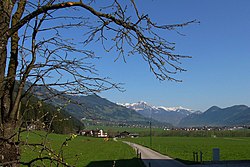
Uderns in the Ziller Valley

The Ziller Valley[1][2][3] (German: Zillertal) is a valley in Tyrol, Austria that is drained by the Ziller River. It is the widest valley south of the Inn Valley (German: Inntal) and lends its name to the Zillertal Alps, the strongly glaciated section of the Alps in which it lies.[4] The Tux Alps lie to its west, while the lower grass peaks of the Kitzbühel Alps are found to the east.

The Ziller Valley is one of the valley areas in Tyrol most visited by tourists.[4] Its largest settlement is Mayrhofen.

Geography

[edit]
Zillertal Alps: south face of Olperer

The Ziller Valley branches from the Inn trench near Jenbach, about 40 km northeast of Innsbruck, running mostly in a north–south direction. The Ziller Valley proper stretches from the village of Strass to Mayrhofen, where it separates into four smaller valleys, the Tux valley and the sparsely settled, so-called Gründe – Zamsergrund, Zillergrund and Stilluppgrund. Along the way, two more Gründe and the Gerlos valley, which leads to the Gerlos Pass and into Salzburg, branch off.

Unlike other side valleys of the Inntal, the Ziller Valley rises constantly, but only marginally, from one end to the other – only about 100 m over 30 km. Permanent settlements cover about 9% of the entire area of the Ziller Valley municipalities.

History

[edit]

Near the Tuxer Joch, a pass between the Wipptal and the Tux valley, there have been archeological finds from middle Stone Age. The oldest remains of settlements in the Ziller Valley date back to the Illyrians during the late Bronze and early Iron Ages – a tribe from the Balkan Peninsula who were absorbed in that area by the Bavarians (Baiuvarii).

The earliest written record of the Ziller Valley dates from 889, when Arnulf of Carinthia granted land to the Archbishop of Salzburg in the "Cilarestale".[5] Ownership of the valley was divided along the Ziller River. Even today this division is visible, as churches on the right bank of the river generally have green towers and belong to Salzburg Diocese, while churches on the left bank have red towers and belong to Innsbruck Diocese.

In 1248, the land west of the Ziller was acquired by the Counts of Tyrol, while the lands east of the Ziller pledged as security to the Counts of Tyrol by the Lords of Rattenberg from 1290 to 1380. In 1504, with both the County of Tyrol and the Archbishopric of Salzburg dominated by the Habsburgs, the Ziller Valley was united under Emperor Maximilian and put under joint Tyrolean/Salzburgian rule.

In 1805, the Treaty of Pressburg ended the War of the Third Coalition and forced Austria to cede Tyrol to Bavaria. For the purposes of this treaty, the Ziller Valley was considered part of Salzburg and thus remained with Austria. The people of the Ziller Valley nevertheless joined Andreas Hofer's Tyrolean Rebellion of 1809 in the Battle of the Ziller Bridge (14 May). Later that year, the insurrection was defeated and the Ziller Valley briefly became Bavarian until the Congress of Vienna in 1814/1815.

The Ziller Valley c. 1898

While the relatively lenient stance of the archbishops of Salzburg had allowed the creation of small pockets of Protestantism in their lands since the Protestant Reformation, the remaining Protestants were oppressed more harshly during the Habsburg rule of the 19th century. In 1837, 437 Protestant inhabitants of the Ziller Valley left the valley after they were given the choice of renouncing the Augsburg Confession or emigrating to Silesia, where Frederick William III of Prussia offered them lands and housing near Erdmannsdorf (now Mysłakowice in western Poland).

In 1902, the Ziller Valley Railway was constructed, which still runs between Jenbach and Mayrhofen to this day, opening up the valley, the economy of which had previously relied mostly on agriculture and mining, to commerce and tourism. From 1921 to 1976, magnesium carbonate (and later tungsten) were mined around the Alpine pastures of the Schrofen and Wangl Almen above the Tuxertal A ropeway conveyor of more than 9 km length was used to transport the ore to the Ziller Valley Railway goods station in the valley below.

The Ziller Valley was known for its itinerant tradesmen, "farm doctors" and singing families. In the second half of the 19th century refuge huts were erected and trails established as climbing became a mass sport. The development of the area for tourism began in 1953/1954 with the construction of the Gerlosstein ski region, today the Zillertal Arena, which was soon followed by other lifts and the opening of the Mayrhofner Penkenbahn in 1954. The use of water power took off in the 1970s.

Economy

[edit]
Sawmill at Fügen and goods train on the Ziller Valley Railway in 2007

In the second half of the 20th century, after the end of mining in the valley, tourism became the area's dominant economic activity. In 2003, tourists stayed a total of 6 million nights in the valley, mostly during winter sports holidays. Following a phase of mergers by building connecting lifts during the 1990s and early 2000s, there are now four big ski areas, the largest of which is the Zillertal Arena, and three smaller satellite areas in the valley. Combined, they offer a total of more than 170 lifts and more than 630 km of downhill slopes.

Traditional agriculture – mostly cattle, dairy and some sheep farming on the Alm pastures – is still widespread and the large sawmill outside the village of Fügen is a sign of the lumber industry that also plays a significant role. The periphery of the area is home to a number of factories. Four large reservoirs in the Gründe supply water to a total of eight hydroelectric power stations, generating slightly more than 1,200 GWh per year.

Culture

[edit]

The Ziller Valley is particularly renowned for its musical tradition. For instance, several families of travelling singers and organ builders from the valley have been credited with spreading the Christmas carol Silent Night across the world during the 19th and early 20th centuries. More recently, the Schürzenjäger band have had tremendous success in German-speaking countries with their crossover mix of Volksmusik and pop.

Religion

[edit]

Catholic Church

[edit]

The majority of the population belongs to the Catholic Church, which plays an important role in the socio-cultural life.[6]

Protestantism

[edit]

After the Reformation a lively Protestant movement developed in the Ziller Valley. There was animosity from the side of the Catholic Church, culminating in the forced exodus of Ziller Valley Protestants in 1837.[7] Today, some smaller Protestant congregations exist in Mayrhofen,[8] Jenbach[9] and Schwaz.

[edit]

References

[edit]
[edit]
Revisions and contributorsEdit on WikipediaRead on Wikipedia
from Grokipedia

Zillertal, also known as the Ziller Valley, is a prominent alpine valley in the Austrian state of Tyrol, drained by the Ziller River and extending approximately 40 kilometers eastward from the Inn Valley near Strass to , where it bifurcates into the Tuxertal and Zemmgrund sub-valleys.
The valley is enveloped by the Zillertal Alps, featuring over 80 glaciers, numerous peaks exceeding 3,000 meters, and the Zillertal Alps , which supports diverse outdoor pursuits including year-round skiing on the Hintertux Glacier—the only such facility in —and extensive and networks totaling over 1,400 kilometers and 1,200 kilometers respectively.
dominates the local economy, drawing millions of visitors annually to resorts like , the valley's largest settlement, for , summer adventures, and cultural experiences rooted in Tyrolean traditions such as brass music and alpine farming, though the region's remoteness historically fostered self-reliant communities engaged in and .

Geography

Topography and Hydrology

The Zillertal constitutes a prominent glacial valley in the Austrian state of Tyrol, extending approximately 30 kilometers southward from its confluence with the Inn Valley. This valley serves as the primary drainage basin for the Ziller River, a 55.7-kilometer-long tributary that originates amid the high peaks of the Zillertal Alps and flows northward with a minimal longitudinal gradient to merge with the Inn River near Schwaz. The Ziller's course defines the valley's hydrology, collecting meltwater from numerous alpine streams and glaciers while channeling precipitation and glacial runoff through a network of side valleys including the Tuxertal and Zemmgrund. Flanking the Zillertal are the Zillertal Alps, a rugged range characterized by jagged summits exceeding 3,000 meters in elevation, with the Hochfeiler standing as the highest point at 3,510 meters along the Austrian-Italian border. Other notable peaks include the Olperer at 3,476 meters, contributing to a dominated by steep cirques, moraines, and U-shaped valleys sculpted by Pleistocene glaciation. The range's eastern and southern boundaries feature alpine passes such as the Pfitscherjoch, facilitating historical and modern access while underscoring the valley's role as a natural corridor between the Central Alps and the region. Prominent hydrological and topographical features include perennial glaciers, with the Hintertux Glacier in the adjacent Tuxertal side valley representing one of Austria's southernmost and highest-elevation ice fields, sustaining year-round meltwater contributions to the Ziller system at altitudes above 3,000 meters. These glaciers, numbering around 85 in the broader Zillertal Alps Nature Park, influence local by regulating seasonal flow variations and depositing sediment that shapes the valley floor's alluvial deposits. The valley's width varies, broadening southward away from the narrower Inn Valley outlet, accommodating channels and floodplain terraces amid schistose bedrock exposures typical of the ' tectonic framework.

Climate and Natural Features

Zillertal's climate is classified as alpine, featuring pronounced seasonal contrasts driven by its gradient from valley floors at around 600 meters to peaks exceeding 3,000 meters in the Zillertal Alps. Winters from to bring cold temperatures, with valley lows averaging -4°C and daytime highs up to 4°C, while higher altitudes regularly drop below -10°C, accompanied by heavy snowfall that accumulates significantly for natural stability. Summers in average highs of 18°C to 20°C in the valley, cooling rapidly with altitude, and receive moderate of about 100-150 mm monthly, fostering brief but lush growing seasons. Annual sunshine totals approximately 300 days, contributing to clean air and diurnal temperature swings. The Zillertal Alps Nature Park encompasses much of the region's high-altitude ecosystems, protecting diverse flora and adapted to glacial, subalpine, and alpine zones. Key includes , which thrive on steep rocky terrains, and reptiles such as the crossed viper in lower meadows; avian and insect diversity is high, with over 500 recorded. Plant life features specialized alpine like cotton grass in wetlands and endangered varieties including downy burdocks and round-leaved sundews in bogs, alongside more than 1,300 overall. These habitats, including forests and forelands, support over 9,000 animal in total, emphasizing the area's role in conserving Central European montane . Seasonal dynamics shape Zillertal's natural processes, with winter snow accumulation prone to in steep gullies like the Zemmgrund, where heavy precipitation and wind-loading trigger slides affecting subalpine patterns. Spring and summer melt from glaciers, such as the Hintertux, generates peak runoff flows that sustain river and alpine meadows but also contribute to erosional features and risks in lower reaches. These cycles underscore the interplay of cryospheric and biotic elements in maintaining resilience amid elevation-driven microclimates.

History

Early Settlement and Medieval Period

Archaeological evidence indicates prehistoric human presence in the Zillertal valley dating back to the , with findings of 8,000-year-old rock crystal tools uncovered through excavations led by local archaeologist Walter Leitner. These artifacts suggest temporary habitation or resource exploitation in the alpine environment, consistent with broader patterns of early alpine activity. Bronze Age developments around 2200–800 BC introduced more sustained pastoral practices, including alpine farming, as evidenced by regional archaeological studies across the . Celtic and Roman influences in Tyrol were peripheral to Zillertal, with the valley's western areas falling under the of Rhaetia; however, no major settlements or infrastructure from these periods have been documented directly in the Zillertal, pointing to its role as a marginal transalpine corridor rather than a core inhabited zone. Permanent medieval settlements emerged in the , driven by clearance of alpine pastures and proximity to trade routes linking the Valley to southern passes. The earliest documented village references include Stummerberg in 1143, Ramsau in 1188, and around 1200, marking the establishment of agrarian communities under feudal oversight. Population growth was bolstered by ancillary economic activities, such as limited local and support for silver extraction in nearby , where medieval output peaked with up to 50,000 workers by 1520, indirectly fostering expansion through labor migration and supply chains. Feudal structures initially aligned with Bavarian counts before integration into the around the late 12th century, with land grants and tithes recorded in protocols reflecting hierarchical lordship over dispersed homesteads. By the 14th century, villages like Zell am Ziller (first mentioned 1318) solidified as self-sustaining units amid these ties.

Habsburg Integration and Early Modern Era

Following the disruptions of the , during which parts of the former Archbishopric of —including the eastern Zillertal—had been annexed to , the valley was fully integrated into the Habsburg in 1816 as part of post-Congress of administrative reorganizations. This incorporation united the previously divided western (Tyrolean) and eastern (ian) portions of the Zillertal under unified Habsburg governance within the , enhancing central control over alpine territories and facilitating tax collection and military levies. The agrarian economy persisted with minimal structural change, dominated by alpine pastoralism including cattle herding for and meat production, supplemented by for timber and fuel, which supported local self-sufficiency amid the valley's rugged terrain and short growing seasons. Small-scale mining, such as extraction in the Zillertal Alps, emerged sporadically from the late 18th century but remained marginal compared to primary agricultural outputs. Religious tensions underscored Habsburg confessional policies, culminating in the 1837 expulsion of around 430 Protestants—termed Inklinanten for their doctrinal leanings—who refused Catholic conformity despite Joseph II's earlier toleration edict. These families, primarily from villages like Stumm and Brandberg, were forcibly relocated to Prussian , reinforcing Catholic dominance in Tyrol and highlighting the limits of Enlightenment reforms under restored absolutism.

Industrialization and 20th-Century Development

The Zillertalbahn, a narrow-gauge steam railway connecting Jenbach to , opened on July 17, 1902, revolutionizing valley transportation by replacing slow road travel with efficient rail service over 31.7 kilometers. This infrastructure not only supported local passenger movement but also bolstered mining operations in Tux by enabling bulk transport to processing facilities, thereby stimulating early industrial activity tied to extraction. The railway's dual role in freight and foreshadowed the valley's shift toward visitor-dependent economies, as it drew initial summer excursionists to the Zillertal's scenic routes. In the mid-20th century, aerial lift systems emerged as key enablers of alpine access, with the Penkenbahn cable car in Mayrhofen commencing operations on July 7, 1954, after challenging winter construction. This pendulum-style lift provided direct ascent to the Penken plateau, expanding reachable terrain for winter skiing and summer hiking, and catalyzed a boom in downhill sports infrastructure. Subsequent developments, such as the Ahorn cable car in 1969, further integrated the valley's slopes into interconnected networks, drawing international skiers and marking the onset of mass tourism as a recovery mechanism following World War II disruptions. Postwar modernization emphasized over extractive industries, with ski area linkages like the early Gerlosstein region (established around 1953–1954) evolving into larger domains that prioritized for economic revitalization. By facilitating reliable snow access and reducing reliance on seasonal , these expansions supported employment shifts and investments, transforming the Zillertal from a peripheral agrarian zone into a hub for alpine recreation amid Austria's broader reconstruction.

Demographics

The Zillertal valley encompasses 25 municipalities with a total resident population of approximately 35,000 as of 2024. This figure reflects a distribution across dispersed settlements, from larger central hubs to smaller peripheral hamlets, with overall remaining low due to the rugged alpine terrain. Historical data reveal stable levels with modest growth since the 1970s, contrasting with earlier periods of stagnation or decline in many rural Tyrolean areas. For instance, individual communities like Strass im Zillertal recorded an increase from 677 inhabitants in 1971 to 863 in 2024, indicative of broader valley-wide patterns. Aggregate figures for the Zillertal Planungsverband show incremental rises, supported by consistent net migration balances in regional demographic profiles. Settlement patterns exhibit significant density variations: urbanized centers such as host around 3,979 residents (2025 estimate), while remote localities like Brandberg number only 382. Fügen, another key hub, counts 4,317 inhabitants, underscoring concentration in mid-valley transport and service nodes. Smaller upstream or villages, such as Gerlos with 787 residents, maintain lower figures typical of high-altitude isolation. Demographic aging aligns with alpine rural norms, featuring a relatively low share of youth (under 15 years comprising about 13-15% in 2024 regional data) and elevated proportions of elderly residents. Emigration rates have remained subdued compared to wider Tyrol, contributing to sustained local stability amid national trends of outward youth migration from peripheral regions.

Ethnic Composition and Language

The residents of Zillertal are overwhelmingly of Austro-Bavarian ethnic origin, tracing their ancestry to medieval German settlers from the Bavarian region who colonized the valley under Habsburg auspices. This composition has historically exhibited high homogeneity, with minimal non-native settlement until the late , when tourism-driven labor demands introduced foreign workers primarily from EU nations. In the district encompassing Zillertal, foreign citizens accounted for 14.2% of the resident population in , a figure below the Tyrolean average of 16.7% but elevated relative to more isolated rural areas due to seasonal in and . These migrants, often from , , , and , integrate into the workforce without significantly altering the dominant Tyrolean cultural framework, as rates remain low and community ties prioritize local lineage. The Zillertaler Dialekt, a subdialect of within the broader Austro-Bavarian linguistic continuum, serves as the for daily intercourse among natives. Actively employed in informal settings, , and local commerce, it underscores the valley's linguistic insularity, with standard High German (Hochdeutsch) confined largely to schools, official documents, and interactions with outsiders. Preservation efforts, including dialect dictionaries and media broadcasts, sustain its use, as evidenced by its prominence in and traditional expressions. Empirical studies on Tyrolean repertoires confirm dominance in private and communal spheres, with over 80% of respondents in regional surveys reporting primary use in everyday communication, resisting pressures from . This pattern reflects causal ties to geographic isolation and cultural continuity, distinguishing Zillertal from urban Austrian centers where erosion is more pronounced.

Economy

Tourism as Economic Driver

Tourism emerged as Zillertal's primary economic sector following the decline of in the mid-20th century, with a significant boom in winter resorts after the driven by expanding infrastructure and accessibility improvements. In , the valley recorded approximately 1.7 million guest arrivals and 7.7 million overnight stays, underscoring its status as one of the largest destinations in the DACH region. These figures reflect 's outsized role, with accounting for a substantial portion of activity through the Zillertaler Superskipass, which provides access to 546 kilometers of pistes and 180 lifts across four interconnected ski areas, including the year-round Hintertux Glacier. Summer tourism complements the seasonal economy via family-focused offerings like the Zillertal Activcard, enabling unlimited use of , one daily ascent and descent on select cable cars, and free entry to six outdoor pools, alongside discounts at leisure facilities. and restaurants constitute the main employers, supporting over 50% of local jobs in tourism-related fields amid the valley's reliance on visitor spending for revenue generation.

Agriculture, Forestry, and Traditional Sectors

constitutes a primary economic and cultural pillar in Zillertal, centered on alpine and hay production from over 400 supplying farms. These operations yield approximately 24 million liters of annually, processed into products like mountain cheese, Alpine cheese, Emmentaler, and grey cheese at facilities such as the in . Hay , derived from near-natural management without or genetically modified feeds, exhibits elevated omega-3 fatty acid content—twice that of conventional —due to cows' diets of alpine and grasses. The annual cattle drives, culminating in , transport herds from high-altitude back to valley farms, ensuring herd health and continuity for the subsequent production cycle while reinforcing traditional practices essential to yields. Forestry complements through sustainable timber harvesting across Zillertal's wooded slopes, adhering to Austria's long-established PEFC-certified principles that prioritize regeneration and protective functions since 1852. Key facilities, including the Fügen operated by binderholz—originating as a Zillertal in the —process up to 1.1 million cubic meters of round timber yearly, yielding sawn timber, glued panels, and for local while sourcing predominantly regional wood to minimize environmental impact. This balanced approach supports and , with harvests calibrated to annual forest growth rates. Traditional sectors have transitioned from historical self-sufficiency, where farms integrated , , and resources for subsistence, to modern local supply chains amid Austria-wide consolidation—evidenced by a continued decline in agricultural holdings to 23.8% organic by 2023. In Zillertal, however, and persist as foundational, providing raw materials for regional processing and products like hay cheeses that command premiums for quality, sustaining rural viability despite reduced numbers.

Secondary Industries and Diversification

The secondary sector in Zillertal emerged modestly in the post-World War II period, with firms focusing on processing local resources and niche to complement the dominant . Key developments included wood processing operations, such as those by binderholz, which expanded from a small established over 70 years ago into a fully integrated group producing solid timber products, glulam, and for and export markets. This sector employs skilled labor in milling, drying, and fabrication, leveraging alpine timber supplies while adhering to sustainable practices. Similarly, food processing has grown through , exemplified by the Erlebnissennerei Zillertal in , Tirol's largest family-owned milk processor, which handles , cheese production, and packaging for regional and national distribution. Mechanical engineering and metalworking represent another pillar, with firms in towns like Zell am Ziller specializing in precision machining (zerspanen) for , , and machinery components since the mid-20th century. RIEDER Zillertal, based in the valley, manufactures construction-specific products including prefabricated timber elements and custom building components, combining traditional with modern production techniques to serve both local and export demands. These operations provide year-round employment for specialized technicians and , reducing reliance on tourism's seasonal fluctuations, though the sector remains small-scale compared to broader Tyrol's industrial base. Export orientation is evident in wood and engineering products, contributing to the valley's mixed economic structure as outlined in regional strategies. Diversification initiatives emphasize attracting stable to balance dependency, with local plans promoting industrial zones for tech-integrated production to foster in traditional trades. While pharmaceutical activities are present via wholesale firms like APONOVA-PHARMA in Hart im Zillertal, true in chemicals or electrotechnics remains limited, with no large-scale facilities verified in the valley. Overall, these secondary activities employ a fraction of the workforce—estimated under 10% in district data—but support export revenues and skilled job retention amid 's volatility.

Culture and Traditions

Local Customs, Festivals, and Daily Life

Daily life in Zillertal revolves around seasonal agricultural rhythms, with families typically managing on alpine pastures during summer months before returning to valley farms in autumn. This pattern supports multi-generational family units, where daily routines center on farm maintenance, production, and preparation for winter storage. A key custom is the preparation and consumption of Zillertaler Krapfen, savory fried dumplings made with rye flour, milk, butter, and boiled potatoes for the dough, filled with grey cheese or Topfen sourced from local farms, often served during festive occasions such as folk festivals and Christmas markets to reflect agrarian self-sufficiency. These are made by combining the ingredients into dough parcels, then frying until crisp, tying directly to the valley's pastoral economy. Festivals emphasize community bonds through events like the , the annual cattle drive held in late September across locales such as Zell am Ziller, Gerlos, and Hintertux, where herds descend from mountain alms adorned with flowers and bells, accompanied by parades, music, and feasting to celebrate the harvest season's end. Brass band traditions animate these occasions, with local ensembles performing folk tunes; the Zillertal State Music School hosts annual competitions and evenings featuring such groups, reinforcing communal participation in musical customs.

Arts, Music, and Linguistic Heritage

Zillertal maintains a vibrant tradition of folk music centered on brass ensembles performing Zillertaler Musik, characterized by lively polkas, marches, and yodels rooted in alpine pastoral life. Over 200 such groups operate in the valley, ranging from family bands to professional outfits that compete in events like the Grand Prix der Volksmusik. Prominent examples include the Zillertaler Schürzenjäger, known for chart-topping alpine folk albums, and the Original Zillertaler, whose recordings preserve instrumental techniques on instruments like the trumpet and tuba. These brass traditions frequently accompany , a courtship-originated involving rhythmic slapping of thighs, knees, and shoe soles, performed in leather shorts and dirndls during regional festivals and tourist spectacles. Ensembles adapt the dance to modern venues, incorporating amplified brass for larger audiences while adhering to historical patterns documented in Tyrolean since the 19th century. The region's linguistic heritage resides in Zillertalerisch, a Central Austro-Bavarian with over 600 documented unique words and 400 idiomatic expressions tied to farming, herding, and mountain , fostering insularity from . This permeates and folk songs archived in collections like those of the Tyrolean Folk Song Archive, which include Zillertal variants preserving legends (Sagen) of local heroes and events through recited narratives and dialect verse. Contemporary fusions in integrate these elements into shows, sustaining authenticity amid commercialization pressures.

Religion

Dominant Role of Catholicism

Catholicism maintains a commanding presence in Zillertal, where religious adherence aligns with Tyrol's regional average of approximately 87% Roman Catholics, exceeding national figures and reflecting sustained parish vitality in rural valleys. Local parishes, such as that in Aschau im Zillertal, anchor community identity through records of baptisms, marriages, and funerals that demonstrate near-universal participation historically. This dominance traces to medieval under Bavarian influence, solidified by efforts that expelled Protestant dissenters from the valley in 1837, ensuring Catholic hegemony amid broader Austrian secularization. The shapes Zillertal's social fabric, influencing via church-affiliated primary schools and catechetical programs that emphasize formation rooted in Thomistic principles. Catholic feast days, including Corpus Christi processions and All Saints' observances, dictate annual rhythms, integrating agrarian cycles with liturgical calendars and fostering intergenerational continuity. frameworks derived from papal encyclicals and local clerical guidance inform family structures and ethical norms, evident in low rates and emphasis on sacramental marriage within Tyrolean demographics. Contemporary indicators of Catholicism's resilience include active pilgrimages, such as the Hainzenberg devotion to Holy Mary initiated in 1659, drawing steady participants despite pressures. Youth engagement counters national trends through events like the annual Zillertaler Nacht-Wallfahrt and vocation-focused hikes, with diocesan reports noting robust turnout among under-30s for sacraments and retreats. These practices, documented in parish bulletins and diocesan archives, affirm Catholicism's adaptive role against secular influences.

Protestant Minority and Secular Influences

The Protestant presence in the Zillertal traces back to the , when local residents encountered Lutheran ideas amid broader religious tensions in Tyrol, but systematic suppression during the limited its growth. By the , a small of "Inklinanten" (those inclined toward ) persisted covertly, prompting authorities to enforce expulsion. In 1837, 437 Protestants were forcibly removed from the valley and resettled in Prussian (now ), effectively dismantling organized Protestant communities and leaving only scattered individuals or hidden adherents. This event marked the culmination of Tyrol's anti-Protestant policies, with no subsequent large-scale revivals in the Zillertal itself. Following Austria's adoption of fuller religious freedoms in the late , small Protestant congregations reemerged in the , including in within the Zillertal and nearby Jenbach and . These groups remain modest, comprising a fraction of Tyrol's population, where Protestants account for roughly 3-4% overall, far below the 83.4% Catholic majority recorded in the 2001 census. Tolerance prevails without pressures for assimilation, allowing these enclaves to maintain distinct practices amid the dominant Catholic framework. Secular influences have intensified in recent decades, driven by the Zillertal's boom, which exposes to international visitors and migrant workers from less religious backgrounds, fostering broader shifts. This mirrors national trends of irreligiosity, with Austria's formal church exits dropping to 71,531 in from peaks over 90,000 annually earlier in the decade, though weekly Catholic hovers below 10% in many areas. In Tyrol's rural valleys like the Zillertal, traditional endures more than urban centers, but economic reliance on seasonal —welcoming millions annually—correlates with declining active among younger demographics, prioritizing pragmatic lifestyles over doctrinal adherence. No forced occurs, yet these external contacts contribute to voluntary disaffiliation, reducing the Protestant minority's relative isolation while diluting overall religious observance.

Infrastructure

Transportation and Accessibility

The primary road access to Zillertal follows Bundesstraße B169 (Zillertaler Straße), which extends approximately 35 km through the valley from the A12 Inntal motorway exit near to , passing through the Brettfall Tunnel to ease congestion and improve connectivity for vehicular traffic. This federal highway supports year-round traversal, supplemented by local bus services operated by Zillertaler Verkehrsbetriebe AG, which provide frequent intra-valley routes, including free ski shuttles integrated with lift passes for seamless access to trailheads and resorts. The Zillertalbahn, a 760 mm narrow-gauge railway, connects Jenbach station—linked to the Austrian mainline network—to over 31.7 km, with service intervals of every 30 minutes using both heritage and modern diesel units. began in the late to address inadequate road conditions, culminating in its official opening on 31 July 1902, which facilitated reliable passenger and freight transport, including from upper valley mines post-1928. Elevated transport networks feature over 180 cable cars and lifts across more than 10 interconnected ski areas, enabling vertical and lateral mobility; notable systems include the 52 lifts in Zillertal Arena and 61 in the complex (encompassing Penken, Ahorn, Rastkogel, and Eggalm), many upgraded in the late 20th and early 21st centuries for high-capacity operations linking basins and peaks. For international arrivals, (INN) lies about 50 km west of the valley entrance, with road transfers typically taking 45-75 minutes depending on the destination within Zillertal, often via shuttle or services coordinated with rail connections at Jenbach.

Public Services and Modern Amenities

The Zillertal valley maintains a network of healthcare facilities tailored to its rural and tourism-driven context, including specialized clinics such as the Sportclinic Zillertal, which provides advanced treatment for alpine and sports-related injuries through a team of expert physicians. General medical services, including diagnostics, physiotherapy, and , are available at centers like Zellmed in Zell am Ziller, equipped with modern and telemedicine capabilities for initial assessments. In emergencies, particularly in remote or mountainous areas, rescue services operated by regional providers such as Heli Tirol ensure rapid response, integrating with Tyrol's broader air network for critical evacuations. Education in Zillertal spans from municipal kindergartens and primary schools in villages like and Zell am Ziller to secondary institutions, with vocational training emphasizing trades in , , and related services to align with the local economy. Specialized programs, including and instruction through local schools, prepare youth for seasonal employment in , reflecting the valley's reliance on visitor industries. Utilities in the region prioritize hydroelectric generation from the Ziller River, enabling a degree of energy self-sufficiency and sustainability; for instance, the power station has produced approximately 670 million kWh annually since 1970, primarily via the Stillup Reservoir system managed by . Wastewater treatment at the Strass im Zillertal plant serves multiple communities and operates as a net energy producer through efficient utilization, exceeding its operational needs. These systems support modern amenities while minimizing reliance on external fossil fuels in the alpine setting.

Environmental Challenges

Impacts of Tourism and Climate Variability

Tourism in Zillertal, particularly , delivers substantial economic benefits through visitor spending and employment, yet exerts pressure on local habitats via infrastructure expansion such as ski lifts and pistes that fragment ecosystems in the Zillertal Alps. This development contributes to challenges in high-altitude areas, where the High Mountain Nature Park Zillertal Alps hosts exceptional vulnerable to land-use changes from recreational facilities. In broader Alpine contexts, including Tyrol, such tourism-driven alterations have raised concerns over habitat degradation and loss of open spaces essential for wildlife corridors. Climate variability poses acute risks to Zillertal's -dependent , with warming temperatures reducing natural cover and shortening reliable ski seasons. Analysis of Tyrol ski areas, including Zillertal Arena, using climate scenarios A1B and B1 indicates that without , natural snow reliability persists until the 2060s under A1B or the century's end under B1 for higher-elevation sites like Zillertal. However, incorporating current snowmaking extends reliability to the 2040s-2050s across modeled areas, though projected season length losses reach 9-24% by the 2050s, escalating to 32-90% by the 2080s. Snowmaking demands intensify dramatically, potentially rising up to 330% by century's end, straining water and energy resources amid debates over long-term viability. Overdevelopment debates in Zillertal highlight tensions from infrastructure competing for land and driving housing pressures, where expanding accommodations elevate costs and risk local displacement. In Alpine valleys like those in Tyrol, such dynamics have prompted concerns over as residents face affordability challenges from conversions and prioritizing visitors. These pressures underscore causal links between tourism growth and socioeconomic strains, with empirical observations from warm winters like 2006/07 in Tyrol revealing heightened sensitivity to snow scarcity that amplifies reliance on costly adaptations.

Conservation Efforts and Sustainability Measures

The Zillertal Alps Nature Park, encompassing 422 square kilometers of high alpine terrain, has been protected since 1991 and received official Nature Park designation in 2001, with a recent extension of 43 square kilometers approved by the Tyrolean government in early October. This status imposes strict regulations, including bans on new public roads, flights, and cable car expansions for purposes, aimed at preserving rare flora, fauna, and geological features across elevations from 1,000 to 3,510 meters. The park's core zone, the Ruhegebiet Zillertaler and Tuxer Hauptkamm, functions as a restricted alpine to minimize human disturbance and support . Glacier monitoring efforts, while more intensively documented in adjacent regions like Hohe Tauern , extend to Zillertal's Hintertux Glacier through seasonal ice surface assessments tied to operational safety and environmental tracking, though data indicate persistent retreat amid infrastructure. Sustainability initiatives emphasize integration, with the Zillertal Arena ski area sourcing 100% carbon-reduced electricity and carbon-neutral heating in locales such as Zell am Ziller, Hochkrimml, and Gerlos, primarily via local facilities that generate CO2-free power for regional supply. Small-scale plants, like those harnessing the Marzenbach stream with a 2-megawatt capacity, contribute to this framework, supplementing broader Tyrolean efforts to leverage alpine water resources for stable grid energy. Eco-tourism certifications, including the Austrian awarded to participating accommodations, enforce standards for waste separation, energy efficiency, and habitat-friendly operations, with Partner Companies providing guided eco-walks to educate visitors on low-impact practices. Verifiable outcomes include preserved cultural landscapes through the High Alps Nature Park Zillertaler Alps (2014–2020), which promoted sustainable agricultural and forestry management, yet evidence reveals limitations in curbing tourism-driven pressures, as visitor volumes—exceeding millions annually in peak seasons—continue to strain and habitat integrity despite regulatory waste reduction mandates in operations. Conflicts persist between conservation goals and expansions or developments, with studies highlighting insufficient of cumulative impacts from high visitor density, underscoring the need for stricter enforcement to achieve measurable gains. Environmental friendliness ratings for areas like Hintertux score moderately at 4 out of 5, reflecting partial successes in integration but ongoing challenges from infrastructure demands.

References

Add your contribution
Related Hubs
User Avatar
No comments yet.