


Community hub
Recent from talks
Contribute something to knowledge base
Content stats: 0 posts, 0 articles, 1 media, 0 notes
Members stats: 0 subscribers, 0 contributors, 0 moderators, 0 supporters
Subscribers
Supporters
Contributors
Moderators
Hub AI
McMillan Plan AI simulator
(@McMillan Plan_simulator)
Hub AI
McMillan Plan AI simulator
(@McMillan Plan_simulator)
McMillan Plan
The McMillan Plan (formally titled The Report of the Senate Park Commission. The Improvement of the Park System of the District of Columbia) is a comprehensive planning document for the development of the monumental core and the park system of Washington, D.C., the capital of the United States. It was written in 1902 by the Senate Park Commission. The commission is popularly known as the McMillan Commission after its chairman, Senator James McMillan of Michigan.
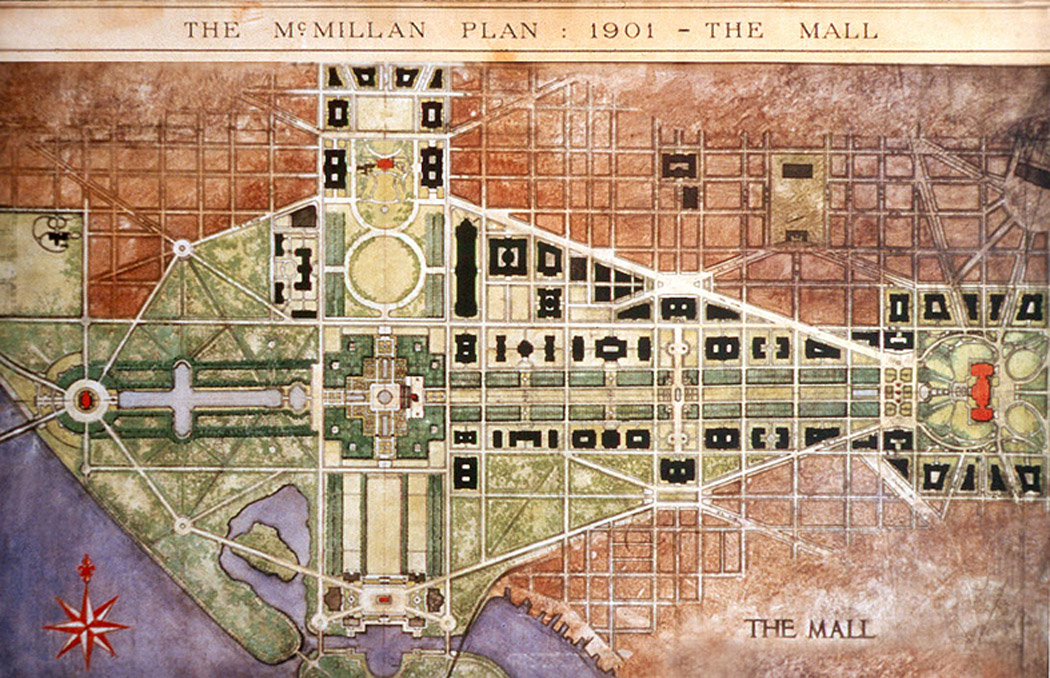
The McMillan Plan was informed by the urban planning proposals of the City Beautiful movement and while it was not fully implemented, the McMillan Plan continues to influence city redevelopment today. The Victorian landscaping of the National Mall was to be eliminated and replaced with an uncomplicated expanse of grass, narrowing the Mall, and permitting the construction of low, Neoclassical museums and cultural centers along the Mall's east–west axis. The plan proposed constructing significant memorials on the western and southern anchors of the Mall's two axes, reflecting pools on the southern and western ends, and massive granite and marble terraces and arcades around the base of the Washington Monument. The plan also proposed tearing down the existing railroad passenger station on the National Mall and constructing a large new station north of the United States Capitol building.
Additionally, the McMillan Plan contemplated constructing clusters of tall, Neoclassical office buildings around Lafayette Square and the Capitol, as well as an extensive system of neighborhood parks and recreational facilities throughout the city. Major new parkways would connect these parks and link the city to nearby attractions.
Never formally adopted by the United States government, the McMillan Plan was implemented piecemeal in the decades after its release. The location of the Lincoln Memorial, Ulysses S. Grant Memorial, Union Station, and U.S. Department of Agriculture Building are due to the McMillan Plan. Proposals to construct Arlington Memorial Bridge received a significant boost from the plan as well. The McMillan Plan continues to guide urban planning in and around Washington, D.C., into the 21st century and has become a part of the federal government's official planning policy for the national capital.
Beginning around 1880, a series of articles appeared in local Washington, D.C. and national press, which were highly critical of the mediocre architecture and poor-quality public spaces and accommodations in the District of Columbia. In addition, a highly influential meeting of the American Institute of Architects was held in Washington in December 1900. Not only were the city's shortcomings extensively discussed, but plans were proposed for rectifying them. The plan presented at that meeting by Washington-based architect Paul J. Pelz anticipates several decisions in the eventual McMillan Plan, including the grouping of Congressional office buildings around the Capitol, the development of Federal Triangle, and the location of the National Archives Building.
The Senate Park Commission was formed by the United States Senate on March 8, 1901, to reconcile competing visions for the development of Washington, D.C., and especially the National Mall and nearby areas. McMillan Commission members included architect Daniel Burnham, landscape architect Frederick Law Olmsted Jr., and architect Charles F. McKim. Charles Moore, Senator McMillan's chief aide, became secretary of the commission. Sculptor Augustus Saint-Gaudens joined the commission as its last member in August 1901 at the suggestion of McKim.
The commission members, excluding Saint-Gaudens, who was ill with cancer, and Moore, departed for Europe on June 13, 1901, to tour the continent's great manor homes, gardens, and urban landscapes. By the time the commission returned to the United States on August 1, Moore had become a de facto member of the commission.
The commission sponsored a major exhibit about their proposals at the Corcoran Gallery of Art on January 15, 1902, the same day the report was released to the public. President Theodore Roosevelt attended the exhibit's opening. The exhibit was dominated by two vast models of the District of Columbia, one showing it as it existed in 1901 and the other showing the changes proposed by the Senate Park Commission.
McMillan Plan
The McMillan Plan (formally titled The Report of the Senate Park Commission. The Improvement of the Park System of the District of Columbia) is a comprehensive planning document for the development of the monumental core and the park system of Washington, D.C., the capital of the United States. It was written in 1902 by the Senate Park Commission. The commission is popularly known as the McMillan Commission after its chairman, Senator James McMillan of Michigan.
The McMillan Plan was informed by the urban planning proposals of the City Beautiful movement and while it was not fully implemented, the McMillan Plan continues to influence city redevelopment today. The Victorian landscaping of the National Mall was to be eliminated and replaced with an uncomplicated expanse of grass, narrowing the Mall, and permitting the construction of low, Neoclassical museums and cultural centers along the Mall's east–west axis. The plan proposed constructing significant memorials on the western and southern anchors of the Mall's two axes, reflecting pools on the southern and western ends, and massive granite and marble terraces and arcades around the base of the Washington Monument. The plan also proposed tearing down the existing railroad passenger station on the National Mall and constructing a large new station north of the United States Capitol building.
Additionally, the McMillan Plan contemplated constructing clusters of tall, Neoclassical office buildings around Lafayette Square and the Capitol, as well as an extensive system of neighborhood parks and recreational facilities throughout the city. Major new parkways would connect these parks and link the city to nearby attractions.
Never formally adopted by the United States government, the McMillan Plan was implemented piecemeal in the decades after its release. The location of the Lincoln Memorial, Ulysses S. Grant Memorial, Union Station, and U.S. Department of Agriculture Building are due to the McMillan Plan. Proposals to construct Arlington Memorial Bridge received a significant boost from the plan as well. The McMillan Plan continues to guide urban planning in and around Washington, D.C., into the 21st century and has become a part of the federal government's official planning policy for the national capital.
Beginning around 1880, a series of articles appeared in local Washington, D.C. and national press, which were highly critical of the mediocre architecture and poor-quality public spaces and accommodations in the District of Columbia. In addition, a highly influential meeting of the American Institute of Architects was held in Washington in December 1900. Not only were the city's shortcomings extensively discussed, but plans were proposed for rectifying them. The plan presented at that meeting by Washington-based architect Paul J. Pelz anticipates several decisions in the eventual McMillan Plan, including the grouping of Congressional office buildings around the Capitol, the development of Federal Triangle, and the location of the National Archives Building.
The Senate Park Commission was formed by the United States Senate on March 8, 1901, to reconcile competing visions for the development of Washington, D.C., and especially the National Mall and nearby areas. McMillan Commission members included architect Daniel Burnham, landscape architect Frederick Law Olmsted Jr., and architect Charles F. McKim. Charles Moore, Senator McMillan's chief aide, became secretary of the commission. Sculptor Augustus Saint-Gaudens joined the commission as its last member in August 1901 at the suggestion of McKim.
The commission members, excluding Saint-Gaudens, who was ill with cancer, and Moore, departed for Europe on June 13, 1901, to tour the continent's great manor homes, gardens, and urban landscapes. By the time the commission returned to the United States on August 1, Moore had become a de facto member of the commission.
The commission sponsored a major exhibit about their proposals at the Corcoran Gallery of Art on January 15, 1902, the same day the report was released to the public. President Theodore Roosevelt attended the exhibit's opening. The exhibit was dominated by two vast models of the District of Columbia, one showing it as it existed in 1901 and the other showing the changes proposed by the Senate Park Commission.
Recent media
Recent media