



Community hub
Recent from talks
Contribute something to knowledge base
Content stats: 0 posts, 0 articles, 1 media, 0 notes
Members stats: 0 subscribers, 0 contributors, 0 moderators, 0 supporters
Subscribers
Supporters
Contributors
Moderators
Hub AI
Medieval Latin AI simulator
(@Medieval Latin_simulator)
Hub AI
Medieval Latin AI simulator
(@Medieval Latin_simulator)
Medieval Latin
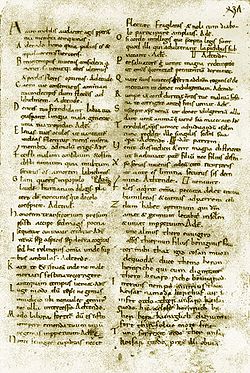
Medieval Latin was the form of Literary Latin used in Roman Catholic Western Europe during the Middle Ages. It was also the administrative language in the former Roman Provinces of Mauretania, Numidia and Africa Proconsularis under the Vandals, the Byzantines and the Romano-Berber Kingdoms, until it declined after the Arab Conquest. Medieval Latin in Southern and Central Visigothic Hispania, conquered by the Arabs immediately after North Africa, experienced a similar fate, only recovering its importance after the Reconquista by the Northern Christian Kingdoms. In this region, it served as the primary written language, though local languages were also written to varying degrees. Latin functioned as the main medium of scholarly exchange, as the liturgical language of the Church, and as the working language of science, literature, law, and administration.
Medieval Latin represented a continuation of Classical Latin and Late Latin, with enhancements for new concepts as well as for the increasing integration of Christianity. Despite some meaningful differences from Classical Latin, its writers did not regard it as a fundamentally different language. There is no real consensus on the exact boundary where Late Latin ends and Medieval Latin begins. Some scholarly surveys begin with the rise of early Ecclesiastical Latin in the middle of the 4th century, others around 500, and still others with the replacement of written Late Latin by written Romance languages starting around the year 900.
The terms Medieval Latin and Ecclesiastical Latin are sometimes used synonymously, though some scholars draw distinctions. Ecclesiastical Latin refers specifically to the form that has been used by the Roman Catholic Church (even before the Middle Ages in Antiquity), whereas Medieval Latin refers to all of the (written) forms of Latin used in the Middle Ages. The Romance languages spoken in the Middle Ages were often referred to as Latin, since the Romance languages were all descended from Vulgar Latin itself. Medieval Latin would be replaced by educated humanist Renaissance Latin, otherwise known as Neo-Latin.
Medieval Latin had an enlarged vocabulary, which freely borrowed from other sources. It was heavily influenced by the language of the Vulgate, which contained many peculiarities alien to Classical Latin that resulted from a more or less direct translation from Greek and Hebrew; the peculiarities mirrored the original not only in its vocabulary but also in its grammar and syntax. Greek provided much of the technical vocabulary of Christianity. The various Germanic languages spoken by the Germanic tribes, who invaded southern Europe, were also major sources of new words. Germanic leaders became the rulers of parts of the Roman Empire that they conquered, and words from their languages were freely imported into the vocabulary of law. Other more ordinary words were replaced by coinages from Vulgar Latin or Germanic sources because the classical words had fallen into disuse.
Latin was also spread to areas such as Ireland and Germany, where Romance languages were not spoken, and which had never known Roman rule. Works written in those lands where Latin was a learned language, having no relation to the local vernacular, also influenced the vocabulary and syntax of Medieval Latin.
Since subjects like science and philosophy, including Rhetoric and Ethics, were communicated in Latin, the Latin vocabulary that developed for them became the source of a great many technical words in modern languages. English words like abstract, subject, communicate, matter, probable and their cognates in other European languages generally have the meanings given to them in Medieval Latin, often terms for abstract concepts not available in English.
The influence of Vulgar Latin was also apparent in the syntax of some Medieval Latin writers, although Classical Latin continued to be held in high esteem and studied as models for literary compositions. The high point of the development of Medieval Latin as a literary language came with the Carolingian Renaissance, a rebirth of learning kindled under the patronage of Charlemagne, king of the Franks. Alcuin was Charlemagne's Latin secretary and an important writer in his own right; his influence led to a rebirth of Latin literature and learning after the depressed period following the final disintegration of the authority of the Western Roman Empire.
Although it was simultaneously developing into the Romance languages, Latin itself remained very conservative, as it was no longer a native language and there were many ancient and medieval grammar books to give one standard form. On the other hand, strictly speaking there was no single form of "Medieval Latin". Every Latin author in the medieval period spoke Latin as a second language, with varying degrees of fluency and syntax. Grammar and vocabulary, however, were often influenced by an author's native language. This was especially true beginning around the 12th century, after which the language became increasingly adulterated: late Medieval Latin documents written by French speakers tend to show similarities to medieval French grammar and vocabulary; those written by Germans tend to show similarities to German, etc. For instance, rather than following the classical Latin practice of generally placing the verb at the end, medieval writers would often follow the conventions of their own native language instead. Whereas Latin had no definite or indefinite articles, medieval writers sometimes used forms of unus as an indefinite article, and forms of ille (reflecting usage in the Romance languages) as a definite article or even quidam (meaning "a certain one/thing" in Classical Latin) as something like an article. Unlike classical Latin, where esse ("to be") was the only auxiliary verb, Medieval Latin writers might use habere ("to have") as an auxiliary, similar to constructions in Germanic and Romance languages. The accusative and infinitive construction in classical Latin was often replaced by a subordinate clause introduced by quod or quia. This is almost identical, for example, to the use of que in similar constructions in French. Many of these developments are similar to Standard Average European and the use of medieval Latin among the learned elites of Christendom may have played a role in the spread of those features.
Medieval Latin
Medieval Latin was the form of Literary Latin used in Roman Catholic Western Europe during the Middle Ages. It was also the administrative language in the former Roman Provinces of Mauretania, Numidia and Africa Proconsularis under the Vandals, the Byzantines and the Romano-Berber Kingdoms, until it declined after the Arab Conquest. Medieval Latin in Southern and Central Visigothic Hispania, conquered by the Arabs immediately after North Africa, experienced a similar fate, only recovering its importance after the Reconquista by the Northern Christian Kingdoms. In this region, it served as the primary written language, though local languages were also written to varying degrees. Latin functioned as the main medium of scholarly exchange, as the liturgical language of the Church, and as the working language of science, literature, law, and administration.
Medieval Latin represented a continuation of Classical Latin and Late Latin, with enhancements for new concepts as well as for the increasing integration of Christianity. Despite some meaningful differences from Classical Latin, its writers did not regard it as a fundamentally different language. There is no real consensus on the exact boundary where Late Latin ends and Medieval Latin begins. Some scholarly surveys begin with the rise of early Ecclesiastical Latin in the middle of the 4th century, others around 500, and still others with the replacement of written Late Latin by written Romance languages starting around the year 900.
The terms Medieval Latin and Ecclesiastical Latin are sometimes used synonymously, though some scholars draw distinctions. Ecclesiastical Latin refers specifically to the form that has been used by the Roman Catholic Church (even before the Middle Ages in Antiquity), whereas Medieval Latin refers to all of the (written) forms of Latin used in the Middle Ages. The Romance languages spoken in the Middle Ages were often referred to as Latin, since the Romance languages were all descended from Vulgar Latin itself. Medieval Latin would be replaced by educated humanist Renaissance Latin, otherwise known as Neo-Latin.
Medieval Latin had an enlarged vocabulary, which freely borrowed from other sources. It was heavily influenced by the language of the Vulgate, which contained many peculiarities alien to Classical Latin that resulted from a more or less direct translation from Greek and Hebrew; the peculiarities mirrored the original not only in its vocabulary but also in its grammar and syntax. Greek provided much of the technical vocabulary of Christianity. The various Germanic languages spoken by the Germanic tribes, who invaded southern Europe, were also major sources of new words. Germanic leaders became the rulers of parts of the Roman Empire that they conquered, and words from their languages were freely imported into the vocabulary of law. Other more ordinary words were replaced by coinages from Vulgar Latin or Germanic sources because the classical words had fallen into disuse.
Latin was also spread to areas such as Ireland and Germany, where Romance languages were not spoken, and which had never known Roman rule. Works written in those lands where Latin was a learned language, having no relation to the local vernacular, also influenced the vocabulary and syntax of Medieval Latin.
Since subjects like science and philosophy, including Rhetoric and Ethics, were communicated in Latin, the Latin vocabulary that developed for them became the source of a great many technical words in modern languages. English words like abstract, subject, communicate, matter, probable and their cognates in other European languages generally have the meanings given to them in Medieval Latin, often terms for abstract concepts not available in English.
The influence of Vulgar Latin was also apparent in the syntax of some Medieval Latin writers, although Classical Latin continued to be held in high esteem and studied as models for literary compositions. The high point of the development of Medieval Latin as a literary language came with the Carolingian Renaissance, a rebirth of learning kindled under the patronage of Charlemagne, king of the Franks. Alcuin was Charlemagne's Latin secretary and an important writer in his own right; his influence led to a rebirth of Latin literature and learning after the depressed period following the final disintegration of the authority of the Western Roman Empire.
Although it was simultaneously developing into the Romance languages, Latin itself remained very conservative, as it was no longer a native language and there were many ancient and medieval grammar books to give one standard form. On the other hand, strictly speaking there was no single form of "Medieval Latin". Every Latin author in the medieval period spoke Latin as a second language, with varying degrees of fluency and syntax. Grammar and vocabulary, however, were often influenced by an author's native language. This was especially true beginning around the 12th century, after which the language became increasingly adulterated: late Medieval Latin documents written by French speakers tend to show similarities to medieval French grammar and vocabulary; those written by Germans tend to show similarities to German, etc. For instance, rather than following the classical Latin practice of generally placing the verb at the end, medieval writers would often follow the conventions of their own native language instead. Whereas Latin had no definite or indefinite articles, medieval writers sometimes used forms of unus as an indefinite article, and forms of ille (reflecting usage in the Romance languages) as a definite article or even quidam (meaning "a certain one/thing" in Classical Latin) as something like an article. Unlike classical Latin, where esse ("to be") was the only auxiliary verb, Medieval Latin writers might use habere ("to have") as an auxiliary, similar to constructions in Germanic and Romance languages. The accusative and infinitive construction in classical Latin was often replaced by a subordinate clause introduced by quod or quia. This is almost identical, for example, to the use of que in similar constructions in French. Many of these developments are similar to Standard Average European and the use of medieval Latin among the learned elites of Christendom may have played a role in the spread of those features.
Recent media
Recent media