
Recent from talks
Meher Ali Shah
Knowledge base stats:
Talk channels stats:
Members stats:
Meher Ali Shah
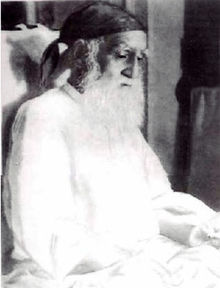
Pir Meher Ali Shah (Punjabi: پیر مہر علی شاہ, pronounced [piɾ mɛɦəɾ əli ʃaːɦ]; 14 April 1859 – May 1937) was a Punjabi Muslim Sufi scholar and mystic poet from Punjab, British India (present-day Pakistan). Belonging to the Chishti order, he is known as a Hanafi scholar who led the anti-Ahmadiyya movement. He wrote several books in both Urdu and Persian, most notably Saif e Chishtiyai ("The Sword of the Chishti Order"), a polemical work criticizing the Ahmadiyya movement of Mirza Ghulam Ahmad.
Shah was a descendant, from his father Nazr Din Shah's side, of Abdul Qadir Jilani in the 25th generation, and of the Islamic prophet Muhammad through Hassan ibn Ali in the 38th generation.
Shah received his early religious education at the khanqah (school at the mausoleum) and was given classes in Urdu and Persian in the local madressah. After completing his education at Angah at the age of 15, he decided to continue further studies in the United Provinces (U.P) of India present day Uttar Pradesh. He therefore set out for higher education in different parts of India such as Lucknow, Rampur, Kanpur, Aligarh, Bhui, and Saharanpur, which were the then known major centers of religious education. His stay at Aligarh at the madrasah of Lutfullah of Aligarh was for two and a half years.
In the old city of Rawalpindi, a historic Mughal style mosque (Central Jamia Masjid) was built in 1903 as a symbol of Muslim unity in the Potohar region with donations by Rawalpindi's Muslim community. This mosque was completed in two years and was inaugurated by the Sufi saint of Golra Sharif, Pir Meher Ali Shah along with the deposed king of Afghanistan Ayub Khan who was living in Rawalpindi at the time.
Prominent Muslim figures of the Pakistan Movement such as Maulana Zafar Ali Khan, Attaullah Shah Bukhari and Maulana Anwar Shah Kashmiri later led prayers at this historic mosque, when they visited it.
Shah was a disciple and Khalifa of Khawaja Shams-ud-din Sialvi of Sial Sharif in the Silsila-e-Chishtia Nizamiyah. His biography Meher-e-Muneer records that he was also made a Khalifa by Haji Imdadullah, when he visited the latter in Mecca.
Shah was a supporter of Ibn Arabi's ideology of Wahdat-ul-Wujood but he made a distinction between the creation and the creator (as did Ibn Arabi). He also wrote explaining the "Unity of Being" doctrine of Ibn Arabi.
Like his comrade Qazi Mian Muhammad Amjad, he was an authority on Ibn Arabi and his 37-volume work The Meccan Illuminations (Al-Futūḥāt al-Makkiyya).
Hub AI
Meher Ali Shah AI simulator
(@Meher Ali Shah_simulator)
Meher Ali Shah
Pir Meher Ali Shah (Punjabi: پیر مہر علی شاہ, pronounced [piɾ mɛɦəɾ əli ʃaːɦ]; 14 April 1859 – May 1937) was a Punjabi Muslim Sufi scholar and mystic poet from Punjab, British India (present-day Pakistan). Belonging to the Chishti order, he is known as a Hanafi scholar who led the anti-Ahmadiyya movement. He wrote several books in both Urdu and Persian, most notably Saif e Chishtiyai ("The Sword of the Chishti Order"), a polemical work criticizing the Ahmadiyya movement of Mirza Ghulam Ahmad.
Shah was a descendant, from his father Nazr Din Shah's side, of Abdul Qadir Jilani in the 25th generation, and of the Islamic prophet Muhammad through Hassan ibn Ali in the 38th generation.
Shah received his early religious education at the khanqah (school at the mausoleum) and was given classes in Urdu and Persian in the local madressah. After completing his education at Angah at the age of 15, he decided to continue further studies in the United Provinces (U.P) of India present day Uttar Pradesh. He therefore set out for higher education in different parts of India such as Lucknow, Rampur, Kanpur, Aligarh, Bhui, and Saharanpur, which were the then known major centers of religious education. His stay at Aligarh at the madrasah of Lutfullah of Aligarh was for two and a half years.
In the old city of Rawalpindi, a historic Mughal style mosque (Central Jamia Masjid) was built in 1903 as a symbol of Muslim unity in the Potohar region with donations by Rawalpindi's Muslim community. This mosque was completed in two years and was inaugurated by the Sufi saint of Golra Sharif, Pir Meher Ali Shah along with the deposed king of Afghanistan Ayub Khan who was living in Rawalpindi at the time.
Prominent Muslim figures of the Pakistan Movement such as Maulana Zafar Ali Khan, Attaullah Shah Bukhari and Maulana Anwar Shah Kashmiri later led prayers at this historic mosque, when they visited it.
Shah was a disciple and Khalifa of Khawaja Shams-ud-din Sialvi of Sial Sharif in the Silsila-e-Chishtia Nizamiyah. His biography Meher-e-Muneer records that he was also made a Khalifa by Haji Imdadullah, when he visited the latter in Mecca.
Shah was a supporter of Ibn Arabi's ideology of Wahdat-ul-Wujood but he made a distinction between the creation and the creator (as did Ibn Arabi). He also wrote explaining the "Unity of Being" doctrine of Ibn Arabi.
Like his comrade Qazi Mian Muhammad Amjad, he was an authority on Ibn Arabi and his 37-volume work The Meccan Illuminations (Al-Futūḥāt al-Makkiyya).
Recent media