


Community hub
Recent from talks
Contribute something to knowledge base
Content stats: 0 posts, 0 articles, 1 media, 0 notes
Members stats: 0 subscribers, 0 contributors, 0 moderators, 0 supporters
Subscribers
Supporters
Contributors
Moderators
Hub AI
Melarsoprol AI simulator
(@Melarsoprol_simulator)
Hub AI
Melarsoprol AI simulator
(@Melarsoprol_simulator)
Melarsoprol
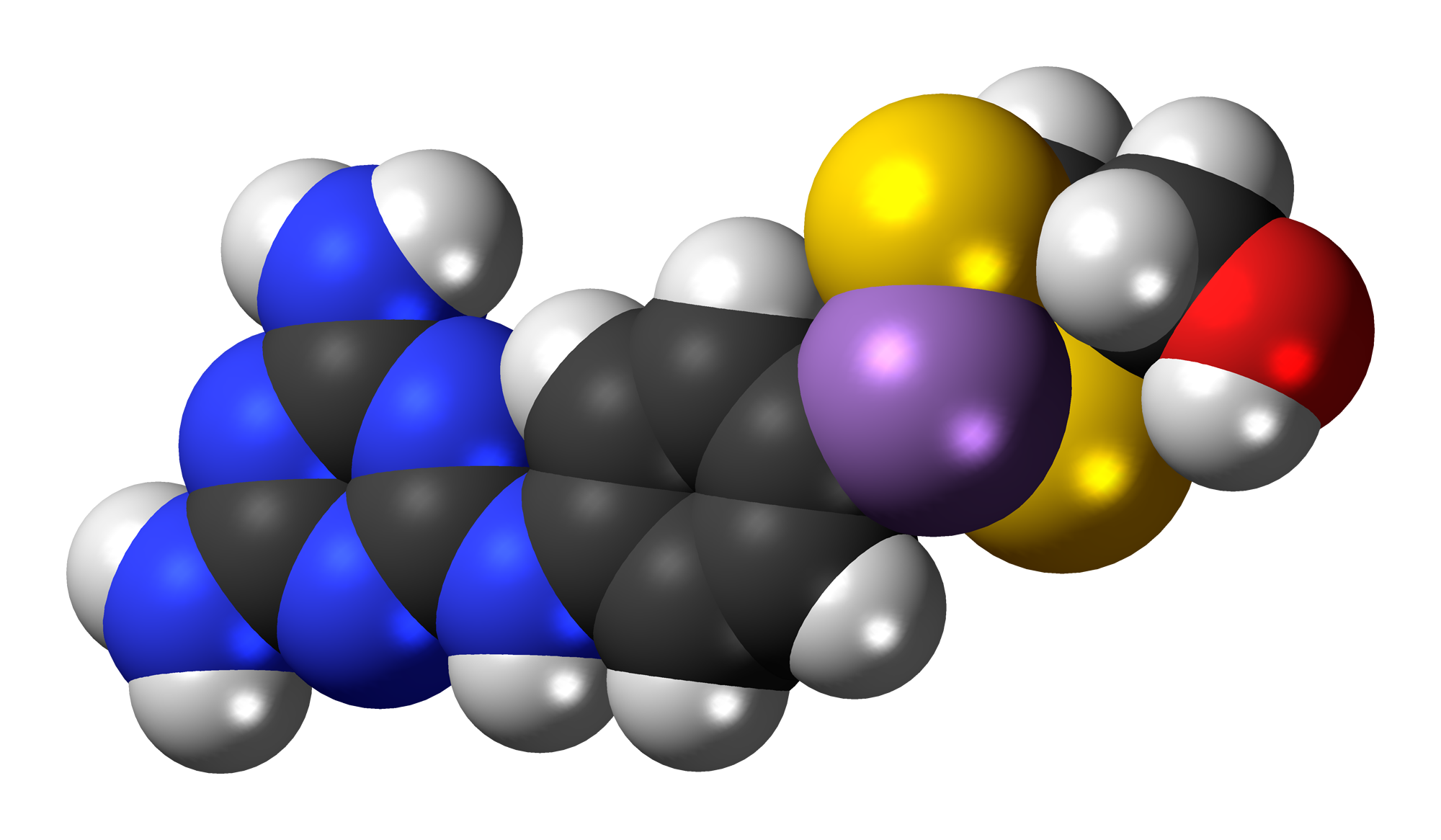
Melarsoprol is an arsenic-containing medication used for the treatment of sleeping sickness (African trypanosomiasis). It is specifically used for second-stage disease caused by Trypanosoma brucei rhodesiense when the central nervous system is involved. For Trypanosoma brucei gambiense, eflornithine or fexinidazole is usually preferred. It is effective in about 95% of people. It is given by injection and is known by patients as "fire in the veins".
Melarsoprol has a high number of side effects. Common side effects include brain dysfunction, numbness, rashes, and kidney and liver problems. About 1–5% of people die during treatment, although this is tolerated due to sleeping sickness itself having a practically 100% mortality rate when untreated. In those with glucose-6-phosphate dehydrogenase (G6PD) deficiency, red blood cell breakdown may occur. It has not been studied in pregnancy. While its mechanism of action is not fully understood, its covalent binding to trypanothione to form the toxic Mel T complex is thought to play a large role.
Melarsoprol has been used medically since 1949. It is on the World Health Organization's List of Essential Medicines. In regions of the world where the disease is common, melarsoprol is provided for free by the World Health Organization. It is not commercially available in Canada or the United States. In the United States, it may be obtained from the Centers for Disease Control and Prevention, while in Canada it is available from Health Canada.
People diagnosed with trypanosome-caused disease should be treated with an anti-trypanosomal. Treatment is based on stage, 1 or 2, and parasite, T. b. rhodesiense or T. b. gambiense. In stage 1 disease, trypanosomes are present only in the peripheral circulation. In stage 2 disease, trypanosomes have crossed the blood-brain barrier and are present in the central nervous system.
The following are considerable treatment options:
Melarsoprol is a treatment used during the second stage of the disease. So far, it is the only treatment available for late-stage T. b. rhodesiense.
Due to high toxicity, melarsoprol is reserved only for the most dangerous cases. Other agents associated with lower toxicity levels are used during stage 1 of the disease. The approval of the nifurtimox-eflornithine combination therapy (NECT) in 2009 for the treatment of T. b. gambiense limited the use of melarsoprol to the treatment of second-stage T. b. rhodesiense.
Failure rates of 27% in certain African countries have been reported. This was caused by both drug resistance and additional mechanisms that have not yet been elucidated. Resistance is likely due to transport problems associated with the P2 transporter, an adenine-adenosine transporter. Resistance can occur with point mutations within this transporter. Resistance has been present since the 1970s.
Melarsoprol
Melarsoprol is an arsenic-containing medication used for the treatment of sleeping sickness (African trypanosomiasis). It is specifically used for second-stage disease caused by Trypanosoma brucei rhodesiense when the central nervous system is involved. For Trypanosoma brucei gambiense, eflornithine or fexinidazole is usually preferred. It is effective in about 95% of people. It is given by injection and is known by patients as "fire in the veins".
Melarsoprol has a high number of side effects. Common side effects include brain dysfunction, numbness, rashes, and kidney and liver problems. About 1–5% of people die during treatment, although this is tolerated due to sleeping sickness itself having a practically 100% mortality rate when untreated. In those with glucose-6-phosphate dehydrogenase (G6PD) deficiency, red blood cell breakdown may occur. It has not been studied in pregnancy. While its mechanism of action is not fully understood, its covalent binding to trypanothione to form the toxic Mel T complex is thought to play a large role.
Melarsoprol has been used medically since 1949. It is on the World Health Organization's List of Essential Medicines. In regions of the world where the disease is common, melarsoprol is provided for free by the World Health Organization. It is not commercially available in Canada or the United States. In the United States, it may be obtained from the Centers for Disease Control and Prevention, while in Canada it is available from Health Canada.
People diagnosed with trypanosome-caused disease should be treated with an anti-trypanosomal. Treatment is based on stage, 1 or 2, and parasite, T. b. rhodesiense or T. b. gambiense. In stage 1 disease, trypanosomes are present only in the peripheral circulation. In stage 2 disease, trypanosomes have crossed the blood-brain barrier and are present in the central nervous system.
The following are considerable treatment options:
Melarsoprol is a treatment used during the second stage of the disease. So far, it is the only treatment available for late-stage T. b. rhodesiense.
Due to high toxicity, melarsoprol is reserved only for the most dangerous cases. Other agents associated with lower toxicity levels are used during stage 1 of the disease. The approval of the nifurtimox-eflornithine combination therapy (NECT) in 2009 for the treatment of T. b. gambiense limited the use of melarsoprol to the treatment of second-stage T. b. rhodesiense.
Failure rates of 27% in certain African countries have been reported. This was caused by both drug resistance and additional mechanisms that have not yet been elucidated. Resistance is likely due to transport problems associated with the P2 transporter, an adenine-adenosine transporter. Resistance can occur with point mutations within this transporter. Resistance has been present since the 1970s.
Recent media
Recent media