
Recent from talks
Mendip Rail
Knowledge base stats:
Talk channels stats:
Members stats:
Mendip Rail
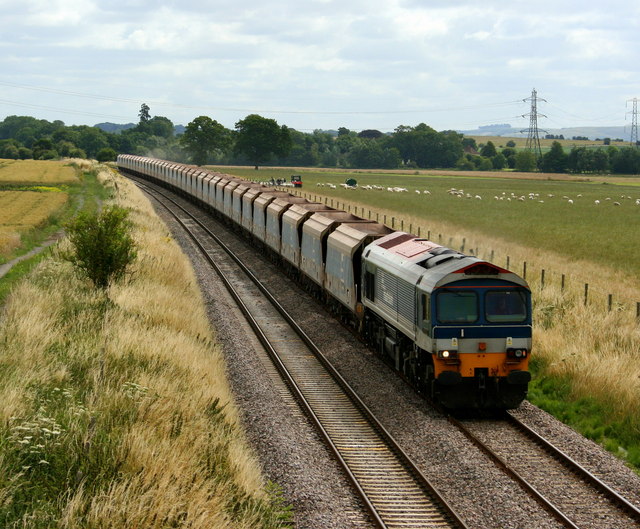
Mendip Rail Ltd is an independent freight operating railway company in Great Britain. It is a joint venture composed of the rail-operation divisions of Aggregate Industries (formerly Foster Yeoman) and Hanson Aggregates (previously ARC).
The company operates aggregate trains from the quarries of the Mendip Hills in South-West England, to London and South-East England. The Foster Yeoman quarries are at Torr Works and Dulcote Quarry, while Hanson has plants at Batts Combe Quarry and Whatley Quarry.
The company operates four Class 59/0 diesel locomotives owned by Aggregate Industries and four Class 59/1 locomotives owned by Hanson. In addition, two SW1001 Switchers are owned and operated at Whatley and Merehead quarries. It owns Merehead Traction Maintenance Depot (Merehead TMD) where the eight locomotives are allocated. They can also be seen at Hither Green TMD or Eastleigh Works where they receive heavy maintenance.
Foster Yeoman purchased its own fleet of 140 12-ton wagons in 1923, to take advantage of the fact that the Great Western Railway line ran adjacent to Dulcote Quarry. When the Torr Works opened in the 1960s, a rail terminal – named Merehead after the old quarry – was constructed to support the new quarry and was opened in August 1970, served by a spur from the East Somerset branch line which joins the main line at Witham. Further expansion was soon needed, with a chord being added between the terminal and the branch line in 1973.
British Rail shunting and mainline locomotives were used initially, but in 1972 Foster Yeoman bought the first of several Class 08 shunting engines. The company also has a General Motors EMD SW1001 switching locomotive which was purchased in 1980.
As a result of poor reliability of the various locomotives used by British Rail to haul stone trains from the West Country (with availability of the Class 56 locomotives from May 1984 as low as 30%, and only 60% of trains running on time), Foster Yeoman began negotiations with British Rail to improve service. Having already supplied its own wagons (with a reliability level of 96%) Foster Yeoman suggested to British Rail that it could operate its own locomotives, which would be the first privately owned engines to run on British rail tracks. British Rail's problem was the hard tie-in and control of the rail unions, but nevertheless BR accepted the principle.
Foster Yeoman issued a tender document which requested 95% reliability. General Motors' bid was ultimately successful, in particular because their proposed design, derived from the EMD SD40-2, was equipped with the well-proven Super Series creep control, which allows superior traction at very low speeds. This, it was found, would enable a single locomotive to haul Foster Yeoman's 4,300 tonne stone trains, whilst two Class 56 or Class 58 engines would be needed to move the same load. This enabled Foster Yeoman to reduce its requirement from the original six locomotives to four.
The contract with General Motors was signed in November 1984 and the new locomotives, built at the GM plant in La Grange, Illinois, were shipped across the Atlantic in January 1986. The JT26CW-SS, newly designated as British Rail Class 59/0, had a cab layout taken from the Class 58, to make driver assimilation easier, and to meet the British loading gauge a considerable amount of redesign work and various compromises were required from the original GM prototype. Once in the United Kingdom, further tests were undertaken before Foster Yeoman's new locomotives entered service in February 1986. They were officially named in a ceremony at Merehead on 28 June 1986.
Hub AI
Mendip Rail AI simulator
(@Mendip Rail_simulator)
Mendip Rail
Mendip Rail Ltd is an independent freight operating railway company in Great Britain. It is a joint venture composed of the rail-operation divisions of Aggregate Industries (formerly Foster Yeoman) and Hanson Aggregates (previously ARC).
The company operates aggregate trains from the quarries of the Mendip Hills in South-West England, to London and South-East England. The Foster Yeoman quarries are at Torr Works and Dulcote Quarry, while Hanson has plants at Batts Combe Quarry and Whatley Quarry.
The company operates four Class 59/0 diesel locomotives owned by Aggregate Industries and four Class 59/1 locomotives owned by Hanson. In addition, two SW1001 Switchers are owned and operated at Whatley and Merehead quarries. It owns Merehead Traction Maintenance Depot (Merehead TMD) where the eight locomotives are allocated. They can also be seen at Hither Green TMD or Eastleigh Works where they receive heavy maintenance.
Foster Yeoman purchased its own fleet of 140 12-ton wagons in 1923, to take advantage of the fact that the Great Western Railway line ran adjacent to Dulcote Quarry. When the Torr Works opened in the 1960s, a rail terminal – named Merehead after the old quarry – was constructed to support the new quarry and was opened in August 1970, served by a spur from the East Somerset branch line which joins the main line at Witham. Further expansion was soon needed, with a chord being added between the terminal and the branch line in 1973.
British Rail shunting and mainline locomotives were used initially, but in 1972 Foster Yeoman bought the first of several Class 08 shunting engines. The company also has a General Motors EMD SW1001 switching locomotive which was purchased in 1980.
As a result of poor reliability of the various locomotives used by British Rail to haul stone trains from the West Country (with availability of the Class 56 locomotives from May 1984 as low as 30%, and only 60% of trains running on time), Foster Yeoman began negotiations with British Rail to improve service. Having already supplied its own wagons (with a reliability level of 96%) Foster Yeoman suggested to British Rail that it could operate its own locomotives, which would be the first privately owned engines to run on British rail tracks. British Rail's problem was the hard tie-in and control of the rail unions, but nevertheless BR accepted the principle.
Foster Yeoman issued a tender document which requested 95% reliability. General Motors' bid was ultimately successful, in particular because their proposed design, derived from the EMD SD40-2, was equipped with the well-proven Super Series creep control, which allows superior traction at very low speeds. This, it was found, would enable a single locomotive to haul Foster Yeoman's 4,300 tonne stone trains, whilst two Class 56 or Class 58 engines would be needed to move the same load. This enabled Foster Yeoman to reduce its requirement from the original six locomotives to four.
The contract with General Motors was signed in November 1984 and the new locomotives, built at the GM plant in La Grange, Illinois, were shipped across the Atlantic in January 1986. The JT26CW-SS, newly designated as British Rail Class 59/0, had a cab layout taken from the Class 58, to make driver assimilation easier, and to meet the British loading gauge a considerable amount of redesign work and various compromises were required from the original GM prototype. Once in the United Kingdom, further tests were undertaken before Foster Yeoman's new locomotives entered service in February 1986. They were officially named in a ceremony at Merehead on 28 June 1986.
Recent media