Hubbry Logo
EMD SW1001EMD SW1001Main
Open search
EMD SW1001
Community hub
EMD SW1001
logo
8 pages, 0 posts
0 subscribers
Be the first to start a discussion here.
EMD SW1001
EMD SW1001
from Wikipedia
EMD SW1001
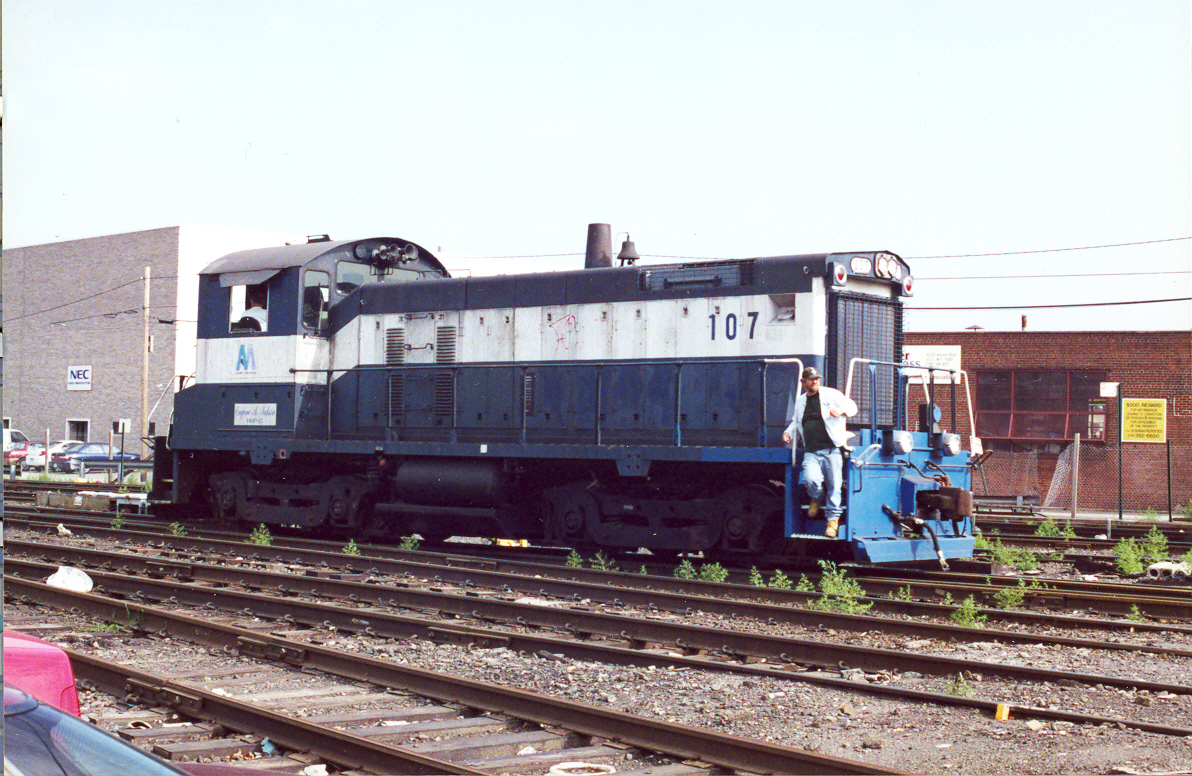
LIRR Number 107 in operation.
Type and origin
Power typeDiesel-electric
BuilderGeneral Motors Electro-Motive Division
ModelSW1001
Build dateSeptember 1968 – June 1986
Total produced230
Specifications
Configuration:
 • AARB-B
Gauge4 ft 8+12 in (1,435 mm) standard gauge
Prime moverEMD 645E
Engine typeV8 Diesel engine
Cylinders8
Performance figures
Power output1,000 hp (750 kW)
Career
LocaleUS (152), Canada (4), Guinea (5), Korea (28), Mexico (17), Morocco (18), Saudi Arabia (5), UK (1)

The EMD SW1001 is a 1,000-horsepower (750 kW) diesel switcher locomotive built by General Motors' Electro-Motive Division between September 1968 and June 1986.[1] A total of 230 were constructed, mainly for North American railroads and industrial operations.

The SW1001 was developed because EMD's SW1000 model had proved unpopular among industrial railroad customers, as the heights of its walkway and cab eaves were much greater than those of earlier EMD switcher models. The overall height was similar, but the SW1000's roof was much flatter in curvature. Industrial railroads that only operated switchers often had facilities designed to the proportions of EMD's earlier switchers.[1]

The SW1001, in essence, placed the hood and powertrain of the SW1000 with the underframe and cab of the earlier SW1200. The EMD 645-series diesel engine had a deeper crankcase and oil pan than the SW1200's EMD 567-series engine. The engine had to be mounted on risers for sufficient clearance, raising the whole hood about 6 in (152 mm) above the walkway compared to the SW1000, and requiring a spacer under the hood. The cab was similar to that of the SW1200, but not identical; it is longer, and has a different window arrangement. The SW1001 uses the same pilot plates as the SW1000; given the lower frame height, these protrude above the walkway deck height, giving the most obvious SW1001 spotting feature.[1]

Export models

[edit]

The SW1001 locomotive type was used in a number of countries outside the USA: in the Americas four units were bought by Canadian businesses; two by Saskatchewan Power and two by the National Harbours Board.[2] 18 by companies in Mexico: 12 by AHMSA, 3 by Lazaro Cardenas Steel (ArcelorMittal), and 3 by Pemex.[2]

In Africa five were supplied to the Boke project in Guinea in the early 1970s and[2] 18 were acquired by the railways of Morocco (ONCF) in 1982 as type DI 500.[3] In Asia the Korean National Railway acquired 28 between 1969 and 1971.[2]

One was acquired in 1980 by Foster Yeoman (vehicle code Y44),[4] and another by Hanson Aggregates in 2000[5] both for use on quarry industrial sites in the England. They are based at Whatley Quarry and Merehead Quarry, both part of Mendip Rail operations.

Five were bought for the government railways of Saudi Arabia in 1981.[2]

Additionally 60 variants with a redesigned cab were built under license as the Renfe Class 310 for the railways of Spain between 1989 and 1991.

EMD

[edit]

(Total Built = 142)

Railroad Quantity Road numbers Date Built
Alabama By-Products Corporation 1 1000 8/1971
Aliquippa & Southern 3 1000-1002 2/1973-3/1975
American Steel Foundries 2 9G9-9G10 6/1979-7/1979
Amoco Oil 1 SE3 12/1978
Armco Steel 24 E150-E169, 1-18-38-1-18-40, 1215 10/1974-6/1982
Birmingham Southern 8 18-19, 220-225 5/1973-10/1974
Champion International 1 06056 7/1979
Chicago Short Line 2 28-29 9/1974
Coors Brewing 1 C998 12/1980
Corinth & Counce Railroad 3 1003-1005 10/1974-5/1981
Cuyahoga Valley 1 1051 2/1973
Detroit Edison 1 217 9/1968
Dow Chemical 5 1001-1003, 1008-1009 12/1980-4/1981
East Cooper & Berkeley 2 2001-2002 12/1977
Electro-Motive (Demonstrator) 1 117 12/1979
Elgin, Joliet & Eastern Railway 2 444-445 8/1971
Ford Motor Company 10 10014-10023 10/1968-12/1975
Galveston Wharves 5 301-305 10/1975-7/1980
General Motors, Central Foundry Division 1 1971 8/1971
General Motors, Chevrolet Motor Division 1 96 5/1972
Indianapolis Power & Light 1 No Number 3/1982
Inland Steel 2 126-127 3/1976
Interlake Steel 2 17-18 10/1974-11/1974
Intermountain Power 1 1 4/1985
Lake Terminal Railroad 1 1021 10/1968
Long Island Railroad 8 100-107 3/1977
Monongahela Connecting Railroad 6 420-425 2/1970-3/1976
New Haven Trap Rock 1 7357 7/1976
Newburgh & South Shore 5 1018-1022 2/1970-4/1975
Northwestern Steel & Wire 3 2-4 5/1981
Olin Chemical 1 1 6/1982
Public Service Company Of Colorado 1 15-1 11/1973
Reading Company 15 2601-2615 11/1973-12/1973
River Terminal Railway 8 101-108 9/1968-12/1978
St Joseph Minerals Company 1 1004 8/1974
Savannah State Docks 2 1001-1002 4/1978
South Carolina Public Railways 1 1001 4-1975
Texas Company 1 24 1/1976
U.S. Steel, Gary Works 3 88-90 3/1970-1/1971
Union Railroad 3 101-103 3/1976

GMD

[edit]

(Total Built = 4)

Railroad Quantity Road numbers Date Built
National Harbours Board 2 7601-7602 7/1976
Saskatchewan Power 2 1001-1002 11/1978

Export

[edit]

(Total Built = 70)

Railroad Quantity Road numbers Date Built
Altos Hornos (Mexico) 9 142, 151-156, 164-165 8/1974-12/1980
Boke Project (Guinea) 5 201-205 3/1972-10/1974
Foster Yeoman (Great Britain) 1 44 12/1980
Korean National Railroad (Korea) 28 2101-2128 3/1969-1/1971
Lazaro Cardenas Steel (Mexico) 1 No Number 1/1976
Mexican Petroleum (Mexico) 3 5, 24-25 8/1980-6/1986, Units 24-25 were built in 8/1980, Unit No. 5 was built in 6/1986.
Moroccan Railways (Morocco) 18 DI501-DI518 10/1982-9/1984
Saudi Government Railway (Saudi Arabia) 5 1022-1026 11/1981

See also

[edit]

References

[edit]
[edit]
Revisions and contributorsEdit on WikipediaRead on Wikipedia
from Grokipedia
The EMD SW1001 is a 1,000-horsepower (750 kW) diesel-electric manufactured by the Electro-Motive Division (EMD) of from September 1968 to June 1986. Designed primarily for yard switching and industrial operations, it utilized an 8-cylinder EMD 645E prime mover paired with a D36 generator, delivering a top speed of 65 mph and a starting of 57,500 pounds. Its B-B and compact dimensions—44 feet 8 inches in length and weighing 230,000 pounds—made it suitable for tight spaces. A key distinguishing feature from the earlier SW1000 was the SW1001's lowered cab roof (14 feet 3 inches high) and frame, adapted from the SW1200 design to provide better clearance under low overhead structures common in factories and steel mills. Approximately 230 units were built, with the majority serving North American railroads and private industries, while others were exported to locations including , , , and several African nations. Prominent domestic users included the Reading Company, which acquired 25 units in late 1973 for hump yard and local service (later inherited by Conrail as numbers 9400–9424), as well as industrial firms such as the Detroit Edison Company, Ford Motor Company, and Armco Steel. The model's straightforward construction and robust performance ensured its longevity, with numerous examples still operational in switching roles as of the 2020s.

History

Development

In the mid-1960s, Electro-Motive Division (EMD) sought to modernize its switcher locomotive offerings to meet evolving industrial and railroad needs, transitioning from older 567-series engines to the more efficient 645-series prime movers. The SW1000, introduced in June 1966, marked EMD's first 8-cylinder switcher rated at 1,000 horsepower, replacing earlier low-horsepower models like the SW600 and SW900 in the lineup. This model provided a compact, reliable option for yard switching, emphasizing durability and ease of maintenance in confined spaces. Despite its technical advancements, the SW1000 encountered resistance from industrial customers due to its elevated and cab height of 15 feet, which restricted its use in facilities with low overhead clearances, such as factories and short-line operations. To address these limitations, EMD developed the SW1001 as a direct response, retaining the SW1000's power output while adapting components for broader market compatibility. This evolution reflected EMD's strategy to refine switcher designs based on user feedback, prioritizing versatility in diverse operational environments. Key design decisions for the SW1001 included incorporating the lower-profile cab and underframe from the earlier SW1200 model, reducing the cab roof height to 14 feet 3 inches to accommodate restricted clearances without compromising interior space or visibility. The locomotive retained the SW1000's 8-645E engine, ensuring consistent 1,000-horsepower performance while benefiting from the 645-series' improved fuel efficiency and reliability over the 567-series. Cataloged in 1968—two years after the SW1000—the SW1001 entered production in September of that year, solidifying EMD's position in the switcher segment through targeted enhancements for efficiency in yard operations.

Production

The Electro-Motive Division (EMD) of General Motors manufactured the SW1001 at its primary facility in La Grange, Illinois, from September 1968 to June 1986, constructing a total of 230 units. A small number of units, approximately four, were assembled by the General Motors Diesel Division (GMDD) in London, Ontario, for specific North American and export customers. Production began with the first unit, serial number 33803, completed in September 1968 and delivered to the Detroit Edison Company as their demonstrator number 217. Early builds through the 1970s targeted domestic railroads and industrial users, exemplified by the Reading Company's order of 25 locomotives in late 1973 (order number 73623, serial numbers 73623-1 through 73623-25). Serial numbers for these initial units generally ranged from the low 33,000s to the mid-70,000s. In the , production continued at a slower pace with minor updates to enhance reliability, such as refined electrical components, while shifting focus toward orders; representative examples include serial numbers in the 78,000 to 85,000 range for international customers like Altos Hornos de México in 1978–1980. The final unit, serial number 858096-1, was built in June 1986 for Petróleos Mexicanos () as their number 5. The end of SW1001 production reflected broader industry trends, including a preference for higher-horsepower switchers like the 1,500 hp SW1500 introduced in and a declining market for specialized 1,000 hp models amid economic shifts in railroading.

Design

Prime mover and engine

The EMD SW1001 is powered by an EMD 8-645E prime mover, an eight-cylinder, with a displacement of 645 cubic inches per cylinder, featuring a bore of 9-1/16 inches and a stroke of 10 inches. This engine delivers 1,000 horsepower (746 kW) at RPM directly to the main generator for traction, optimized for the low-speed demands of switching operations. The fuel system employs a return-flow design with a single DC motor-driven gear pump supplying fuel from a 600-gallon tank, incorporating sight glasses and a relief valve for reliable operation. Unit injection provides precise fuel delivery, while the cooling system uses water-cooled cylinder liners and heads, oil-cooled pistons, a centrifugal , and fin-tube radiators with a 190-gallon capacity, ensuring efficient management during prolonged low-speed maneuvers typical of yard work. Maintenance is facilitated by the 645-series modular power assembly design, which allows for straightforward replacement of individual units—including heads, liners, and pistons—offering advantages in and reduced compared to the earlier 567-series s. Hinged engine hatches provide direct access to these components without major disassembly. Performance characteristics include torque curves tailored for speeds of 0-10 mph, enabling a maximum starting of 57,500 pounds at 25% wheel adhesion (or up to 69,000 pounds at 30% adhesion) and continuous of 42,000 pounds at 6.7 mph with a 62:15 gear ratio.

Electrical and control systems

The electrical system of the EMD SW1001 converts mechanical power from into electrical energy for , utilizing a main generator directly coupled to the via a flexible . This generator, an EMD D25 model, is self-ventilated and nominally rated at 600 V DC, delivering up to 1,000 horsepower continuously at engine speeds of 900 RPM under standard conditions (60°F air intake, 29.9 in. Hg ). The D25 steps down the voltage to supply to the traction motors, enabling efficient while maintaining compatibility with the locomotive's B-B configuration. Power is delivered to four EMD D77 series-wound, direct-current traction motors, one per axle, which are axle-hung with forced ventilation and roller-type armature bearings. These motors operate in a series-parallel arrangement, with the control system automatically transitioning from series to parallel configuration around 7-8 mph to optimize at higher speeds. A single engine-driven blower provides cooling air to all four motors via underframe ducts, ensuring reliable performance during switching operations. The operator control system features a standard EMD throttle with eight notches for graduated power application, integrated with a reverse lever and a selector switch for transition management, all housed in an electrical control cabinet behind the cab partition. Load regulation automatically adjusts main generator excitation to maintain consistent horsepower-to-tractive effort ratios across throttle positions, and optional dynamic braking capability uses the traction motors as generators to dissipate energy through grid resistors for enhanced retarding force without relying solely on air brakes. Auxiliary electrical systems are powered by a separate engine-driven DC auxiliary generator, which supplies current for control circuits, battery charging, headlights, and other cab functions. A 64-volt, 32-cell lead-acid battery with 284 ampere-hour capacity, located behind the cab, provides starting power and backup for low-voltage needs. The , rated at 254 cubic feet per minute, is also engine-driven and electrically controlled to maintain pressures of 130-140 psi. Safety interlocks are integrated into the electrical setup, including a dead-man's foot pedal that applies air brakes and sounds a warning whistle if released during operation, preventing unintended movement. Overspeed protection employs an electrical switch in the speed recorder to detect excessive wheel speeds, triggering engine shutdown or application as needed, while low pressure and high sensors in the control circuits automatically halt the engine to avert damage.

Frame, cab, and trucks

The frame of the EMD SW1001 is an all-welded underframe adapted from the SW1200 design, serving as the primary structural member supporting the hood, cab, and associated equipment, including welded draft gear pockets and center bearings for bolster integration. This construction provides a robust, low-profile chassis optimized for industrial switching, with combination jacking pads and cable sling points integral to the underframe at the front and rear bolsters for maintenance access. The overall length over coupler pulling faces measures 44 feet 8 inches, contributing to maneuverability in confined yard spaces. The cab features a fabricated steel structure with a lowered roof height of 14 feet 3 inches above the rail, significantly shorter than the SW1000's 15 feet, to navigate low-clearance facilities like tunnels and industrial buildings common on shortline and plant railroads. It incorporates a rounded roof profile similar to the SW1200 for enhanced overhead clearance while maintaining structural integrity, with a cab width of 10 feet to match the locomotive's overall dimensions of 10 feet 6.75 inches over grab irons. Inside, the cab provides a single-operator layout with the engineer's control station positioned to the left of the operator's seat, including throttle, reverse lever, and selector switch for precise handling; large sliding double-sash side windows, front and rear doors (including a main center rear door and front left walkway access), and a lined ceiling with perforated metal and insulation enhance visibility and comfort during extended yard duties. Two adjustable wall-mounted upholstered seats accommodate the operator and possibly a conductor, with multiple-unit control options available for synchronized operation of additional units from one cab. The trucks consist of two EMD four-wheel, pedestal-type steel units with integral side frames and two axle-hung traction motors each, configured in a B-B arrangement for balanced in switching service. Each has an 8-foot rigid and 40-inch heat-treated rolled or steel wheels with 5.5-inch tread width, enabling the to negotiate minimum curve radii of 100 feet for single-unit operation and supporting tight yard maneuvers. Suspension employs parallel double helical and semi-elliptic springs with adjustable height, mounted on forged equalizers over Timken Class F tapered roller journal bearings, rated for a maximum speed of 45 mph. The total weight is approximately 230,000 pounds, distributed evenly across the four axles at about 57,500 pounds each, with a low center of gravity facilitated by the shortened frame height to ensure stability during low-speed shunting; slight rearward bias is evident from 1/4-inch front and 1/2-inch rear side bearing clearances.

Operations and variants

Original model

The EMD SW1001 was a standard-gauge, four-axle diesel-electric rated at 1,000 horsepower, utilizing a B-B with 40-inch diameter wheels on rigid switcher trucks spaced 8 feet apart and truck centers of 22 feet. Overall dimensions included a length of 44 feet 8 inches over the coupler pulling faces, a width of 10 feet over the side sills, and a maximum height of 14 feet 3 inches above the rail, making it suitable for operations under restrictive clearances compared to its predecessor, the SW1000. The locomotive weighed approximately 230,000 pounds when fully loaded, with a starting of 57,500 pounds. Standard equipment on the original SW1001 included a 26-L air brake system with self-lapping valves, 10-inch by 6-inch double-acting brake cylinders, and a main reservoir capacity of 49,000 cubic inches, optimized for short-haul switching duties. Couplers were AAR Type E with a 6-1/4-inch by 8-inch shank mounted 34 inches above the rail, while the bell was positioned on the underframe ahead of the forward truck and the horn mounted on the cab roof for standard audible signaling. A 600-gallon was standard, though larger capacities up to 1,000 gallons were available as options for extended yard operations. Locomotives were typically delivered in the purchasing railroad's specified paint scheme, though early production units often featured EMD's builder's blue body with stripes and lettering for demonstrator or initial orders before custom application. Numbering followed the railroad's conventions, applied in or white on sides and long hood. The SW1001 was designed primarily for yard service and light road switching within 20 to 30 miles, with a recommended maximum speed of 45 mph and capability to negotiate curves down to 100-foot radius on a single unit; in typical switching operations averaged 2 to 3 miles per gallon, reflecting the efficient low-rpm operation of its 8-cylinder 645E engine. During production from 1968 to 1986, totaling 230 units.

Export adaptations

Out of the 230 EMD SW1001 locomotives produced between 1968 and 1986, approximately 79 units were exported outside the United States, including to Canada, Mexico, South Korea, Morocco, Saudi Arabia, Guinea, and the United Kingdom. Mexico received 18 units for industrial service, with deliveries to Altos Hornos de México (AHMSA) totaling 12 locomotives between 1974 and 1980, three to Lázaro Cárdenas Steel in 1976, and three to Petróleos Mexicanos (Pemex) in 1980 and 1986. The largest single export order was for 28 units to the Korean National Railroad (KNR), delivered in 1969 and 1971. Morocco acquired 18 units for the Office National des Chemins de Fer (ONCF) in 1982 and 1984, while Saudi Arabia received five for government railways in 1981, and Guinea obtained five for the Boké mining project in 1972 and 1974. Canada received four units. In the , a single SW1001 was supplied to Foster Yeoman in 1980 (numbered 44 and later named Western Yeoman II) for use at Merehead Quarry; this unit featured buffers and link (chain) couplers adapted for compatibility with British and wagons. The locomotive's wider dimensions compared to standard freight cars necessitated these coupling modifications to enable shunting operations on the quarry's internal network. A second unit, originally built for the Boké project in , was acquired second-hand by Hanson Aggregates in 2000 and used at Whatley Quarry.

Operators and preservation

North American operators

The EMD SW1001 saw limited adoption among Class I railroads in , with the emerging as the largest purchaser, acquiring 25 units numbered 2601–2625 in 1973 for yard switching duties in constrained clearances. These locomotives were integral to Reading's freight operations until the railroad's merger into in 1976, after which the units continued in similar roles under Conrail's numbering as 9400–9424. Southern later inherited a small number through the 1999 Conrail split, renumbering three ex-Reading units as 2100, 2102, and 2103, which remain in occasional yard and shop switching service as of 2025. Other Class I users included the Elgin, Joliet and Eastern with two units (444–445) for industrial plant switching and the with eight units (100–107) deployed in maintenance-of-way tasks from the early 1970s. Industrial operators formed the backbone of SW1001 adoption in the United States, favoring the model's low-profile cab for navigating tight factory environments. Armco Steel was a prominent buyer, purchasing 20 units (E-150 through E-169) between 1974 and 1981 primarily for its Middletown Works in , where they handled intra-plant car movements until the facility's decline in the . acquired 10 units (10014–10023) in the late 1970s for assembly plant rail operations, while U.S. Steel's obtained three (88–90) for similar steel mill switching. Dow Chemical also utilized five units (1001–1003, 1008–1009) at its facilities for chemical transport handling. In , four units went to private industrial firms, including in , supporting limited yard work without major Class I involvement. Overall, North American fleets totaled approximately 146 SW1001s, with 142 in the U.S. and four in , reflecting the model's niche appeal for short-haul switching rather than mainline service. From the through the , these locomotives excelled in Class I yard operations and shortline hauls, as well as industrial sidings, where their 1,000 hp rating suited low-speed maneuvers over short distances. By the , many units faced retirement due to non-compliance with EPA Tier 1 and later emissions standards introduced in 1998, prompting replacements with genset switchers or rebuilt compliant locomotives to reduce particulate and outputs. As of 2025, a handful persist in active secondary and industrial roles, particularly on shortlines and private tracks, underscoring their durability despite regulatory pressures.
Major North American OperatorsFleet SizeAcquisition YearsPrimary Role
(later /NS)251973Yard switching
Armco Steel201974–1981Plant car movements
10Late 1970sAssembly plant operations
8Early 1970sMaintenance-of-way
, 31970sSteel mill switching
Canadian industrials (e.g., )41970s–1980sYard work

International and preserved examples

The EMD SW1001 found limited export application beyond North America, primarily serving industrial and mining operations in select countries. In Mexico, 13 units were produced for key industrial users, including 9 for Altos Hornos de México (AHMSA) at numbers 142, 151–156, and 164–165, one for Lázaro Cárdenas Steel (later ArcelorMittal Lázaro Cárdenas) (serial #756104-1, possibly numbered 1), and three for Petróleos Mexicanos (Pemex) at numbers 5, 24–25; these locomotives, valued for their low hood design in clearance-restricted yards, continue active duty in switching tasks as of the early 2020s. In the United Kingdom, a single unit was delivered to the aggregates firm Foster Yeoman in 1971, numbered 44 and dubbed Western Yeoman II, where it handled internal shunting at rail-connected quarries before retirement. African deployments included five units to the Friguia bauxite mining project (now Boke project) in Guinea, numbered 201–205, supporting ore transport from 1979 onward, and 18 to the Office National des Chemins de Fer (ONCF) in Morocco, classified DI501–DI518 for yard and branchline service starting in 1980. Additional exports comprised 28 to the Korea National Railroad (#2101–2128, 1969–1971) and five to Saudi Arabia's Dammam–Riyadh line (#1022–1026, 1981), emphasizing the model's adaptability to diverse industrial needs. Preservation efforts for the SW1001 remain modest, with few units entering public collections due to their utilitarian industrial focus. One notable example is former Reading Railroad SW1001 No. 2613 (built November 1973, builder's number 73623-13), now Norfolk Southern No. 2103, preserved in operational condition as a shop switcher at the Juniata Locomotive Shop in , where it assists in maintenance operations. A handful of others reside in private collections, such as ex-industrial units maintained by rail enthusiasts for static display or occasional heritage runs, though no dedicated museum exhibits feature the model prominently. Restoration projects have centered on extending through component overhauls, including engine repowers with updated EMD 645-series variants for improved reliability and partial emissions compliance under Tier 0 standards; these rebuilds, often by specialized firms like , have enabled continued use on shortline and tourist operations without full replacement. As of 2025, numerous SW1001s persist in active industrial service globally, with concentrations in steel and oil sectors alongside scattered U.S. private fleets, underscoring their durability in low-speed switching environments.

References

Add your contribution
Related Hubs
User Avatar
No comments yet.