Hubbry Logo
Mercer MuseumMercer MuseumMain
Open search
Mercer Museum
Community hub
Mercer Museum
logo
8 pages, 0 posts
0 subscribers
Be the first to start a discussion here.
Mercer Museum
Mercer Museum
from Wikipedia

Mercer Museum
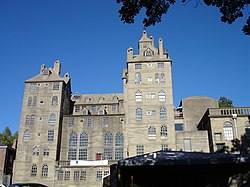
Mercer Museum in Doylestown, Pennsylvania
Mercer Museum is located in Pennsylvania
Mercer Museum
Mercer Museum is located in the United States
Mercer Museum
Location84 S. Pine St.,
Doylestown, Pennsylvania, U.S.
Coordinates40°18′28″N 75°7′38″W / 40.30778°N 75.12722°W / 40.30778; -75.12722
Built1904
ArchitectDr. Henry Mercer
Architectural styleColonial Revival
Part ofFonthill, Mercer Museum, and Moravian Pottery and Tile Works (ID85002366)
NRHP reference No.72001097[1]
Significant dates
Added to NRHPMarch 16, 1972[1]
Designated NHLDCPFebruary 4, 1985[2]

The Mercer Museum is a museum located in Doylestown, Pennsylvania. The Bucks County Historical Society operates the Mercer Museum, the Research Library, and Fonthill Castle, the former home of the museum's founder, archeologist Henry Chapman Mercer.

The museum was individually listed on the National Register of Historic Places in 1972,[1] and was later included in a National Historic Landmark District along with the Moravian Pottery and Tile Works and Fonthill. These three structures are the only poured-in-place concrete structures built by Mercer.[2]

History

[edit]
Sample of tile work from the on-site production facility in the Mercer Museum

Henry Mercer was a gentleman anthropologist. On a cruise up the Ruhr in early adulthood, Mercer was impressed by the eclipse of artisanal culture by industrial production, and resolved himself to preserving artifacts of preindustrial life.

During the late 19th and early 20th centuries, Mercer collected pre-industrial hand tools and other implements of the past. He believed that the story of human progress and accomplishments was told by the tools and objects that people used and saw these time-honored crafts slowly disappearing from memory.

Mercer personally designed plans for a museum to house his collection, six stories tall and cast of poured-in-place concrete. Mercer's museum was completed in 1916.

In addition to tools, it displays furnishings of early America, carriages, stove plates, a gallows, antique fire engines, a whaleboat, and the Lenape Stone. The Mercer Museum Library, which houses the Bucks County Historical Society's archive of historical research materials, is located on its third floor.

In June 2011, construction was completed on a new, extensive visitors center at the front of the museum.

Construction

[edit]

The museum is one of three poured-in-place concrete structures built by Mercer. The others include his home Fonthill and the Moravian Pottery and Tile Works, both of which are located one mile from the museum.

Mercer decided to build with concrete after the Great Boston Fire of 1872 destroyed his aunt's prized collection of medieval armor, which had been stored in wooden structures. He did not want his own collections to suffer the same fate.

Locals mocked his choice of building materials, but on completion of the museum, he lit a bonfire on its roof to prove that it was fireproof.[3] Mercer's museum was an early demonstration of rebar-reinforced concrete as a structural material.

[edit]

References

[edit]
[edit]
Revisions and contributorsEdit on WikipediaRead on Wikipedia
from Grokipedia
The Mercer Museum is a historic located in , founded in 1916 by Henry Chapman Mercer to preserve and display an extensive collection of pre-industrial American artifacts, reflecting everyday life, trades, and crafts before the widespread adoption of machine-made goods. Housed in a distinctive six-story castle that Mercer designed and built between 1912 and 1916, the museum features over 40,000 items, including hand tools, horse-drawn vehicles, and large-scale objects like a and a , organized thematically to showcase early American ingenuity and labor. Henry Chapman Mercer (1856–1930), a multifaceted scholar known as a , , and ceramicist, began amassing his collection in the late , driven by concerns over the rapid industrialization that threatened to erase traditional artisanal practices. By the time of the museum's opening, Mercer's holdings numbered nearly 30,000 objects, which he meticulously categorized and displayed in a structure inspired by medieval European castles but constructed using innovative techniques to ensure durability. The museum's central atrium serves as a dramatic showcase for oversized artifacts, while surrounding alcoves and rooms delve into specific categories such as healing arts, tinsmithing, and , providing visitors with an immersive narrative of pre-1850 American folkways and technological development. Recognized as a since 1985 and accredited by the , the Mercer Museum has evolved through expansions, including a $12.5 million wing added in that enhanced exhibition space and visitor amenities, drawing over 65,000 annual visitors. It forms part of the broader Mercer Museum & Fonthill Castle complex, where Fonthill—Mercer's nearby home built between 1908 and 1912—complements the museum by highlighting his personal collections of tiles and prints. The institution continues to offer interactive programs, changing exhibits, and educational initiatives that emphasize the cultural and of its unparalleled assemblage, considered the most comprehensive of its kind in the United States.

History and Founding

Founding and Early Development

Henry Chapman Mercer (1856–1930), an , antiquarian, and pioneering tile maker, initiated his collection of pre-industrial American artifacts around 1897, driven by apprehensions that rapid industrialization would obliterate the tools and crafts representing traditional American life. Influenced by the Arts and Crafts movement and his earlier role as curator of archaeology at the Museum from 1894 to 1897, Mercer sought to preserve these objects as vital links to Pennsylvania's historical and cultural heritage, amassing items that documented everyday pre-1850 folkways and technological practices. His efforts reflected a broader commitment to safeguarding "above-ground" against the encroaching obsolescence caused by machine-age production. By 1907, as his collection expanded significantly, Mercer resolved to construct a dedicated to ensure its public accessibility and enduring protection, acquiring suitable land in his hometown of Doylestown, . This decision was bolstered by an inheritance that enabled such ambitious projects, and he envisioned the structure as a symbolic of permanence, inspired by the robust, medieval European castles he had encountered during his travels. Commencing in 1908, Mercer personally drafted initial sketches and architectural plans for the museum, prioritizing a monumental, fireproof design capable of accommodating and showcasing his burgeoning assemblage of over 25,000 objects without risk of loss to the era's frequent fires. This conceptual phase aligned closely with his concurrent development of Fonthill Castle, built as his residence from 1908 to 1912 on adjacent Doylestown property.

Artifact Acquisition and Opening

Henry Chapman Mercer initiated the acquisition of artifacts for what would become the Mercer Museum in 1897, driven by a concern over the rapid disappearance of handmade objects amid industrialization. That year, he mounted an initial public exhibit of his early finds at the Bucks County Courthouse. Over the subsequent two decades, through 1916, he amassed approximately 30,000 items representing pre-1850 American tools, crafts, and daily implements, emphasizing the preservation of pre-industrial . Mercer's methodical approach involved diverse strategies, including direct purchases—often securing "penny lots" at local auctions—soliciting donations from regional collectors and families, and conducting extensive fieldwork by scouring barns, garrets, junk piles, and rural sites across the Delaware Valley and beyond. These efforts not only gathered physical objects but also incorporated Mercer's documentation of oral histories from craftspeople, ensuring contextual understanding of the artifacts' uses. The culmination of this collection-building occurred with the museum's dedication on June 17, 1916, when the completed concrete structure in , first welcomed visitors to view the assembled artifacts. Initial public access was structured around guided tours to navigate the expansive, multi-level displays, allowing visitors to appreciate the scale and thematic organization of the holdings. Funding for the acquisition and development relied heavily on Mercer's personal wealth, including a substantial received in 1905, which supported both fieldwork expeditions and the project's overall costs amid limited external backing. Following Mercer's death on March 2, 1930, the Bucks County Historical Society assumed responsibility for the , having received the , its collection, and an endowment through his bequest, thereby ensuring its continued operation and maintenance.

Architecture and Construction

Design Innovations

Henry Chapman Mercer, an and tile maker without formal architectural training, drew inspiration from medieval European castles and the American Colonial Revival style to create the Mercer Museum as a monumental structure evoking both historical permanence and playful whimsy. He envisioned a six-story edifice with 55 exhibit rooms and alcoves, featuring irregular towers, battlements, and an asymmetrical silhouette that mimicked the rugged fortresses of Europe's past while nodding to early American . This design choice symbolized the enduring legacy of pre-industrial American crafts, transforming the museum into a tangible embodiment of Mercer's fascination with and history. At the heart of the museum's innovative interior layout is the "Great Court," a soaring central atrium that penetrates all six floors, facilitating vertical displays of oversized artifacts and flooding the space with natural light through expansive skylights. This open, multi-level void not only maximizes visibility across exhibits but also creates a dramatic, immersive environment that encourages visitors to perceive everyday tools and objects in a grand, contextual scale. Surrounding the atrium, a of alcoves, niches, and winding corridors organizes the collection thematically, blending functionality with an exploratory, castle-like flow. Mercer's design incorporated symbolic elements such as gargoyles and intricate decorative motifs, which reflect his deep interest in mythological and historical symbolism, infusing the structure with a whimsical yet scholarly character. These handcrafted details, executed in the innovative poured-in-place medium, underscore his experimental approach, prioritizing aesthetic storytelling over conventional blueprints. By eschewing traditional architectural plans in favor of on-site sketches and improvisations, Mercer ensured the museum's form organically evolved to house his vast collection of over 40,000 artifacts.

Building Process and Materials

Construction of the Mercer Museum began in 1913 and was completed in 1916, spanning three years of intensive labor under the direct supervision of Henry Chapman Mercer himself. Without the involvement of professional engineers or architects, Mercer guided a small crew of eight local day laborers, supplemented by a horse named Lucy that helped hoist materials, in an organic building process that relied on sketches rather than formal blueprints. The workers, initially unfamiliar with concrete techniques, learned Mercer's methods on-site, mixing and pouring the material by hand with minimal machinery until a cement mixer was introduced toward the end. The museum's primary material was poured-in-place , a pioneering choice for such a large-scale structure at the time, reinforced with iron rods, wire mesh, and hollow pipes to enhance strength. Mercer selected this medium for its fireproof qualities and resistance to decay, directly inspired by the , which had destroyed his aunt's collection of medieval armor and prompted his commitment to safeguarding artifacts in an indestructible building. Wooden forms were employed to create the building's intricate shapes, including towers, turrets, and curved walls, allowing for the organic, castle-like form that emerged progressively from the inside out. The resulting structure reaches 115 feet in height with a base of 97 by 71 feet across six stories. Utilities were integrated into a self-contained system designed by Mercer, including , heating, and , which were installed during to ensure the building's functionality as a secure repository for his collections. This comprehensive approach highlighted Mercer's hands-on innovation, blending practicality with the durability needed for long-term preservation.

Collections and Exhibits

Scope and Organization

The Mercer Museum's core collection focuses on pre-1850 American pre-industrial artifacts, encompassing tools, implements, and objects that illustrate and work before widespread industrialization. This encyclopedic assemblage includes nearly 50,000 objects representing more than 60 early American trades and crafts, such as blacksmithing, , and tinsmithing. Notable examples range from practical tools like blacksmithing anvils and hammers to larger items including carriages, a , a used for executions in Bucks County, and the Lenape Stone, a controversial prehistoric artifact depicting a Native American hunting scene. Rather than arranging artifacts chronologically, the collections are organized thematically by function and aspect of , emphasizing how people lived, worked, and interacted with their environment. Key categories include , with tools like plows, scythes, and threshing machines; transportation, featuring horse-drawn vehicles, harnesses, and early wheeled contraptions; domestic life, encompassing household implements for cooking, , and cleaning; and public safety, highlighted by early equipment and devices. This thematic approach, devised by founder Henry Chapman Mercer, groups related objects to convey broader narratives of technological and social development in America. Special holdings within the collection underscore unique aspects of American , such as a significant array of early American plates—ornamental cast-iron panels depicting historical scenes—and an assortment of fire engines from the 18th and 19th centuries. Complementing the artifacts is the museum's on the third floor, which houses over 20,000 volumes, along with archives and images, dedicated to the of crafts, trades, Bucks County , and pre-industrial technologies.

Unique Display Features

The Mercer Museum distinguishes itself through Henry Chapman Mercer's unconventional presentation of pre-industrial artifacts, eschewing traditional glass cases in favor of open, integrated displays that mount objects directly on walls, ceilings, and balconies across its multi-level structure. This case-free approach, implemented during the museum's construction from 1912 to 1916, allows visitors unobstructed close-up access to over 40,000 items, fostering a tactile and exploratory experience that highlights the craftsmanship of early American tools. Central to this philosophy is the creation of immersive "period rooms" that recreate historical workshops, homes, and trades, where artifacts are arranged to simulate functional environments such as shops or dairies, drawing from Mercer's thematic organization of the collection by daily life activities. These setups, preserved in 24 of the museum's 55 rooms as originally installed, immerse visitors in the pre-1820 era by blending objects into architectural niches and alcoves, evoking the abundance and practicality of everyday labor without artificial separation. The six-story Great Court serves as the architectural and display centerpiece, featuring vertical organization where large-scale artifacts—like whale boats, stagecoaches, and Conestoga wagons—are hung from overhead rails or positioned on encircling balconies and catwalks. This suspended arrangement not only maximizes space in the castle's atrium but also encourages multi-perspective viewing, as items appear from various angles across levels, enhancing a sense of historical depth and the tools' integral role in . By avoiding modern barriers, the displays maintain Mercer's original intent of raw accessibility, promoting an unfiltered immersion in the artifacts' context.

Significance and Legacy

Historical Recognition

The Mercer Museum was individually listed on the in 1972, recognizing its architectural significance and role in preserving early American . This listing highlighted the museum's unique poured-in-place structure, constructed between 1912 and 1916, as an early and innovative example of the material's use in large-scale, fireproof . In 1985, the museum was designated a as part of the Fonthill, Mercer Museum, and . This federal recognition, administered by the U.S. Department of the Interior, underscored the district's national importance in , , and industry, particularly Henry Chapman Mercer's pioneering advancements in concrete construction techniques that influenced subsequent modernist designs. The designation emphasized the museum's labyrinthine layout and monumental scale as a deliberate reflection of pre-industrial American life. The Mercer Museum has been acknowledged as a pivotal institution for the preservation of American folk art and industrial , housing one of the largest collections of pre-1900 tools and artifacts that document everyday crafts and trades. Its cultural impact extends to features in scholarly publications and media, such as architectural analyses in periodicals that praise its role in early 20th-century museum innovation, and appearances in documentaries exploring American heritage sites.

Modern Operations and Preservation

Since 1930, the Mercer Museum has been operated by the Bucks County Historical Society, which manages its daily functions, collections, and programs while maintaining the site's historical integrity. A significant modernization effort culminated in the 2011 opening of a new wing, funded by a $12.5 million capital campaign, which added 13,000 square feet including a visitors center, exhibition gallery, and educational spaces to improve and visitor orientation. This addition enhanced compliance with contemporary museum standards for and program delivery without altering the original concrete structure. In recent years, the has prioritized collections care through initiatives outlined in its 2022-2025 Strategic Plan, including improvements to environmental controls for storage and exhibition areas to protect the over 40,000 artifacts from deterioration. efforts have expanded access to archives via a dedicated lab offering services for photographs and documents, alongside free public access to research databases like Ancestry and Fold3 since 2022. Exhibitions adhere to modern interpretive practices, with one major rotating show annually in the changing gallery, balancing contemporary presentation techniques with Henry Mercer's original vision of immersive, thematic displays on pre-industrial life. Visitor experiences have been enhanced through diverse guided and self-guided options, including interactive educational programs for schools and families focused on early American technologies and crafts. The museum integrates seamlessly with Fonthill Castle tours via combined ticketing and shared programming, allowing visitors to explore Mercer's legacy across sites. These efforts contribute to annual attendance exceeding 65,000, reflecting sustained public interest in the museum's unique holdings.

References

Add your contribution
Related Hubs
User Avatar
No comments yet.