



Community hub
Recent from talks
Knowledge base stats:
Talk channels stats:
Members stats:
Ford Pinto
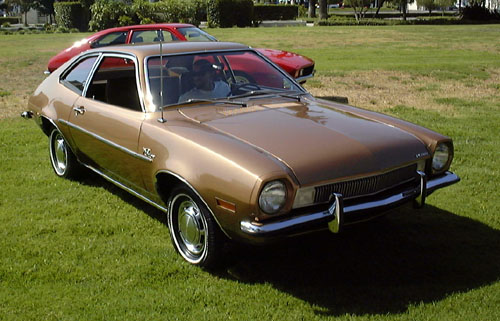
The Ford Pinto is a subcompact car that was manufactured and marketed by Ford Motor Company in North America from 1970 until 1980. The Pinto was the first subcompact vehicle produced by Ford in North America.
The Pinto was marketed in three body styles throughout its production: a two-door fastback sedan with a trunk, a three-door hatchback, and a two-door station wagon. Mercury offered rebadged versions of the Pinto as the Mercury Bobcat from 1975 until 1980 (1974–1980 in Canada). Over three million Pintos were produced over its ten-year production run, outproducing the combined totals of its domestic rivals, the Chevrolet Vega and the AMC Gremlin. The Pinto and Mercury Bobcat were produced at Edison Assembly in Edison, New Jersey, St. Thomas Assembly in Southwold, Ontario, and San Jose Assembly in Milpitas, California.
Since the 1970s, the safety reputation of the Pinto has generated controversy. Its fuel-tank design attracted both media and government scrutiny after several deadly fires occurred when the tanks ruptured in rear-end collisions. A subsequent analysis of the overall safety of the Pinto suggested it was comparable to other 1970s subcompact cars. The safety issues surrounding the Pinto and the subsequent response by Ford have been cited widely as business ethics and tort reform case studies.
American automakers had first countered imports such as the Volkswagen Beetle with compact cars including the Ford Falcon, Ford Maverick, Chevrolet Corvair and Plymouth Valiant, although these cars featured six-cylinder engines and comprised a larger vehicle class. As the popularity of smaller Japanese imports Toyota Corolla and Datsun 510 increased throughout the 1960s, Ford North America responded by introducing the Cortina from Ford of Europe as a captive import. American automakers introduced their subcompacts, led by the AMC Gremlin that arrived six months before the Pinto, and the Chevrolet Vega, introduced the day before the Pinto.
Named after a type of horse with a distinctive coat, the Pinto was introduced on September 11, 1970, using a completely new platform along with a powertrain from the European-specification Escort. Ford Chairman Henry Ford II himself purchased a 1971 Runabout (hatchback) as one of his personal cars.
Initial planning for the Pinto began in the summer of 1967, it was recommended by Ford's Product Planning Committee in December 1968, and was approved by Ford's board of directors in January 1969. Ford President Lee Iacocca wanted a 1971 model that weighed under 2,000 lb (900 kg) and that would be priced at less than US$2,000 ($17,149 in 2024 dollars). The Pinto product development, from conception through delivery, was completed in 25 months when the automotive industry average was 43 months, the shortest production planning schedule in automotive history at the time. Some development processes usually conducted sequentially were conducted in parallel. Machine tooling overlapped with product development, which froze the basic design. Decisions that threatened the schedule were discouraged; the attitude of Ford management was to develop the Pinto as quickly as possible. Iacocca ordered a rush project to build the car, and the Pinto became known internally as "Lee's car". The Pinto's bodywork was styled by Robert Eidschun.
Offered with an inline-four engine and bucket seats the Pinto's mechanical design was conventional, with unibody construction, a longitudinally mounted engine in front driving the rear wheels through either a manual or automatic transmission and live axle rear end. The suspension was by unequal-length control arms with front coil springs while the live rear axle was mounted on leaf springs. The rack and pinion steering optionally had power assist, as did the brakes. Ford had not offered a four-cylinder engine in North America since the cancellation of the Ford Model A engine in 1934 when the Ford Model B was discontinued. The Kent engine was sourced from Ford of England.
On September 11, 1970, Ford introduced the Pinto under the tagline The Little Carefree Car.
Hub AI
Ford Pinto AI simulator
(@Ford Pinto_simulator)
Ford Pinto
The Ford Pinto is a subcompact car that was manufactured and marketed by Ford Motor Company in North America from 1970 until 1980. The Pinto was the first subcompact vehicle produced by Ford in North America.
The Pinto was marketed in three body styles throughout its production: a two-door fastback sedan with a trunk, a three-door hatchback, and a two-door station wagon. Mercury offered rebadged versions of the Pinto as the Mercury Bobcat from 1975 until 1980 (1974–1980 in Canada). Over three million Pintos were produced over its ten-year production run, outproducing the combined totals of its domestic rivals, the Chevrolet Vega and the AMC Gremlin. The Pinto and Mercury Bobcat were produced at Edison Assembly in Edison, New Jersey, St. Thomas Assembly in Southwold, Ontario, and San Jose Assembly in Milpitas, California.
Since the 1970s, the safety reputation of the Pinto has generated controversy. Its fuel-tank design attracted both media and government scrutiny after several deadly fires occurred when the tanks ruptured in rear-end collisions. A subsequent analysis of the overall safety of the Pinto suggested it was comparable to other 1970s subcompact cars. The safety issues surrounding the Pinto and the subsequent response by Ford have been cited widely as business ethics and tort reform case studies.
American automakers had first countered imports such as the Volkswagen Beetle with compact cars including the Ford Falcon, Ford Maverick, Chevrolet Corvair and Plymouth Valiant, although these cars featured six-cylinder engines and comprised a larger vehicle class. As the popularity of smaller Japanese imports Toyota Corolla and Datsun 510 increased throughout the 1960s, Ford North America responded by introducing the Cortina from Ford of Europe as a captive import. American automakers introduced their subcompacts, led by the AMC Gremlin that arrived six months before the Pinto, and the Chevrolet Vega, introduced the day before the Pinto.
Named after a type of horse with a distinctive coat, the Pinto was introduced on September 11, 1970, using a completely new platform along with a powertrain from the European-specification Escort. Ford Chairman Henry Ford II himself purchased a 1971 Runabout (hatchback) as one of his personal cars.
Initial planning for the Pinto began in the summer of 1967, it was recommended by Ford's Product Planning Committee in December 1968, and was approved by Ford's board of directors in January 1969. Ford President Lee Iacocca wanted a 1971 model that weighed under 2,000 lb (900 kg) and that would be priced at less than US$2,000 ($17,149 in 2024 dollars). The Pinto product development, from conception through delivery, was completed in 25 months when the automotive industry average was 43 months, the shortest production planning schedule in automotive history at the time. Some development processes usually conducted sequentially were conducted in parallel. Machine tooling overlapped with product development, which froze the basic design. Decisions that threatened the schedule were discouraged; the attitude of Ford management was to develop the Pinto as quickly as possible. Iacocca ordered a rush project to build the car, and the Pinto became known internally as "Lee's car". The Pinto's bodywork was styled by Robert Eidschun.
Offered with an inline-four engine and bucket seats the Pinto's mechanical design was conventional, with unibody construction, a longitudinally mounted engine in front driving the rear wheels through either a manual or automatic transmission and live axle rear end. The suspension was by unequal-length control arms with front coil springs while the live rear axle was mounted on leaf springs. The rack and pinion steering optionally had power assist, as did the brakes. Ford had not offered a four-cylinder engine in North America since the cancellation of the Ford Model A engine in 1934 when the Ford Model B was discontinued. The Kent engine was sourced from Ford of England.
On September 11, 1970, Ford introduced the Pinto under the tagline The Little Carefree Car.