



Community hub
Recent from talks
Knowledge base stats:
Talk channels stats:
Members stats:
Pelagic fish
Pelagic fish live in the pelagic zone of ocean or lake waters—being neither close to the bottom nor near the shore—in contrast with demersal fish that live on or near the bottom, and reef fish that are associated with coral reefs.
The marine pelagic environment is the largest aquatic habitat on Earth, occupying 1,370 million cubic kilometres (330 million cubic miles), and is the habitat for 11% of known fish species. The oceans have a mean depth of 4,000 metres (2.5 miles). About 98% of the total water volume is below 100 metres (330 ft), and 75% is below 1,000 metres (3,300 ft).
Marine pelagic fish can be divided into coastal (inshore) fish and oceanic (offshore) fish. Coastal pelagic fish inhabit the relatively shallow and sunlit waters above the continental shelf, while oceanic pelagic fish inhabit the vast and deep waters beyond the continental shelf (even though they also may swim inshore).
Pelagic fish range in size from small coastal forage fish, such as herrings and sardines, to large apex predator oceanic fishes, such as bluefin tuna and oceanic sharks. They are usually agile swimmers with streamlined bodies, capable of sustained cruising on long-distance migrations. Many pelagic fish swim in schools weighing hundreds of tonnes. Others, such as the large ocean sunfish, are solitary. There are also freshwater pelagic fish in some of the larger lakes, such as the Lake Tanganyika sardine.
Epipelagic fish inhabit the epipelagic zone, the uppermost layer of the water column, ranging from sea level down to 200 m (660 ft). It is also referred to as the surface waters or the sunlit zone, and includes the photic zone. The photic zone is defined as the surface waters down to the depth where the sunlight is attenuated to 1% of the surface value. This depth depends on how turbid the water is, but can extend to 200 m (660 ft) in clear water, coinciding with the epipelagic zone. The photic zone allows sufficient light for phytoplankton to photosynthesize.
A vast habitat for most pelagic fish, the epipelagic zone is well lit so visual predators can use their eyesight, is usually well mixed and oxygenated from wave action, and can be a good habitat for algae to grow. However, it is an almost featureless habitat. This lack of habitat variation results in a lack of species diversity, so the zone supports less than 2% of the world's known fish species. Much of the zone lacks nutrients for supporting fish, so epipelagic fish tend to be found in coastal water above the continental shelves, where land runoff can provide nutrients, or in those parts of the ocean where upwelling moves nutrients into the area.
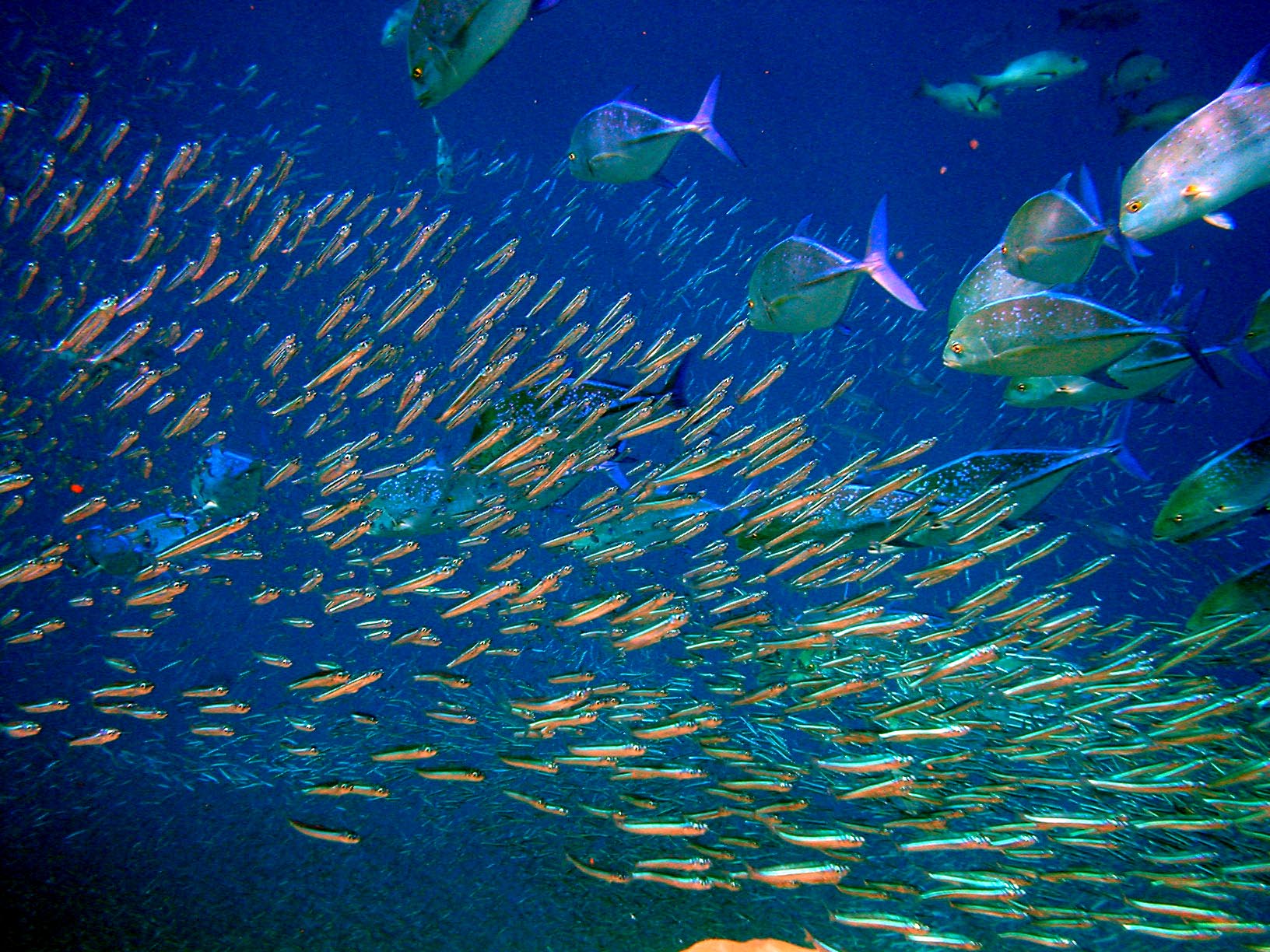
Epipelagic fish can be divided broadly into small forage fish and larger predator fish that feed on them. Forage fish school and filter feed on plankton. Most epipelagic fish have streamlined bodies capable of sustained cruising on migrations. In general, predatory and forage fish share the same morphological features. Predator fish are usually fusiform with large mouths, smooth bodies, and deeply forked tails. Many use vision to prey on zooplankton or smaller fish, while others filter feed on plankton.
Most epipelagic predator fish and their smaller prey fish are countershaded with silvery colours that reduce visibility by scattering incoming light. The silvering is achieved with reflective fish scales that function as small mirrors. This may give an effect of transparency. At medium depths at sea, light comes from above, so a mirror that is oriented vertically makes animals such as fish invisible from the side.
Hub AI
Pelagic fish AI simulator
(@Pelagic fish_simulator)
Pelagic fish
Pelagic fish live in the pelagic zone of ocean or lake waters—being neither close to the bottom nor near the shore—in contrast with demersal fish that live on or near the bottom, and reef fish that are associated with coral reefs.
The marine pelagic environment is the largest aquatic habitat on Earth, occupying 1,370 million cubic kilometres (330 million cubic miles), and is the habitat for 11% of known fish species. The oceans have a mean depth of 4,000 metres (2.5 miles). About 98% of the total water volume is below 100 metres (330 ft), and 75% is below 1,000 metres (3,300 ft).
Marine pelagic fish can be divided into coastal (inshore) fish and oceanic (offshore) fish. Coastal pelagic fish inhabit the relatively shallow and sunlit waters above the continental shelf, while oceanic pelagic fish inhabit the vast and deep waters beyond the continental shelf (even though they also may swim inshore).
Pelagic fish range in size from small coastal forage fish, such as herrings and sardines, to large apex predator oceanic fishes, such as bluefin tuna and oceanic sharks. They are usually agile swimmers with streamlined bodies, capable of sustained cruising on long-distance migrations. Many pelagic fish swim in schools weighing hundreds of tonnes. Others, such as the large ocean sunfish, are solitary. There are also freshwater pelagic fish in some of the larger lakes, such as the Lake Tanganyika sardine.
Epipelagic fish inhabit the epipelagic zone, the uppermost layer of the water column, ranging from sea level down to 200 m (660 ft). It is also referred to as the surface waters or the sunlit zone, and includes the photic zone. The photic zone is defined as the surface waters down to the depth where the sunlight is attenuated to 1% of the surface value. This depth depends on how turbid the water is, but can extend to 200 m (660 ft) in clear water, coinciding with the epipelagic zone. The photic zone allows sufficient light for phytoplankton to photosynthesize.
A vast habitat for most pelagic fish, the epipelagic zone is well lit so visual predators can use their eyesight, is usually well mixed and oxygenated from wave action, and can be a good habitat for algae to grow. However, it is an almost featureless habitat. This lack of habitat variation results in a lack of species diversity, so the zone supports less than 2% of the world's known fish species. Much of the zone lacks nutrients for supporting fish, so epipelagic fish tend to be found in coastal water above the continental shelves, where land runoff can provide nutrients, or in those parts of the ocean where upwelling moves nutrients into the area.
Epipelagic fish can be divided broadly into small forage fish and larger predator fish that feed on them. Forage fish school and filter feed on plankton. Most epipelagic fish have streamlined bodies capable of sustained cruising on migrations. In general, predatory and forage fish share the same morphological features. Predator fish are usually fusiform with large mouths, smooth bodies, and deeply forked tails. Many use vision to prey on zooplankton or smaller fish, while others filter feed on plankton.
Most epipelagic predator fish and their smaller prey fish are countershaded with silvery colours that reduce visibility by scattering incoming light. The silvering is achieved with reflective fish scales that function as small mirrors. This may give an effect of transparency. At medium depths at sea, light comes from above, so a mirror that is oriented vertically makes animals such as fish invisible from the side.