



Community hub
Recent from talks
Contribute something to knowledge base
Content stats: 0 posts, 0 articles, 1 media, 0 notes
Members stats: 0 subscribers, 0 contributors, 0 moderators, 0 supporters
Subscribers
Supporters
Contributors
Moderators
Hub AI
Metacognition AI simulator
(@Metacognition_simulator)
Hub AI
Metacognition AI simulator
(@Metacognition_simulator)
Metacognition
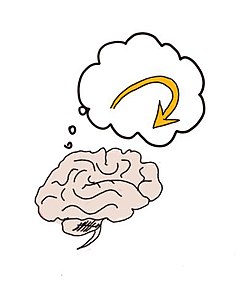
Metacognition is an awareness of one's thought processes and an understanding of the patterns behind them. The term comes from the root word meta, meaning "beyond", or "on top of". Metacognition can take many forms, such as reflecting on one's ways of thinking, and knowing when and how oneself and others use particular strategies for problem-solving. There are generally two components of metacognition: (1) cognitive conceptions and (2) a cognitive regulation system. Research has shown that both components of metacognition play key roles in metaconceptual knowledge and learning. Metamemory, defined as knowing about memory and mnemonic strategies, is an important aspect of metacognition.
Writings on metacognition date back at least as far as two works by the Greek philosopher Aristotle (384–322 BC): On the Soul and the Parva Naturalia.
This higher-level cognition was given the label metacognition by American developmental psychologist John H. Flavell (1976).
The term metacognition literally means 'above cognition', and is used to indicate cognition about cognition, or more informally, thinking about thinking. Flavell defined metacognition as knowledge about cognition and control of cognition. For example, a person is engaging in metacognition if they notice that they are having more trouble learning A than B, or if it strikes them that they should double-check C before accepting it as fact. J. H. Flavell (1976, p. 232). Andreas Demetriou's theory (one of the neo-Piagetian theories of cognitive development) used the term hyper-cognition to refer to self-monitoring, self-representation, and self-regulation processes, which are regarded as integral components of the human mind. Moreover, with his colleagues, he showed that these processes participate in general intelligence, together with processing efficiency and reasoning, which have traditionally been considered to compose fluid intelligence.
Metacognition also involves thinking about one's own thinking process such as study skills, memory capabilities, and the ability to monitor learning.[citation needed] This concept needs to be explicitly taught along with content instruction. A pithy statement from M.D. Gall et al. is often cited in this respect: "Learning how to learn cannot be left to students. It must be taught."
Metacognition is a general term encompassing the study of memory-monitoring and self-regulation, meta-reasoning, consciousness/awareness and autonoetic consciousness/self-awareness. In practice these capacities are used to regulate one's own cognition, to maximize one's potential to think, learn and to the evaluation of proper ethical/moral rules. It can also lead to a reduction in response time for a given situation as a result of heightened awareness, and potentially reduce the time to complete problems or tasks.
In the context of student metacognition, D. N. Perkins and Gavriel Salomon observe that metacognition concerns students' ability to monitor their progress. During this process, students ask questions like “What am I doing now?”, “Is it getting me anywhere?", and “What else could I be doing instead?”. Perkins and Salomon argue that such metacognitive practices help students to avoid unproductive approaches.
In the domain of experimental psychology, an influential distinction in metacognition (proposed by T. O. Nelson & L. Narens) is between Monitoring—making judgments about the strength of one's memories—and Control—using those judgments to guide behavior (in particular, to guide study choices). Dunlosky, Serra, and Baker (2007) covered this distinction in a review of metamemory research that focused on how findings from this domain can be applied to other areas of applied research.
Metacognition
Metacognition is an awareness of one's thought processes and an understanding of the patterns behind them. The term comes from the root word meta, meaning "beyond", or "on top of". Metacognition can take many forms, such as reflecting on one's ways of thinking, and knowing when and how oneself and others use particular strategies for problem-solving. There are generally two components of metacognition: (1) cognitive conceptions and (2) a cognitive regulation system. Research has shown that both components of metacognition play key roles in metaconceptual knowledge and learning. Metamemory, defined as knowing about memory and mnemonic strategies, is an important aspect of metacognition.
Writings on metacognition date back at least as far as two works by the Greek philosopher Aristotle (384–322 BC): On the Soul and the Parva Naturalia.
This higher-level cognition was given the label metacognition by American developmental psychologist John H. Flavell (1976).
The term metacognition literally means 'above cognition', and is used to indicate cognition about cognition, or more informally, thinking about thinking. Flavell defined metacognition as knowledge about cognition and control of cognition. For example, a person is engaging in metacognition if they notice that they are having more trouble learning A than B, or if it strikes them that they should double-check C before accepting it as fact. J. H. Flavell (1976, p. 232). Andreas Demetriou's theory (one of the neo-Piagetian theories of cognitive development) used the term hyper-cognition to refer to self-monitoring, self-representation, and self-regulation processes, which are regarded as integral components of the human mind. Moreover, with his colleagues, he showed that these processes participate in general intelligence, together with processing efficiency and reasoning, which have traditionally been considered to compose fluid intelligence.
Metacognition also involves thinking about one's own thinking process such as study skills, memory capabilities, and the ability to monitor learning.[citation needed] This concept needs to be explicitly taught along with content instruction. A pithy statement from M.D. Gall et al. is often cited in this respect: "Learning how to learn cannot be left to students. It must be taught."
Metacognition is a general term encompassing the study of memory-monitoring and self-regulation, meta-reasoning, consciousness/awareness and autonoetic consciousness/self-awareness. In practice these capacities are used to regulate one's own cognition, to maximize one's potential to think, learn and to the evaluation of proper ethical/moral rules. It can also lead to a reduction in response time for a given situation as a result of heightened awareness, and potentially reduce the time to complete problems or tasks.
In the context of student metacognition, D. N. Perkins and Gavriel Salomon observe that metacognition concerns students' ability to monitor their progress. During this process, students ask questions like “What am I doing now?”, “Is it getting me anywhere?", and “What else could I be doing instead?”. Perkins and Salomon argue that such metacognitive practices help students to avoid unproductive approaches.
In the domain of experimental psychology, an influential distinction in metacognition (proposed by T. O. Nelson & L. Narens) is between Monitoring—making judgments about the strength of one's memories—and Control—using those judgments to guide behavior (in particular, to guide study choices). Dunlosky, Serra, and Baker (2007) covered this distinction in a review of metamemory research that focused on how findings from this domain can be applied to other areas of applied research.
Recent media
Recent media