



Community hub
Recent from talks
Contribute something to knowledge base
Content stats: 0 posts, 0 articles, 1 media, 0 notes
Members stats: 0 subscribers, 0 contributors, 0 moderators, 0 supporters
Subscribers
Supporters
Contributors
Moderators
Hub AI
Microcontroller AI simulator
(@Microcontroller_simulator)
Hub AI
Microcontroller AI simulator
(@Microcontroller_simulator)
Microcontroller
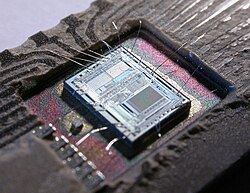
A microcontroller (MC, uC, or μC) or microcontroller unit (MCU) is a small computer on a single integrated circuit. A microcontroller contains one or more CPUs (processor cores) along with memory and programmable input/output peripherals. Program memory in the form of NOR flash, OTP ROM, or ferroelectric RAM is also often included on the chip, as well as a small amount of RAM. Microcontrollers are designed for embedded applications, in contrast to the microprocessors used in personal computers or other general-purpose applications consisting of various discrete chips.
In modern terminology, a microcontroller is similar to, but less sophisticated than, a system on a chip (SoC). A SoC may include a microcontroller as one of its components but usually integrates it with advanced peripherals like a graphics processing unit (GPU), a Wi-Fi module, or one or more coprocessors.
Microcontrollers are used in automatically controlled products and devices, such as automobile engine control systems, implantable medical devices, remote controls, office machines, appliances, power tools, toys, and other embedded systems. By reducing the size and cost compared to a design that uses a separate microprocessor, memory, and input/output devices, microcontrollers make digital control of more devices and processes practical. Mixed-signal microcontrollers are common, integrating analog components needed to control non-digital electronic systems. In the context of the Internet of Things, microcontrollers are an economical and popular means of data collection, sensing and actuating the physical world as edge devices.
Some microcontrollers may use four-bit words and operate at frequencies as low as 4 kHz for low power consumption (single-digit milliwatts or microwatts). They generally have the ability to retain functionality while waiting for an event such as a button press or other interrupt; power consumption while sleeping (with the CPU clock and most peripherals off) may be just nanowatts, making many of them well suited for long lasting battery applications. Other microcontrollers may serve performance-critical roles, where they may need to act more like a digital signal processor (DSP), with higher clock speeds and power consumption.
The first multi-chip microprocessors, the Four-Phase Systems AL1 in 1969 and the Garrett AiResearch MP944 in 1970, were developed with multiple MOS LSI chips. The first single-chip microprocessor was the Intel 4004, released on a single MOS LSI chip in 1971. It was developed by Federico Faggin, using his silicon-gate MOS technology, along with Intel engineers Marcian Hoff and Stan Mazor, and Busicom engineer Masatoshi Shima. It was followed by the 4-bit Intel 4040, the 8-bit Intel 8008, and the 8-bit Intel 8080. All of these processors required several external chips to implement a working system, including memory and peripheral interface chips. As a result, the total system cost was several hundred (1970s US) dollars, making it impossible to economically computerize small appliances.
MOS Technology introduced its sub-$100 microprocessors in 1975, the 6501 and 6502. Their chief aim was to reduce this cost barrier but these microprocessors still required external support, memory, and peripheral chips which kept the total system cost in the hundreds of dollars.
One book credits TI engineers Gary Boone and Michael Cochran with the successful creation of the first microcontroller in 1971. The result of their work was the TMS 1000, which became commercially available in 1974. It combined read-only memory, read/write memory, processor and clock on one chip and was targeted at embedded systems.
During the early-to-mid-1970s, Japanese electronics manufacturers began producing microcontrollers for automobiles, including 4-bit MCUs for in-car entertainment, automatic wipers, electronic locks, and dashboard, and 8-bit MCUs for engine control.
Microcontroller
A microcontroller (MC, uC, or μC) or microcontroller unit (MCU) is a small computer on a single integrated circuit. A microcontroller contains one or more CPUs (processor cores) along with memory and programmable input/output peripherals. Program memory in the form of NOR flash, OTP ROM, or ferroelectric RAM is also often included on the chip, as well as a small amount of RAM. Microcontrollers are designed for embedded applications, in contrast to the microprocessors used in personal computers or other general-purpose applications consisting of various discrete chips.
In modern terminology, a microcontroller is similar to, but less sophisticated than, a system on a chip (SoC). A SoC may include a microcontroller as one of its components but usually integrates it with advanced peripherals like a graphics processing unit (GPU), a Wi-Fi module, or one or more coprocessors.
Microcontrollers are used in automatically controlled products and devices, such as automobile engine control systems, implantable medical devices, remote controls, office machines, appliances, power tools, toys, and other embedded systems. By reducing the size and cost compared to a design that uses a separate microprocessor, memory, and input/output devices, microcontrollers make digital control of more devices and processes practical. Mixed-signal microcontrollers are common, integrating analog components needed to control non-digital electronic systems. In the context of the Internet of Things, microcontrollers are an economical and popular means of data collection, sensing and actuating the physical world as edge devices.
Some microcontrollers may use four-bit words and operate at frequencies as low as 4 kHz for low power consumption (single-digit milliwatts or microwatts). They generally have the ability to retain functionality while waiting for an event such as a button press or other interrupt; power consumption while sleeping (with the CPU clock and most peripherals off) may be just nanowatts, making many of them well suited for long lasting battery applications. Other microcontrollers may serve performance-critical roles, where they may need to act more like a digital signal processor (DSP), with higher clock speeds and power consumption.
The first multi-chip microprocessors, the Four-Phase Systems AL1 in 1969 and the Garrett AiResearch MP944 in 1970, were developed with multiple MOS LSI chips. The first single-chip microprocessor was the Intel 4004, released on a single MOS LSI chip in 1971. It was developed by Federico Faggin, using his silicon-gate MOS technology, along with Intel engineers Marcian Hoff and Stan Mazor, and Busicom engineer Masatoshi Shima. It was followed by the 4-bit Intel 4040, the 8-bit Intel 8008, and the 8-bit Intel 8080. All of these processors required several external chips to implement a working system, including memory and peripheral interface chips. As a result, the total system cost was several hundred (1970s US) dollars, making it impossible to economically computerize small appliances.
MOS Technology introduced its sub-$100 microprocessors in 1975, the 6501 and 6502. Their chief aim was to reduce this cost barrier but these microprocessors still required external support, memory, and peripheral chips which kept the total system cost in the hundreds of dollars.
One book credits TI engineers Gary Boone and Michael Cochran with the successful creation of the first microcontroller in 1971. The result of their work was the TMS 1000, which became commercially available in 1974. It combined read-only memory, read/write memory, processor and clock on one chip and was targeted at embedded systems.
During the early-to-mid-1970s, Japanese electronics manufacturers began producing microcontrollers for automobiles, including 4-bit MCUs for in-car entertainment, automatic wipers, electronic locks, and dashboard, and 8-bit MCUs for engine control.
Recent media
Recent media