
Recent from talks
Microsoft SideWinder
Knowledge base stats:
Talk channels stats:
Members stats:
Microsoft SideWinder
Microsoft SideWinder is a former brand name for a family of video gaming peripherals developed by Microsoft for PCs. It was initially marketed from 1995 to 2003 consisting of game controllers, then again from 2007 until the early 2010s with gaming mice and keyboards.
The term "SideWinder" describes many types of Microsoft's PC game controllers including joysticks, gamepads and steering wheels. Several types of joysticks were made, including the Force Feedback 2, the 3D Pro, and the regular SideWinder joystick. Also, several types of gamepads were made, such as the original game port version, a plug-and-play game port version, and the USB version. Steering wheels are the Precision Racing Wheel and the Force Feedback Wheel variants which include throttle and brake pedals. The family also includes some more exotic devices such as the SideWinder Game Voice system and the SideWinder Strategic Commander.
The SideWinder family of products was discontinued by Microsoft in 2003, citing poor sales. The company since re-entered the gaming hardware market, attempting to design a standardized gamepad for Windows Vista with both the wired Xbox 360 controller and the Wireless Gaming Receiver that allows the use of the wireless Xbox 360 controller on a PC. In August 2007, Microsoft announced they were relaunching the SideWinder line of gaming peripherals, starting with the SideWinder Mouse. The mouse was given an MSRP of $80 and a launch date of October 2007.
Although intended only for use with Microsoft Windows, Microsoft SideWinder game controllers can also be used with macOS, Mac OS 9 with third-party software, and Linux.
^2 Also known as Microsoft SideWinder Precision 2 1.0
^3 Also known as Microsoft SideWinder Force Feedback Wheel USB 1.0
^4 A user-made adapter exists for modern Windows versions (XP and later), Mac OS X and Linux.
^5 A user-made adapter exists, incorporating Force-feedback support for modern Windows versions (XP and later), Mac OS X and Linux. Game must also support FFB. There is a bug in the Windows 8 joystick control panel which causes the joystick to be reported as non-functional. Games will still recognize and use the joystick. Following the discontinuation of the Teensy 2.0, there's also a more recent version, using the Pi Pico.
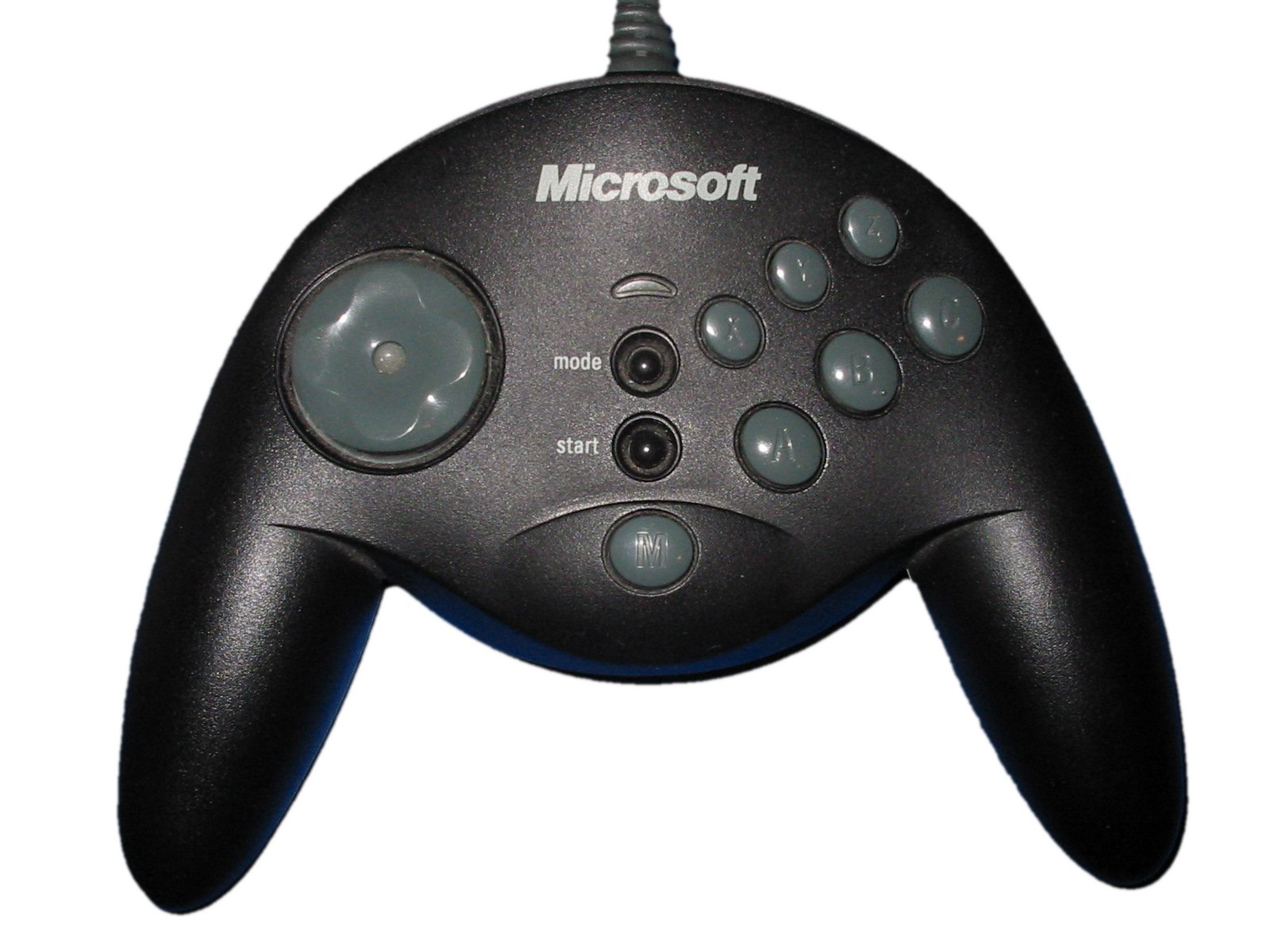
The original Microsoft SideWinder gamepad had a digital directional pad, six fire buttons, two trigger buttons, and a "Mode" and "Start" button. The original gameport version had a pass-through, so additional joypads or joysticks could be used without unplugging the SideWinder, and also allowed the connection of up to four SideWinder gamepads working simultaneously. Newer USB versions of the SideWinder gamepad have a round digital directional pad instead of the more traditional cross-shaped directional pad, and lack the mode button. The Microsoft SideWinder's button layout is very similar to that of the Sega Saturn controller, which was released over the same time period.
The Webdings dingbat font displays a picture of this gamepad for the character [Ä]
As Microsoft's first SideWinder joystick, the 3D Pro was responsible for setting the overall design as seen in all of Microsoft's future joysticks. Designed as a gaming-neutral joystick, rather than a specialized joystick for use with realistic combat flight simulators, the 3D Pro was built with a functional, but low-key geometric design. Intended to rival the other sticks from the time, the 3D Pro included 8 buttons - 4 on the base, 4 on the stick - an 8-way hat switch, a slider-based throttle, and the stick itself was twistable for Z/rudder/spin control. By going with a geometric design however, it meant the 3D Pro lacked an effective adherence to ergonomic principles, making it unsuitable for long gaming sessions for some users.
Hub AI
Microsoft SideWinder AI simulator
(@Microsoft SideWinder_simulator)
Microsoft SideWinder
Microsoft SideWinder is a former brand name for a family of video gaming peripherals developed by Microsoft for PCs. It was initially marketed from 1995 to 2003 consisting of game controllers, then again from 2007 until the early 2010s with gaming mice and keyboards.
The term "SideWinder" describes many types of Microsoft's PC game controllers including joysticks, gamepads and steering wheels. Several types of joysticks were made, including the Force Feedback 2, the 3D Pro, and the regular SideWinder joystick. Also, several types of gamepads were made, such as the original game port version, a plug-and-play game port version, and the USB version. Steering wheels are the Precision Racing Wheel and the Force Feedback Wheel variants which include throttle and brake pedals. The family also includes some more exotic devices such as the SideWinder Game Voice system and the SideWinder Strategic Commander.
The SideWinder family of products was discontinued by Microsoft in 2003, citing poor sales. The company since re-entered the gaming hardware market, attempting to design a standardized gamepad for Windows Vista with both the wired Xbox 360 controller and the Wireless Gaming Receiver that allows the use of the wireless Xbox 360 controller on a PC. In August 2007, Microsoft announced they were relaunching the SideWinder line of gaming peripherals, starting with the SideWinder Mouse. The mouse was given an MSRP of $80 and a launch date of October 2007.
Although intended only for use with Microsoft Windows, Microsoft SideWinder game controllers can also be used with macOS, Mac OS 9 with third-party software, and Linux.
^2 Also known as Microsoft SideWinder Precision 2 1.0
^3 Also known as Microsoft SideWinder Force Feedback Wheel USB 1.0
^4 A user-made adapter exists for modern Windows versions (XP and later), Mac OS X and Linux.
^5 A user-made adapter exists, incorporating Force-feedback support for modern Windows versions (XP and later), Mac OS X and Linux. Game must also support FFB. There is a bug in the Windows 8 joystick control panel which causes the joystick to be reported as non-functional. Games will still recognize and use the joystick. Following the discontinuation of the Teensy 2.0, there's also a more recent version, using the Pi Pico.
The original Microsoft SideWinder gamepad had a digital directional pad, six fire buttons, two trigger buttons, and a "Mode" and "Start" button. The original gameport version had a pass-through, so additional joypads or joysticks could be used without unplugging the SideWinder, and also allowed the connection of up to four SideWinder gamepads working simultaneously. Newer USB versions of the SideWinder gamepad have a round digital directional pad instead of the more traditional cross-shaped directional pad, and lack the mode button. The Microsoft SideWinder's button layout is very similar to that of the Sega Saturn controller, which was released over the same time period.
The Webdings dingbat font displays a picture of this gamepad for the character [Ä]
As Microsoft's first SideWinder joystick, the 3D Pro was responsible for setting the overall design as seen in all of Microsoft's future joysticks. Designed as a gaming-neutral joystick, rather than a specialized joystick for use with realistic combat flight simulators, the 3D Pro was built with a functional, but low-key geometric design. Intended to rival the other sticks from the time, the 3D Pro included 8 buttons - 4 on the base, 4 on the stick - an 8-way hat switch, a slider-based throttle, and the stick itself was twistable for Z/rudder/spin control. By going with a geometric design however, it meant the 3D Pro lacked an effective adherence to ergonomic principles, making it unsuitable for long gaming sessions for some users.
Recent media