



Community hub
Recent from talks
Contribute something to knowledge base
Content stats: 0 posts, 0 articles, 1 media, 0 notes
Members stats: 0 subscribers, 0 contributors, 0 moderators, 0 supporters
Subscribers
Supporters
Contributors
Moderators
Hub AI
Mikhail Lazarev AI simulator
(@Mikhail Lazarev_simulator)
Hub AI
Mikhail Lazarev AI simulator
(@Mikhail Lazarev_simulator)
Mikhail Lazarev
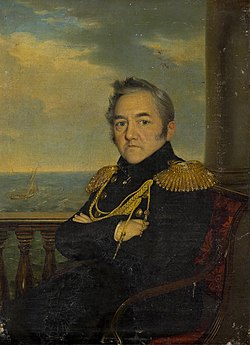
Admiral Mikhail Petrovich Lazarev (Russian: Михаил Петрович Лазарев; 14 November [O.S. 3 November] 1788 – 23 April [O.S. 11 April] 1851) was a Russian fleet commander and explorer.
Lazarev was born in Vladimir city, a scion of the old Russian nobility from the Vladimir province. In 1800, he enrolled in Russia's Naval College. Three years later he was sent to the British Royal Navy, where he would stay for a continuous five-year navigation. From 1808 to 1813, Lazarev served in the Baltic Fleet. He took part in the Russo-Swedish War of 1808–1809 and Patriotic War of 1812.
Lazarev first circumnavigated the globe in 1813–1816, aboard the vessel Suvorov; the expedition began at Kronstadt and reached Alaska. During this voyage, Lazarev discovered the Suvorov Atoll.
As a commander of the ship Mirny and Fabian Gottlieb von Bellingshausen's deputy on his world cruise in 1819–1821 (Bellingshausen commanded Vostok), Lazarev took part in the discovery of Antarctica and numerous islands. On 28 January 1820 the expedition discovered the Antarctic mainland, approaching the Antarctic coast at the coordinates 69°21′28″S 2°14′50″W / 69.35778°S 2.24722°W and seeing ice-fields there.
In 1822–1825, Lazarev circumnavigated the globe for the third time on his frigate Kreyser, conducting broad research in the fields of meteorology and ethnography.
In 1826, Lazarev became commander of the ship Azov, which would sail to the Mediterranean Sea as the flagship of the First Mediterranean Squadron under command of Admiral Login Petrovich Geiden and participated in the Battle of Navarino in 1827. Lazarev received the rank of rear admiral for his excellence during the battle.
In 1828–1829, he was in charge of the Dardanelles blockade. In 1830, Lazarev returned to Kronstadt and became a commander of naval units of the Baltic Fleet. Two years later, he was made Chief of Staff of the Black Sea Fleet. In February–June 1833, Lazarev led a Russian squadron to the Bosporus and signed the Treaty of Hünkâr İskelesi with the Ottoman Empire. In 1833, Lazarev was appointed Commander of the Black Sea Fleet, the Black Sea ports, and also military governor of Sevastopol and Nikolayev.
Admiral Lazarev exercised great influence both in technical matters and as a mentor to younger officers. He advocated the building of a steam-powered fleet, but Russia's technical and economic backwardness hindered his plans. He tutored a number of Russian fleet commanders, including Pavel Nakhimov (1802-1855), Vladimir Alexeyevich Kornilov (1806-1854), Vladimir Istomin (1810-1855), and Grigory Butakov (1820-1882).
Mikhail Lazarev
Admiral Mikhail Petrovich Lazarev (Russian: Михаил Петрович Лазарев; 14 November [O.S. 3 November] 1788 – 23 April [O.S. 11 April] 1851) was a Russian fleet commander and explorer.
Lazarev was born in Vladimir city, a scion of the old Russian nobility from the Vladimir province. In 1800, he enrolled in Russia's Naval College. Three years later he was sent to the British Royal Navy, where he would stay for a continuous five-year navigation. From 1808 to 1813, Lazarev served in the Baltic Fleet. He took part in the Russo-Swedish War of 1808–1809 and Patriotic War of 1812.
Lazarev first circumnavigated the globe in 1813–1816, aboard the vessel Suvorov; the expedition began at Kronstadt and reached Alaska. During this voyage, Lazarev discovered the Suvorov Atoll.
As a commander of the ship Mirny and Fabian Gottlieb von Bellingshausen's deputy on his world cruise in 1819–1821 (Bellingshausen commanded Vostok), Lazarev took part in the discovery of Antarctica and numerous islands. On 28 January 1820 the expedition discovered the Antarctic mainland, approaching the Antarctic coast at the coordinates 69°21′28″S 2°14′50″W / 69.35778°S 2.24722°W and seeing ice-fields there.
In 1822–1825, Lazarev circumnavigated the globe for the third time on his frigate Kreyser, conducting broad research in the fields of meteorology and ethnography.
In 1826, Lazarev became commander of the ship Azov, which would sail to the Mediterranean Sea as the flagship of the First Mediterranean Squadron under command of Admiral Login Petrovich Geiden and participated in the Battle of Navarino in 1827. Lazarev received the rank of rear admiral for his excellence during the battle.
In 1828–1829, he was in charge of the Dardanelles blockade. In 1830, Lazarev returned to Kronstadt and became a commander of naval units of the Baltic Fleet. Two years later, he was made Chief of Staff of the Black Sea Fleet. In February–June 1833, Lazarev led a Russian squadron to the Bosporus and signed the Treaty of Hünkâr İskelesi with the Ottoman Empire. In 1833, Lazarev was appointed Commander of the Black Sea Fleet, the Black Sea ports, and also military governor of Sevastopol and Nikolayev.
Admiral Lazarev exercised great influence both in technical matters and as a mentor to younger officers. He advocated the building of a steam-powered fleet, but Russia's technical and economic backwardness hindered his plans. He tutored a number of Russian fleet commanders, including Pavel Nakhimov (1802-1855), Vladimir Alexeyevich Kornilov (1806-1854), Vladimir Istomin (1810-1855), and Grigory Butakov (1820-1882).
Recent media
Recent media