



Community hub
Recent from talks
Knowledge base stats:
Talk channels stats:
Members stats:
Minor-planet moon
A minor-planet moon is an astronomical object that orbits a minor planet as its natural satellite. As of January 2022[update], there are 457 minor planets known or suspected to have moons. Discoveries of minor-planet moons (and binary objects, in general) are important because the determination of their orbits provides estimates on the mass and density of the primary, allowing insights into their physical properties that are generally not otherwise accessible.
Several of the moons are quite large compared to their primaries: 90 Antiope, Mors–Somnus and Sila–Nunam (95%), Patroclus–Menoetius, Altjira and Lempo–Hiisi (90%, with Lempo–Paha at 50%). The largest known minor-planet moon in absolute size is Pluto's moon Charon, which has about half the diameter of Pluto.
There are also several known ring systems around distant objects (see: Rings of Chariklo and Chiron).
In addition to the terms satellite and moon, the term "binary" (binary minor planet) is sometimes used for minor planets with one moon, and "triple" for minor planets with two moons. If one object is much bigger it is referred to as the primary and its companion as the secondary. The term double asteroid is sometimes used for systems in which the asteroid and its moon are roughly the same size, while binary tends to be used independently from the relative sizes of the components. When binary minor planets are similar in size, the Minor Planet Center (MPC) refers to them as "binary companions" instead of referring to the smaller body as a satellite. A good example of a true binary is the 90 Antiope system, identified in August 2000. Very small satellites are often referred to as moonlets.
Prior to the era of the Hubble Space Telescope and space probes reaching the outer Solar System, attempts to detect satellites around asteroids were limited to optical observations from Earth. For example, in 1978, stellar occultation observations were claimed as evidence of a satellite for the asteroid to 532 Herculina. However, later more-detailed imaging by the Hubble Telescope did not reveal a satellite, and the current consensus is that Herculina does not have a significant satellite. There were other similar reports of asteroids having companions (usually referred to as satellites) in the following years. A letter by astronomer Thomas Hamilton in the Sky & Telescope magazine at this time pointed to apparently simultaneous impact craters on Earth (for example, the Clearwater Lakes in Quebec), suggesting that these craters were caused by pairs of gravitationally bound objects.
Also in 1978, Pluto's largest moon Charon was discovered; however, at the time Pluto was still considered to be one of the major planets.
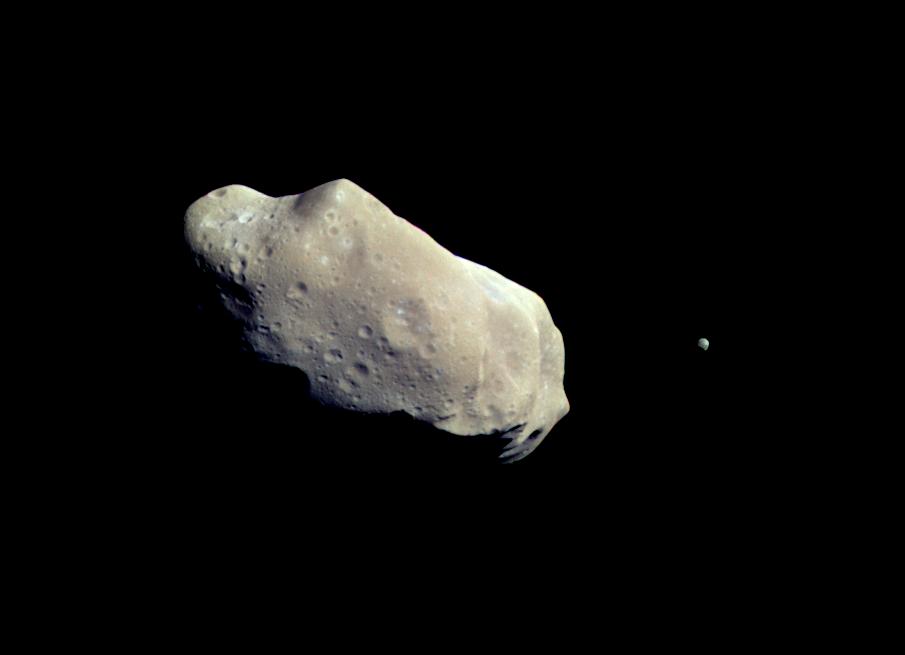
In 1993, the first asteroid moon was confirmed when the Galileo probe discovered the small Dactyl orbiting 243 Ida in the asteroid belt. The second was discovered around 45 Eugenia in 1998. In 2001, 617 Patroclus and its same-sized companion Menoetius became the first known binary asteroids in the Jupiter trojans. The first trans-Neptunian binary after Pluto–Charon, 1998 WW31, was optically resolved in 2002.
In 2021, 130 Elektra was discovered to have three moons, making it the only known quadruple asteroid.
Hub AI
Minor-planet moon AI simulator
(@Minor-planet moon_simulator)
Minor-planet moon
A minor-planet moon is an astronomical object that orbits a minor planet as its natural satellite. As of January 2022[update], there are 457 minor planets known or suspected to have moons. Discoveries of minor-planet moons (and binary objects, in general) are important because the determination of their orbits provides estimates on the mass and density of the primary, allowing insights into their physical properties that are generally not otherwise accessible.
Several of the moons are quite large compared to their primaries: 90 Antiope, Mors–Somnus and Sila–Nunam (95%), Patroclus–Menoetius, Altjira and Lempo–Hiisi (90%, with Lempo–Paha at 50%). The largest known minor-planet moon in absolute size is Pluto's moon Charon, which has about half the diameter of Pluto.
There are also several known ring systems around distant objects (see: Rings of Chariklo and Chiron).
In addition to the terms satellite and moon, the term "binary" (binary minor planet) is sometimes used for minor planets with one moon, and "triple" for minor planets with two moons. If one object is much bigger it is referred to as the primary and its companion as the secondary. The term double asteroid is sometimes used for systems in which the asteroid and its moon are roughly the same size, while binary tends to be used independently from the relative sizes of the components. When binary minor planets are similar in size, the Minor Planet Center (MPC) refers to them as "binary companions" instead of referring to the smaller body as a satellite. A good example of a true binary is the 90 Antiope system, identified in August 2000. Very small satellites are often referred to as moonlets.
Prior to the era of the Hubble Space Telescope and space probes reaching the outer Solar System, attempts to detect satellites around asteroids were limited to optical observations from Earth. For example, in 1978, stellar occultation observations were claimed as evidence of a satellite for the asteroid to 532 Herculina. However, later more-detailed imaging by the Hubble Telescope did not reveal a satellite, and the current consensus is that Herculina does not have a significant satellite. There were other similar reports of asteroids having companions (usually referred to as satellites) in the following years. A letter by astronomer Thomas Hamilton in the Sky & Telescope magazine at this time pointed to apparently simultaneous impact craters on Earth (for example, the Clearwater Lakes in Quebec), suggesting that these craters were caused by pairs of gravitationally bound objects.
Also in 1978, Pluto's largest moon Charon was discovered; however, at the time Pluto was still considered to be one of the major planets.
In 1993, the first asteroid moon was confirmed when the Galileo probe discovered the small Dactyl orbiting 243 Ida in the asteroid belt. The second was discovered around 45 Eugenia in 1998. In 2001, 617 Patroclus and its same-sized companion Menoetius became the first known binary asteroids in the Jupiter trojans. The first trans-Neptunian binary after Pluto–Charon, 1998 WW31, was optically resolved in 2002.
In 2021, 130 Elektra was discovered to have three moons, making it the only known quadruple asteroid.