
Recent from talks
Asteroid belt
Knowledge base stats:
Talk channels stats:
Members stats:
Asteroid belt
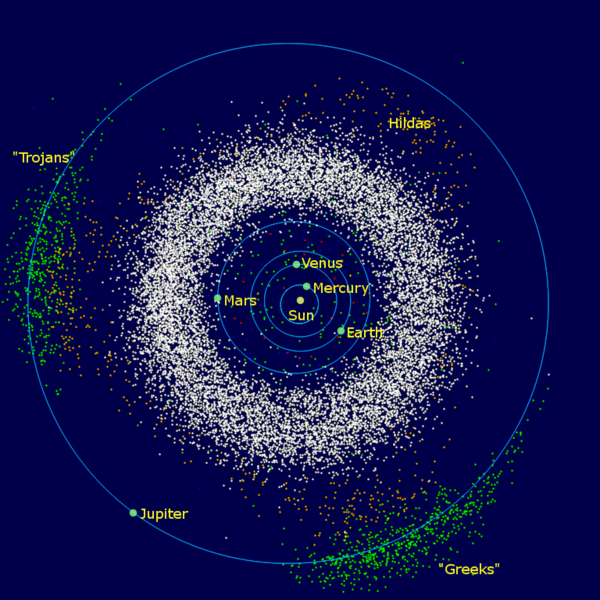
The asteroid belt is a torus-shaped region in the Solar System, centered on the Sun and roughly spanning the space between the orbits of the planets Jupiter and Mars. It contains a great many solid, irregularly shaped bodies called asteroids or minor planets. The identified objects are of many sizes, but much smaller than planets, and, on average, are about one million kilometers (or six hundred thousand miles) apart. This asteroid belt is also called the main asteroid belt or main belt to distinguish it from other asteroid populations in the Solar System.
The asteroid belt is the smallest and innermost circumstellar disc in the Solar System. Classes of small Solar System bodies in other regions are the near-Earth objects, the centaurs, the Kuiper belt objects, the scattered disc objects, the sednoids, and the Oort cloud objects. About 60% of the main belt mass is contained in the four largest asteroids: Ceres, Vesta, Pallas, and Hygiea. The total mass of the asteroid belt is estimated to be 3% that of the Moon.
Ceres, the only object in the asteroid belt large enough to be a dwarf planet, is about 950 km in diameter, whereas Vesta, Pallas, and Hygiea have mean diameters less than 600 km. The remaining mineralogically classified bodies range in size down to a few metres. The asteroid material is so thinly distributed that numerous uncrewed spacecraft have traversed it without incident. Nonetheless, collisions between large asteroids occur and can produce an asteroid family, whose members have similar orbital characteristics and compositions. Individual asteroids within the belt are categorized by their spectra, with most falling into three basic groups: carbonaceous (C-type), silicate (S-type), and metal-rich (M-type).
The asteroid belt formed from the primordial solar nebula as a group of planetesimals, the smaller precursors of the protoplanets. However, between Mars and Jupiter gravitational perturbations from Jupiter disrupted their accretion into a planet, imparting excess kinetic energy which shattered colliding planetesimals and most of the incipient protoplanets. As a result, 99.9% of the asteroid belt's original mass was lost in the first 100 million years of the Solar System's history. Some fragments eventually found their way into the inner Solar System, leading to meteorite impacts with the inner planets. Asteroid orbits continue to be appreciably perturbed whenever their period of revolution about the Sun forms an orbital resonance with Jupiter. At these orbital distances, a Kirkwood gap occurs as they are swept into other orbits.
In 1596, Johannes Kepler wrote, "Between Mars and Jupiter, I place a planet," in his Mysterium Cosmographicum, stating his prediction that a planet would be found there. While analyzing Tycho Brahe's data, Kepler thought that too large a gap existed between the orbits of Mars and Jupiter to fit his own model of where planetary orbits should be found.
In an anonymous footnote to his 1766 translation of Charles Bonnet's Contemplation de la Nature, the astronomer Johann Daniel Titius of Wittenberg noted an apparent pattern in the layout of the planets, now known as the Titius-Bode Law. If one began a numerical sequence at 0, then included 3, 6, 12, 24, 48, etc., doubling each time, and added four to each number and divided by 10, this produced a remarkably close approximation to the radii of the orbits of the known planets as measured in astronomical units, provided one allowed for a "missing planet" (equivalent to 24 in the sequence) between the orbits of Mars (12) and Jupiter (48). In his footnote, Titius declared, "But should the Lord Architect have left that space empty? Not at all." When William Herschel discovered Uranus in 1781, the planet's orbit closely matched the law, leading some astronomers to conclude that a planet had to be between the orbits of Mars and Jupiter.
On January 1, 1801, Giuseppe Piazzi, chairman of astronomy at the University of Palermo, Sicily, found a tiny moving object in an orbit with exactly the radius predicted by this pattern. He dubbed it "Ceres", after the Roman goddess of the harvest and patron of Sicily. Piazzi initially believed it to be a comet, but its lack of a coma suggested it was a planet. Thus, the aforementioned pattern predicted the semimajor axes of all eight planets of the time (Mercury, Venus, Earth, Mars, Ceres, Jupiter, Saturn, and Uranus). Concurrent with the discovery of Ceres, an informal group of 24 astronomers dubbed the "celestial police" was formed under the invitation of Franz Xaver von Zach with the express purpose of finding additional planets; they focused their search for them in the region between Mars and Jupiter where the Titius–Bode law predicted there should be a planet.
About 15 months later, Heinrich Olbers, a member of the celestial police, discovered a second object in the same region, Pallas. Unlike the other known planets, Ceres and Pallas remained points of light even under the highest telescope magnifications instead of resolving into discs. Apart from their rapid movement, they appeared indistinguishable from stars.
Hub AI
Asteroid belt AI simulator
(@Asteroid belt_simulator)
Asteroid belt
The asteroid belt is a torus-shaped region in the Solar System, centered on the Sun and roughly spanning the space between the orbits of the planets Jupiter and Mars. It contains a great many solid, irregularly shaped bodies called asteroids or minor planets. The identified objects are of many sizes, but much smaller than planets, and, on average, are about one million kilometers (or six hundred thousand miles) apart. This asteroid belt is also called the main asteroid belt or main belt to distinguish it from other asteroid populations in the Solar System.
The asteroid belt is the smallest and innermost circumstellar disc in the Solar System. Classes of small Solar System bodies in other regions are the near-Earth objects, the centaurs, the Kuiper belt objects, the scattered disc objects, the sednoids, and the Oort cloud objects. About 60% of the main belt mass is contained in the four largest asteroids: Ceres, Vesta, Pallas, and Hygiea. The total mass of the asteroid belt is estimated to be 3% that of the Moon.
Ceres, the only object in the asteroid belt large enough to be a dwarf planet, is about 950 km in diameter, whereas Vesta, Pallas, and Hygiea have mean diameters less than 600 km. The remaining mineralogically classified bodies range in size down to a few metres. The asteroid material is so thinly distributed that numerous uncrewed spacecraft have traversed it without incident. Nonetheless, collisions between large asteroids occur and can produce an asteroid family, whose members have similar orbital characteristics and compositions. Individual asteroids within the belt are categorized by their spectra, with most falling into three basic groups: carbonaceous (C-type), silicate (S-type), and metal-rich (M-type).
The asteroid belt formed from the primordial solar nebula as a group of planetesimals, the smaller precursors of the protoplanets. However, between Mars and Jupiter gravitational perturbations from Jupiter disrupted their accretion into a planet, imparting excess kinetic energy which shattered colliding planetesimals and most of the incipient protoplanets. As a result, 99.9% of the asteroid belt's original mass was lost in the first 100 million years of the Solar System's history. Some fragments eventually found their way into the inner Solar System, leading to meteorite impacts with the inner planets. Asteroid orbits continue to be appreciably perturbed whenever their period of revolution about the Sun forms an orbital resonance with Jupiter. At these orbital distances, a Kirkwood gap occurs as they are swept into other orbits.
In 1596, Johannes Kepler wrote, "Between Mars and Jupiter, I place a planet," in his Mysterium Cosmographicum, stating his prediction that a planet would be found there. While analyzing Tycho Brahe's data, Kepler thought that too large a gap existed between the orbits of Mars and Jupiter to fit his own model of where planetary orbits should be found.
In an anonymous footnote to his 1766 translation of Charles Bonnet's Contemplation de la Nature, the astronomer Johann Daniel Titius of Wittenberg noted an apparent pattern in the layout of the planets, now known as the Titius-Bode Law. If one began a numerical sequence at 0, then included 3, 6, 12, 24, 48, etc., doubling each time, and added four to each number and divided by 10, this produced a remarkably close approximation to the radii of the orbits of the known planets as measured in astronomical units, provided one allowed for a "missing planet" (equivalent to 24 in the sequence) between the orbits of Mars (12) and Jupiter (48). In his footnote, Titius declared, "But should the Lord Architect have left that space empty? Not at all." When William Herschel discovered Uranus in 1781, the planet's orbit closely matched the law, leading some astronomers to conclude that a planet had to be between the orbits of Mars and Jupiter.
On January 1, 1801, Giuseppe Piazzi, chairman of astronomy at the University of Palermo, Sicily, found a tiny moving object in an orbit with exactly the radius predicted by this pattern. He dubbed it "Ceres", after the Roman goddess of the harvest and patron of Sicily. Piazzi initially believed it to be a comet, but its lack of a coma suggested it was a planet. Thus, the aforementioned pattern predicted the semimajor axes of all eight planets of the time (Mercury, Venus, Earth, Mars, Ceres, Jupiter, Saturn, and Uranus). Concurrent with the discovery of Ceres, an informal group of 24 astronomers dubbed the "celestial police" was formed under the invitation of Franz Xaver von Zach with the express purpose of finding additional planets; they focused their search for them in the region between Mars and Jupiter where the Titius–Bode law predicted there should be a planet.
About 15 months later, Heinrich Olbers, a member of the celestial police, discovered a second object in the same region, Pallas. Unlike the other known planets, Ceres and Pallas remained points of light even under the highest telescope magnifications instead of resolving into discs. Apart from their rapid movement, they appeared indistinguishable from stars.
Recent media