


Community hub
Recent from talks
Contribute something to knowledge base
Content stats: 0 posts, 0 articles, 1 media, 0 notes
Members stats: 0 subscribers, 0 contributors, 0 moderators, 0 supporters
Subscribers
Supporters
Contributors
Moderators
Hub AI
Mitochondrion AI simulator
(@Mitochondrion_simulator)
Hub AI
Mitochondrion AI simulator
(@Mitochondrion_simulator)
Mitochondrion
A mitochondrion (pl. mitochondria) is an organelle found in the cells of most eukaryotes, such as animals, plants and fungi. Mitochondria have a double membrane structure and use aerobic respiration to generate adenosine triphosphate (ATP), which is used throughout the cell as a source of chemical energy. They were discovered by Albert von Kölliker in 1857 in the voluntary muscles of insects. The term mitochondrion, meaning a thread-like granule, was coined by Carl Benda in 1898. The mitochondrion is popularly nicknamed the "powerhouse of the cell", a phrase popularized by Philip Siekevitz in a 1957 Scientific American article of the same name.
Some cells in some multicellular organisms lack mitochondria (for example, mature mammalian red blood cells). The multicellular animal Henneguya salminicola is known to have retained mitochondrion-related organelles despite a complete loss of their mitochondrial genome. A large number of unicellular organisms, such as microsporidia, parabasalids and diplomonads, have reduced or transformed their mitochondria into other structures, e.g. hydrogenosomes and mitosomes. The oxymonads Monocercomonoides, Streblomastix, and Blattamonas completely lost their mitochondria.
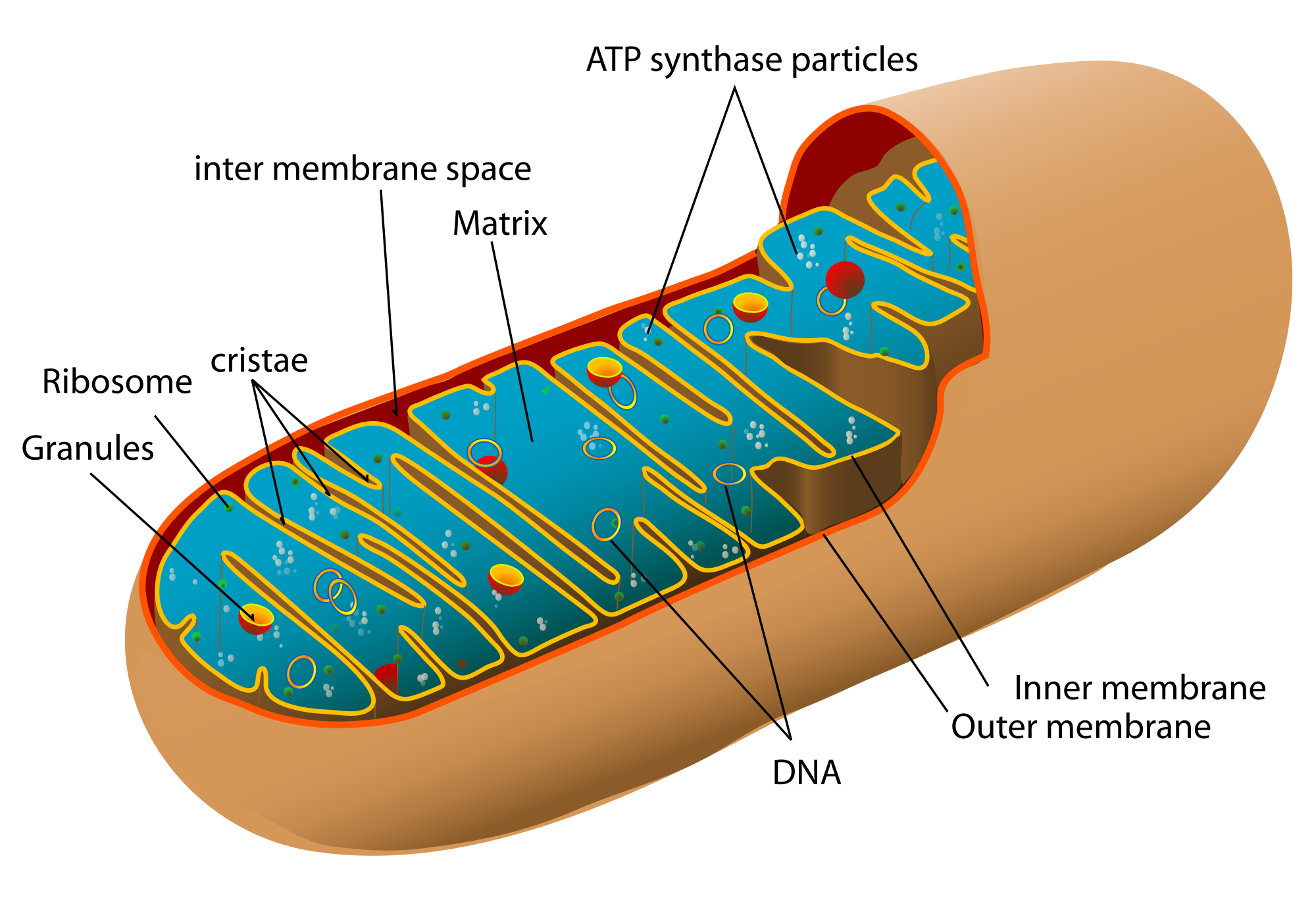
Mitochondria are commonly between 0.75 and 3 μm2 in cross section, but vary considerably in size and structure. Unless specifically stained, they are not visible. The mitochondrion is composed of compartments that carry out specialized functions. These compartments or regions include the outer membrane, intermembrane space, inner membrane, cristae, and matrix.
In addition to supplying cellular energy, mitochondria are involved in other tasks, such as signaling, cellular differentiation, and cell death, as well as maintaining control of the cell cycle and cell growth. Mitochondrial biogenesis is in turn temporally coordinated with these cellular processes.
Mitochondria are implicated in human disorders and conditions such as mitochondrial diseases, cardiac dysfunction, heart failure, and autism.
The number of mitochondria in a cell vary widely by organism, tissue, and cell type. A mature red blood cell has no mitochondria, whereas a liver cell can have more than 2000.
Although most of a eukaryotic cell's DNA is contained in the cell nucleus, the mitochondrion has its own genome ("mitogenome") that is similar to bacterial genomes. This finding has led to general acceptance of symbiogenesis (endosymbiotic theory) – that free-living prokaryotic ancestors of modern mitochondria permanently fused with eukaryotic cells in the distant past, evolving such that modern animals, plants, fungi, and other eukaryotes respire to generate cellular energy.
Mitochondria may have a number of different shapes. A mitochondrion contains outer and inner membranes composed of phospholipid bilayers and proteins. The two membranes have different properties. Because of this double-membraned organization, there are five distinct parts to a mitochondrion:
Mitochondrion
A mitochondrion (pl. mitochondria) is an organelle found in the cells of most eukaryotes, such as animals, plants and fungi. Mitochondria have a double membrane structure and use aerobic respiration to generate adenosine triphosphate (ATP), which is used throughout the cell as a source of chemical energy. They were discovered by Albert von Kölliker in 1857 in the voluntary muscles of insects. The term mitochondrion, meaning a thread-like granule, was coined by Carl Benda in 1898. The mitochondrion is popularly nicknamed the "powerhouse of the cell", a phrase popularized by Philip Siekevitz in a 1957 Scientific American article of the same name.
Some cells in some multicellular organisms lack mitochondria (for example, mature mammalian red blood cells). The multicellular animal Henneguya salminicola is known to have retained mitochondrion-related organelles despite a complete loss of their mitochondrial genome. A large number of unicellular organisms, such as microsporidia, parabasalids and diplomonads, have reduced or transformed their mitochondria into other structures, e.g. hydrogenosomes and mitosomes. The oxymonads Monocercomonoides, Streblomastix, and Blattamonas completely lost their mitochondria.
Mitochondria are commonly between 0.75 and 3 μm2 in cross section, but vary considerably in size and structure. Unless specifically stained, they are not visible. The mitochondrion is composed of compartments that carry out specialized functions. These compartments or regions include the outer membrane, intermembrane space, inner membrane, cristae, and matrix.
In addition to supplying cellular energy, mitochondria are involved in other tasks, such as signaling, cellular differentiation, and cell death, as well as maintaining control of the cell cycle and cell growth. Mitochondrial biogenesis is in turn temporally coordinated with these cellular processes.
Mitochondria are implicated in human disorders and conditions such as mitochondrial diseases, cardiac dysfunction, heart failure, and autism.
The number of mitochondria in a cell vary widely by organism, tissue, and cell type. A mature red blood cell has no mitochondria, whereas a liver cell can have more than 2000.
Although most of a eukaryotic cell's DNA is contained in the cell nucleus, the mitochondrion has its own genome ("mitogenome") that is similar to bacterial genomes. This finding has led to general acceptance of symbiogenesis (endosymbiotic theory) – that free-living prokaryotic ancestors of modern mitochondria permanently fused with eukaryotic cells in the distant past, evolving such that modern animals, plants, fungi, and other eukaryotes respire to generate cellular energy.
Mitochondria may have a number of different shapes. A mitochondrion contains outer and inner membranes composed of phospholipid bilayers and proteins. The two membranes have different properties. Because of this double-membraned organization, there are five distinct parts to a mitochondrion:
Recent media
Recent media