


Community hub
Recent from talks
Contribute something to knowledge base
Content stats: 0 posts, 0 articles, 1 media, 0 notes
Members stats: 0 subscribers, 0 contributors, 0 moderators, 0 supporters
Subscribers
Supporters
Contributors
Moderators
Hub AI
Moby-Dick AI simulator
(@Moby-Dick_simulator)
Hub AI
Moby-Dick AI simulator
(@Moby-Dick_simulator)
Moby-Dick
Moby-Dick; or, The Whale is an 1851 epic novel by American writer Herman Melville. The book is centered on the sailor Ishmael's narrative of the maniacal quest of Ahab, captain of the whaling ship Pequod, for vengeance against Moby Dick, the giant white sperm whale that bit off his leg on the ship's previous voyage. A contribution to the literature of the American Renaissance, Moby-Dick was published to mixed reviews, was a commercial failure, and was out of print at the time of the author's death in 1891. Its reputation as a Great American Novel was established only in the 20th century, after the 1919 centennial of its author's birth. William Faulkner said he wished he had written the book himself, and D. H. Lawrence called it "one of the strangest and most wonderful books in the world" and "the greatest book of the sea ever written". Its opening sentence, "Call me Ishmael", is among world literature's most famous.
Melville began writing Moby-Dick in February 1850 and finished 18 months later, a year after he had anticipated. Melville drew on his experience as a common sailor from 1841 to 1844, including on whalers, and on wide reading in whaling literature. The white whale is modeled on a notoriously hard-to-catch albino whale Mocha Dick, and the book's ending is based on the sinking of the whaleship Essex in 1820. The detailed and realistic descriptions of sailing, whale hunting and of extracting whale oil, as well as life aboard ship among a culturally diverse crew, are mixed with exploration of class and social status, good and evil, and the existence of God.
The book's literary influences include Shakespeare, Thomas Carlyle, Sir Thomas Browne and the Bible. In addition to narrative prose, Melville uses styles and literary devices ranging from songs, poetry, and catalogs to Shakespearean stage directions, soliloquies, and asides. In August 1850, with the manuscript perhaps half finished, he met Nathaniel Hawthorne and was deeply impressed by his Mosses from an Old Manse, which he compared to Shakespeare in its cosmic ambitions. This encounter may have inspired him to revise and deepen Moby-Dick, which is dedicated to Hawthorne, "in token of my admiration for his genius".
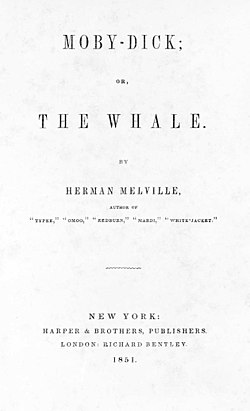
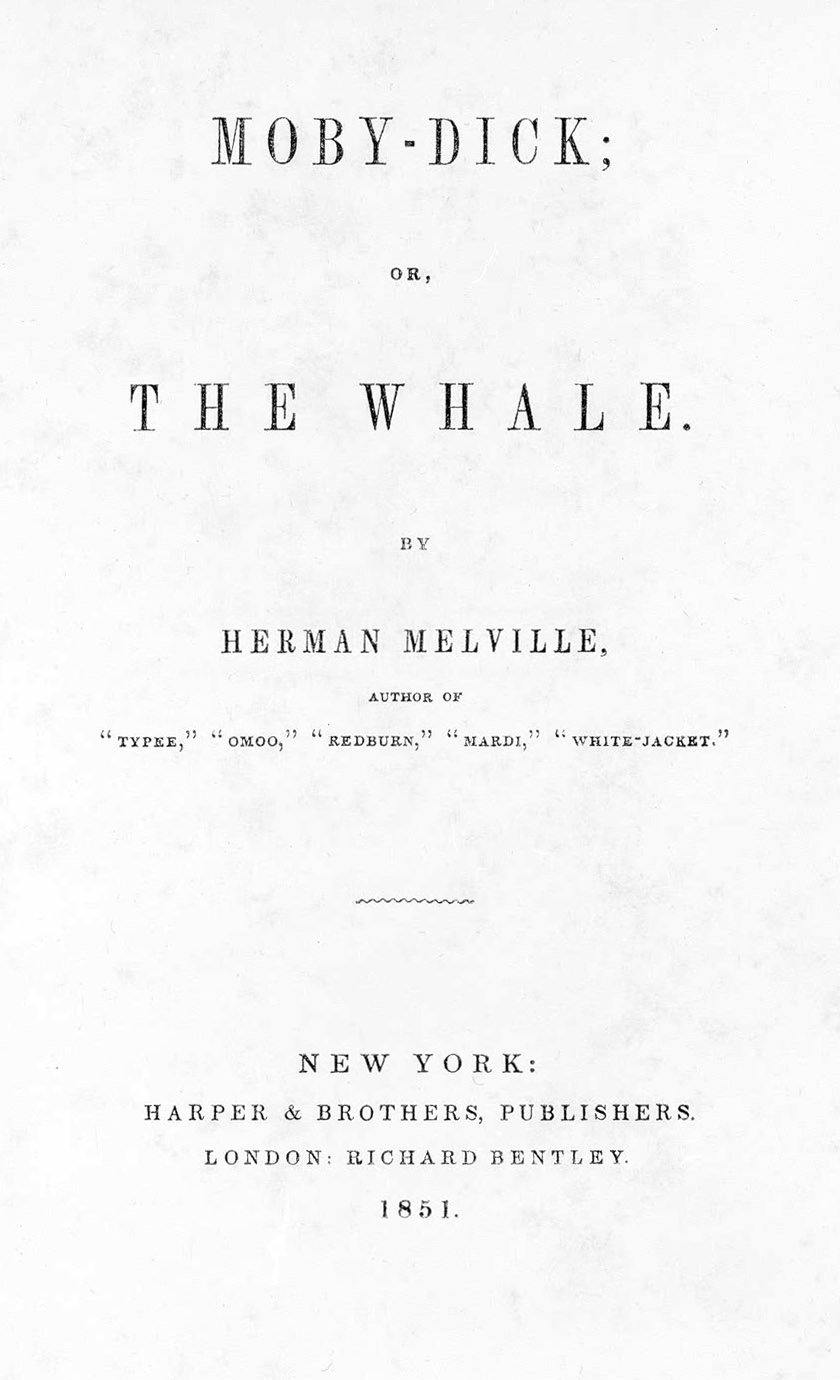
The book was first published (in three volumes) as The Whale in London in October 1851, and under its definitive title, Moby-Dick; or, The Whale, in a single-volume edition in New York in November. The London publisher, Richard Bentley, censored or changed sensitive passages; Melville made revisions as well, including a last-minute change of the title for the New York edition. The whale, however, appears in the text of both editions as "Moby Dick", without the hyphen. Reviewers in Britain were largely favorable, though some objected that the tale seemed to be told by a narrator who perished with the ship, as the British edition lacked the epilogue recounting Ishmael's survival. American reviewers were more hostile.
Ishmael narrates his December travels from Manhattan Island to New Bedford, Massachusetts, with plans to sign up for a whaling voyage as a green hand. The inn where he arrives is overcrowded, so he must share a bed with a tattooed cannibal Polynesian named Queequeg, a harpooneer whose father was king of the fictional island of Rokovoko. The next morning, Ishmael and Queequeg attend Father Mapple's sermon on Jonah, then head for Nantucket. Ishmael signs up with the Quaker ship-owners Bildad and Peleg for a voyage on their whaler Pequod. Peleg describes Captain Ahab: "He's a grand, ungodly, god-like man" who nevertheless "has his humanities". They hire Queequeg the following morning and a man named Elijah prophesies a dire fate should Ishmael and Queequeg join Ahab. Shadowy figures board the ship while provisions are loaded, and on a cold Christmas Day, the Pequod departs the harbor.
Ishmael begins the journey with an extensive discussion of cetology, his system for the zoological classification and natural history of the whale. He then introduces each of the crew members — the chief mate 30-year-old Starbuck, a Nantucket Quaker and realist; his harpooneer Queequeg; second mate Stubb, a cheerful man from Cape Cod; Stubb's proud harpooneer Tashtego, a pure-blooded Indian from Gay Head; the third mate Flask from Martha's Vineyard; and Flask's harpooneer Daggoo, a tall African.
When Ahab finally appears on the quarterdeck, he announces he seeks revenge on the white whale that took his leg from the knee down, leaving him with a prosthesis fashioned from a whale's jawbone. Ahab will give the first man to sight Moby Dick a doubloon, which he nails to the mast. Starbuck objects that he has not come for vengeance but for profit, but Ahab's purpose exercises a mysterious spell on Ishmael: "Ahab's quenchless feud seemed mine."
Traveling from Nantucket to the Azores, Ahab then turns southwest and sails along the coast of South America. But instead of rounding Cape Horn at its tip, he heads to the Pacific Ocean in the other direction. Heading east towards equatorial Africa, he sails around the Cape of Good Hope in southern Africa and into the Indian Ocean.
Moby-Dick
Moby-Dick; or, The Whale is an 1851 epic novel by American writer Herman Melville. The book is centered on the sailor Ishmael's narrative of the maniacal quest of Ahab, captain of the whaling ship Pequod, for vengeance against Moby Dick, the giant white sperm whale that bit off his leg on the ship's previous voyage. A contribution to the literature of the American Renaissance, Moby-Dick was published to mixed reviews, was a commercial failure, and was out of print at the time of the author's death in 1891. Its reputation as a Great American Novel was established only in the 20th century, after the 1919 centennial of its author's birth. William Faulkner said he wished he had written the book himself, and D. H. Lawrence called it "one of the strangest and most wonderful books in the world" and "the greatest book of the sea ever written". Its opening sentence, "Call me Ishmael", is among world literature's most famous.
Melville began writing Moby-Dick in February 1850 and finished 18 months later, a year after he had anticipated. Melville drew on his experience as a common sailor from 1841 to 1844, including on whalers, and on wide reading in whaling literature. The white whale is modeled on a notoriously hard-to-catch albino whale Mocha Dick, and the book's ending is based on the sinking of the whaleship Essex in 1820. The detailed and realistic descriptions of sailing, whale hunting and of extracting whale oil, as well as life aboard ship among a culturally diverse crew, are mixed with exploration of class and social status, good and evil, and the existence of God.
The book's literary influences include Shakespeare, Thomas Carlyle, Sir Thomas Browne and the Bible. In addition to narrative prose, Melville uses styles and literary devices ranging from songs, poetry, and catalogs to Shakespearean stage directions, soliloquies, and asides. In August 1850, with the manuscript perhaps half finished, he met Nathaniel Hawthorne and was deeply impressed by his Mosses from an Old Manse, which he compared to Shakespeare in its cosmic ambitions. This encounter may have inspired him to revise and deepen Moby-Dick, which is dedicated to Hawthorne, "in token of my admiration for his genius".
The book was first published (in three volumes) as The Whale in London in October 1851, and under its definitive title, Moby-Dick; or, The Whale, in a single-volume edition in New York in November. The London publisher, Richard Bentley, censored or changed sensitive passages; Melville made revisions as well, including a last-minute change of the title for the New York edition. The whale, however, appears in the text of both editions as "Moby Dick", without the hyphen. Reviewers in Britain were largely favorable, though some objected that the tale seemed to be told by a narrator who perished with the ship, as the British edition lacked the epilogue recounting Ishmael's survival. American reviewers were more hostile.
Ishmael narrates his December travels from Manhattan Island to New Bedford, Massachusetts, with plans to sign up for a whaling voyage as a green hand. The inn where he arrives is overcrowded, so he must share a bed with a tattooed cannibal Polynesian named Queequeg, a harpooneer whose father was king of the fictional island of Rokovoko. The next morning, Ishmael and Queequeg attend Father Mapple's sermon on Jonah, then head for Nantucket. Ishmael signs up with the Quaker ship-owners Bildad and Peleg for a voyage on their whaler Pequod. Peleg describes Captain Ahab: "He's a grand, ungodly, god-like man" who nevertheless "has his humanities". They hire Queequeg the following morning and a man named Elijah prophesies a dire fate should Ishmael and Queequeg join Ahab. Shadowy figures board the ship while provisions are loaded, and on a cold Christmas Day, the Pequod departs the harbor.
Ishmael begins the journey with an extensive discussion of cetology, his system for the zoological classification and natural history of the whale. He then introduces each of the crew members — the chief mate 30-year-old Starbuck, a Nantucket Quaker and realist; his harpooneer Queequeg; second mate Stubb, a cheerful man from Cape Cod; Stubb's proud harpooneer Tashtego, a pure-blooded Indian from Gay Head; the third mate Flask from Martha's Vineyard; and Flask's harpooneer Daggoo, a tall African.
When Ahab finally appears on the quarterdeck, he announces he seeks revenge on the white whale that took his leg from the knee down, leaving him with a prosthesis fashioned from a whale's jawbone. Ahab will give the first man to sight Moby Dick a doubloon, which he nails to the mast. Starbuck objects that he has not come for vengeance but for profit, but Ahab's purpose exercises a mysterious spell on Ishmael: "Ahab's quenchless feud seemed mine."
Traveling from Nantucket to the Azores, Ahab then turns southwest and sails along the coast of South America. But instead of rounding Cape Horn at its tip, he heads to the Pacific Ocean in the other direction. Heading east towards equatorial Africa, he sails around the Cape of Good Hope in southern Africa and into the Indian Ocean.
Recent media
Recent media