Hubbry Logo
QueequegQueequegMain
Open search
Queequeg
Community hub
Queequeg
logo
8 pages, 0 posts
0 subscribers
Be the first to start a discussion here.
Queequeg
Queequeg
from Wikipedia

Queequeg
Moby Dick character
Created byHerman Melville
In-universe information
GenderMale
NationalitySouth Pacific Islander

Queequeg is a character in the 1851 novel Moby-Dick by American author Herman Melville. The story outlines his royal, Polynesian descent, as well as his desire to "visit Christendom" that led him to leave his homeland.[1] Queequeg is visually distinguished by his striking facial tattoos and tan skin. Ishmael encounters Queequeg in Chapter Three and they become unlikely friends. Once aboard the whaling ship the Pequod, Queequeg becomes the harpooner for the mate Starbuck.

Familial and cultural history

[edit]

Queequeg is native to the fictional island of Kokovoko (also known as Rokovoko), an "island far away to the West and South",[1] or more specifically in the South Pacific Ocean. He was the son of High Chief, King as well various other well-respected individuals of his community. Queequeg's culture is referenced to be cannibalistic. The narration of the book makes it clear that cannibalism was not universally accepted at this time.

In the novel, Queequeg is described as having an "ambitious soul" who had a strong "desire to visit Christendom".[1] Queequeg left home when he snuck onto a Sag Harbor ship that was passing by his father's land. At first rejected by the whaler that landed on his island, he skillfully jumped from a canoe and clamped to the side of the boat as it was leaving for the open sea, at which point the captain relented.[1] He was trained as a whaleman during this time and continued in this profession going forward.

Despite his interest in "Christendom", Queequeg practiced a pagan religion. Queequeg practices a form of animism using a small idol named Yojo, for whom he builds small ceremonial fires. As part of his religion, he practices a prolonged period of fasting and silence (which Ishmael calls his "Ramadan").[1] In chapter seventeen, Queequeg locks himself in his room in Nantucket to keep his fast and silence. Even after Ishmael enters the room, Queequeg is unbothered and does not acknowledge Ishmael's presence.[1]

Queequeg's tattoos

[edit]

In her book Tattooing the World, author Juniper Ellis contemplates the significance of Queequeg's face and bodily markings. Ellis claims that Melville was inspired by a representation of the Māori Chief Te Pēhi Kupe in George Lillie Craik's book, The New Zealanders. Records indicate that Melville's encounter with Craik's book in 1850 caused him to replace Bulkington (the originally intended companion of Ishmael) with a new character: Queequeg.[2]

While the descriptions of Queequeg's tattoos are dissimilar to those of the Māori Chief, Ellis claims that Melville took inspiration from Te Pēhi Kupe. The parallels and distinctions between his source of inspiration are important to Ellis's interpretation of Queequeg. Although they are similar, Queequeg's tattoos are described in the text as more geometric and square-shaped than the Māori tattoos that are often "rounded into spirals".[2] Because the historical evidence points to Craik's book as an inspiration for Melville, Ellis argues that these tattoos similarly indicate genealogy, family, and individual identities. Additionally, she believes that these parallels create a stronger link between Queequeg and Pacific origin cultures.[2]

Relationship with Ishmael

[edit]

Queequeg and Ishmael first meet in New Bedford, Massachusetts when Ishmael and he are placed in the same room of The Spouter-Inn. At this moment, Queequeg had just returned from a whaling voyage and Ishmael was staying the night on the way towards a voyage as well. Queequeg returns late to the inn, not knowing that Ishmael has been booked into the same room with him. Ishmael is at first afraid of this unfamiliar person who he must share a bed with, however, he keeps an open mind. He quickly comes to the conclusion that "for all his tattooings he [Queequeg] was on the whole a clean, comely-looking cannibal."[1]

Chapter Four begins with Queequeg's arm "thrown over" Ishmael in his sleep.[1] This scene is an abrupt, striking contrast to the previous chapter in which Queequeg threatens to kill Ishmael. Ishmael states that "You had almost thought I had been his wife." Soon after, in Chapter 10, Queequeg proclaims that they are married, which in his country implies that they are "bosom friends".[1]

Steven B. Herrmann analyzes this relationship in his journal article "Melville's Portrait of Same-Sex Marriage in Moby-Dick." Herrmann believes that the "Ishmael-Queequeg 'marriage'...is the first portrait of same-sex marriage in American literature."[3] He sees the physical affection between the two characters as Melville moving beyond the "cultural imprints of homophobia" in literature.[3] Regardless of Herrmann's beliefs, it cannot be confirmed whether Melville intended for this to be a homosexual relationship; Melville leaves this interpretation to the reader.

Queequeg's coffin

[edit]

Toward the end of the novel Queequeg falls ill and is presumed to die. In chapter 110, Queequeg expresses his desire to not be buried in his hammock, "according to the usual sea-custom", but rather that a canoe-like coffin be made for him when he dies.[1] Sickness does not overtake Queequeg. While he recovers from his illness, he does die by other means in the end. He does not survive the Pequod's wreck as Ishmael is the only survivor. Still, he is ultimately responsible for saving Ishmael's life from beyond the grave. Ishmael survives the wreck by clinging to the coffin that had been made for Queequeg.[1]

Michael C. Berthold's journal article titled "Moby-Dick and American Slave Narrative" from the Massachusetts Review outlines one idea regarding the symbolic meaning of Queequeg's coffin.[4] When Queequeg heals and is no longer presumed to die in chapter 110, the book mentions how he spent many hours "carving the lid with all manner of grotesque figures and drawings...to copy parts of the twisted tattooing on his body."[1] In his article, Berthold says that because of the tattoos carved into it, the coffin is "Queequeg's sacred text and co-extensive with his own body."[4] Berthold sees this moment as in contrast to chapter 18 when Captain Peleg mislabels him as Quohog in the forms enrolling him to work on the ship. Queequeg is unable to correct Peleg's mistake because he cannot read or write. He is only able to sign the document with a mark that replicates one tattoo on his right arm.[1] Dissimilarly, Berthold mentions that the coffin allows for Queequeg to "reproduce his entire body" in terms of tattoos. Berthold sees this full representation of Queequeg's tattoos on the coffin as a reclamation of "the wholeness that the official discourse of a Peleg denies him" previously in chapter 18.

Race through Queequeg

[edit]

In her journal article "'Defamiliarization' and the Ideology of Race in 'Moby Dick'", Martha Vick states that the "use of language to acknowledge equality [specifically in descriptions of Queequeg] bestows the highest dignity possible on a nonwhite character at the same time that it calls into question the use of racial characteristics as criteria for determining identity."[5] For example, Ishmael initially describes Queequeg as a cannibal and a savage, but soon realizes that his appearances are misleading. Vick believes that Ishmael's consideration of Queequeg that contrasts the "illusion of his darkness" with the "reality of his goodness" promotes questioning of the traditional ideas of the racial hierarchy.[5] Vick mentions how Ishmael then states that "a man can be honest in any sort of skin", which contributes to her argument that Melville's language encourages a new and just way of thinking.

At one point in chapter 10, Ishmael describes Queequeg as having "large, deep eyes, fiery black and bold... He looked like a man who had never cringed and never had had a creditor... His [Queequeg's] forehead was drawn out in freer and brighter relief, and looked more expansive than it otherwise would."[1] Ishmael goes on to equate this description of Queequeg to George Washington's head. Ishmael states: "It had the same long regularly graded retreating, like two long promontories thickly wooded on top. Queequeg was George Washington cannibalistically developed."[1]

Skills and interests

[edit]

In Chapter Three, Queequeg stays out late selling human heads from New Zealand.[1]

Queequeg (center) and Ishmael approach the Pequod

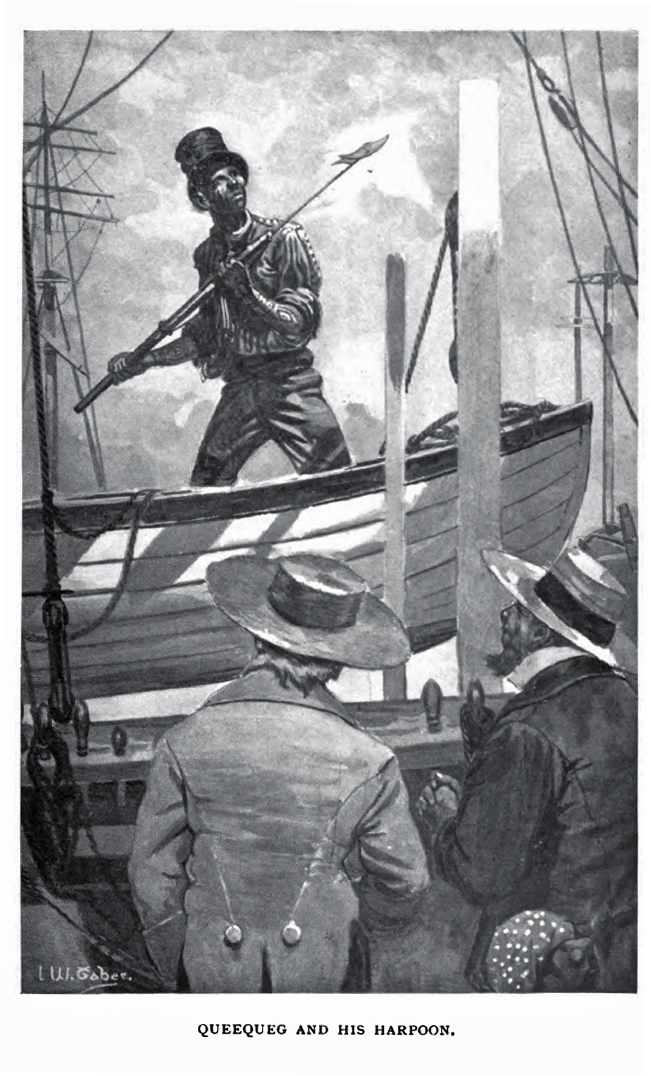
He is an extraordinary harpooner, demonstrating his skill for the money-tight owners of the Pequod by striking a small drop of tar floating on the water with one throw. The owners are so impressed that they immediately offer him a 90th lay (190 of the ship's profit) in exchange for his signing on with the crew. By contrast, Ishmael (who has experience in the merchant marine but none as a whaler) is initially offered a 777th lay but eventually secures a 300th. In port, Queequeg carries his sharpened harpoon with him at all times, unless prevented from doing so. He shaves with his harpoon as well and smokes regularly from a tomahawk that he carries with him.[1]

Cultural references

[edit]

Notes

[edit]

References

[edit]
Revisions and contributorsEdit on WikipediaRead on Wikipedia
from Grokipedia

Queequeg is a fictional Polynesian harpooneer and central character in Herman Melville's novel Moby-Dick, originating from the uncharted island of Kokovoko as the son of a chieftain who rejected royal privilege to join the trade after stowing away on a visiting ship in pursuit of civilized knowledge. His body is entirely covered in intricate, hieroglyphic tattoos applied by native artists from a young age, symbolizing both aesthetic and arcane significance within his culture. A self-described former cannibal who once partook in ritual consumption of enemies, Queequeg carries his small idol Yojo for pagan consultations and demonstrates unwavering loyalty, physical prowess in , and moral fortitude, including saving lives at despite initial perceptions of savagery by white characters.
Queequeg forms an immediate and intimate bond with the narrator upon their chance meeting in New Bedford, culminating in a shared treated as a matrimonial rite of comradeship that transcends cultural divides, highlighting themes of equality and mutual respect amid maritime perils. Aboard the Pequod under , he excels as harpooneer for the first mate Starbuck's boat, wielding his skills with precision and bravery during hunts for the white whale . Near the novel's climax, afflicted by illness during the final chase, Queequeg requests a be crafted to his specifications, which he uses symbolically before his death, later serving as Ishmael's improbable means of survival after the ship's sinking. His portrayal draws from Melville's encounters with Pacific Islanders during his own seafaring years, presenting Queequeg as a figure of noble whose virtues challenge Eurocentric assumptions of superiority.

Origins and Background

Familial Lineage

Queequeg is portrayed as the son of a ruling the fictional island of Rokovoko, located far to the west and south in the , a place described as absent from all maps since "true places never are." His father held the position of high chief and among a cannibalistic people, exemplified by hosting feasts where slain enemies—up to fifty in one battle—were barbecued and served garnished with , cocoanuts, and as customary presents to friends. This royal lineage endowed Queequeg with "excellent blood" and "royal stuff" in his veins, though marked by the island's practices, including his youthful participation in . Extended family included an uncle serving as and maternal aunts wed to unconquerable warriors, underscoring a heritage intertwined with priesthood and martial prowess; his paternal grandfather also held the role of . Accounts of siblings vary, with references to a younger brother who succeeded their father on the throne, as well as possible additional brothers and sisters, though Queequeg himself renounced succession to pursue after stowing away on a visiting ship at around age eighteen. His is noted as a woman of great rank, contributing to the family's influential status.

Cultural and Polynesian Roots

Queequeg originates from the fictional South Pacific island of Kokovoko, portrayed in Moby-Dick as a remote Polynesian landmass shrouded in equatorial mists, inaccessible to European maps. As the son of a tribal king, he was groomed for priesthood and idol craftsmanship, roles tied to Polynesian chiefly lineages where spiritual authority reinforced social hierarchy. Disillusioned with his society's rigid customs—including ritual cannibalism and idol worship—he abandoned Kokovoko on a whaling ship to witness Christian civilization, eventually adopting harpooneering as a trade. This backstory blends aristocratic Polynesian elements with a noble savage archetype, emphasizing themes of cultural displacement amid 19th-century global maritime expansion. Queequeg's extensive tattoos, covering him "all over with a queer uniform symbol or hieroglyphic," mirror real Polynesian practices, particularly the tā moko, which encoded genealogy, status, and spiritual protection through intricate, chiselled patterns. likely drew from published portraits of tattooed chiefs, such as Te Pēhi Kupe (c. 1800–1829), whose self-portrait—sent to in 1824 and reproduced in Western texts—featured bold facial and body moko that paralleled Queequeg's "puzzle" designs, interpreted by as arcane wisdom rather than mere decoration. These markings, applied by native artists using bone tools and pigments, served protective and identity functions in Polynesian societies, though Melville generalized them across fictional Kokovoko to evoke exotic otherness. His religious observances, centered on the shrunken-head idol Yojo carried for counsel and periodic fasting rituals akin to purification rites, evoke Polynesian and veneration prevalent in islands like the Marquesas and , where Melville sojourned in 1842–1844 aboard the Lucy Ann. Yet, these depictions romanticize and conflate traits— was more associated with Fijian or Marquesan outliers than core Polynesian polities—prioritizing narrative symbolism over ethnographic precision, as literary analysis notes Melville's success in capturing physical and ritual exteriors while eliding deeper linguistic or social variances. Historically, Polynesian men from , , and other archipelagos joined American fleets in significant numbers by the , valued for their navigational skills, endurance, and prowess with harpoons derived from traditional . Melville's portrayal thus grounds Queequeg in verifiable maritime reality, where Pacific Islanders comprised up to % of some crews, countering Western stereotypes by highlighting their competence amid cultural clashes. This integration reflects causal dynamics of economic opportunity and colonial contact, drawing from Melville's firsthand Pacific experiences rather than solely invented .

Physical Characteristics

Appearance and Tattoos

Queequeg is portrayed as a robust, muscular Polynesian standing approximately six feet tall, with broad noble shoulders, a barrel-like chest, and Herculean arms that convey both strength and agility. His build combines sturdiness with sinewy lightness, enabling cat-like grace in movement, though lacking excessive bulk. The skin exhibits a dark glossy tawny or purplish-yellow hue, deepened by tropical exposure to a woody, burnt texture. His facial features include high cheekbones, a broad flat , wide with thin lips and widely spaced teeth, and deep-set black eyes shadowed with intensity, framed by a wild, tangled mane-like . The shaved head bears a tattooed crown, enhancing the exotic, savage aspect that initially alarms , yet reveals underlying nobility upon closer acquaintance. Queequeg's most distinctive trait is his comprehensive tattooing, covering every limb from head to foot in a network of hieroglyphic designs executed by and seer of Kokovoko during a three-day . These markings, checkered with dark squares on the face, chest, arms, and legs—resembling dark green frogs or Satanic blue flames—form an intricate, pictorial treatise. Queequeg interprets them as a of the heavens and , alongside a mystical guide to truth, though their full meaning eludes even him, requiring a for finer details like labyrinthine arm patterns or symbolic figures such as a piercing a vine wreath. The tattoos vary in shade from blackish to tawny, influenced by sun exposure, underscoring their organic, lived-in quality. Later, as illness wastes his body to a lizard-like frame, the enduring tattoos highlight their permanence against physical decline.

Personality Traits and Abilities

Harpooneering Skills

Queequeg, originating from the island of Kokovoko, abandoned his princely status to pursue , eventually becoming the chief harpooneer among his tribe before shipping out on Western vessels. This background underscores his innate proficiency in the craft, honed through years of traditions adapted to industrial techniques. During recruitment for the Pequod in Chapter 16, Queequeg impressed Captain Peleg by precisely striking a small drop of floating on the water from the ship's bulwark with his , rendering it "out of sight" in a single throw. This feat of accuracy and control, performed under , secured his berth as a harpooneer despite initial about his foreign origins. In whaling operations, Queequeg's skills extended beyond throwing to include daring improvisation and anatomical precision. In Chapter 78, "Cistern and Buckets," while the crew extracted from a suspended 's head, the Indian harpooneer Tashtego fell headfirst into the cavity as the head detached and began sinking. Queequeg dove after it, executed side lunges with his sword near the bottom to breach the thick casing, and extracted Tashtego by the hair moments before submersion, preventing both drowning and loss of the valuable oil reservoir. This rescue highlighted his aquatic agility, familiarity with , and rapid decision-making under peril—essential for harpooneers facing entangled lines or capsized boats. As the Pequod's designated harpooneer for multiple boat crews, Queequeg participated in sperm whale pursuits, maintaining and wielding his weapon with ritualistic care, often invoking his gods before sharpening its barbs. His prowess contributed to the ship's early successes, embodying the blend of Polynesian ferocity and whaleman discipline that Melville contrasts with less adept crews.

Moral Character and Interests

Queequeg exhibits a profound sense of honor and , exemplified by his daring rescue of a stranded from the mast of the sinking ship Bouton de Rose in 1840, during which he scaled the vessel's side in heavy seas despite warnings of its instability. This act underscores his selfless courage, prioritizing human life over personal risk, a trait observes as transcending cultural boundaries. His loyalty manifests in unbreakable bonds, particularly with , whom he treats as a brother, sharing resources and defending against prejudice from innkeepers and crewmates alike. Despite his Polynesian origins involving cannibalistic practices—Queequeg recounts consuming human flesh in tribal rituals before adopting —his conduct aboard the Pequod reveals a reformed moral compass aligned with over savagery. He displays by dividing his earnings equally with and maintaining composure amid the crew's superstitions, earning respect through deeds rather than words. Queequeg's integrity shines in his refusal to abandon duty, even when illness strikes, requesting a to ensure his body receives proper rites, reflecting a stoic acceptance of mortality. His interests center on mastery, where he hones harpooning with ritualistic precision, viewing it as both and cultural extension of his tattooed heritage symbolizing Polynesian cosmology. Devout to his idol Yojo, Queequeg consults it for guidance on voyages, blending spiritual fatalism with pragmatic , yet he tolerates Christian practices without proselytizing, indicating a tolerant worldview. These pursuits reveal a character driven by and , having forsaken royal inheritance in Rokovoko to wander the seas since the early 1830s, seeking knowledge of distant civilizations.

Interpersonal Dynamics

Bond with Ishmael

Ishmael first encounters Queequeg at the Spouter-Inn in , where overcrowding forces the two to share a despite Ishmael's initial alarm at Queequeg's tattooed appearance and pagan idol, Yojo. Ishmael's trepidation quickly dissipates as he observes Queequeg's orderly habits and dignified demeanor, leading him to reflect that "better is a dinner of herbs where love is, than a stalled ox and hatred therewith." By morning, Ishmael embraces the arrangement, viewing Queequeg as a noble "son of darkness" whose simplicity surpasses Christian hypocrisy he had witnessed at church. In Chapter 10, titled "A Bosom Friend," their solidifies through shared rituals: Queequeg offers Ishmael his tomahawk-pipe for a smoke, symbolizing trust, after which Queequeg performs a Maori-inspired forehead press, declaring them wedded "bosom friends" bound by mutual sacrifice, even unto death. This pact transcends cultural divides, as Ishmael reciprocates by joining Queequeg's worship of Yojo, kneeling beside the idol while invoking , an act Melville frames as harmonious rather than contradictory. Their companionship extends to attending Whaleman's Chapel together, where Queequeg's pagan reverence contrasts yet complements Ishmael's introspection on mortality. The bond proves practical when they jointly sign onto the Pequod in on December 27, 1840 (as dated in the ), with Queequeg's harpooneering credentials securing 's berth despite his novice status. Melville depicts this alliance as a model of , unmarred by , though later voyage perils test its depth, such as Queequeg's refusal to abandon Ishmael during a storm. Unlike transient sailor ties, their friendship endures as a , emphasizing Melville's theme of innate human solidarity over societal barriers.

Narrative Role

Contributions to the Voyage

Queequeg served as the principal er for Starbuck's on the Pequod, leveraging his renowned proficiency with the harpoon to strike and secure during the ship's extended pursuit . His skill was evident in the initial whale hunts, where he executed precise thrusts amid turbulent seas, contributing to the crew's early successes in processing for oil. In Chapter 64, during the of a captured , Queequeg descended into the carcass alongside Tashtego to extract , tethered to on deck via the "monkey-rope"—a precarious lifeline that underscored the collective risk and interdependence required for operations. This highlighted Queequeg's physical courage and technical expertise, as his actions directly facilitated the extraction of valuable components essential to the voyage's commercial viability. Queequeg's interpretive contributions included sharing omens from his pagan consultations, such as Yojo's guidance during a casting of whalebone lots in Chapter 51, which influenced crew decisions on whale sightings and reinforced the superstitious undercurrents of the expedition. Though not always aligning with Christian crew members' views, these insights integrated diverse cultural practices into the Pequod's operational rhythm, aiding in the navigation of uncertainties inherent to whaling.

The Coffin Episode and Its Aftermath

In Chapter 110 of , Queequeg contracts a sudden fever while assisting the crew in accessing and repairing a persistent leak in the Pequod's hold, where casks of oil had been stowed and subsequently damaged. Convinced that death was imminent due to the severity of his symptoms, which left him and unable to perform duties, Queequeg directed the ship's carpenter to construct a without delay, specifying its dimensions to match his robust frame. The carpenter complied swiftly, producing a simple pine box that Queequeg inspected by lying within it, adjusting the fit, and declaring it adequate with the native term "Rarmai," signifying approval. Despite preparations for his burial rites, including the involvement of Pip in mourning and the crew's observation of his stoic acceptance, Queequeg experienced a profound shift in resolve. Contemplating his unfinished personal and obligations—such as his pact with and the hunt for —he exerted an act of willpower, likening it to gripping a rope to pull himself from the brink, which precipitated a rapid recovery over the following week. This turnaround, attributed by to Queequeg's inherent vitality rather than medical intervention, left the crew amazed, as no fever-breaking remedies proved effective prior to his self-determined rally. Following his , Queequeg repurposed the as a practical sea chest, lashing it shut and adorning its lid with intricate tattoos that chronicled key events of his life in symbolic hieroglyphics, transforming it into a akin to his own tattooed body. He continued to use it for storing belongings during the remainder of the voyage, maintaining its utility aboard the Pequod. The coffin's ultimate role emerged in the catastrophe of the Pequod's sinking after the third and final chase of . As the vessel disintegrated, Queequeg's sea chest—now serving as an life per his earlier contingency instructions during his illness—was cast into the sea alongside a trailing line. , separated from the vortex that engulfed the rest of the including Queequeg, seized the and floated upon it for a full day and night until rescued by the ship on its search for lost souls. This preservation of , the novel's narrator and sole survivor, directly linked Queequeg's foresight and craftsmanship to the perpetuation of the tale itself.

Literary Interpretations

Symbolism of Otherness and Nobility

Queequeg's depiction as a tattooed Polynesian harpooneer from the fictional Rokovoko island embodies otherness as a cultural and racial antithesis to the Anglo-American protagonists, highlighting Melville's engagement with and in mid-19th-century literature. His body, covered in "puzzling hieroglyphics" that Ishmael likens to an indecipherable code, symbolizes the inscrutability of non-Western traditions, evoking the era's fascination with Pacific islanders as enigmatic "savages" whose defied . This otherness manifests in practices like idol worship with his Yojo and cannibalistic background, positioning Queequeg as an outsider whose pagan rituals contrast sharply with the Pequod's nominal , yet provoke 's introspective tolerance rather than outright rejection. In counterpoint to this alienation, Queequeg's nobility emerges through virtues that transcend cultural barriers, aligning with the Romantic "" archetype wherein uncivilized figures possess innate moral superiority over corrupted modernity. As a prince by birth who forsakes royalty for , he exhibits , as in his marital bond with via the gams ritual, and heroism, such as rescuing a fellow boarder from a using his with precise restraint. Literary analysis identifies this as Melville's deliberate inversion of stereotypes, where Queequeg's prelapsarian goodness—untainted by industrial society's hypocrisies—elevates him above figures like the manipulative innkeeper or the crew's petty quarrels, his tomahawk signature forming an infinity loop to signify universal humanity. Critics like those examining virtue in traditional terms affirm Queequeg's portrayal as a "truly ," whose actions, such as and coffin-building in Chapter 110 amid illness, reflect stoic acceptance and communal foresight over self-preservation. This duality of otherness and nobility critiques Eurocentric hierarchies without romanticizing primitivism uncritically; Queequeg's tattoos, while alien, enable practical prowess in whaling, and his death—clinging to his self-made coffin—paradoxically preserves life for Ishmael, symbolizing redemptive potential in the marginalized. Scholarly readings emphasize how Melville synthesizes racial traits in Queequeg to represent mankind's totality, challenging reductive views of the "other" as inferior while grounding nobility in observable deeds rather than abstract ideals. Such interpretations, drawn from textual evidence, avoid sentimental overlays, portraying Queequeg's essence as a pragmatic fusion of exotic difference and ethical fortitude amid the novel's existential perils.

Racial and Cultural Depictions

Queequeg is depicted as a native of the fictional of Kokovoko, located far to the west and , a place not found on any map as "true places never are." Physically, he is described in Chapter 3 as a robust figure standing about six feet tall with noble shoulders, a swarthy complexion, and his entire body covered in intricate tattoos executed in the manner of Arzber's hieroglyphics, rendering him a "complete " in appearance. These tattoos, applied during his youth on his native , symbolize a cultural practice blending artistry and ritual significance, drawing from Polynesian traditions Melville encountered in his travels, though exaggerated for literary effect. Culturally, Queequeg embodies elements of customs, including worship of a small wooden idol named Yojo, which he consults for guidance, and rituals such as and before whaling expeditions. He acknowledges a of from his homeland but claims to have abandoned it upon exposure to Christian missionaries in the Sag Harbor, retaining instead a pragmatic that comes to admire. His use of a for , , and reflects a utilitarian adaptation of native tools to maritime life, highlighting Melville's portrayal of indigenous ingenuity over barbarism. In racial terms, Melville presents Queequeg not as a monolithic "savage" but as a composite figure transcending ethnic categories, with traits evoking Polynesian, Maori, and broader Pacific origins, challenging mid-19th-century phrenological and physiognomic racial pseudosciences prevalent in American discourse. This depiction aligns with the noble savage archetype, wherein Queequeg's innate morality, loyalty, and skill surpass the hypocrisies of white civilization, as evidenced by Ishmael's evolving respect and their fraternal bond. Scholarly analyses interpret this as Melville's subversion of racial hierarchies, using Queequeg's tattoos and customs to critique deterministic views of race while emphasizing shared humanity through action rather than origin.

Critiques of Anachronistic Readings

Critiques of anachronistic readings of Queequeg emphasize that imposing 20th- and 21st-century frameworks, such as postcolonial theory or critical race paradigms, onto Melville's 1851 portrayal distorts the character's depiction as an autonomous, virtuous figure embodying Romantic-era ideals of the . Scholars argue these modern lenses retroactively frame Queequeg's tattoos, cannibal heritage, and interracial bond with as symbols of colonial trauma or subaltern silencing, neglecting the novel's explicit praise of his harpooneering prowess, moral integrity, and —traits admires without hierarchical condescension. For instance, Queequeg's decision to carve his own in Chapter 110 and will himself to recover demonstrates willful agency, not victimhood, aligning with Melville's antebellum context of individual resilience amid democratic pluralism rather than systemic oppression narratives. Such readings often stem from a scholarly of projecting contemporary ideologies onto , as identified by critics who trace anachronistic interpretations back to early 20th-century responses like D.H. Lawrence's post-World War I casting of as proto-fascist, a pattern that extends to Queequeg by recasting his as racial othering. Traditional interpreters, including those emphasizing Melville's Shakespearean epic scope, counter that Queequeg functions as a mythic of primal , not a tokenized minority, with his equality to white crewmates underscoring the text's of through competence rather than grievance. This approach privileges the historical of the , where Melville deconstructed racial hierarchies via empowerment—e.g., Queequeg's sermon-like challenging Protestant norms—over ahistorical applications that prioritize modern identity categories. Furthermore, these critiques highlight how academia's prevalent ideological biases amplify interpretations viewing Queequeg as inherently inferior despite textual evidence of his superiority in and , such as outshining European sailors in efficiency and exhibiting stoic wisdom during storms. By decentering rigid racial paradigms, analysts reveal Melville's use of figures like Queequeg to within white society, not to prefigure intersectional victimhood, thereby restoring the character's role in the novel's metaphysical quest over politicized readings that impose unverifiable causal claims of enduring trauma. Empirical fidelity to the text's publication context, including influences from Pacific voyage accounts, supports this recovery of Queequeg as a symbol of uncorrupted humanity, unburdened by later theoretical overlays.

Cultural Legacy

Adaptations in Media

Queequeg appears in several film and television adaptations of Moby-Dick, often portrayed as a tattooed Polynesian harpooneer emphasizing his physical prowess and bond with Ishmael. In John Huston's 1956 film Moby Dick, Austrian actor Friedrich von Ledebur depicted Queequeg as a stoic, imposing figure central to the crew's dynamics aboard the Pequod. The portrayal highlighted his tattoos and harpooning skills during whale hunts, though the adaptation condensed the novel's interpersonal depth. Television miniseries have featured Queequeg in more expansive narratives. The 1998 USA Network production, directed by , cast New Zealand Māori actor Piripi Waretini as Queequeg, incorporating cultural immersion in the role through research into Polynesian tattooing traditions. Waretini's performance underscored Queequeg's nobility and the coffin-lifebuoy episode, aligning with Melville's depiction of his loyalty. In the 2011 miniseries directed by Mike Barker, actor portrayed Queequeg, bringing a Native American perspective to the character's exotic otherness while focusing on his whaling expertise and friendship with . Stage and operatic adaptations have innovated Queequeg's representation, often amplifying symbolic elements. In the San Francisco Opera's 2010 production of Jake Heggie's Moby-Dick, Samoan-New Zealand bass Jonathan Lemalu played Queequeg, with the role involving researched tattoos to evoke Polynesian heritage and integrating dance-like movements in whaling scenes. Theatrical versions, such as the 2015 Chicago Shakespeare Theater adaptation, featured choreography for Queequeg to convey his harpooning agility and cultural rituals, positioning him as a dynamic force in the ensemble. More recent stage works, like the Repertory Theatre of St. Louis's production, cast actors such as Kevin Aoussou to emphasize Queequeg's physicality and narrative contributions to the Pequod's fate. These portrayals generally preserve Queequeg's role as a noble savage archetype, though adaptations vary in fidelity to Melville's detailed ethnographic descriptions.

Influence on Literature and Scholarship

Queequeg's character has shaped scholarly examinations of racial dynamics and cultural hybridity in 19th-century American fiction, serving as a counterpoint to the noble savage archetype through his agency and integration into the Pequod's crew. Postcolonial analyses highlight how Melville's depiction critiques imperial hierarchies, with Queequeg's tattoos and rituals embodying resistant indigenous knowledge systems that challenge Western literacy norms. Birgit Brander Rasmussen's Queequeg's Coffin: Indigenous Literacies and Early American Literature (2012) leverages the character's coffin carvings—described by Ishmael as hieroglyphic—as a metaphor for pre-Columbian non-alphabetic literacies, arguing that such symbols reveal overlooked native epistemologies intersecting with European texts in the Americas. In and , the Ishmael-Queequeg bond influences interpretations of in antebellum literature, with scholars positing it as an early model of interracial intimacy that prefigures modern same-sex narratives, though some critiques note the risk of retrofitting 21st-century frameworks onto Melville's era. This relational dynamic has prompted studies on disavowal and embodiment, where Queequeg's tattooed body resists racialized , informing broader discussions of corporeality in multicultural texts. Allusions to Queequeg in subsequent often invoke his and loyalty, as seen in the naming of the submarine Queequeg in Lemony Snicket's series (2000–2006), where it symbolizes perilous yet redemptive voyages akin to the Pequod's quest. Scholarly works citing Queequeg extend to comparative race studies, contrasting his portrayal with figures in Elizabeth Stoddard's The Morgesons (1862) to explore African-Native intersections in Melville's oeuvre. These engagements underscore Queequeg's enduring role in dissecting America's imperial self-conception, though interpretations vary in attributing Melville's intent versus reader projections.

References

Add your contribution
Related Hubs
User Avatar
No comments yet.