Hubbry Logo
QuarterdeckQuarterdeckMain
Open search
Quarterdeck
Community hub
Quarterdeck
logo
8 pages, 0 posts
0 subscribers
Be the first to start a discussion here.
Quarterdeck
Quarterdeck
from Wikipedia

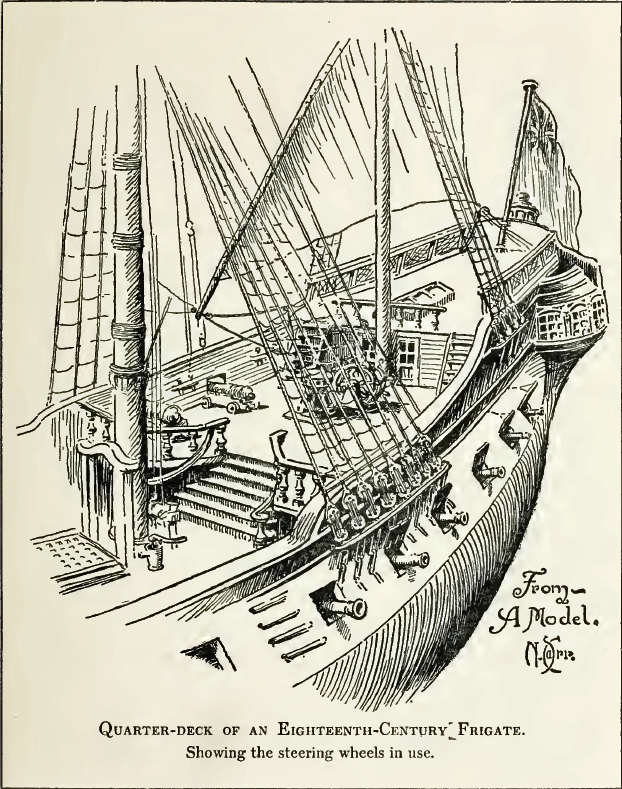
Raised quarterdeck of an 18th-century frigate, between the main mast and the even higher poop deck at the stern.
Before helicopter decks became common, warships such as the Rothesay class often had a deck at the stern used for secondary armament.
Seaplanes were often operated from the quarterdeck of battleships, as here on USS Colorado
Quarterdeck of a Japanese warship. Note the watchstanders in uniform, the wooden plaque, and the proximity to the accommodation ladder.

The quarterdeck is a raised deck behind the main mast of a sailing ship. Traditionally it was where the captain commanded his vessel and where the ship's colours were kept. This led to its use as the main ceremonial and reception area on board, and the word is still used to refer to such an area on a ship or even in naval establishments on land. Many such facilities have areas decorated like shipboard quarterdecks.[1]

In the 20th century the word came to be applied to the area at the stern of the ship, often (on naval vessels) used for secondary weapons and (on battleships) seaplane catapults.

Ceremonial use

[edit]

There are ancient traditions of offering special deference to the quarterdeck. Greek, Roman, and Carthaginian warships all carried shrines which were given special respect. This continued into Christian times,[2] and in medieval British warships, the religious shrine was set up on the quarterdeck. All hands were required to salute it by taking off their hats or caps. This led to the habit of saluting whenever one entered the quarterdeck.[3]

Today, quarterdeck refers not to a specific deck, but to a ceremonial area designated as such by the captain, often used as the ship's reception area while in harbour. As in the days of sail, it is a place where the captain has special control and prerogatives.[2]

In port, the quarterdeck is the most important place on the ship, and is the central control point for all its major activities, as well as it is where the captain usually stands. Underway, its importance diminishes as control of the ship is transferred to the bridge. The quarterdeck is normally on the main deck, but may be elsewhere in some types of ship. It is usually marked off by special lines, deck markings, decorative cartridge cases, or fancy knotwork.[4]

Special attention is paid to the quarterdeck's cleanliness and physical appearance. Those standing watch on the quarterdeck must be in the uniform of the day and present a smart appearance at all times. Personnel not in the uniform of the day generally avoid crossing the quarterdeck unless their work requires it. On ships with a well-defined quarterdeck area, uniformed personnel should salute when they enter it. Smoking and recreational activities are prohibited on the quarterdeck unless specially authorised by the commanding officer.[4]

The starboard gangway to the quarterdeck is normally used by officers and their visitors; the port gangway is used by everyone else. In bad weather, all personnel use the lee gangway. On smaller ships with only one gangway, it may be rigged to either side and is used by everyone. Flagships sometimes have an additional starboard gangway for the flag officer and officers of his staff.[4]

History

[edit]

In medieval times, warships had a single deck, with raised structures at each end: the "forecastle" in the front, and the "aftercastle" in the rear. Following the introduction of cannon, the aftercastle was gradually replaced with a simpler structure consisting of the halfdeck above the main deck, extending forwards from the stern to the mainmast; and above that the quarterdeck, extending about half as far forwards. Later the halfdeck was extended the entire length of the ship, becoming the main deck (the former main deck now being the gun deck), leaving the quarterdeck as the only significant deck above the main deck.[citation needed]

The captain or master commanded the ship from the quarterdeck. The quarterdeck was traditionally the place where the captain walked when on deck, usually on the windward side. The navigator also used it when taking his sights when fixing the vessel's position. On most ships, it was customary that only officers could use the quarterdeck, others being allowed there only when assigned for specific duties.[3] By extension, on flush-decked ships the after part of the main deck, where the officers took their station, was also known as the quarterdeck.[citation needed]

Scouting

[edit]

In Sea Scouts a Quarterdeck is described as a group of foremost youth officers in a ship, summarily the same model is applied to form Quarterdecks on the Council & National Level.[5][6]

Quarterdeck trainings are also often carried out by Sea Scout Ships to equip leaders to be able to effectively organize the unit.[7][8][9][10]

See also

[edit]

References

[edit]
Revisions and contributorsEdit on WikipediaRead on Wikipedia
from Grokipedia
The quarterdeck is the raised stern portion of a ship's upper deck, typically extending from the mainmast aft to the or , and historically serving as the command station for the and officers during voyages. This area, often elevated for better and , covers approximately one-quarter of the ship's length, hence its name, and was a key feature in vessels from the onward. In naval tradition, the quarterdeck held profound ceremonial and symbolic importance, functioning as a space for official rituals and honors. It was considered the heart of naval authority, with strict protocols such as saluting when entering or leaving to enforce respect for . Architecturally, the quarterdeck provided tactical advantages by housing the helm and allowing officers to oversee operations while elevated for visibility; it was often shielded from and featured ornate galleries for and ventilation in the captain's cabins. Over time, as naval technology evolved from to and modern warships, the quarterdeck's physical prominence diminished on many vessels, particularly those with full-length weather decks or flight operations aft. Nonetheless, its cultural legacy endures in contemporary navies, where it designates the for dignitaries, the site for boarding ceremonies, and a symbolic zone of command on bases or ships in port—exemplified by the U.S. Navy's use of quarterdecks for security control points and official receptions. This enduring role underscores the quarterdeck's transition from a to an of naval and .

Definition and Overview

Etymology and Basic Concept

The term "quarterdeck" originates from the English naval , combining "quarter," which denotes the rear or section of a vessel—specifically the aftermost quarter of its —and "deck," referring to a horizontal platform or floor within the ship's structure. This first emerged in the early , with the earliest recorded use dating to in the writings of English naval officer , describing a partial deck extending forward from the . The designation reflects the quarterdeck's original extent, which covered approximately one-quarter of the ship's from the aft end, distinguishing it as a specialized area above the main hull. At its core, the quarterdeck constitutes the raised portion of a ship's upper deck situated at the , serving as an elevated platform primarily reserved for officers, command activities, and official proceedings. This positioning at the vessel's rear—known as the , the rearmost part opposite the bow—provided strategic oversight and separation from the working areas forward. Unlike the , a raised forward deck often used by enlisted crew for lookout duties, the quarterdeck emphasized and exclusivity in naval operations. To grasp the quarterdeck's role, it is essential to understand basic ship deck layering and stern configuration in sailing vessels. Decks are stacked horizontally within a ship's hull, with the upper deck forming the highest continuous level spanning from bow to , exposed to the weather and supporting masts, rigging, and superstructure. Below it lies the in warships, a lower level dedicated to mounting cannons for broadside fire, while deeper layers like the orlop deck handle storage and berthing. In traditional ships, the 's rounded or squared design accommodated the quarterdeck's elevation, often integrating with the above for enhanced visibility and protection from forward seas. This arrangement underscored the quarterdeck's function as a command nexus, briefly underscoring its ceremonial significance in naval protocols.

Physical Characteristics in Naval Design

The quarterdeck in naval design typically consists of a raised platform located at the of the vessel, positioned behind the main mast on ships and serving as an elevated extension of the upper deck. This structure often incorporates a above it for additional height and enclosure, providing a vantage point for command operations, and is enclosed by bulwarks or railings to offer protection against waves and falls. The of the quarterdeck generally spans one-quarter to one-third of the ship's overall deck , allowing sufficient space for essential functions while maintaining structural balance. Variations in quarterdeck design occur across ship classes, with warships featuring higher elevations and more ornate elements such as fittings and protective awnings to enhance and prestige, in contrast to the utilitarian configurations on merchant vessels that prioritize simplicity and efficiency. These differences reflect the tactical demands of vessels versus the economic focus of commercial ones. Historically, quarterdeck construction on employed planking, typically 2 inches thick, laid over beams measuring about 7.2 inches fore-and-aft by 4.8 inches deep, spaced 24-28 inches apart, with strings for support to ensure against marine conditions. In modern metal-hulled vessels, the evolves to steel grating for the deck surface, promoting drainage, reducing weight, and improving stability through open frameworks that allow water to pass through while maintaining non-slip traction. This shift supports the quarterdeck's role in officer oversight of deck activities.

Historical Development

Origins in Age of Sail

The quarterdeck emerged in European navies during the as sailing ships transitioned from earlier designs like the to more specialized warships such as galleons, providing an elevated stern platform that offered captains a superior vantage point for command during battles obscured by . This raised structure, inherited from the high stern castles of carracks, was narrower than the main deck to accommodate the ship's hull lines, enhancing stability while allowing for better visibility over the deck and . In galleons, the quarterdeck's considerable height above the served as a battle platform for officers and marksmen, integrating seamlessly with the overall design to support transoceanic voyages and combat maneuvers. Key developments in the quarterdeck's design included the integration of steering mechanisms and the captain's cabin directly below, centralizing control at the . By the mid-16th century, the —a vertical lever extending from the up through the deck—enabled helmsmen to operate from the quarterdeck alongside the captain, allowing for coordinated adjustments amid the chaos of sail handling and gunfire. The cabin beneath provided private quarters for the , often fitted with access ladders to the deck above, reflecting the growing emphasis on hierarchical command in . This layout facilitated the adoption of broadside tactics, where ships maneuvered to present their full gun batteries; the quarterdeck mounted chaser guns, long-barreled pieces to harass pursuing vessels without exposing the vulnerable broadside. A notable example of the quarterdeck's significance is seen in during the in 1805, where the structure featured protective splinter netting rigged overhead to shield officers from falling debris and two 12-pounder carronades as stern chasers, alongside signal halyards for fleet communications. From this elevated position, Admiral Nelson directed operations, hoisting the famous signal "England expects that every man will do his duty" via flags on the mizzen mast before being mortally wounded by musket fire while pacing the deck. The quarterdeck's design thus underscored its dual role as a tactical hub and vulnerable command post in line-of-battle engagements.

Evolution Through Steam and Modern Eras

The transition to steam propulsion in the marked a pivotal evolution in quarterdeck design, as naval architects adapted traditional raised structures to integrate with emerging mechanical systems. Early steamships often retained a extending from the to the quarterdeck, echoing sailing vessel layouts, but high bulwarks that trapped water and caused flooding of lower state-rooms were replaced with open rails and netting for improved drainage and safety. To accommodate tall funnels for exhaust and the introduction of double-tiered bridge structures spanning sturdy stanchions, quarterdeck heights were adjusted, allowing better visibility for command while positioning the captain's station near gear and propulsion elements. In ironclad warships, such as those developed during the , protective iron plating was applied to the hull and key areas to shield command functions from fire, representing a fundamental shift from vulnerable wooden designs to armored steam-powered vessels. The brought further transformations driven by specialized types, where the quarterdeck's role diminished in favor of operational priorities. On carriers, evolving from conversions to purpose-built vessels, traditional stern structures were integrated into flight decks that optimized operations, with limited stern space retained for boarding and access. Submarines, constrained by hydrodynamic needs for submerged efficiency, featured minimal or purely symbolic quarterdecks—often small platforms aft of the or —prioritizing stealth and internal operations over exposed deck space. These adaptations reflected broader naval priorities of speed, integration, and , reducing the quarterdeck's prominence from its sailing-era centrality. Following , quarterdeck design trended toward practicality and durability, emphasizing integration with advanced materials and reduced ceremonial emphasis to support high-intensity operations. Composite materials, such as fiber-reinforced polymers, were increasingly adopted for upper structures, offering corrosion resistance, lighter weight, and lower maintenance compared to steel. The USS Enterprise (CVN-65), commissioned in 1961 as the U.S. Navy's first carrier, illustrated this era with its 1,123-foot , while prioritizing and aviation capabilities over ornate traditional features.

Ceremonial and Symbolic Role

Protocols and Traditions

One of the fundamental protocols associated with the quarterdeck is the upon boarding a naval vessel, performed by bringing the right hand to the head as a of respect to the ship and its ensign. This tradition, rooted in historical of uncovering or touching the , requires personnel to halt at the quarterdeck, face the , and execute the before proceeding. The national ensign and commissioning pennant are positioned at the staff on the quarterdeck, reinforcing its symbolic role in these rites. Key traditions include the ceremonial reception of dignitaries through "piping the side," where a boatswain's mate sounds the call on a pipe to signal the visitor's arrival, accompanied by sideboys forming ranks on the quarterdeck. The sideboys, dressed in ceremonial attire, in unison as the visitor ascends to the deck, with their number determined by rank—two for officers of O-4 and below, four for O-5 and O-6, six for O-7 and O-8, and eight for O-9 and above. This practice, originating from age-of-sail assistance in boarding, emphasizes honor and formality. The quarterdeck also serves as the venue for inspections and divine services, where strict governs conduct to maintain reverence, such as standing at attention and avoiding disruptions. Historically, it has been linked to solemn observances like "," a phrase denoting the death of a , drawn from Alfred Lord Tennyson's poem and used in naval announcements to symbolize the transition from life to the . In both the Royal and U.S. , personnel wear prescribed and perform hand salutes upon entering the quarterdeck to signify respect for authority. These protocols collectively preserve the quarterdeck's status as a hallowed space for symbolic acts of deference and commemoration.

Role in Shipboard Hierarchy

In naval tradition, the quarterdeck served as a restricted area primarily reserved for commissioned s and midshipmen, with enlisted personnel granted access only for assigned duties or with explicit permission from a superior . This exclusivity reinforced the ship's command structure, positioning the quarterdeck as the captain's domain for key decision-making, navigation oversight, and strategic consultations. Historical regulations, such as those in the during the , limited the number of quarterdeck boys and midshipmen to maintain this hierarchy, ensuring that only those in training for roles could occupy the space regularly. Similarly, U.S. practices from the early mandated the continuous presence of at least one commissioned on the quarterdeck to uphold authority and operational control. The elevated physical position of the quarterdeck symbolically underscored the vertical nature of shipboard command, providing officers with visibility over the crew and reinforcing the 's omnipresent oversight. This design facilitated clear lines of communication and authority, allowing the to issue orders directly from a vantage point that symbolized their supreme position in the hierarchy. Historically, marine detachments enforced this symbolic order by posting sentries on the quarterdeck, serving as both ceremonial guards and practical enforcers of access restrictions, a role that dated back to the Age of Sail and emphasized the separation between officers and the lower deck. These marine guards not only deterred unauthorized entry but also maintained discipline through their armed presence during routine operations. The quarterdeck's role extended to the enforcement of naval , often serving as the site for reprimands and minor proceedings like courts-martial, from which the oversaw punishments such as flogging or confinement carried out on the main deck below. For severe infractions like , executions were conducted by at the yardarm to serve as public deterrents, underscoring the enforced from the quarterdeck. This practice integrated the quarterdeck into the broader naval culture of vertical , where was visibly tied to rank and command visibility.

Operational and Practical Uses

Daily Functions on Ships

In sailing ships of the Age of Sail, the quarterdeck functioned as the elevated stern platform where the helm was positioned, enabling the officer of the watch to direct steering operations and monitor visual signals for and fleet maneuvers. This central location facilitated routine command oversight during daily voyages, with watch personnel adjusting sails and course based on readings from the nearby . In modern U.S. Navy vessels, the quarterdeck serves as the primary topside control point for operational access and security, where watchstanders manage personnel movements, log entries and exits, and coordinate routine ship-to-shore activities such as mail delivery and boat operations. The of the Watch (POOW) supervises these duties, ensuring continuous monitoring by a team including the (OOD), of the Watch (QMOW), and sentries, typically in four-hour shifts to maintain ship readiness without interruption. The quarterdeck incorporates practical storage solutions for essential operational tools, including communication devices, visitor logs, and select emergency gear, allowing watch personnel to respond promptly to routine needs or alerts. Maintenance tasks on the quarterdeck form a core part of daily shipboard routines, with the POOW responsible for inspecting and preserving , cleaning surfaces, and conducting rigging checks to uphold operational standards. In historical contexts, performed regular painting and holystoning (scrubbing with ) on the quarterdeck to prevent from saltwater exposure and maintain footing during wet conditions. The quarterdeck integrates with shipboard communication systems to support efficient operations; in older vessels, voice tubes connected the area to lower decks for relaying helm orders and signals, while modern setups employ sound-powered telephones, radios, and the 1MC announcing system for coordinating watches and alerts. Safety features on the quarterdeck prioritize prevention and response, including non-slip (nonskid) coatings on deck surfaces to reduce risks during movement or heavy , and strategically placed stations for immediate access in man-overboard scenarios. Watch personnel enforce these measures, reporting violations and requiring safety gear like life jackets during rough seas.

Adaptations in Modern Navies

In modern naval vessels, the quarterdeck has evolved to serve as the primary security and reception hub, particularly on littoral combat ships (LCS) where it facilitates VIP arrivals and boarding operations through designated gangway access points. This area is staffed continuously by watch personnel to manage visitor screening and ceremonial protocols, ensuring compliance with shipboard security standards. Integration with the ship's (CIC) occurs primarily through communication systems like the 20MC general announcing circuit, which relays tactical updates and alerts directly to the quarterdeck for real-time coordination during in-port operations. Digital displays for log entries and monitoring may supplement traditional deck logs, enhancing operational efficiency in 21st-century environments. Global variations reflect national priorities; NATO member navies emphasize standardized quarterdeck protocols for , such as uniform boarding procedures and communication handshakes during joint exercises to facilitate seamless multinational operations. Challenges in contemporary designs include enhancing weatherproofing and threat resilience on exposed quarterdecks, with innovations like reinforced enclosures to counter drone incursions and integrated cyber-secure networks to protect systems from digital vulnerabilities.

Quarterdeck in Scouting

Integration in Sea Scouts

The quarterdeck concept was adopted in the program of the Boy Scouts of America (now Scouting America) upon its founding in 1912, as a means to simulate naval traditions in youth nautical training. This integration involves designating a specific area on scout vessels or creating mock setups known as "landships" for meetings, leadership exercises, and advancement ceremonies, thereby replicating shipboard environments even on land. The primary purpose of the quarterdeck in Sea Scouts is to instill nautical discipline and promote teamwork among youth members, mirroring historical naval practices while adapting them to a scouting context. It serves as a focal point for officer-led , where youth practice self-directed planning and execution of ship activities under adult oversight. Participation in quarterdeck functions is required for achieving ranks such as Ordinary and Able , including completion of dedicated quarterdeck training to prepare members for officer roles. Key elements of these quarterdecks include the placement of flags for ceremonial protocols and bells for timekeeping and signaling, which reinforce for maritime customs during gatherings and drills. These setups emphasize reverence akin to naval quarterdecks, where the and elected officers preside over formal proceedings.

Training Programs and Events

The National Quarterdeck serves as Sea Scouts BSA's premier youth-led initiative, comprising a team of selected high-achieving who guide the national program for a one-year term from June 1 to May 31. For example, applications for the 2025–2026 term opened in March 2025; selections were announced on May 9, 2025, at the BSA National Annual Meeting, with “Abbey” H. of , serving as National and Lilith “Lily” E. of , as National Boatswain Elect. These youth leaders contribute to program development by communicating with regional support teams, establishing council-level Quarterdecks, assisting in national event planning, and creating resources like training materials to enhance across local ships. As of November 2025, the 2025–2026 National Quarterdeck, led by National Boatswain “Abbey” H., continues to support program development, including releasing a youth recruitment video on November 17, 2025. Through this structure, participants gain advanced experience in collaborative decision-making and program oversight, often drawing on simulated ship environments to practice nautical protocols during national gatherings. At the local ship level, quarterdeck programs emphasize hands-on training in and , beginning with structured sessions like the Introduction to Leadership Skills for Ships (ILSS), a foundational course that covers team dynamics, planning, and communication tailored to nautical contexts. These are supplemented by regular quarterdeck drills focused on essential skills such as muster formations, watchstanding rotations, and close-order nautical maneuvers, which build discipline and operational readiness within the ship's simulated deck setup. Advancement ceremonies further integrate the quarterdeck as a ceremonial focal point, where new members or rank achievers are formally "piped aboard" using the bosun's call to honor traditions and reinforce hierarchy. Monthly quarterdeck meetings, attended by ship officers and adult leaders, facilitate and scheduling, ensuring these events align with broader objectives. Participation in quarterdeck programs directly supports ' rank progression and long-term career preparation, instilling practical nautical competencies alongside acumen. For instance, achieving the Ordinary rank requires completing quarterdeck training, strengthening ship membership through event coordination, and demonstrating seamanship basics like safety protocols and basic piloting. Higher advancements, such as , build on this by mandating sustained quarterdeck responsibilities, including leading drills, ceremonies, and multi-day cruises, which equip scouts with skills transferable to maritime professions like naval service or commercial boating. Overall, these initiatives foster a pathway from Apprentice-level introductions to expert-level command roles, with often crediting the experience for entry into real-world nautical fields.

References

Add your contribution
Related Hubs
User Avatar
No comments yet.