



Community hub
Recent from talks
Knowledge base stats:
Talk channels stats:
Members stats:
Modular synthesizer
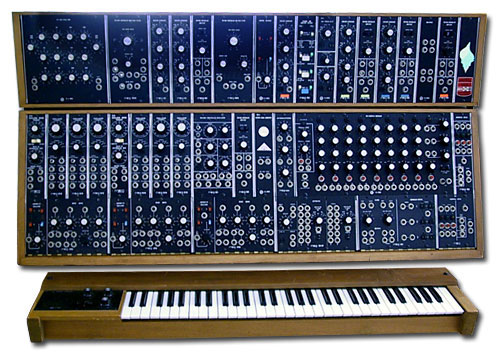
Modular synthesizers are synthesizers composed of separate modules for different functions. The modules can be connected together by the user to create a patch. The outputs from the modules may include audio signals, analog control voltages, or digital signals for logic or timing conditions. Typical modules are voltage-controlled oscillators, voltage-controlled filters, voltage-controlled amplifiers and envelope generators.
The first modular synthesizer was developed by German engineer Harald Bode in the late 1950s. The 1960s saw the introduction of the Moog synthesizer and the Buchla Modular Electronic Music System, created around the same period. The Moog was composed of separate modules which created and shaped sounds, such as envelopes, noise generators, filters, and sequencers, connected by patch cords.
The Japanese company Roland released the Roland System 100 in 1975, followed by the System 700 in 1976 and the System 100m in 1979.
In the late 1970s, modular synthesizers started to be largely supplanted by highly-integrated keyboard synthesizers, samplers, sound modules, and other MIDI-connected gear. By the 1990s, modular synthesizers had fallen out of favor compared to cheaper, smaller digital and software synthesizers. However, there continued to be a community who chose the physically patched approach, the flexibility and the sound of traditional modular systems.
Since the late 1990s, [when?] there has been a resurgence in the popularity of analog synthesizers aided by physical standardization practices, an increase in available retro gear and interest, decreased production costs and increased electronic reliability and stability, the rediscovered ability of modules to control things other than sound, and a generally heightened education through the development of virtual synthesis systems such as VCV Rack, MAX/MSP, Pd and Reaktor etc.
The basic modular functions are: signal, control, logic and timing. Typically, inputs and outputs are an electric voltage.
The difference between a synthesizer module and a stand-alone effects unit is that an effects unit will have connections for input and output of the audio signal and knobs or switches for users to control various parameters of the device (for example, the modulation rate for a chorus effect) while a synthesizer module may have connections for input and output, but will also have connections so that the device's parameters can be further controlled by other modules (for example, to connect a low-frequency oscillator module to the modulation input of a delay module to get the chorus effect.)
There exist many different types of modules. Modules with the same basic functions may have different inputs, outputs and controls, depending on their degree of complexity. Some examples include the voltage-controlled oscillator (VCO), which may have options for sync (hard or soft), linear or exponential frequency modulation, and variable waveshape; the voltage-controlled filter (VCF) that may have both resonance and bandwidth controls; and the envelope generator which may provide outputs at each stage of the process. Examples of more complex modules include the frequency shifter, sequencer, and vocoder.
Hub AI
Modular synthesizer AI simulator
(@Modular synthesizer_simulator)
Modular synthesizer
Modular synthesizers are synthesizers composed of separate modules for different functions. The modules can be connected together by the user to create a patch. The outputs from the modules may include audio signals, analog control voltages, or digital signals for logic or timing conditions. Typical modules are voltage-controlled oscillators, voltage-controlled filters, voltage-controlled amplifiers and envelope generators.
The first modular synthesizer was developed by German engineer Harald Bode in the late 1950s. The 1960s saw the introduction of the Moog synthesizer and the Buchla Modular Electronic Music System, created around the same period. The Moog was composed of separate modules which created and shaped sounds, such as envelopes, noise generators, filters, and sequencers, connected by patch cords.
The Japanese company Roland released the Roland System 100 in 1975, followed by the System 700 in 1976 and the System 100m in 1979.
In the late 1970s, modular synthesizers started to be largely supplanted by highly-integrated keyboard synthesizers, samplers, sound modules, and other MIDI-connected gear. By the 1990s, modular synthesizers had fallen out of favor compared to cheaper, smaller digital and software synthesizers. However, there continued to be a community who chose the physically patched approach, the flexibility and the sound of traditional modular systems.
Since the late 1990s, [when?] there has been a resurgence in the popularity of analog synthesizers aided by physical standardization practices, an increase in available retro gear and interest, decreased production costs and increased electronic reliability and stability, the rediscovered ability of modules to control things other than sound, and a generally heightened education through the development of virtual synthesis systems such as VCV Rack, MAX/MSP, Pd and Reaktor etc.
The basic modular functions are: signal, control, logic and timing. Typically, inputs and outputs are an electric voltage.
The difference between a synthesizer module and a stand-alone effects unit is that an effects unit will have connections for input and output of the audio signal and knobs or switches for users to control various parameters of the device (for example, the modulation rate for a chorus effect) while a synthesizer module may have connections for input and output, but will also have connections so that the device's parameters can be further controlled by other modules (for example, to connect a low-frequency oscillator module to the modulation input of a delay module to get the chorus effect.)
There exist many different types of modules. Modules with the same basic functions may have different inputs, outputs and controls, depending on their degree of complexity. Some examples include the voltage-controlled oscillator (VCO), which may have options for sync (hard or soft), linear or exponential frequency modulation, and variable waveshape; the voltage-controlled filter (VCF) that may have both resonance and bandwidth controls; and the envelope generator which may provide outputs at each stage of the process. Examples of more complex modules include the frequency shifter, sequencer, and vocoder.