Hubbry Logo
search
logo
2255847

Modular synthesizer

logo
Community Hub0 Subscribers
Read side by side
from Wikipedia

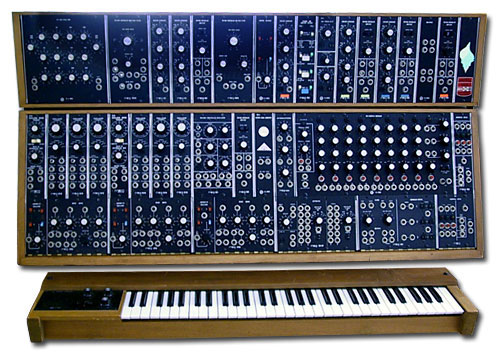
Moog 55 (c. 1972 to c. 1981)
Steve Porcaro of Toto with a modular synthesizer in 1982

Modular synthesizers are synthesizers composed of separate modules for different functions. The modules can be connected together by the user to create a patch. The outputs from the modules may include audio signals, analog control voltages, or digital signals for logic or timing conditions. Typical modules are voltage-controlled oscillators, voltage-controlled filters, voltage-controlled amplifiers and envelope generators.

History

[edit]

The first modular synthesizer was developed by German engineer Harald Bode in the late 1950s.[1] The 1960s saw the introduction of the Moog synthesizer and the Buchla Modular Electronic Music System, created around the same period.[2] The Moog was composed of separate modules which created and shaped sounds, such as envelopes, noise generators, filters, and sequencers,[3][4] connected by patch cords.[5]

The Japanese company Roland released the Roland System 100 in 1975, followed by the System 700 in 1976 and the System 100m in 1979.[1]

In the late 1970s, modular synthesizers started to be largely supplanted by highly-integrated keyboard synthesizers, samplers, sound modules, and other MIDI-connected gear. By the 1990s, modular synthesizers had fallen out of favor compared to cheaper, smaller digital and software synthesizers.[1] However, there continued to be a community who chose the physically patched approach, the flexibility and the sound of traditional modular systems.

Since the late 1990s, [when?] there has been a resurgence in the popularity of analog synthesizers aided by physical standardization practices, an increase in available retro gear and interest, decreased production costs and increased electronic reliability and stability, the rediscovered ability of modules to control things other than sound, and a generally heightened education through the development of virtual synthesis systems such as VCV Rack, MAX/MSP, Pd and Reaktor etc.

Types of module

[edit]

The basic modular functions are: signal, control, logic and timing. Typically, inputs and outputs are an electric voltage.

The difference between a synthesizer module and a stand-alone effects unit is that an effects unit will have connections for input and output of the audio signal and knobs or switches for users to control various parameters of the device (for example, the modulation rate for a chorus effect) while a synthesizer module may have connections for input and output, but will also have connections so that the device's parameters can be further controlled by other modules (for example, to connect a low-frequency oscillator module to the modulation input of a delay module to get the chorus effect.)

There exist many different types of modules. Modules with the same basic functions may have different inputs, outputs and controls, depending on their degree of complexity. Some examples include the voltage-controlled oscillator (VCO), which may have options for sync (hard or soft), linear or exponential frequency modulation, and variable waveshape; the voltage-controlled filter (VCF) that may have both resonance and bandwidth controls; and the envelope generator which may provide outputs at each stage of the process. Examples of more complex modules include the frequency shifter, sequencer, and vocoder.

Modular synthesizers may be bulky and expensive. There are some standards that manufacturers follow for their range of physical synthesizers, such as 1 V/octave control voltages, and gate and trigger thresholds providing general compatibility; however, connecting synthesizers from different manufacturers may require cables with different kinds of plugs.

A Doepfer A-100 (1995 to present)

German engineer Dieter Doepfer believed modular synthesizers could still be useful for creating unique sounds, and created a new, smaller modular system, the Doepfer A-100. This led to a new standard for modular systems, Eurorack; as of 2017, over 100 companies, including Moog and Roland, were developing Eurorack modules.[1]

Typical modules

[edit]

Modules can usually be categorized as either sources or processors.[6] Standard modules found in a modular synthesizer are:

Sources - characterized by an output, but no signal input; it may have control inputs:

  • VCO – Voltage-controlled oscillator, outputs a signal whose frequency is a function of input control voltage and settings. In its basic form, these may be simple waveforms (most usually a square wave or a sawtooth wave, but also includes pulse, triangle and sine waves), however these can be dynamically changed through such controls as sync, frequency modulation, and self-modulation.
  • Noise source - Common types of noise offered by modular synthesizers include white, pink, and low frequency noise.
  • LFO - A low-frequency oscillator may or may not be voltage-controlled. It may be operated with a period anywhere from a fortieth of a second to several minutes. It is generally used as a control voltage for another module. For example, modulating a VCO will produce a frequency modulation perceived as vibrato, while modulating a VCA will produce amplitude modulation perceived as tremolo, depending on the control frequency. A rectangular wave output from an LFO can be used as a logic output for timing or trigger functions on other modules.
  • EG - An envelope generator is a transient voltage source. A trigger control signal applied to an envelope generator produces a single, shaped voltage. Often configured as ADSR (attack, decay, sustain, release) it provides a control voltage that rises and falls. Usually it controls the amplitude of a VCA or the cutoff frequency of a VCF, but the patchable structure of the synthesizer makes it possible to use the envelope generator to modulate other parameters such as the frequency or pulse width of the VCO. Simpler EGs (AD or AR) or more complex (DADSR—delay, attack, decay, sustain, release) are sometimes available.
  • Sequencer or analog sequencer, is a family of compound module types that may be a source or a processor. As a source, depending upon the configuration, it may produce a sequence of voltages, usually set by adjusting values on front panel knobs. The sequencer may also output a trigger, or gate, at each step. Sequencers are stepped by a trigger being applied to the trigger input. Designs may allow for stepping forwards or backward, oscillating patterns, random order, or only using a limited number of steps. An example of an analog sequencer and controller with this level of complexity is the Doepfer A-154, A-155 combination.

Processors - characterized by a signal input and an output and may have control inputs:

  • VCF - Voltage-controlled filter, which attenuates frequencies below (high-pass), above (low-pass) or both below and above (band-pass) a certain frequency.[a] Most VCFs have variable resonance, sometimes voltage-controlled.
  • VCA - Voltage-controlled amplifier, varies the amplitude of a signal in response to an applied control voltage. The response curve may be linear or exponential. Also called a two-quadrant multiplier.
  • LPG - Low-pass gate, is a compound module, similar to a VCA combined with a VCF. The circuit uses a resistive opto-isolator to respond to the control voltage, which also filters the sound, allowing more high-frequency information through at higher amplification.
  • RM - Ring modulator - Two audio inputs are utilized to create sum and difference frequencies while suppressing the original signals. Also called an analog multiplier or frequency mixer.
  • Mixer - A module that adds voltages.
  • Multiple - Fan out a voltage output to multiple inputs.
  • Slew limiter - A sub-audio low-pass filter. When used in a control voltage path to an oscillator, produces a portamento effect.
  • S&H - Sample and hold, is usually used as a control-voltage processor. Depending upon the design, usually an ascending edge (trigger), captures the value of the voltage at the input, and outputs this voltage until the trigger input reads another voltage and repeats the process.
  • Sequencer, (see also above), as a processor, may have a signal input into each step, (location or stage), which is output, when stepped to. An example of this type of sequencer is the Doepfer A-155.
  • Custom control inputs - It is possible to connect any kind of voltage to a modular synthesizer as long as it remains in the usable voltage range of the instrument, usually -15V to +15V.

Modern manufacturers of modular hardware synthesizers

[edit]
Latest Fénix

Hardware offerings range from complete systems in cases to kits for hobbyists. Many manufacturers augment their range with products based on recent re-designs of classic modules; often both the original and subsequent reworked designs are available free on the Internet, the original patents having lapsed. Many hobbyist designers also make available bare PCB boards and front panels for sale to other hobbyists.

Technical specifications

[edit]

Form factors

[edit]

Many early synthesizer modules had height in integer inches: 11" (e.g., Roland 700), 10" (e.g., Wavemakers), 9" (e.g., Aries), 8" (e.g., ARP 2500), 7" (e.g., Polyfusion, Buchla, Serge), 6" (e.g., E-mu) and width in 1/4" inch multiples. More recently it has become more popular to follow the standard 19" rack unit system: 6U (Wiard), 5U (8.75" e.g., Moog/Modcan), 4U (e.g., Serge), 3U (Eurorack).

Two 3U unit standards, in particular, are notable: Frac Rack (e.g., PAiA), which uses the entire 3U for the front panel, and Eurorack (e.g., Doepfer) which has a 2 mm horizontal lip that the front panels are seated between. Further minor variations exist where European or Japanese manufacturers round a U measurement up or down to some closer convenient metric equivalent; for example, the common 5U modules are exactly 8.75 inches (222.25 mm), but non-American manufacturers may prefer 220 or 230 mm.

Electrical

[edit]

Other differences are in the plugs used, which can match 1/4-inch (6.3 mm) or 3.5 mm phone connectors, banana jacks, or breadboard patch leads; in the main power supply, which is most often ±12 V[7] or ±15 V, but can range from 2.5±2.5 V[8] to 0±18 V for different manufacturers or systems; in the trigger or gate voltages (Moog S-trigger or positive gate), with typical audio signal levels (often ±5 V with ±5 V headroom); and with control voltages of volts/octave, typically 1 V/octave, but in some cases 1.2 V/octave.

In most analog modular systems the frequency is exponentially related to the control voltage (such as 1 volt/octave or 1.2 volts/octave), sometimes called linear because the human ear perceives frequencies in a logarithmic fashion, with each octave having the same perceptual size. Some synthesizers (such as Korg MS-20, ETI 4600) use a system where the frequency (but not the perceived pitch) is linear with voltage.

Due to the continuously variable nature of knobs and sliders, reproducing an exact patch can be difficult.

Modular software synthesizers

[edit]

There are also software synthesizers which are organized as interconnectable modules. Many of these are virtual analog synthesizers, where the modules simulate hardware functionality. Some of them are also virtual modular systems, which simulate real historical modular synthesizers.

Computers have grown so powerful that software programs can now model the signals, sounds, and patchability of modular synthesizers. While potentially lacking the physical presence of desirable analog sound generation, real voltage manipulation, knobs, sliders, cables, and LEDs, software modular synthesizers offer near infinite variations and visual patching at a more affordable price and in compact form.

The popular plugin formats such as VST may be combined in a modular fashion.

Semi-modular synthesizers

[edit]
The Volca Modular, a compact semi-modular synthesiser

A modular synthesizer has a case or frame into which arbitrary modules can be fitted; modules are usually connected together using patch cords and a system may include modules from different sources, as long as it fits the form factors of the case and uses the same electrical specifications.

A semi-modular synthesizer on the other hand is a collection of modules from a single manufacturer that makes a cohesive product, an instrument. Modules may not be swapped out and usually a typical configuration has been pre-wired. The modules are typically not separable and may physically be parts of a contiguous circuit board. However, the manufacturer provides mechanisms to allow the user to connect modules in different orders and often to connect external components or modules (chosen and supplied by the user) between those of the instrument.[citation needed]

Matrix systems

[edit]
EMS Synthi (VCS 3) II uses a pin matrix for patching

Matrix systems use pin matrices or other crosspoint switches rather than patch cords. The ARP 2500 was the first synthesizer to use a fixed switch matrix. The pin matrix was made popular in the EMS VCS-3 and its descendants like the EMS Synthi 100. Other systems include the ETI 4600, and the Maplin 5600s.

The clean logical layout of these matrices has inspired a number of manufacturers like Arturia to include digitally programmable matrices in their analog or virtual analog synthesizers. Many fully digital synthesizers, like the Alesis Ion, make use of the logic and nomenclature of a modulation matrix, even when the graphical layout of a hardware matrix is completely absent.

Patch override systems

[edit]

The different modules of a semi-modular synthesizer are wired together into a typical configuration but can be re-wired by the user using patch cords. Some examples are the ARP 2600, Anyware Semtex, Cwejman S1, EML101, Evenfall Minimodular, Future Retro XS, Korg MS-10 / MS-20 / PS-3100 / PS-3200 / PS-3300, Mungo State Zero, Roland System 100, Korg Volca Modular and Moog Mother-32 .

Electronically reconfigurable systems

[edit]

Reconfigurable systems allow certain signals to be routed through modules in different orders without the use of patch cords. Examples include the Oberheim Matrix and Rhodes Chroma, and Moog Voyager.

Hybrid modular synthesizers

[edit]

Hybrid synthesizers use hardware and software in combination to realize patches. Examples include the Arturia Origin by Arturia (fully self-contained), Clavia Nord Modular and Clavia Nord Modular G2 (these need an external computer to edit patches) and Audiocubes.

See also

[edit]

Notes

[edit]

References

[edit]
[edit]
Revisions and contributorsEdit on WikipediaRead on Wikipedia
from Grokipedia
A modular synthesizer is an electronic musical instrument consisting of separate, interchangeable modules—such as oscillators, filters, amplifiers, and envelope generators—that users connect via patch cables to generate, shape, and control sounds in highly customizable configurations.[1] These systems rely on voltage control to modulate parameters like pitch, timbre, and amplitude, allowing for complex, evolving sonic textures beyond the limitations of fixed-architecture synthesizers.[2] Unlike integrated keyboards, modular setups emphasize experimentation, where each module performs a specific function and the overall instrument is assembled by the user to suit creative needs.[3] The origins of modular synthesis trace back to the mid-1960s, when American engineers Robert Moog and Don Buchla independently developed pioneering voltage-controlled systems that marked a shift from earlier tape-based electronic music techniques.[4] Moog introduced his first commercial modular synthesizer in 1964, featuring discrete components for sound synthesis that gained prominence through recordings like Wendy Carlos's Switched-On Bach in 1968.[1][5] Concurrently, Buchla's 100 series, launched around 1966, incorporated innovative elements like touch-sensitive interfaces and sequencers, influencing experimental composers on the West Coast.[4] These early systems, often housed in large custom cabinets, were adopted in studios and by artists in genres ranging from progressive rock to avant-garde music during the 1970s.[2] By the 1980s, the rise of compact, preset-based synthesizers and digital MIDI integration led to a decline in large-scale modular use, as they were seen as cumbersome and expensive.[2] A revival began in the 1990s with the Eurorack format, standardized in 1995 by German manufacturer Dieter Doepfer, which miniaturized modules to a 3U height and 1V/octave pitch standard, making modular synthesis more portable and affordable.[3] This format, now the dominant standard, has spurred hundreds of manufacturers and fostered communities around DIY builds, live performances, and sound design in electronic dance music and contemporary composition.[1]

History

Early Analog Developments

The foundations of modular synthesis trace back to early 20th-century inventions of electronic musical instruments that relied on vacuum tubes for generating oscillations and shaping sound envelopes, though these lacked the interconnectivity of later modular systems. In 1920, Russian inventor Léon Theremin developed the Theremin, one of the earliest electronic musical instruments, which used two vacuum-tube oscillators operating at ultrasonic frequencies to produce audible tones via heterodyning.[6] The instrument's pitch and volume were controlled by the performer's hand proximity to antennas, altering capacitance to modulate the oscillators' frequencies and amplitudes in a precursor to voltage control.[6] This contactless interface marked an early exploration of electronic sound manipulation without mechanical components.[6] Building on this, German engineer Friedrich Trautwein introduced the Trautonium in 1928, a monophonic instrument employing vacuum tubes to generate sawtooth waveforms for pitch and timbre variation.[7] Players pressed a fingerboard wire against a metal strip to select notes, with additional controls for vibrato and envelope shaping via tube-based circuits, emphasizing expressive dynamics over fixed scales.[7] That same year, French inventor Maurice Martenot created the Ondes Martenot, another vacuum-tube oscillator instrument that produced sine waves with a keyboard and ring-controlled ribbon for pitch bending, alongside levers for envelope and timbre adjustments.[7] These devices, while innovative, operated as standalone units with integrated tube amplification for oscillation and basic amplitude shaping, laying groundwork for analog sound synthesis.[8] In the 1940s and 1950s, American composer Raymond Scott advanced custom electronic music production through his Manhattan Research Inc. studios, designing voltage-controlled circuits for instruments like the Clavivox around 1956.[9] The Clavivox featured a keyboard interface connected to a theremin-like oscillator with voltage regulation for precise pitch and envelope control, enabling automated sequencing in commercial jingles and experimental compositions.[9] Scott's setups incorporated vacuum-tube modules for signal generation and processing, foreshadowing modular experimentation without full patchability.[9] A pinnacle of pre-1960s analog development was the RCA Mark II Sound Synthesizer, completed in 1957 by engineers Harry Olson and Herbert Belar at RCA Laboratories and installed at the Columbia-Princeton Electronic Music Center.[10] This room-sized machine comprised approximately 1,700 vacuum tubes organized into semi-modular components, including 24 oscillators, noise generators, filters, and envelope shapers, programmed via punched paper tape to sequence sounds across four polyphonic voices.[11] Though its fixed architecture limited real-time patching, the system's tape-based modularity allowed composers to assemble complex timbres and dynamics, bridging early tube-based oscillation to voltage-driven synthesis.[10] These innovations highlighted vacuum tubes' role in enabling electronic envelope shaping—controlling attack, decay, and release—essential for mimicking acoustic instruments pre-modularity.[8]

Key Systems and Evolution to Modern Era

The development of modular synthesizers in the 1960s began with pioneering systems from Robert Moog and Don Buchla, which established foundational approaches to voltage-controlled synthesis. In 1964, Robert Moog developed the first prototype of his modular synthesizer in collaboration with composer Herbert Deutsch, demonstrating it at the Audio Engineering Society convention in October of that year; this solid-state system marked a significant advancement in portability and musical expressiveness over earlier vacuum-tube designs. By 1965, Moog's company began taking orders for custom systems, commercializing the modular format with key components such as the 901 series oscillators for generating audio signals and the iconic 904-A low-pass filter, known for its resonant ladder design that became a staple in electronic music. Concurrently, Don Buchla introduced the Buchla 100 series in 1963, commissioned by composers Morton Subotnick and Ramon Sender for the San Francisco Tape Music Center; this system emphasized "West Coast" synthesis principles, prioritizing complex modulation and waveshaping over traditional melodic structures, with modules like function generators and voltage-controlled amplifiers enabling abstract timbral exploration without a conventional keyboard. In the 1970s, other manufacturers expanded modular design with innovative routing and integration features. ARP Instruments launched the ARP 2500 in 1970, a semi-modular system featuring a unique 10x10 Cherry matrix switching panel that allowed for preset and dynamic signal routing between up to 16 modules, facilitating complex patches in a more accessible cabinet format than earlier customs. Similarly, Electronic Music Studios (EMS) in London produced influential modular systems, including the Synthi 100 introduced in 1971—a massive console with over 100 modules connected via a pin matrix for studio applications—and the portable Synthi AKS in 1972, which incorporated a built-in sequencer and joystick controller for live performance. These systems gained prominence through landmark recordings and performances that popularized modular synthesizers in mainstream music. Wendy Carlos utilized a custom Moog modular system, comprising multiple 900-series modules, to record her 1968 album Switched-On Bach, with sessions beginning in 1967; the release showcased electronically realized interpretations of Bach's works, selling over a million copies and introducing the public to the synthesizer's potential. In progressive rock, Keith Emerson of Emerson, Lake & Palmer prominently featured a large custom Moog modular—often towering on stage—during the band's 1970s tours and albums like Tarkus (1971), employing its polyphonic capabilities and ribbon controller for dramatic solos that blended classical influences with rock energy. The popularity of modular systems waned in the 1980s as integrated synthesizers, such as the Minimoog and Prophet-5, offered compact, preset-based alternatives that were more affordable and easier to transport for touring musicians. A revival emerged in the 1990s, driven by Dieter Doepfer's introduction of the A-100 Eurorack system in 1995, which standardized module dimensions at 3U height and 1V/octave control voltage, making modular synthesis more accessible and compatible across manufacturers. By the early 2000s, modular evolution shifted from bespoke wooden cabinets to standardized rack-mount formats, exemplified by Eurorack's widespread adoption and systems like Synthesizers.com's 2000 lineup of 5U-compatible racks, enabling scalable, portable setups that integrated vintage-inspired modules with modern production workflows.

Principles of Operation

Signal Flow and Patching

In modular synthesizers, patching refers to the process of connecting the outputs of one module to the inputs of another using patch cables, allowing users to create custom signal paths for sound generation and processing.[3] This flexible routing enables the reconfiguration of the synthesizer's architecture on demand, distinguishing modular systems from fixed-voice instruments.[12] Audio signal flow typically begins with sound-generating modules, such as oscillators, and progresses through processing stages like filters and amplifiers before reaching the output. For instance, an audio signal might route from an oscillator's output to a filter's input to shape timbre, then to a voltage-controlled amplifier (VCA) to control amplitude, and finally to a mixer or main output for playback through speakers.[3] These signals represent audible frequencies, generally ranging from 20 Hz to 20 kHz, and operate at levels around 10V peak-to-peak (±5V) in standard Eurorack formats.[13] Control signal flow involves low-frequency or DC voltages that modulate parameters across modules, separate from but parallel to audio paths. Control voltage (CV) signals, often unipolar (0-10V) or bipolar (±5V), route from sources like sequencers or low-frequency oscillators (LFOs) to destinations such as filter cutoffs or oscillator pitch inputs. Gate and trigger signals, typically 0 V (off) to +5 V or +10 V (on), flowing from clock sources to modules requiring timing cues.[3][12] Normalization provides pre-wired default connections between module jacks, simplifying initial setups by routing signals automatically when no patch cable is inserted. These connections can be overridden by plugging in a cable, which breaks the internal link and introduces an external signal. For example, a mixer's channels might be normalled to internal noise sources or a VCA's control input could default to a constant voltage for always-on operation.[14][3] A representative example of patching is the basic subtractive synthesis voice, where an oscillator's audio output connects to a filter input, the filter output to a VCA audio input, and the VCA output to the system main out; simultaneously, a gate signal triggers an envelope generator, whose output patches to the VCA control input for amplitude shaping.[12] This configuration produces a classic synthesized tone, with the signal path emphasizing harmonic subtraction via the filter.[15] Challenges in signal flow include maintaining appropriate levels and impedance matching to prevent distortion or signal loss. Audio and CV signals at 10V peak-to-peak exceed typical line-level standards, often requiring attenuators to interface with external gear without clipping. Impedance mismatches arise when low-impedance outputs drive high-impedance inputs, though Eurorack standards mitigate this with typical input impedances of 100kΩ and low output impedances near 0Ω or 1kΩ.[13][3]

Voltage Control and Modulation

In modular synthesizers, voltage control enables dynamic manipulation of sound parameters through control voltage (CV) signals, which are low-level DC voltages that influence elements like pitch, timbre, and amplitude. The CV/Gate standard, predominant in modern systems, uses a 1V/octave scaling for pitch control, where an increase of 1 volt raises the pitch by one octave from a reference point—for instance, applying +1V to a voltage-controlled oscillator (VCO) tuned to C3 (approximately 130.81 Hz) shifts it to C4 (261.63 Hz).[16] This exponential relationship ensures consistent musical intervals across the frequency spectrum, as human pitch perception is logarithmic rather than linear. Gate signals, typically 0V (off) to +5V or +10V (on), trigger events like note starts, complementing CV for sequencing and performance.[16] Historically, voltage standards varied between pioneers: Robert Moog's systems adopted the 1V/octave convention in the 1960s, becoming the de facto industry norm due to its simplicity in mapping musical scales. In contrast, Don Buchla's designs employed a 1.2V/octave scale (0.1V per semitone), rooted in easier voltage measurements for discrete steps, which persisted in Buchla-compatible modules. Conversion utilities, such as Eurorack modules like the Expert Sleepers Disting, bridge these formats by scaling voltages (e.g., multiplying 1V/oct signals by 1.2 for compatibility), allowing hybrid setups without retuning.[16] Modulation in modular systems relies on CV sources to vary parameters over time, creating evolving textures. Low-frequency oscillators (LFOs) generate periodic CV waves (typically below 20 Hz) to cyclically alter traits like filter cutoff frequency, producing effects such as wah-wah sweeps when an LFO triangle wave modulates a low-pass filter's resonance. Envelopes provide transient CV contours, often ADSR-shaped (attack, decay, sustain, release), triggered by gates to briefly open a filter cutoff during note onsets for percussive timbres. Sequencers output stepped CV sequences for rhythmic pitch or modulation patterns, such as advancing a filter cutoff through discrete values to mimic arpeggios in timbre. These sources route via patch cables to targets, enabling complex interactions unique to modular flexibility.[17] Frequency modulation (FM) and amplitude modulation (AM) extend these techniques into synthesis primitives, often at audio rates for harmonic generation. In FM, a modulator signal varies the instantaneous frequency of a carrier oscillator, yielding sidebands that enrich spectra; for example, a sine-wave modulator at half the carrier frequency creates metallic or bell-like tones when the modulation index (proportional to modulator amplitude) exceeds 1.[18] AM, conversely, modulates the carrier's amplitude, producing sum and difference frequencies that add vibrato or tremolo at low rates but inharmonic overtones at audio rates, as in ring modulation variants where carrier and modulator multiply to suppress originals. Both thrive in modular patching, with VCOs serving dual roles as carrier and modulator for real-time experimentation.[19] Modular synthesizers are inherently monophonic, with a single CV/Gate pair controlling one voice, posing challenges for polyphony like playing chords. Achieving multiple notes requires parallel voices—e.g., duplicating oscillators, filters, and envelopes per note—escalating module count, power draw, and cost; a four-voice chord might demand four full signal paths, straining Eurorack space. Workarounds include MIDI-to-CV converters distributing notes round-robin or sequencers assigning pitches to separate oscillators, but true polyphony demands careful resource allocation to avoid monophonic limitations.[20] The 1V/octave pitch control derives from the exponential nature of frequency doubling per octave. Let $ f $ be the desired frequency and $ f_0 $ the reference frequency at 0V (often around 8 Hz or middle C). Since one octave doubles frequency, the voltage $ V $ satisfies $ f = f_0 \times 2^V $, so solving for $ V $:
V=log2(ff0) V = \log_2 \left( \frac{f}{f_0} \right)
This logarithmic scaling, implemented via linear-to-exponential converters in VCOs, ensures a 1V increment always yields an octave shift, independent of the base frequency—e.g., from 100 Hz to 200 Hz (+1V), then 400 Hz (+2V). The derivation stems from musical equal temperament, where semitones are $ 2^{1/12} $ factors, but octave focus simplifies to base-2 logs for voltage precision.[21]

Core Modules

Oscillators and Generators

Oscillators and generators form the foundational sound sources in modular synthesizers, producing periodic or aperiodic electrical signals that serve as the raw material for musical tones and textures. Voltage-controlled oscillators (VCOs) are the primary type, generating repeating waveforms whose frequency is precisely tuned by control voltages, typically following a 1-volt-per-octave standard for musical intervals. These modules enable the creation of pitched sounds essential to melodic and harmonic content in synthesis. Classic VCO waveforms include the sine wave, which offers a pure tone without harmonics; the triangle wave, providing a soft, hollow sound with odd harmonics; the sawtooth wave, rich in both even and odd harmonics for bright, aggressive timbres; and the square wave, featuring strong odd harmonics for a reedy or hollow quality. Many VCOs allow pulse-width modulation on square or pulse outputs, varying the duty cycle to alter timbre dynamically. Noise generators complement VCOs by producing aperiodic signals for non-pitched elements like percussion or atmospheric effects. White noise has equal energy across all frequencies, ideal for sharp, percussive sounds such as snares due to its broad spectrum. Pink noise, with energy decreasing by 3 dB per octave, emphasizes lower frequencies for smoother, wind-like textures. Blue noise, increasing by 3 dB per octave, concentrates high frequencies, suiting hi-hat or cymbal emulations. Complex oscillators, inspired by Buchla designs, extend beyond basic waveforms through integrated waveshaping techniques to generate evolving timbres. These modules often feature a primary oscillator modulated by a secondary one, incorporating wavefolding to reflect waveform portions and add harmonics, or frequency shifting to transpose sidebands without altering pitch, creating metallic or formant-like sounds. The Buchla 261e, for instance, allows continuous waveshape variation from sine to pulse while supporting modulation for timbral complexity. Tuning stability in VCOs is critical for polyphonic or live performance applications, as temperature variations can detune oscillators. Modern designs employ temperature compensation using matched transistor pairs or NTC thermistors to counteract thermal drift in exponential converters, achieving high stability, typically around 0.1% output voltage deviation (less than a few cents drift per octave over typical operating temperatures). Chips like the AS3340 integrate such compensation, minimizing warm-up time and pitch drift. Typical VCO specifications include a frequency range from sub-audio rates around 1 Hz (usable as low-frequency oscillators) to 20 kHz for ultrasonic effects, spanning 8–10 octaves with 1 V/octave tracking. Sync inputs enable phase locking to external signals, where a hard sync resets the oscillator on each trigger for harmonic synchronization, or soft sync gently pulls the phase without full reset. The Moog 921 VCO series, introduced around 1970, exemplifies early precision engineering with selectable ranges from 32' to 1' (low to high pitch), multiple waveform outputs, and auxiliary sub-outputs for expanded versatility. Sub-oscillators, often integrated or standalone, generate square or sine waves one or two octaves below the primary VCO to enhance bass frequencies and add weight without additional polyphony demands.

Filters and Processors

Filters and processors in modular synthesizers modify audio signals by altering their frequency content, amplitude, or introducing specific effects, enabling sound designers to shape tones from raw waveforms. Voltage-controlled filters (VCFs) are central to this process, allowing dynamic adjustment of the frequency response through control voltages (CV). Common filter types include low-pass, which attenuates frequencies above a cutoff point; high-pass, which removes frequencies below the cutoff; and band-pass, which passes a specific range while rejecting others. The iconic low-pass filter design, such as the Moog ladder filter, employs a four-stage transistor ladder topology that provides a steep 24 dB per octave roll-off, creating a smooth yet aggressive attenuation of high frequencies. High-pass filters subtract the low-pass output from the input to emphasize higher frequencies, while band-pass configurations cascade low- and high-pass stages for a 12 dB per octave roll-off per pole, isolating midrange bands. Resonance, controlled by the Q factor, boosts frequencies near the cutoff, with higher Q values producing a sharper peak that enhances tonal emphasis. In VCFs, the cutoff frequency is modulated via CV inputs, often following an exponential response (e.g., approximately 200 mV per octave) to align with musical pitch scaling, allowing real-time sweeps and harmonic alterations. At high resonance levels, filters can enter self-oscillation, where the Q factor exceeds unity gain, turning the module into a sine wave generator at the cutoff frequency due to 360-degree phase shift and feedback instability. Beyond filters, processors like sample-and-hold (S&H) circuits capture and retain an input voltage until triggered, producing stepped modulation from random sources such as noise generators for unpredictable yet quantized changes. Slew limiters smooth these abrupt transitions by imposing a maximum rate of voltage change, creating portamento-like glides or lag effects in modulation signals. Ring modulators multiply two input signals to generate sum and difference frequencies, yielding metallic, bell-like tones by suppressing carrier fundamentals. Dynamics processors include compressors, which reduce amplitude variations by attenuating signals above a threshold, thereby controlling peaks and sustaining quieter elements while introducing subtle harmonic distortion as a byproduct of gain reduction. Distortion modules clip or overdrive signals to add harmonics and saturate amplitudes, providing grit and warmth for aggressive sound shaping. A seminal example is the EMS VCS3 filter, a nonlinear diode ladder design with voltage-controlled cutoff that exhibits unique asymmetric distortion and temperature-sensitive behavior, influencing its warm, characterful response in early modular systems. In modern implementations, operational transconductance amplifier (OTA)-based filters, such as those using the SSI2164 chip, offer compact, versatile multimode operation with exponential CV control, contrasting discrete transistor designs like the Moog ladder that prioritize authentic analog warmth through individual components.

Control and Utility Modules

Envelopes and Sequencers

Envelope generators, often abbreviated as EGs, are essential modules in modular synthesizers that produce time-varying control voltages to shape sounds dynamically, typically modulating amplitude, timbre, or pitch over the duration of a note. The most common type is the ADSR envelope, which consists of four stages: Attack, where the output voltage rises from zero to a peak level; Decay, a reduction from the peak toward a sustained level; Sustain, a held voltage proportional to the input gate height during the note; and Release, a fall to zero after the gate ends. These stages are triggered by a gate signal, a sustained voltage that initiates the envelope cycle when it exceeds a threshold, usually between 2V and 5V in Eurorack systems, allowing compatibility across modules while preventing false triggers from low-level noise.[22][23][24] To ensure smooth transitions between stages, many envelope generators incorporate adjustable slew rates, which limit the maximum rate of voltage change, preventing abrupt jumps and enabling portamento-like glides or organic contours in the output CV. For instance, the classic Moog 911 Envelope Generator, a staple in early modular systems, outputs an ADSR contour with attack, decay, and release times ranging from 2 ms to 10 s, sustain level adjustable from 0 to approximately 5.5 V peak, all triggered via an S-trigger input convertible to standard gates. In contrast, the Buchla 281 Quad Function Generator offers greater flexibility with four independent channels configurable in pairs for multi-stage envelopes, supporting transient modes for one-shot ADSR-like responses or sustained/cyclic modes for ongoing automation, with rise/fall times adjustable from 1 ms to 10 s per stage.[22][25] Voltage-controlled sequencers provide patterned control voltages for creating melodic or harmonic progressions, typically featuring 8-step analog designs that output stepped CV sequences synchronized to an external clock. Each step's voltage level, often ranging from 0 to 10V to span multiple octaves, is set via knobs or stored digitally, with voltage control allowing real-time modulation of sequence length, direction, or individual steps for evolving patterns. The Pittsburgh Modular Sequencer, for example, cycles through 4, 6, or 8 steps with two simultaneous CV outputs, enabling basic polyphonic sequences when patched to multiple oscillators.[26] Trigger delays and clock dividers enhance rhythmic complexity by manipulating timing in sequencing setups, allowing polyrhythms and syncopation without additional clocks. A trigger delay module, such as the Doepfer A-162, receives an input gate or trigger and outputs a delayed version with adjustable offset from 0 to approximately 10 s and pulse width, useful for offsetting hi-hats or creating swung grooves by delaying every other beat. Clock dividers, like those in the 2hp Div module, subdivide an incoming clock signal into factors of 1, 2, 3, 4, 5, 6, 7, 8, or 16, generating slower pulses from a master tempo to drive basslines or sparse percussion alongside faster elements, fostering intricate, non-linear rhythms central to experimental synthesis.[27][28] Multi-stage envelopes extend beyond basic ADSR for intricate automation, chaining multiple rise/fall segments to approximate complex curves like those in acoustic instruments or generative processes. The Buchla 281 exemplifies this by linking its four generators into quadrature pairs, where outputs phase-shift for spatial effects or sequential triggering, enabling complex multi-stage envelopes through pairing and quadrature modes for detailed timbre evolution over time.[29]

Mixers and Utilities

Mixers in modular synthesizers are essential modules for combining multiple audio or control voltage (CV) signals into a single output, often featuring multiple input channels with individual gain controls for level adjustment and panning capabilities to position signals in stereo fields. These modules support gain staging to prevent signal clipping while maintaining dynamic range, and they can handle both audio-rate signals for sound mixing and low-frequency CV for modulation blending. For instance, multi-channel mixers like those from Doepfer provide DC-coupled inputs suitable for both purposes, ensuring compatibility across the signal chain.[3] Attenuators and offsets are utility modules designed to scale and shift CV levels, allowing users to adjust the amplitude of modulation signals or convert between voltage standards, such as reducing a 0-10V Buchla signal to a 0-5V Eurorack-compatible range. An attenuator reduces signal strength without altering its shape, while an offset adds or subtracts a DC voltage to reposition the signal within the desired range, which is crucial for precise control in voltage-controlled systems. Passive attenuators, which rely on resistive voltage dividers, offer simple, power-free operation but may introduce minor loading effects on source modules. Broader utilities encompass modules providing multiple jacks for signal distribution, inverters for phase reversal, amplifiers for boosting weak signals, and quantizers for snapping CV to discrete musical scales like pitch correction in melodic sequences. Multiples, such as the Doepfer A-180 series, passively split a single signal to multiple outputs without buffering to avoid impedance mismatches, enabling one source to drive several destinations simultaneously. Inverters flip the polarity of a signal (e.g., turning positive-going CV negative), while amplifiers provide unity or higher gain; quantizers ensure CV values align to tempered scales, enhancing musicality in generative patching. These tools facilitate efficient signal management within the patch flow.[30] Patchbay functions in modular systems often incorporate normalized or non-normalized routing to streamline connections. Normalized patchbays maintain default signal paths between jacks unless interrupted by a patch cable, preserving standard routings like oscillator to filter without additional wiring; non-normalized bays require explicit patching for all connections, offering greater flexibility but increasing cable clutter. This design choice supports both semi-permanent setups and experimental reconfiguration in analog workflows.[14] Key specifications for these modules include headroom typically exceeding +20 dBu to accommodate peak signals without distortion, and input impedances around 100 kΩ to minimize loading on driving modules while ensuring compatibility with standard 3.5 mm jacks. Output impedances are often lower, around 1 kΩ, for clean signal transfer, with DC coupling standard to pass both audio and CV seamlessly.[13]

System Configurations

Form Factors and Standards

Modular synthesizers have adopted various form factors and standards over time to standardize physical enclosures, mounting, and module integration, enabling scalability from compact setups to expansive systems. Early developments in the 1970s introduced the Frac Rack format by PAiA Electronics, a fractional rack system designed by John Simonton that fits modules into a 3U-high space using half-rack widths for more accessible, DIY-friendly construction.[31] Concurrently, the 19-inch MU (Moog Unit) format emerged from Robert Moog's modular designs in the late 1960s and 1970s, utilizing a 5U height (8.75 inches) within standard 19-inch rack cabinets to house larger panels and components typical of early analog systems.[32] The Eurorack standard, established by Dieter Doepfer of Doepfer Musikelektronik in 1995, revolutionized modern modular synthesis by defining a compact, interoperable framework.[33] Modules adhere to a fixed 3U height of 128.5 mm, with widths measured in horizontal pitch (HP) units where 1 HP equals 5.08 mm, allowing precise fitting and widespread manufacturer compatibility.[34] This format's Eurocard-inspired design promotes dense packing while maintaining structural integrity through standardized mounting holes spaced at 5.08 mm intervals. In contrast, the Buchla format, developed by Don Buchla since the 1960s, employs banana jacks for patching and supports panel heights of 1U (44.45 mm) or 3U (133.35 mm), often in custom cabinets that prioritize tactile, non-traditional layouts over rack conformity.[35] Common case types across formats include desktop enclosures for tabletop use, powered skiffs as small, self-contained units with integrated power distribution for portability, and 19-inch racks that align with professional audio equipment standards for studio integration.[36] Compatibility hinges on HP metrics for layout planning; a typical Eurorack row in a 19-inch rack spans 84 HP usable space after deducting for rails and frames, enabling users to calculate module arrangements—such as fitting an 8 HP oscillator alongside a 12 HP filter—without overlap.[34] Into the 2020s, trends emphasize mobility with lightweight portable cases featuring reinforced handles and modular expandability, alongside powered modules that incorporate onboard supplies to reduce cabling and enhance on-the-go usability in live and experimental contexts.[37]

Power and Electrical Interfaces

Modular synthesizers require stable DC power supplies to operate analog and digital circuits reliably, with standards varying by format to ensure compatibility across modules. In the Eurorack format, the primary power rails are +12 V and -12 V DC, often supplemented by a +5 V rail for digital components or LED lighting.[38] Power supplies for Eurorack systems typically deliver up to 1200 mA per rail, allowing for multiple modules in a case.[38] Individual modules draw current measured in milliamps (mA) per rail, with representative examples including oscillators at 50-100 mA on the +12 V rail and filters at 20-60 mA, necessitating careful planning to avoid exceeding supply capacity.[39] Power distribution in Eurorack occurs via bus boards, which connect to the main power supply and provide multiple output headers for modules, often incorporating filtering capacitors to minimize voltage ripple and noise.[40] These boards use 10-pin or 16-pin shrouded IDC connectors for secure, keyed ribbon cable attachments that prevent incorrect polarity during installation.[41] For signal interfaces, Eurorack employs 3.5 mm TS (tip-sleeve) mono jacks for audio and control voltages, with TRS (tip-ring-sleeve) variants used occasionally for balanced signals or MIDI.[40] In contrast, 5U formats such as MU (Makenoise/Synthesizers.com) and DOTCOM (Synthesizers.com) standardize on ±15 V rails with an optional +5 V supply, providing higher headroom for vintage-inspired analog designs compared to Eurorack's lower voltages.[42] Buchla systems, particularly the 200e series, also use ±15 V and +5 V rails, but feature banana jacks (4 mm) for signal patching, enabling stackable connections that differ from Eurorack's non-stackable jacks.[43] Power connectors in Buchla setups include multi-pin headers like EDAC 306 series, fed from a central 12 V DC input converted internally.[44] Grounding and shielding are essential to mitigate hum and electromagnetic interference in modular setups, where multiple modules share a common ground plane via the bus board to equalize potentials and reduce ground loops.[40] Effective shielding involves star grounding—connecting all module grounds to a single point—and using low-noise power supplies with local decoupling capacitors near sensitive audio paths to suppress 60 Hz hum from AC mains bleed.[45] Safety features in modern modular power systems include resettable polyfuses rated at 100-500 mA per rail to protect against overcurrent, alongside Schottky diodes for reverse polarity protection that block incorrect connections without excessive voltage drop.[46] In the 2020s, many bus boards incorporate LED indicators for each rail to visually confirm voltage presence and polarity, enhancing troubleshooting and preventing damage during setup.[45] These measures align with broader electrical safety practices, such as using isolated DC supplies to avoid AC hazards.[40]

Hardware Implementations

Modern Manufacturers and Formats

Doepfer, founded by Dieter Doepfer in Germany, pioneered the Eurorack format in 1995 with its A-100 system, establishing a standardized modular platform that revolutionized accessibility for analog synthesis enthusiasts worldwide.[47] The company's enduring lineup includes foundational modules like voltage-controlled oscillators and filters, maintaining a focus on reliable, no-frills analog designs that form the backbone of many contemporary setups.[48] Make Noise, based in North Carolina, draws heavily from West Coast synthesis traditions, producing modules inspired by Buchla and Serge systems, such as the Maths multifunction generator and the DPO dual oscillator, which emphasize complex wavefolding and dynamic modulation.[49] These innovations blend experimental timbres with intuitive patching, appealing to performers seeking organic, evolving soundscapes. Intellijel, a Canadian manufacturer, specializes in high-end utility modules like attenuverters, multiples, and mixers, offering precise control tools that enhance signal routing and modulation in professional rigs.[50] Pittsburgh Modular leads in versatile case designs, with products like the Structure series providing robust, expandable enclosures up to 420HP, complete with high-current power supplies for studio and travel use.[51] TipTop Audio excels in percussion-focused modules, recreating classic drum sounds from Roland's TR-808 and TR-909 series through analog circuits like the BD808 bass drum and SD909 snare, enabling authentic rhythm generation within modular environments.[52] In the 2020s, manufacturers like Rossum Electro-Music have advanced MIDI integration and digital signal processing (DSP), exemplified by the Locutus MIDI mediator, which bridges Eurorack CV with external MIDI gear for seamless hybrid workflows, and the Assimil8or sampler, which employs DSP for multi-timbral sample manipulation.[53] These developments reflect a broader push toward interoperability between analog and digital domains. The modular market juxtaposes boutique producers, such as Make Noise and Intellijel, which prioritize artisanal quality and limited runs, against mass-produced options from companies like Doepfer, offering affordable entry points; typical module prices range from $100 for basic utilities to $500 for complex oscillators or processors.[54] This dichotomy supports a growing ecosystem valued at approximately USD 237 million as of 2024, driven by demand for customizable hardware.[55] Events such as Moogfest (held annually from 2004 to 2019 in Asheville and later Durham, North Carolina) fostered innovation through workshops, performances, and manufacturer showcases, uniting thousands of synthesists to explore modular trends and collaborations.[56]

Eurorack and Buchla Systems

The Eurorack format, standardized in the 1990s by Doepfer Musikelektronik, utilizes a 3U (approximately 128.5 mm) height and horizontal pitch (HP) measurement for module width, with 3.5 mm jacks for audio and control voltage connections, enabling compact and customizable systems.[57] This design facilitates affordable entry points, such as powered 104 HP cases available for around $245 to $300, making it accessible for beginners and expanding users alike. In contrast, the Buchla systems, pioneered by Donald Buchla in the 1960s, employ banana jacks for control voltages and pulses alongside 3.5 mm jacks for audio, emphasizing experimental interfaces like touch-sensitive controllers in the 200h series, which include pressure- and position-activated outputs to foster non-traditional interaction.[58] The 200h series, part of Buchla's ongoing product line, prioritizes multifunctional modules for complex sound generation, such as noise and voltage generators that support random and unpredictable outcomes suited to avant-garde exploration.[59] Eurorack boasts a vast ecosystem, with over 17,000 modules listed across hundreds of manufacturers as of 2025, reflecting its widespread adoption and diversity in sound design tools.[60] Buchla maintains a niche but influential ecosystem, with approximately 20-30 core modules in the 200 series and compatible formats, valued for their historical role in shaping West Coast synthesis philosophies.[61] Cross-compatibility between the formats is achievable through adapters, such as banana-to-3.5 mm cable converters and active Eurorack interfaces like the Buchla Polyglot, which handle signal level differences and power requirements to integrate modules from one system into the other.[62] Eurorack systems are particularly favored for live performances due to their portability and modular scalability, allowing musicians to assemble compact rigs for dynamic, on-stage improvisation.[63] Buchla systems, however, excel in avant-garde composition, as evidenced by their early use in works by composers like Morton Subotnick, where touch interfaces and voltage-controlled processing enable abstract, non-linear musical structures.[64]

Software Implementations

Virtual Modular Environments

Virtual modular environments refer to software platforms that simulate the functionality of hardware modular synthesizers, enabling users to design, patch, and perform with virtual modules in a digital workspace. These environments replicate the modular philosophy of interconnecting components via virtual cables, providing an accessible entry point to synthesis without the cost or space requirements of physical gear. By leveraging digital signal processing (DSP), they emulate analog behaviors, such as voltage-controlled oscillations and filter resonances, while supporting both creative experimentation and professional production.[65][66] Prominent platforms include VCV Rack, a free and open-source virtual Eurorack simulator that has become a standard in the 2020s for learning and prototyping modular systems. Released in 2016 and continuously updated, VCV Rack offers a vast ecosystem of modules, including the Fundamental pack with core components like oscillators, filters, and envelopes that mimic classic hardware designs. Users connect modules through virtual patch cables in a customizable rack interface, allowing for real-time sound design and integration as a standalone application or plugin. Softube Modular, a proprietary plugin introduced in 2016, focuses on high-fidelity emulations with licensed recreations from hardware brands like Doepfer and Intellijel, emphasizing authentic circuit behaviors for studio use.[67][68][69][70] Emulation in these environments relies on advanced DSP techniques to model analog components accurately, such as zero-delay feedback (ZDF) filters that preserve the nonlinear response of hardware without introducing computational latency in feedback loops. ZDF methods, pioneered in virtual analog filter design, enable precise replication of analog warmth and instability, as seen in modules simulating Moog or Roland ladders. VCV Rack's DSP engine processes audio at sample-accurate rates, supporting polyphony and modulation depths akin to Eurorack standards, while Softube employs dynamic circuit modeling to capture transient behaviors like oscillator drift.[71][72][73] Accessibility is a core strength, with both platforms running cross-platform on Windows, macOS, and Linux, making them suitable for diverse users from hobbyists to educators. VCV Rack is particularly lightweight, though complex patches with hundreds of modules can demand significant CPU resources, often mitigated by its efficient C++ core and options for freezing sub-patches. Softube Modular, as a VST/AU/AAX plugin, integrates seamlessly into digital audio workstations (DAWs) but may require more processing power for its detailed emulations. These tools lower barriers to modular synthesis, enabling experimentation on standard computers without specialized hardware.[68][66][70] A vibrant community drives innovation, particularly in VCV Rack, where developers create and share custom modules using the open SDK, resulting in over 3,000 third-party plugins by 2025 that extend beyond hardware clones to include generative algorithms and effects. The VCV Community forum facilitates tutorials, troubleshooting, and collaboration, fostering a collaborative ethos similar to hardware modding scenes. VR integrations, such as SynthVR—a Eurorack-inspired environment for Meta Quest headsets that allows immersive 3D patching with hand-tracking gestures—represent advancements in spatial audio synthesis since its release in 2021.[74][75][76] Despite their advantages, virtual environments face limitations, notably the absence of tactile feedback from physical knobs and cables, which can hinder intuitive workflow for users accustomed to hardware's hands-on nature. This digital abstraction, while precise, may reduce the serendipitous discoveries often sparked by manual interactions in physical systems.[70]

Digital Integration Tools

Digital integration tools bridge modular synthesizers with computer-based digital audio workstations (DAWs) and software environments, enabling seamless control of analog hardware through digital protocols. MIDI-to-CV converters, such as the Expert Sleepers ES-8 module, allow DAWs to send control voltage (CV) signals to modular systems via USB, facilitating precise automation of parameters like pitch, gates, and modulation from software sequencers. This integration supports polyphonic control and high-resolution CV output, with the ES-8 featuring eight channels of 24-bit CV at up to 96 kHz sample rates, making it a staple for hybrid setups in professional studios.[77] Software bridges further enhance this connectivity; for instance, Ableton Live's Max for Live devices, such as the "Modular CV Tools" pack, provide hybrid patching capabilities, allowing users to route MIDI from Live to CV converters for real-time manipulation of analog modules while recording audio directly back into the DAW. These tools streamline workflows by combining the tactile nature of hardware with the flexibility of software editing. Hardware integration with virtual environments like VCV Rack is achieved via compatible interfaces such as the ES-8, converting digital signals to CV/Gate outputs. Firmware advancements in modular modules also promote digital integration. Mutable Instruments' modules, including the Plaits oscillator released in 2019, incorporate open-source firmware that users can modify or update via USB, enabling custom digital enhancements like expanded waveform algorithms or MIDI compatibility without altering analog cores. Protocols such as CV over USB and Open Sound Control (OSC) extend this further; for example, the MiRack iOS app uses OSC to interface with hardware converters, allowing mobile devices to sequence and modulate Eurorack systems remotely. As of 2025, emerging trends include AI-assisted patching tools that analyze user patches and suggest optimizations or automations via machine learning models integrated with DAW plugins, improving preset storage and recall efficiency in complex setups. These integrations offer key benefits, including automated recording of CV envelopes for post-production editing and non-volatile preset storage on digital devices, reducing reliance on manual hardware tweaks and enhancing reproducibility in live performances.

Variant Systems

Semi-Modular Designs

Semi-modular synthesizers incorporate fixed internal signal paths that enable immediate sound generation without requiring patch cables, while providing override jacks to allow users to customize and extend those paths partially. This design balances accessibility with the creative potential of modular synthesis by normalizing certain connections internally, such as routing an oscillator to a filter, but exposing points for intervention.[78][79] Prominent examples include the Moog Mother-32, released in 2015, which features a 100% analog signal path, a 32-step sequencer, and a 32-point patchbay for reconfiguring its pre-wired modules like the voltage-controlled oscillator and ladder filter.[78] The Korg MS-20, originally introduced in 1978 and reissued multiple times including in 2013 as the MS-20 Mini, offers dual semi-modular sections with high- and low-pass filters, external signal processing, and patch points for modulation routing.[80] Similarly, the Make Noise 0-Coast from 2015 presents a single-voice semi-modular instrument with a triangle-core oscillator, wavefolding, and extensive CV inputs/outputs, drawing from both Moog and Buchla influences without adhering to a specific format.[81][82] These designs offer advantages such as beginner-friendliness, where users can produce sounds right out of the box via front-panel controls and internal patching, making them ideal for learning synthesis principles before diving into full reconfiguration.[78] Their compact, often desktop-sized form factors also enhance portability compared to expansive full modular rigs, facilitating use in live performances or small studio setups.[79] However, limitations include reduced flexibility relative to fully modular systems, as the core module set and internal wiring cannot be swapped or fundamentally altered, constraining the depth of signal path experimentation.[83] In the 2020s, semi-modular synthesizers have evolved toward greater expandability, incorporating features like multi-pin headers or direct Eurorack mounting options to facilitate integration with additional modules, as exemplified by the Moog Grandmother (2018), which includes 13 patch points and compatibility for external CV and audio expansion. This progression allows standalone units to serve as cores for growing systems. They are employed either independently for self-contained composition and performance or mounted in cases alongside other components to bridge into larger modular environments.[84]

Hybrid Analog-Digital Systems

Hybrid analog-digital systems in modular synthesis integrate analog circuitry for signal generation, processing, or filtering with digital components for control, waveform synthesis, or storage, offering the warmth and organic response of analog audio paths alongside the precision, stability, and versatility of digital technology.[85] This approach addresses limitations of pure analog systems, such as tuning instability and limited waveform complexity, while avoiding the sometimes sterile timbre of fully digital designs. In Eurorack and similar formats, hybrid modules typically feature digital oscillators or engines paired with analog filters to produce rich, tunable sounds suitable for experimental music production.[85] A prominent example is the Erica Synths Perkons Voice module, which employs a hybrid architecture with a digital sound engine capable of 13 synthesis algorithms, including sample-based "rompler" modes, followed by an analog multimode filter and overdrive circuit for tonal shaping.[86] This 14HP Eurorack module supports CV control for tuning and patching, with features like drone mode and 4-note polyphony, allowing it to function as a versatile percussion voice or melodic oscillator in modular rigs; it consumes +59mA/+12V and -30mA/-12V, with audio output at 10V peak-to-peak.[86] Users can store up to 99 presets digitally, enhancing workflow in live or studio environments.[87] Another key implementation is the Weston Precision Audio HV1 Hybrid Oscillator, centered on a stable analog triangle-core voltage-controlled oscillator (VCO) augmented by a digital oscillator for wavetable synthesis, phase modulation, and detuning capabilities.[88] The analog core provides classic subtractive synthesis timbres, while the digital section adds adjustable phase shifting and waveform morphing, enabling complex harmonics without compromising analog tracking accuracy across 1V/octave inputs.[89] Designed for Eurorack, the HV1 includes a display for parameter visualization and supports firmware updates for expanded features, such as enhanced modulation options, making it ideal for hybrid systems blending traditional and modern synthesis techniques.[88] Early explorations of hybrid integration in modular contexts include DIY projects like the tabulaRasa oscillator, which uses a digital microcontroller (ATmega328) to load custom waveforms from an SD card into an analog output stage, powered by ±12V or ±15V for Eurorack compatibility.[90] Such designs, detailed in academic proceedings, demonstrate how open-source hardware bridges digital waveform design with analog signal paths, influencing contemporary commercial modules by prioritizing accessibility and customization.[90] Overall, these systems expand modular synthesis possibilities, enabling musicians to achieve precise digital control over analog sonic character.

References

User Avatar
No comments yet.