
Recent from talks
Molokini
Knowledge base stats:
Talk channels stats:
Members stats:
Molokini
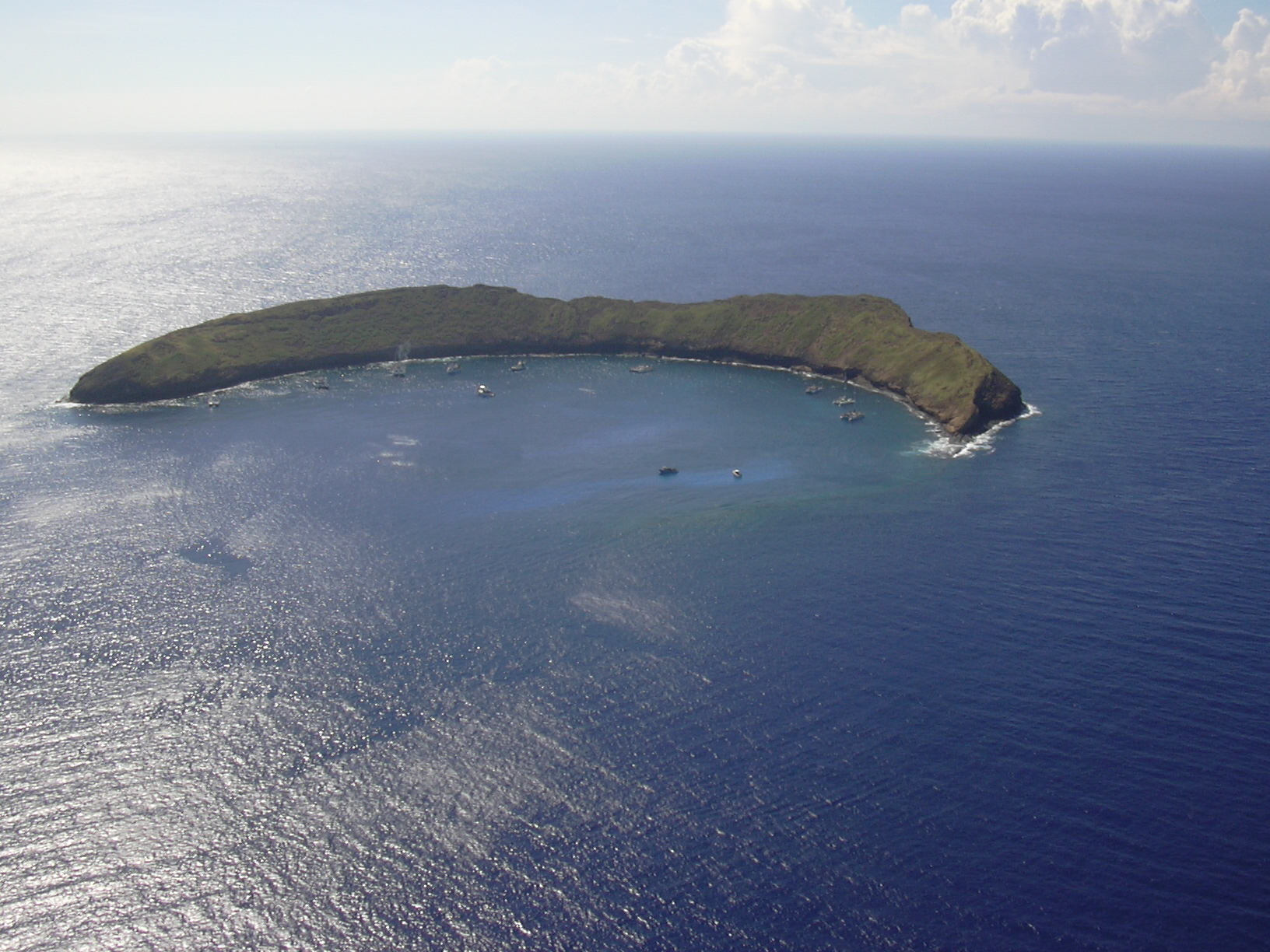
Molokini is a crescent-shaped, partially submerged volcanic crater which forms a small, uninhabited islet located in ʻAlalākeiki Channel between the islands of Maui and Kahoʻolawe, within Maui County in Hawaiʻi. It is the remains of one of the seven Pleistocene epoch volcanoes that formed the prehistoric Maui Nui island, during the Quaternary Period of the Cenozoic Era.
The islet has an area of 23 acres (9.3 ha), a diameter of about 0.4 miles (0.6 km), is 161 feet (50 m) at its highest point, and is located about 2.5 miles (2.2 nmi; 4.0 km) west of Makena State Park and south of Maʻalaea Bay. The islet is a Hawaiʻi State Seabird Sanctuary.
Molokini is a destination for scuba diving, snuba, and snorkeling. Its crescent shape protects divers inside it from waves and the channel's powerful currents, though diving also takes place off the 300-foot (91.5-meter) sheer outer wall. Molokini is great for snorkelers and divers, offering water clarity of up to 150 feet. With no sand beach, visitors instead find sand patches, basalt rocks, and boulders covering the bottom of the cove. In the morning, when winds are calmer, smaller tour boats also take guests to snorkel off the outer wall.
The crater houses a reef with visibility as deep as 150 feet (46 m). Molokini is home to about 250 species of fish, many endemic (see Ecology below). The best conditions occur in early morning. The water depth is 20–50 feet (6–15 m) in the majority of the allowed dive spots.
Because Molokini attracts many boats, the Hawaii State Division of Boating and Recreation established mooring buoys and "Day Use Mooring Rules" for Molokini to protect against damage from dropped anchors.
In Hawaiian legend, Molokini (translating to "many ties") was a beautiful woman. She and Pele, the fire goddess, were in love with the same man. The jealous Pele cut her rival in two and transformed her into stone. This act of vengeance is rumored to be the reason for the crescent-shaped Molokini crater. The woman's head is supposedly Puʻu Olai, the cinder cone by Makena Beach.
Potassium-argon dating indicates that Molokini erupted approximately 230,000 years ago. Archaeological evidence, primarily in the form of stone sinkers and lures, show that early Hawaiians visited Molokini to fish. They also likely harvested seabirds, eggs and feathers.
During World War II, the United States Navy used Molokini for target practice, as its shape is somewhat similar to a battleship. In 1975 and 1984, the Navy detonated in-place unexploded munitions found within the crater, resulting in the destruction of large areas of coral. This resulted in a public outcry. A thorough search and manual removal of unexploded munitions to deep water was carried out by volunteer divers as a result. A 2006 survey found no evidence of unexploded munitions on the islet. As a result of the extensive target practice, the southwest rim of the islet is damaged.[citation needed]
Hub AI
Molokini AI simulator
(@Molokini_simulator)
Molokini
Molokini is a crescent-shaped, partially submerged volcanic crater which forms a small, uninhabited islet located in ʻAlalākeiki Channel between the islands of Maui and Kahoʻolawe, within Maui County in Hawaiʻi. It is the remains of one of the seven Pleistocene epoch volcanoes that formed the prehistoric Maui Nui island, during the Quaternary Period of the Cenozoic Era.
The islet has an area of 23 acres (9.3 ha), a diameter of about 0.4 miles (0.6 km), is 161 feet (50 m) at its highest point, and is located about 2.5 miles (2.2 nmi; 4.0 km) west of Makena State Park and south of Maʻalaea Bay. The islet is a Hawaiʻi State Seabird Sanctuary.
Molokini is a destination for scuba diving, snuba, and snorkeling. Its crescent shape protects divers inside it from waves and the channel's powerful currents, though diving also takes place off the 300-foot (91.5-meter) sheer outer wall. Molokini is great for snorkelers and divers, offering water clarity of up to 150 feet. With no sand beach, visitors instead find sand patches, basalt rocks, and boulders covering the bottom of the cove. In the morning, when winds are calmer, smaller tour boats also take guests to snorkel off the outer wall.
The crater houses a reef with visibility as deep as 150 feet (46 m). Molokini is home to about 250 species of fish, many endemic (see Ecology below). The best conditions occur in early morning. The water depth is 20–50 feet (6–15 m) in the majority of the allowed dive spots.
Because Molokini attracts many boats, the Hawaii State Division of Boating and Recreation established mooring buoys and "Day Use Mooring Rules" for Molokini to protect against damage from dropped anchors.
In Hawaiian legend, Molokini (translating to "many ties") was a beautiful woman. She and Pele, the fire goddess, were in love with the same man. The jealous Pele cut her rival in two and transformed her into stone. This act of vengeance is rumored to be the reason for the crescent-shaped Molokini crater. The woman's head is supposedly Puʻu Olai, the cinder cone by Makena Beach.
Potassium-argon dating indicates that Molokini erupted approximately 230,000 years ago. Archaeological evidence, primarily in the form of stone sinkers and lures, show that early Hawaiians visited Molokini to fish. They also likely harvested seabirds, eggs and feathers.
During World War II, the United States Navy used Molokini for target practice, as its shape is somewhat similar to a battleship. In 1975 and 1984, the Navy detonated in-place unexploded munitions found within the crater, resulting in the destruction of large areas of coral. This resulted in a public outcry. A thorough search and manual removal of unexploded munitions to deep water was carried out by volunteer divers as a result. A 2006 survey found no evidence of unexploded munitions on the islet. As a result of the extensive target practice, the southwest rim of the islet is damaged.[citation needed]
Recent media