
.JPG/250px-Crescent_Moon_(cropped).JPG)


.JPG)
Community hub
Recent from talks
Contribute something
Nothing was collected or created yet.
Crescent
View on Wikipedia.JPG)
.svg)
.svg)
.jpg)
A crescent shape (/ˈkrɛsənt/, UK also /ˈkrɛzənt/)[1] is a symbol or emblem used to represent the lunar phase (as it appears in the northern hemisphere) in the first quarter (the "sickle moon"), or by extension a symbol representing the Moon itself.
In Hindu Iconography, Shiva is often shown wearing a crescent moon on his head, symbolising his control over time, as well as his attributes of both creation and destruction.[2]
It is used as the astrological symbol for the Moon, and hence as the alchemical symbol for silver. It was also the emblem of Diana/Artemis, and hence represented virginity. In veneration of Mary in the Catholic Church, it is associated with Mary, mother of Jesus.
From its use as roof finial in Ottoman mosques, it has also become associated with Islam, and the crescent was introduced as chaplain badge for Muslim United States military chaplains in 1993.[3]
Symbolism
[edit]


The crescent symbol is primarily used to represent the Moon, not necessarily in a particular lunar phase. When used to represent a waxing or waning lunar phase, "crescent" or "increscent" refers to the waxing first quarter, while the symbol representing the waning final quarter is called "decrescent".
The crescent symbol was long used as a symbol of the Moon in astrology, and by extension of Silver (as the corresponding metal) in alchemy.[4] The astrological use of the symbol is attested in early Greek papyri containing horoscopes.[5]
In the 2nd-century Bianchini's planisphere, the personification of the Moon is shown with a crescent attached to her headdress.[6] Its ancient association with Ishtar/Astarte and Diana is preserved in the Moon (as symbolised by a crescent) representing the female principle (as juxtaposed with the Sun representing the male principle), and (Artemis-Diana being a virgin goddess) especially virginity and female chastity.
In Christian symbolism, the crescent entered Marian iconography, by the association of Mary with the Woman of the Apocalypse (described with "the moon under her feet, and on her head a crown of twelve stars" in Revelation) The most well known representation of Mary as the Woman of the Apocalypse is the Virgin of Guadalupe.
On the domes of certain Eastern Orthodox churches, particularly Russian Orthodox ones, there appears a cross over a crescent. This symbolises Jesus Christ as two of the threefold office, the King and High Priest. It is sometimes mistakenly taken as a symbol of the victory of Christianity over Islam, but it has nothing to do with it nor Islam at all, as domes featuring the cross-over-crescent design were constructed in medieval Russia in the 12th century, prior to the arrival of Islam in Kievan Rus'.[7]
Shape
[edit]

The crescent shape is a type of lune, the latter consisting of a circular disk with a portion of another disk removed from it, so that what remains is a shape enclosed by two circular arcs which intersect at two points. In a crescent, the enclosed shape does not include the center of the original disk.
The tapered regions towards the points of intersection of the two arcs are known as the "horns" of the crescent. The classical crescent shape has its horns pointing upward (and is often worn as horns when worn as a crown or diadem, e.g. in depictions of the lunar goddess, or in the headdress of Persian kings, etc.[8]
The word crescent is derived etymologically from the present participle of the Latin verb crescere "to grow", technically denoting the waxing moon (luna crescens). As seen from the northern hemisphere, the waxing Moon tends to appear with its horns pointing towards the left, and conversely the waning Moon with its horns pointing towards the right; the English word crescent may however refer to the shape regardless of its orientation, except for the technical language of blazoning used in heraldry, where the word "increscent" refers to a crescent shape with its horns to the left, and "decrescent" refers to one with its horns to the right, while the word "crescent" on its own denotes a crescent shape with horns pointing upward.[9]
The shape of the lit side of a spherical body (most notably the Moon) that appears to be less than half illuminated by the Sun as seen by the viewer appears in a different shape from what is generally termed a crescent in planar geometry: Assuming the terminator lies on a great circle, the crescent Moon will actually appear as the figure bounded by a half-ellipse and a half-circle, with the major axis of the ellipse coinciding with a diameter of the semicircle.
Unicode encodes a crescent (increscent) at U+263D (☽) and a decrescent at U+263E (☾). The Miscellaneous Symbols and Pictographs block provides variants with faces as emoji: U+1F31B 🌛 FIRST QUARTER MOON WITH FACE and U+1F31C 🌜 LAST QUARTER MOON WITH FACE.
History
[edit]Early history
[edit]
The crescent shape is used to represent the Moon, and the Moon deity Nanna/Sin from an early time, visible in Akkadian cylinder seals as early as 2300 BC.
The Egyptian logograph representing the Moon also had a crescent shape 𓇹 (Gardiner N11, ı͗ꜥḥ "moon" (with increscent and decrescent variants); variant N12 𓇺). In addition, there is a 19th-dynasty hieroglyph representing the "moon with its lower half obscured (N9 𓇷 psḏ, with a variant with a crescent shape N10 𓇸).[10]
The crescent was well used in the iconography of the ancient Near East and was used by the Phoenicians in the 8th century BC as far as Carthage and Numidia in modern Tunisia and Algeria. The crescent and star also appears on pre-Islamic coins of South Arabia.[11]
The combination of star and crescent also arises in the ancient Near East, representing the Moon and Ishtar (the planet Venus), often combined into a triad with the solar disk.[12] It was inherited both in Sassanian and Hellenistic iconography.
Classical antiquity
[edit]Selene, the moon goddess, was depicted with a crescent upon her head, often referred to as her horns, and a major identifying feature of hers in ancient works of art.[13][14]
In the iconography of the Hellenistic period, the crescent became the symbol of Artemis-Diana, the virgin hunter goddess associated with the Moon. Numerous depictions show Artemis-Diana wearing the crescent Moon as part of her headdress. The related symbol of the star and crescent was the emblem of the Mithradates dynasty in the Kingdom of Pontus and was also used as the emblem of Byzantium.
-

-
 Bust of Selene on a Roman sarcophagus (3rd century)
 -


Middle Ages
[edit]


The crescent remained in use as an emblem in the Sasanian Empire, used as a Zoroastrian regal or astrological symbol. In the Crusades it came to be associated with the Orient (the Byzantine Empire, the Levant and Outremer in general) and was widely used (often alongside a star) in Crusader seals and coins. It was used as a heraldic charge by the later 13th century. Isaac Komnenos of Cyprus, the claimant to the Byzantine Empire who ruled Cyprus until overthrown by the crusading King Richard I of England, used arms with "a crescent of gold on a shade of azure, with a blazing star of eight points". Later, King Richard granted the same as the coat of arms of the city of Portsmouth, in recognition of the significant involvement of soldiers, sailors, and vessels from Portsmouth in the conquest of Cyprus.[15] This remains Portsmouth's coat of arms up to the present.
Anna Notaras, daughter of the last megas doux of the Byzantine Empire Loukas Notaras, after the fall of Constantinople and her emigration to Italy, made a seal with her coat of arms which included "two lions holding above the crescent a cross or a sword".[16]
From its use in the Sasanian Empire, the crescent also found its way into Islamic iconography after the Muslim conquest of Persia. Umar is said to have hung two crescent-shaped ornaments captured from the Sasanian capital of Ctesiphon in the Kaaba.[17] The crescent also became the symbol of the Umayyad Caliphate.[citation needed] The crescent appears to have been adopted as an emblem on military flags by the Islamic armies from at least the 13th century, although the scholarly consensus holds that the widespread use of the crescent in Islam develops later, during the 14th to 15th century.[18] The use of such flags is reflected in the 14th-century Libro del Conoscimiento and the Catalan Atlas. Examples include the flags attributed to Gabes, Tlemcen, Tunis and Buda,[19] Nubia/Dongola (documented by Angelino Dulcert in 1339) and the Mamluks of Egypt.[20]
The Roman Catholic fashion of depicting Madonna standing or sitting on a crescent develops in the 15th century.
Early modern and modern
[edit]

The goddess Diana was associated with the Moon in classical mythology. In reference to this, feminine jewelry representing crescents, especially diadems, became popular in the early modern period. The tarot card of the "Popess" also wears a crescent on her head.
Conrad Grünenberg in his Pilgrimage to the Holy Land (1486) consistently depicts cities in the Holy Land with crescent finials.[21] Flags with crescents appear to have been used on Ottoman vessels since at least the 16th century.
Prints depicting the Battle of Lepanto (1571), including the print by Agostino Barberigo of Rome made just a few weeks after the battle,[22] and the Martino Rota of Venice in the following year, show the Ottoman vessels displaying flags with one or several crescents in various orientations (as do the monumental paintings commissioned later based on these prints). Rota also shows numerous crescent finials, both on ships and on fortresses depicted in the background, as well as some finials with stars or suns radiant, and in some cases a sun radiant combined with a crescent in the star-and-crescent configuration.
The official adoption of star and crescent as the Ottoman state symbol started during the reign of Sultan Mustafa III (1757–1774) and its use became well-established during Sultan Abdul Hamid I (1774–1789) and Sultan Selim III (1789–1807) periods. A buyruldu (decree) from 1793 states that the ships in the Ottoman navy have that flag.[23]
Muhammad Ali, who became Pasha of Egypt in 1805, introduced the first national flag of Egypt, red with three white crescents, each accompanied by a white star.
The association of the crescent with the Ottoman Empire appears to have resulted in a gradual association of the crescent shape with Islam in the 20th century.[further explanation needed] A Red Crescent appears to have been used as a replacement of the Red Cross as early as in the Russo-Turkish War of 1877/8, and it was officially adopted in 1929.
While some Islamic organisations since the 1970s have embraced the crescent as their logo or emblem (e.g. Crescent International magazine, established 1980), some Muslim publications tend to emphasize that the interpretation of the crescent, historically used on the banners of Muslim armies, as a "religious symbol" of Islam was an error made by the "Christians of Europe".[24] The identification of the crescent as an "Islamic symbol" is mentioned by James Hastings as a "common error" to which "even approved writers on Oriental subjects" are prone as early as 1928.[25]
The crescent was used on a flag of the American Revolutionary War and was called the Liberty (or Moultrie) Flag.
The symbol of the Triple Goddess is a circle flanked by a left facing and right facing crescent, which represents a maiden, mother and crone archetype.[26] The biohazard symbol bears peculiar resemblance to the triple crescent badge of Henry II of France.
-

-
 Muhammad I of Granada leading his troops during the Mudéjar revolt of 1264–66, illustrated in the contemporary Cantigas de Santa Maria
 -
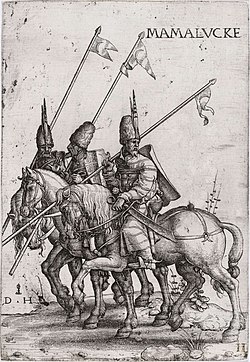 Mamluk lancers, early 16th century (etching by Daniel Hopfer)
 -
 Triple crescent badge of Henry II of France (d. 1559), Château d'Écouen
 -
 A scene from the Battle of Varna (1444) on the Kronika wszystkiego świata of Marcin Bielski (1564)
 -
 The painting of the 1571 Battle of Lepanto by Tommaso Dolabella (c. 1632) shows a variety of naval flags with crescents attributed to the Ottoman Empire
 -
 A naval battle painting of the Barbary state of Ottoman Algiers titled A Sea Fight with Barbary Corsairs by Laureys a Castro, c. 1681
 -
 Madonna on the crescent, Bad Waldsee church (17th century)
 -
 Portrait of a Lady as Diana by Pompeo Batoni (1760s)
 -
 Symbol of the Triple Goddess
 -
 A circle with an upward facing crescent representing the Wiccan Horned God

.jpg)


.jpg)


Heraldry
[edit]The crescent has been used as a heraldic charge since the 13th century. In heraldic terminology, the term "crescent" when used alone refers to a crescent with the horns pointing upward. A crescent with the horns pointing left (dexter) is called "a crescent increscent" (or simply "an increscent"), and when the horns are pointing right (sinister), it is called "a crescent decrescent" (or "a decrescent"). A crescent with horns pointing down is called "a crescent reversed". Two crescents with horns pointing away from each other are called "addorsed".[27] Siebmachers Wappenbuch (1605) has 48 coats of arms with one or more crescents, for example:[28]
- Azure, a crescent moon argent pierced by an arrow fesswise Or all between in chief three mullets of six points and in base two mullets of six points argent (von Hagen, p. 176);
- Azure, an increscent and a decrescent addorsed Or (von Stoternheim, p. 146);
- Per pale Or and sable, a crescent moon and in chief three mullets of six points counterchanged (von Bodenstein, p. 182).
In English heraldry, the crescent is used as a difference denoting a second son.[27]
-
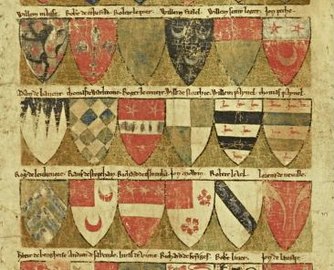 Three examples of coats of arms with crescents from the Dering Roll (c. 1270): No. 118: Willem FitzLel (sable crusily and three crescents argent); no. 120: John Peche (gules, a crescent or, on a chief argent two mullets gules); no. 128: Rauf de Stopeham (argent, two (of three) crescents and a canton gules).
 -
![Coat of arms of the Neuamt bailiwick of Zürich (16th century).[29] Its reversed crescent was taken up in the 20th-century municipal coats of arms of Niederglatt, Neerach and Stadel (canton of Zürich).](//upload.wikimedia.org/wikipedia/commons/thumb/3/3e/Wappen_Neuamt.png/250px-Wappen_Neuamt.png) Coat of arms of the Neuamt bailiwick of Zürich (16th century).[29] Its reversed crescent was taken up in the 20th-century municipal coats of arms of Niederglatt, Neerach and Stadel (canton of Zürich).
Coat of arms of the Neuamt bailiwick of Zürich (16th century).[29] Its reversed crescent was taken up in the 20th-century municipal coats of arms of Niederglatt, Neerach and Stadel (canton of Zürich). -
 This coat of arms of the Divorde family (Holland and Brabant), around 1440, shows three crescents.
 -
 Inverted crescent on Polish coat of arms.

![Coat of arms of the Neuamt bailiwick of Zürich (16th century).[29] Its reversed crescent was taken up in the 20th-century municipal coats of arms of Niederglatt, Neerach and Stadel (canton of Zürich).](https://en.wikipedia.org/wiki/File:Wappen_Neuamt.png)


Contemporary use
[edit]The crescent remains in use as astrological symbol and astronomical symbol representing the Moon. Use of a standalone crescent in flags is less common than the star and crescent combination. Crescents without stars are found in the South Carolina state flag (1861), the flag of Maldives (1965), the flag of the Organisation of Islamic Cooperation (1981)[30] and the flag of the Arab League.
New Orleans is nicknamed "the Crescent City", and a crescent (or crescent and star) is used to represent the city in official emblems.[31]
Crescents, often with faces, are found on numerous modern municipal coats of arms in Europe, e.g. France: Katzenthal, Mortcerf; Germany: Bönnigheim, Dettighofen, Dogern, Jesenwang, Karstädt, Michelfeld (Angelbachtal), Waldbronn; Italy: Province of Agrigento; Malta: Qormi; Sweden: Trosa; Switzerland: Boswil, Dättlikon, Neerach (from the 16th-century Neuamt coat of arms).
The crescent printed on military ration boxes is the US Department of Defense symbol for subsistence items. The symbol is used on packaged foodstuffs but not on fresh produce or on items intended for resale.[32]
Since 1993, the crescent has also been in use as chaplain badge for Muslim chaplains in the US military.[3]
-
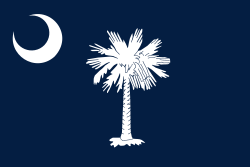 Flag of South Carolina (1861)
 -
 Flag of Maldives (1965)
 -
 The emblem of the International Red Cross and Red Crescent Movement around the world
 -
 Symbol of the Nationalist Movement Party of Turkey
 -
 The Dreamliner logo is painted on many Boeing 787s
 -
 Coat of arms of the 1st-54 Regulares Battalion "Tetuán" (Spanish Army)


Other things called "crescent"
[edit]
The term crescent may also refer to objects with a shape reminiscent of the crescent shape, such as houses forming an arc, a type of solitaire game, Crescent Nebula, glomerular crescent (crescent shaped scar of the glomeruli of the kidney),[33][34] the Fertile Crescent (the fertile area of land between Mesopotamia and Egypt roughly forming a crescent shape), and the croissant (the French form of the word) for the crescent-shaped pastry.
See also
[edit]- Barkhan dune
- Lune (mathematics)
- Star and crescent
- Astronomical symbols
- Astrological symbols
- Lunar phase
Footnotes
[edit]Notes
[edit]- ^ from Middle English cressaunt 'crescent-shaped ornaments'; from Old French creissant 'crescent shape'; from Latin crēscēns 'growing, waxing'.
See e.g. the following:- "crescent". Dictionary.com Unabridged (Online). n.d.
- "crescent". Collins English Dictionary. HarperCollins.
- "crescent". Lexico UK English Dictionary. Oxford University Press. Archived from the original on 2021-10-22. Retrieved 2022-09-02.
- ^ Chwalkowski, Farrin (2016-12-14). Symbols in Arts, Religion and Culture: The Soul of Nature. Cambridge Scholars Publishing. p. 338. ISBN 978-1-4438-5728-4.
- ^ a b On December 14, 1992, the Army Chief of Chaplains requested that an insignia be created for future Muslim chaplains, and the design (a crescent) was completed January 8, 1993. Emerson, William K., Encyclopedia of United States Army Insignia and Uniforms (1996), p. 269f. Prior to its association with Islam, a crescent badge had already been used in the US military for the rank of commissary sergeant (Emerson 1996:261f).
- ^ Alchemy and Symbols, By M. E. Glidewell, Epsilon.
- ^ Neugebauer, Otto; Van Hoesen, H. B. (1987). Greek Horoscopes. pp. 1, 159, 163.
- ^ "Bianchini's planisphere". Florence, Italy: Istituto e Museo di Storia della Scienza (Institute and Museum of the History of Science). Archived from the original on 2009-10-30. Retrieved 2010-03-19. Maunder, A. S. D. (1934). "The origin of the symbols of the planets". The Observatory. 57: 238–247. Bibcode:1934Obs....57..238M.
- ^ "The Origins of Orthodox Crosses with a Crescent | Church Blog". 2018-05-02. Retrieved 2025-03-21.
- ^ The new Moon at sunset and the old Moon at sunrise, when observed with horns pointing upward, is also known as "wet moon" in English, in an expression loaned from Hawaiian culture.
- ^ Arthur Charles Fox-Davies, A Complete Guide to Heraldry (1909), p. 289. Online texts at https://archive.org/details/completeguidetoh00foxduoft or http://www7b.biglobe.ne.jp/~bprince/hr/foxdavies/index.htm .
- ^ A.H. Gardiner, Egyptian Grammar: Being an Introduction to the Study of Hieroglyphs. 3rd Ed., pub. Griffith Institute, Oxford, 1957 (1st edition 1927), p. 486.
- ^ Tombs and Moon Temple of Hureidah, Gertrude Caton Thompson, p.76
- ^ "the three celestial emblems, the sun disk of Shamash (Utu to the Sumerians), the crescent of Sin (Nanna), and the star of Ishtar (Inanna to the Sumerians)". Irving L. Finkel, Markham J. Geller, Sumerian Gods and Their Representations, Styx, 1997, p71.
- ^ Bell, s.v. Selene; Roman Sarcophagi in the Metropolitan Museum of Art, 1978, p. 35
- ^ British Museum 1923,0401.199; LIMC 13213 (Selene, Luna 21); LIMC 13181 (Selene, Luna 4)
- ^ Quail 1994, pp. 14–18.
- ^ Tipaldos, G. E., Great Greek Encyclopedia, Vol. XII, page 292, Athens, 1930
- ^ Oleg Grabar, "Umayyad Dome," Ars orientalis (1959), p. 50, cited after Berger (2012:164).
- ^ Pamela Berger, The Crescent on the Temple: The Dome of the Rock as Image of the Ancient Jewish Sanctuary (2012), p. 164f
- ^ Znamierowski Flags through the ages: A guide to the world of flags, banners, standards and ensigns, (2000) section 'the Muslim crescent', cited by Ivan Sache, FOTW Archived 2016-03-22 at the Wayback Machine, 11 March 2001
- ^ "After king Nasr ad din had fled to Cairo in 1397 to beg assistance against his cousin, the King of Nubia is depicted with a yellow flag with a white crescent but also with a yellow shield with a white crescent. At the same time the yellow crescented flag waves over all the Mameluk Empire. The flag of the Sultan of Egypt is yellow with three white crescents. From this we may conclude that any autonomy of the Nubian king was over at the time." Hubert de Vries, Muslim Nubia (hubert-herald.nl).
- ^ so for Jaffa (29r), Raman (31v-32r), Jerusalem (35v-36r). Grünenberg's pilgrimage took place still during the late Mamluk era (Burji dynasty) of control over the Holy Land.
- ^ Agostino Barberigo, L' ultimo Et vero Ritrato Di la vitoria de L'armata Cristiana de la santissima liga Contre a L'armata Turcheschà [...], 1571. Antonio Lafreri , L’ordine tenuto dall’armata della santa Lega Christiana contro il Turcho [...], n'e seguita la felicissima Vittoria li sette d'Ottobre MDLXXI [...], Rome, 1571
- ^ İslâm Ansiklopedisi (in Turkish). Vol. 4. Istanbul: Türkiye Diyanet Vakfı. 1991. p. 298.
- ^ "Like the Crusaders, the Christians of Europe were misled into a belief that the crescent was the religious symbol of Islam" Islamic Review 30 (1942), p. 70., "many Muslim scholars reject using the crescent moon as a symbol of Islam. The faith of Islam historically had no symbol, and many refuse to accept it.", Fiaz Fazli, Crescent magazine, Srinagar, September 2009, p. 42.
- ^ "There is no more common error than the supposition that the crescent (or rather crescent and star) is an Islamic symbol, and even approved writers on Oriental subjects are apt to fall into it." James Hastings, Encyclopædia of Religion and Ethics, Volumes 11–12 (1928), p. 145.
- ^ Gilligan, Stephen G., and Simon, Dvorah (2004). Walking in Two Worlds: The Relational Self in Theory, Practice, and Community. Zeig Tucker & Theisen Publishers. p. 148. ISBN 1-932462-11-2, ISBN 978-1-932462-11-1. Retrieved 03 January 2022.
- ^ a b Arthur Charles Fox-Davies, A complete guide to heraldry (1909), p. 289.
- ^ Sara L. Uckelman, An Ordinary of Siebmacher's Wappenbuch (ellipsis.cx) (2014)
- ^ geteilt von Blau mit gestürztem goldenem Halbmond und von Gold mit zwei roten Rosen ("per fess azure a crescent reversed or and of the second two roses gules") Historisch-Biographisches Lexikon der Schweiz, vol. V, p. 243.
- ^ In 2011 replaced with a logo showing a crescent engulfing the globe. "Ihsanoglu urges international community to recognize state of Palestine at the United Nations, historic change of OIC logo and name to Organisation of the Islamic Cooperation". Organisation of Islamic Cooperation. 28 June 2011. Retrieved 25 January 2016.[permanent dead link]
- ^ "History of the NOPD Badge". Archived from the original on 2013-07-24. The origin is the crescent shape of the old city, hugging the East Bank of the Mississippi River.
- ^ MIL STD 129, FM 55-17
- ^ . It is a sign of rapidly progressive glomerulonephritis (also called crescentic glomerulonephritis). "iROCKET Learning Module: Glomerular Pathology, Case I". Archived from the original on December 12, 2012.
- ^ "Renal Pathology".
References
[edit]- Bell, Robert E., Women of Classical Mythology: A Biographical Dictionary, ABC-CLIO 1991, ISBN 0-87436-581-3. Internet Archive.
- Quail, Sarah (1994). The Origins of Portsmouth and the First Charter. City of Portsmouth. ISBN 0-901559-92-X.


Crescent
View on GrokipediaAstronomical and Geometric Foundations
Lunar Phenomenon
The crescent moon denotes the initial and terminal phases of the lunar cycle, characterized by a narrow, curved sliver of illumination visible from Earth. These phases occur when the Moon's elongation from the Sun— the angular separation as viewed from Earth—is small, resulting in only a minor fraction of the Moon's dayside being observable. The waxing crescent follows the new moon, with illumination increasing from near 0% to approximately 50% over about seven days until the first quarter phase, though the distinctly thin crescent shape is most prominent in the first 1 to 3 days post-new moon, when less than 10% of the disk is lit.[5][6][7] This visibility arises from the orbital geometry: as the Moon orbits Earth, the angle between the observer's line of sight to the Moon and the Sun diminishes after full moon, culminating in conjunction at new moon. Post-conjunction, the waxing crescent emerges low in the western sky immediately after sunset, with the illuminated arc appearing on the right in the Northern Hemisphere due to the Moon's eastward motion. Conversely, the waning crescent precedes new moon, appearing low in the eastern sky before dawn with the lit arc on the left, diminishing to invisibility as conjunction approaches. The entire crescent visibility window is confined to twilight periods, never appearing high overhead or at midnight.[8][9][10] A notable feature during crescent phases is earthshine, a subtle illumination of the Moon's nightside caused by sunlight reflected from Earth's oceans and clouds scattering back onto the lunar surface. This "old moon in the new moon's arms" effect, first explained by Leonardo da Vinci, reveals the Moon's unlit portion faintly glowing, providing insight into Earth's albedo—its reflectivity—which measures about 0.30 globally. Earthshine peaks near thin crescents when the phase angle allows optimal reflection geometry, and its intensity varies with Earth's cloud cover and phase of the Moon.[5][11][12] The detectability of the earliest waxing crescent, often within 18-24 hours after new moon under ideal conditions, depends on factors like atmospheric clarity, observer latitude, and lunar declination; in mid-northern latitudes, it may require binoculars initially. This phenomenon has enabled precise lunar calendars, as the first crescent sighting traditionally marks month beginnings in various cultures, reflecting the Moon's synodic period of approximately 29.53 days.[7][13]Geometric Properties
In plane geometry, a crescent is mathematically termed a lune, defined as the region bounded by two circular arcs of unequal radii whose endpoints coincide at two points, forming a concave or convex curved digon without straight sides.[14] This shape arises from the intersection of two circles, where the lune constitutes one of the two symmetric non-overlapping regions exterior to their lens-shaped common intersection.[14] The perimeter of a lune comprises the lengths of its two bounding arcs. For circles of radii (smaller) and (larger) with centers separated by distance , the central angles subtended by the arcs are determined via the law of cosines: for the smaller arc and for the larger. The perimeter is then , with angles in radians.[15] The area of a lune equals the difference between the circular segments subtended by each arc. Each segment area is the sector area minus the triangular area: for the smaller circle, segment = ; similarly for the larger. Thus, lune area . An equivalent closed form is .[15][15] A notable property involves the lune of Hippocrates, constructed on a right isosceles triangle with legs of length : a semicircle of diameter the hypotenuse () and quarter-circles of radii on the legs. Hippocrates of Chios (ca. 470–410 BCE) proved this lune's area equals the triangle's area , as the semicircle area minus the two quarter-segment excesses compensates exactly, providing an early exact quadrature of a curved figure.[14] This demonstrates that specific lunes admit rectification to polygonal areas, though general lunes resist simple construction.[16]Pre-Modern Historical Development
Ancient Near Eastern Origins
The crescent symbol emerged in the ancient Near East during the Early Dynastic period (circa 2900–2350 BCE) within Sumerian iconography, where it served as the primary emblem of the moon god Nanna, also called Suen.[17] This motif, known in Sumerian as u₄-sakar, depicted the waxing crescent moon and symbolized the lunar cycle's phases, linking the deity to natural rhythms of illumination, fertility, and timekeeping essential for agriculture and calendars.[17] Earliest attestations appear on cylinder seals from Mesopotamian sites, portraying Nanna in cultic contexts or the crescent alone as a dedicatory sign, with examples traceable to seals produced around 2900 BCE onward.[17] The god's cult center at the temple in Ur, known as E-kiš-nu-ĝal ("House of the Great Light"), reinforced the crescent's role in worship, where it evoked bull horns—associating Nanna with male virility, cattle breeding, and prosperity in pastoral economies.[17] Frequently paired with an eight-pointed star representing the goddess Inanna (later Ishtar), the crescent-star combination highlighted astral deities' interplay, as seen in seals from the Third Dynasty of Ur (circa 2112–2004 BCE), including those linked to King Ur-Nammu.[17] Beyond seals, crescent motifs appeared in jewelry as lunate pendants during the Early Bronze Age, functioning as amulets for protection and status in Mesopotamian and Levantine burials, often tied to lunar deity veneration including Sin (Akkadian form of Nanna).[18] This symbolism persisted into Akkadian and later periods, influencing broader Near Eastern astral iconography, though its Sumerian origins rooted it in polytheistic cosmology prioritizing empirical celestial observations for divination and ritual timing.[17]Classical Antiquity
In ancient Greek mythology, the crescent moon served as a primary attribute of Selene, the Titaness personifying the moon. Artistic depictions from the Archaic period onward, including vase paintings and sculptural reliefs, routinely portrayed Selene with a crescent-shaped diadem or crown atop her head, symbolizing the waxing or waning lunar phase.[19] This iconography emphasized her role in illuminating the night sky, often shown driving a chariot across the heavens pulled by winged horses or oxen.[19] Selene's crescent also appeared in gem engravings and coins, reinforcing its association with lunar cycles and feminine divinity.[20] The crescent's symbolism extended to Artemis, the goddess of the hunt, whose bow was likened to the moon's curved form, though her primary emblems were arrows and deer rather than the crescent itself. Hesychius's lexicon from the 5th century CE references crescent moon amulets worn for protection in the Greek world, linking the shape to apotropaic functions against evil.[21] In Hellenistic art, syncretism blended Selene's attributes with those of other goddesses, such as in representations pairing her with Helios, the sun god, where the crescent contrasted solar rays.[19] Roman adaptations mirrored Greek precedents, with Luna as the moon goddess bearing the crescent moon alongside her biga chariot in temple reliefs and sarcophagi from the Republican era through the Imperial period.[22] Diana, equated with Artemis, incorporated lunar aspects, depicted in statues and mosaics with a crescent diadem signifying her dominion over night and chastity; a 3rd-century CE sarcophagus relief exemplifies this, showing her profile adorned with the curved lunar emblem.[23] Literary sources like Horace's Carmen Saeculare (17 BCE) invoked Luna's crescent in rituals, underscoring its ritualistic role in marking celestial and seasonal transitions.[22] While not a widespread civic symbol, the crescent appeared in military contexts, such as on auxiliary shields evoking protective lunar forces tied to Venusian cults.[24] These representations persisted into late antiquity, influencing provincial art without evolving into abstract heraldry.Medieval Period
In the Byzantine Empire, the crescent retained significance as a civic emblem of Constantinople throughout the medieval era, rooted in pre-Christian legends associating it with the moon's purported intervention in defending the city against Philip II of Macedon in 340 BCE, and later linked to the goddess Diana, to whom Byzantium was dedicated. This symbolism appeared on coins, seals, and military standards, symbolizing protection and continuity from Hellenistic traditions into Christian rule under emperors like Justinian I (r. 527–565) and beyond.[25] The crescent entered Islamic military iconography during the 11th–12th centuries via the Seljuk Turks, who reportedly observed it as a celestial sign of victory for Sultan Alparslan before the Battle of Manzikert in 1071, after which it adorned banners and shields. By the time of the Crusades, European accounts documented crescents on Saracen flags and tents, distinguishing Muslim armies; for instance, chroniclers like William of Tyre described such emblems during the sieges of Antioch (1098) and Jerusalem (1099), though without uniform adoption across factions like the Fatimids or Zengids. This usage reflected practical adaptation from regional precedents rather than doctrinal mandate, as Islam proscribes anthropomorphic or astral icons in core theology.[26][27][28] In Western Europe, crusaders returning from the Levant integrated the crescent into emerging heraldry by the late 12th century, adopting it as a badge of honor for service in the Holy Land, particularly among French nobles; it also standardized as a mark of cadency denoting the second son, symbolizing enlightenment under sovereign grace. Medieval armorials, such as those from the 13th-century Siege of Acre, show crescents on shields of knights like those under Richard I of England, often stylized with horns upward. Concurrently, amuletic crescents circulated in folk practices for warding evil, especially in childbirth rituals, drawing from lunar fertility motifs without overt pagan revival.[29][30] By the 13th–14th centuries, the crescent proliferated on Islamic emblems under successor states like the Mamluks of Egypt, who incorporated it into sultanate arms alongside cups or stars, and the Golden Horde, whose 1339 flag featured a white crescent on red, signaling Turkic-Mongol synthesis. In contrast, its European heraldic role remained secular, occasionally denoting Turkish adversaries in battle rolls, underscoring causal divergence: Eastern continuity via conquest and omen, Western via trophy and differentiation.[31]Religious and Cultural Symbolism
Pagan and Pre-Islamic Associations
In Mesopotamian religion, the crescent moon served as the primary emblem of the moon god Nanna, also known as Suen in Sumerian and Sin in Akkadian, dating back to the Uruk period around 4000–3100 BCE.[17] This symbol, often rendered as a recumbent crescent (u₄-sakar in Sumerian), appeared on cylinder seals, temple reliefs, and divine standards, representing the waxing lunar phase and the god's role in measuring time, fertility, and prosperity for herders and farmers.[17] Nanna's cult center at the city of Ur featured ziggurats adorned with crescent motifs, underscoring the symbol's integration into ritual and architecture by the Third Dynasty of Ur circa 2100–2000 BCE.[17] The crescent also linked to lunar goddesses in the Near East, such as Inanna/Ishtar, where it combined with a star or disc to denote celestial pairings, as seen in seals depicting the deity with horned headdresses evoking the crescent shape.[4] In Phoenician and later Seleucid contexts, the goddess Astarte bore similar crescent or horned attributes, symbolizing regenerative feminine power tied to lunar cycles.[4] In Greco-Roman paganism, the crescent crowned the moon goddess Selene (Roman Luna), depicted as a diadem or cloak fold on sarcophagi and coins from the 5th century BCE onward, embodying the nocturnal luminary's chariot-driven voyage.[19] Artemis (Roman Diana), while primarily a huntress, incorporated lunar symbolism including the crescent in Hellenistic art, associating her with wilderness phases of the moon and overlapping with Selene in mystery cults.[19] Pre-Islamic Arabian paganism inherited Near Eastern lunar motifs, with the crescent linked to tribal deities like Al-Lat, a goddess of fertility and war whose iconography echoed Mesopotamian precedents, though direct epigraphic evidence remains limited to South Arabian inscriptions from the 1st millennium BCE.[32] Sasanian Persian art, as in Taq-e Bostan reliefs from the 3rd–4th centuries CE, featured crescents above arches, denoting imperial and Zoroastrian celestial auspices predating Islamic conquest.[4]Islamic Adoption and Usage
The Islamic lunar calendar, known as the Hijri calendar, relies on the observation of the new crescent moon, or hilal, to determine the commencement of each month. This practice is rooted in Quranic instruction to observe celestial bodies for reckoning time, as stated in Surah Al-Baqarah 2:189: "They ask you about the new moons. Say, 'They are measurements of time for the people and for Hajj.'"[33] The sighting of the crescent after the astronomical new moon, typically 17-23 hours later, signals the start of months like Ramadan and Shawwal, with global variations due to local visibility.[34] Committees in countries such as Saudi Arabia and Pakistan announce sightings based on eyewitness reports, though astronomical predictions are increasingly used alongside traditional methods.[35] Symbolically, the crescent moon did not originate as an emblem of Islam and holds no explicit religious sanction in the Quran or Hadith. Early Islamic tradition lacked fixed icons, emphasizing tawhid (oneness of God) over visual symbols to avoid idolatry. The association emerged historically through Turkic influences, particularly the Seljuk Turks in the 12th century, who incorporated the crescent from pre-Islamic Anatolian and Byzantine precedents. Its widespread adoption as a marker of Muslim identity occurred under the Ottoman Empire, which formalized the crescent (often with a star) on its naval ensign by the late 18th century and national flag from 1844 until 1922.[36] Ottoman conquest of Constantinople in 1453 reportedly led to the retention of the city's crescent banner as a trophy, evolving into an imperial motif that symbolized sovereignty rather than theology.[37] This Ottoman legacy propagated the crescent-star to successor states and broader Islamic contexts, appearing on flags of nations like Turkey, Pakistan, and Algeria, as well as in mosque architecture and organizational logos. However, many Islamic scholars reject it as an authentic symbol, viewing it as a cultural accretion influenced by imperial politics rather than prophetic tradition, with some attributing its pre-Islamic roots to pagan lunar deities.[32] Despite this, its utility in denoting Islamic affiliation persists in secular and national emblems, detached from ritual observance.[38]Christian and Other Religious Contexts
In Christian iconography, the crescent moon serves as a symbol of the Virgin Mary, particularly under her title of the Immaculate Conception, depicted as standing upon the moon in accordance with Revelation 12:1, which describes a woman "clothed with the sun, with the moon under her feet."[39] This representation emerged as early as the fifteenth century, drawing from biblical imagery of the moon as a supportive element beneath the divine feminine figure.[39] Within Eastern Orthodox Christianity, the crescent appears on certain crosses, often at the base, interpreted variably as a symbol of the Holy Chalice containing Christ's blood or as the footrest of the cross signifying dominion over earthly powers.[40] This motif may also evoke the moon's reflection of the sun's light, paralleling the Church's derivation of illumination from Christ.[41] In some instances, such as on Russian Orthodox crosses influenced by Tatar regions, the crescent reflects historical cultural exchanges without inherent Islamic connotation.[41] The crescent's presence in Byzantine Christian contexts predates its Ottoman adoption, originating as the emblem of Byzantium (later Constantinople), a city dedicated initially to the moon goddess but retained under Christian rule after Constantine's era, appearing on coins and standards as a civic symbol.[25] Post-conquest, Christian usage sometimes incorporated the crescent beneath a cross to denote victory over Islamic forces, as seen in the Plevna Chapel monument commemorating the 1877-1878 Russo-Turkish War, where the cross surmounts the crescent to signify Orthodox triumph.[42] Beyond Christianity, the crescent holds limited distinct religious symbolism in other traditions excluding Islam and pre-Islamic paganism; for instance, it appears in some Hindu depictions associated with Shiva's locks but lacks canonical status akin to Christian usages. In Judaism and other Abrahamic faiths, no prominent crescent symbolism is documented, underscoring its more incidental or borrowed appearances in non-dominant religious frameworks.Heraldic and Political Applications
European Heraldry
In European heraldry, the crescent denotes a curved charge resembling the moon in its first quarter, with horns typically directed to chief unless blazoned otherwise as reversed or pendent.[43] Its introduction during the medieval period traces to crusading knights' encounters with Eastern motifs, including Byzantine textiles and Seljuk emblems, which Frankish nobles adapted into Western armorial practice following the Crusades.[44] [29] Seals of King Richard I of England (1189–1199), for instance, incorporated the crescent as a nod to crusader service, linking it to the symbol's Eastern associations predating its full Islamic connotation.[45] The charge functions principally as a mark of cadency for the second son, distinguishing his branch from the paternal arms while preserving heraldic inheritance.[46] [47] This usage, standardized in English heraldry by the late medieval era, appears in families such as Neville (gules, a saltire argent between four crescents or) and de Brewys.[48] Earlier, during the 13th–14th centuries, the crescent enjoyed popularity among eldest sons, with over 70 instances recorded in period rolls, before shifting to younger sons as cadency systems formalized.[49] Examples include the Percy lineage (azure, five fusils conjoined in fesse or, for difference a crescent) and Strange of Knockyn, reflecting its role in lineage differentiation.[49] Beyond cadency, the crescent appears as a primary or secondary charge in familial and municipal arms, often combined with ordinaries like fesses or chevrons, as in "Or, a fess gules between three crescents sable" or the Fitz-Simon arms (sable, three crescents argent with labels).[50] [51] Attributed meanings, drawn from heraldic tradition rather than uniform doctrine, encompass enlightenment by sovereign favor or the hope of augmented glory, though such interpretations vary and lack consistent empirical basis across sources.[52] Its prevalence in post-Crusade arms underscores adaptation from martial contexts, with occasional use denoting direct service in the Holy Land campaigns.[53] In continental Europe, particularly France, it similarly marked crusader honors, appearing in arms of returned knights by the 13th century.[54]National Flags and Emblems
The crescent moon, frequently accompanied by a star, features prominently in the national flags of multiple Muslim-majority countries, a usage tracing to the Ottoman Empire's standardization of the design as its naval ensign in the late 18th century and national flag from 1844, which influenced subsequent Islamic state symbolism despite the emblem's pre-Islamic origins.[36][55] This adoption emphasized the crescent's representation of progress and the star as light or divine guidance, though Ottoman selection in 1844 aimed to symbolize the empire's diverse subjects rather than Islam exclusively.[56] Current national flags incorporating the crescent include those of Algeria (adopted 1962, red star and crescent on halved green-white field), Azerbaijan (1991, centered white crescent and star on blue-red-green stripes), Comoros (2001, white crescent enclosing four stars on green field with vertical red stripe), Malaysia (1949, yellow crescent and 14-pointed star on blue canton amid 14 red-white stripes), Maldives (1965, white crescent on green rectangle within red field), Mauritania (2017 revision, yellow five-pointed star within red-edged gold crescent on green field), Pakistan (1947, white crescent and star on green field with white vertical stripe), Tunisia (1959, red crescent and star within white disk on red field), Turkey (1936 constitution, white crescent and star on red field), Turkmenistan (2001, white crescent and five stars on green field with red carpet motif), and Uzbekistan (1991, white crescent and 12 stars on blue-white-green stripes with red fimbriations).[57][58][59] Non-Islamic examples include Singapore's flag (1965, white crescent and five stars on red-white bicolor, symbolizing a "young nation rising"), where the crescent denotes increasing fortune rather than religion, and Nepal's unique double-pennon flag (1962, crimson with blue border, featuring a white moon emblem in the upper pennon representing perseverance and benevolent rule).[57][60] In national emblems, the crescent appears less ubiquitously but persists in contexts like Brunei's coat of arms (within the royal parasol and wings, alongside the flag's crescent), reinforcing monarchical and Islamic ties, and historical emblems such as the Regency of Algiers' lesser coat of arms (19th century, featuring a crescent amid Islamic motifs).[59][61]| Country | Flag Elements Involving Crescent | Adoption Year | Symbolic Note |
|---|---|---|---|
| Algeria | Red star and crescent on green-white bicolor | 1962 | Islamic unity[59] |
| Turkey | White crescent and star on red field | 1844 (Ottoman precursor); 1936 formalized | Ottoman heritage, progress[36] |
| Pakistan | White crescent and star on green with white stripe | 1947 | Islamic symbolism, light of Islam[57] |
| Singapore | White crescent and five stars on red-white | 1965 | Rising nation, not religious[57] |
Modern Interpretations and Debates
Contemporary Secular Uses
In contemporary graphic design and branding, the crescent moon serves as a versatile motif symbolizing renewal, transformation, and femininity, detached from religious connotations. Designers leverage its sleek, curved form for minimalist aesthetics in logos, apparel, and accessories, often evoking lunar cycles to represent growth or intuition. This usage aligns with broader trends in visual identity where abstract celestial elements convey modernity and fluidity without invoking tradition-bound interpretations.[62][63] A prominent example is the work of French fashion designer Marine Serre, whose signature crescent moon logo—featuring upturned horns—emerged in her collections around 2017 and gained widespread visibility by 2020. Serre's motif, printed on catsuits and sportswear, embodies themes of hybridity, boundary-crossing, and empowerment, drawing from upcycled materials and futuristic silhouettes rather than cultural or faith-based symbolism. The design has been adopted by high-profile figures including Beyoncé, A$AP Rocky, and Kylie Jenner, propelling it into mainstream secular fashion discourse and influencing streetwear trends.[64][65][66] Beyond fashion, the crescent appears in product branding for wellness, jewelry, and tech sectors, where it underscores cyclical progress or subtle elegance. For instance, it features in emblematic designs for personal care items and creative agencies, prioritizing visual appeal over historical or ideological ties. Such applications reflect a detachment from its pre-modern associations, prioritizing empirical design principles like balance and recognizability in competitive markets.[67][68]Controversies Over Origins and Associations
The crescent moon's status as a symbol of Islam remains contested, lacking any basis in the Quran or prophetic traditions, which has led numerous Islamic scholars to reject its representational role for the faith to avoid associations with idolatry or innovation (bid'ah).[69] This view holds that early Islam deliberately eschewed visual symbols, emphasizing tawhid (divine unity) over emblems, with the crescent emerging as a later cultural import rather than a doctrinal mandate.[38] For instance, Ottoman-era adoption formalized its use on flags and standards by the late 18th century, as evidenced by a 1793 imperial decree mandating the crescent for naval vessels, but this reflected imperial heraldry rather than religious prescription.[36] Historical origins of the crescent predate Islam by millennia, appearing in ancient Mesopotamian, Greek, and Byzantine iconography as a lunar emblem often paired with solar or stellar motifs, symbolizing celestial cycles or deities like Selene or Astarte.[69] The Ottoman Turks, who conquered Constantinople in 1453, incorporated the symbol—already prominent in Byzantine coinage and standards—into their regalia, possibly as a trophy of victory or continuation of Turkic shamanistic traditions involving moon worship. This adoption fueled debates over pagan continuity, with critics arguing it linked Islam to pre-monotheistic fertility cults, though Ottoman chroniclers attributed it to a prophetic dream of founder Osman I around 1299, where a crescent spanned the earth as a sign of imperial destiny—a legend lacking corroboration in primary Islamic sources.[36] Such narratives underscore causal tensions between empirical historical diffusion and religiously idealized origins. In modern contexts, the crescent's associations extend beyond religion to evoke Ottoman imperialism and Turkic identity, prompting intra-Muslim disputes; for example, non-Turkic traditions like Shia Islam often prioritize alternative symbols, viewing the crescent-star as a Sunni-Ottoman imposition rather than universal.[70] Secularist reformers in early 20th-century Turkey, under Mustafa Kemal Atatürk, retained it on the 1923 national flag to symbolize continuity amid Westernization, yet this has sparked conservative backlash claiming dilution of its "Islamic" purity.[37] Geopolitical controversies arise in emblems like the Red Crescent, founded in 1863 as an Islamic counterpart to the Red Cross, where its use in humanitarian aid is criticized by some as conflating neutral relief with militant associations tied to Ottoman-era conquests.[69] These debates highlight source biases in academic narratives, which often underemphasize the symbol's non-Arab, non-prophetic roots due to pan-Islamic romanticization in post-colonial historiography.References
- https://commons.wikimedia.org/wiki/Gallery_of_flags_with_crescents