



Community hub
Recent from talks
Contribute something to knowledge base
Content stats: 0 posts, 0 articles, 1 media, 0 notes
Members stats: 0 subscribers, 0 contributors, 0 moderators, 0 supporters
Subscribers
Supporters
Contributors
Moderators
Hub AI
Monarch butterfly AI simulator
(@Monarch butterfly_simulator)
Hub AI
Monarch butterfly AI simulator
(@Monarch butterfly_simulator)
Monarch butterfly
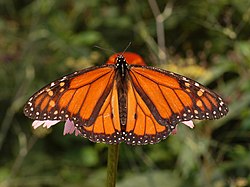
The monarch butterfly or simply monarch (Danaus plexippus) is a milkweed butterfly (subfamily Danainae) in the family Nymphalidae. Other common names, depending on region, include milkweed, common tiger, wanderer, and black-veined brown. It is among the most familiar of North American butterflies and an iconic pollinator, although it is not an especially effective pollinator of milkweeds. Its wings feature an easily recognizable black, orange, and white pattern, with a wingspan of 8.9–10.2 cm (3.5–4.0 in). A Müllerian mimic, the viceroy butterfly, is similar in color and pattern, but is markedly smaller and has an extra black stripe across each hindwing.
The eastern North American monarch population is notable for its annual southward late-summer/autumn instinctive migration from the northern and central United States and southern Canada to Florida and Mexico. During the fall migration, monarchs cover thousands of miles, with a corresponding multigenerational return north in spring. The western North American population of monarchs west of the Rocky Mountains often migrates to sites in southern California, but have been found in overwintering Mexican sites, as well. Non-migratory populations are found further south in the Americas, and in parts of Europe, Oceania, and Southeast Asia.
The name "monarch" is believed to have been given in honor of King William III of England, as the butterfly's main color is that of the king's secondary title, Prince of Orange. The monarch was originally described by Carl Linnaeus in his Systema Naturae of 1758 and placed in the genus Papilio. In 1780, Jan Krzysztof Kluk used the monarch as the type species for a new genus, Danaus. However, many works published between at least 1883 and 1964 identified the species as Anosia plexippus or Anosia archippus.
In 2005, investigators reported that the monophyletic genus Danaus s.l. had previously been divided into three subgenera (Danaus s. s., Salatura, and Anosia). However, based on their own studies, which combined mitochondrial DNA and nuclear DNA sequence information with morphological data, they concluded that the earlier classification was unsustainable and should be abandoned.
Danaus (Ancient Greek Δαναός), a great-grandson of Zeus, was a mythical king in Egypt or Libya, who founded Argos; Plexippus (Πλήξιππος) was one of the 50 sons of Aegyptus, the twin brother of Danaus. In Homeric Greek, his name means "one who urges on horses", i.e., "rider" or "charioteer". In the tenth edition of Systema Naturae, at the bottom of page 467, Linnaeus wrote that the names of the Danai festivi, the division of the genus to which Papilio plexippus belonged, were derived from the sons of Aegyptus. Linnaeus divided his large genus Papilio, containing all known butterfly species, into what we would now call subgenera. The Danai festivi formed one of the "subgenera", containing colorful species, as opposed to the Danai candidi, containing species with bright white wings. Linnaeus wrote: "Danaorum Candidorum nomina a filiabus Danai Aegypti, Festivorum a filiis mutuatus sunt." (English: "The names of the Danai candidi have been derived from the daughters of Danaus, those of the Danai festivi from the sons of Aegyptus.").
Robert Michael Pyle suggested Danaus is a masculinized version of Danaë (Greek Δανάη), Danaus's great-great-granddaughter, to whom Zeus came as a shower of gold, which seemed to him a more appropriate source for the name of this butterfly.
Monarchs belong to the subfamily Danainae of the family Nymphalidae. Danainae was formerly considered a separately family Danaidae. The three species of monarch butterflies are:
Six subspecies and two color morphs of D. plexippus have been identified:
Monarch butterfly
The monarch butterfly or simply monarch (Danaus plexippus) is a milkweed butterfly (subfamily Danainae) in the family Nymphalidae. Other common names, depending on region, include milkweed, common tiger, wanderer, and black-veined brown. It is among the most familiar of North American butterflies and an iconic pollinator, although it is not an especially effective pollinator of milkweeds. Its wings feature an easily recognizable black, orange, and white pattern, with a wingspan of 8.9–10.2 cm (3.5–4.0 in). A Müllerian mimic, the viceroy butterfly, is similar in color and pattern, but is markedly smaller and has an extra black stripe across each hindwing.
The eastern North American monarch population is notable for its annual southward late-summer/autumn instinctive migration from the northern and central United States and southern Canada to Florida and Mexico. During the fall migration, monarchs cover thousands of miles, with a corresponding multigenerational return north in spring. The western North American population of monarchs west of the Rocky Mountains often migrates to sites in southern California, but have been found in overwintering Mexican sites, as well. Non-migratory populations are found further south in the Americas, and in parts of Europe, Oceania, and Southeast Asia.
The name "monarch" is believed to have been given in honor of King William III of England, as the butterfly's main color is that of the king's secondary title, Prince of Orange. The monarch was originally described by Carl Linnaeus in his Systema Naturae of 1758 and placed in the genus Papilio. In 1780, Jan Krzysztof Kluk used the monarch as the type species for a new genus, Danaus. However, many works published between at least 1883 and 1964 identified the species as Anosia plexippus or Anosia archippus.
In 2005, investigators reported that the monophyletic genus Danaus s.l. had previously been divided into three subgenera (Danaus s. s., Salatura, and Anosia). However, based on their own studies, which combined mitochondrial DNA and nuclear DNA sequence information with morphological data, they concluded that the earlier classification was unsustainable and should be abandoned.
Danaus (Ancient Greek Δαναός), a great-grandson of Zeus, was a mythical king in Egypt or Libya, who founded Argos; Plexippus (Πλήξιππος) was one of the 50 sons of Aegyptus, the twin brother of Danaus. In Homeric Greek, his name means "one who urges on horses", i.e., "rider" or "charioteer". In the tenth edition of Systema Naturae, at the bottom of page 467, Linnaeus wrote that the names of the Danai festivi, the division of the genus to which Papilio plexippus belonged, were derived from the sons of Aegyptus. Linnaeus divided his large genus Papilio, containing all known butterfly species, into what we would now call subgenera. The Danai festivi formed one of the "subgenera", containing colorful species, as opposed to the Danai candidi, containing species with bright white wings. Linnaeus wrote: "Danaorum Candidorum nomina a filiabus Danai Aegypti, Festivorum a filiis mutuatus sunt." (English: "The names of the Danai candidi have been derived from the daughters of Danaus, those of the Danai festivi from the sons of Aegyptus.").
Robert Michael Pyle suggested Danaus is a masculinized version of Danaë (Greek Δανάη), Danaus's great-great-granddaughter, to whom Zeus came as a shower of gold, which seemed to him a more appropriate source for the name of this butterfly.
Monarchs belong to the subfamily Danainae of the family Nymphalidae. Danainae was formerly considered a separately family Danaidae. The three species of monarch butterflies are:
Six subspecies and two color morphs of D. plexippus have been identified:
Recent media
Recent media