Hubbry Logo
PapilioPapilioMain
Open search
Papilio
Community hub
Papilio
logo
8 pages, 0 posts
0 subscribers
Be the first to start a discussion here.
Papilio
Papilio
from Wikipedia

Papilio
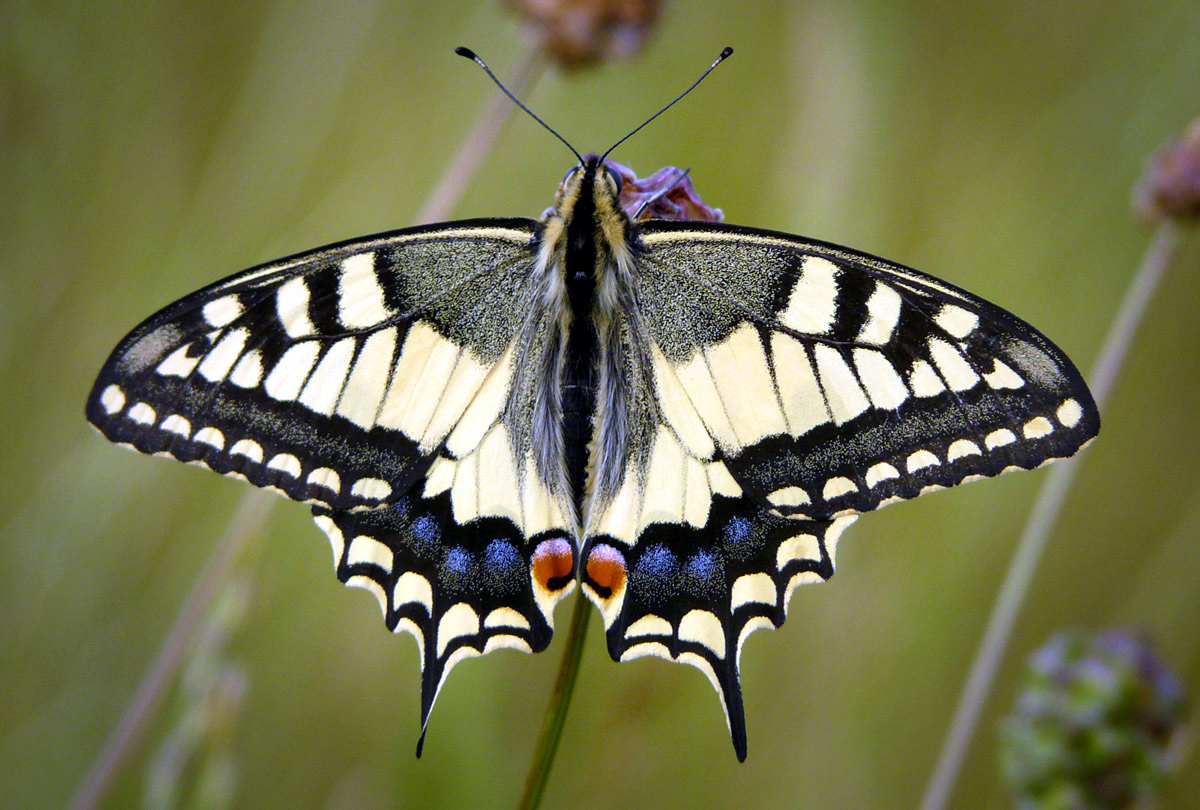
Papilio machaon
Scientific classification Edit this classification
Kingdom: Animalia
Phylum: Arthropoda
Class: Insecta
Order: Lepidoptera
Family: Papilionidae
Subfamily: Papilioninae
Tribe: Papilionini
Genus: Papilio
Linnaeus, 1758
Type species
Papilio machaon
Linnaeus, 1758[1]
Synonyms[2]
  • Eques Kirby, 1896
  • Eques Linnaeus, 1758
  • Heliconius Linnaeus, 1758
  • Papileo Berkenhout, 1795
  • Papillon Roger, 1826
  • Papipio Linnaeus, 1764
  • Papirio Billberg, 1820
  • Roddia Korshunov, 1995

Papilio is a genus in the swallowtail butterfly family, Papilionidae, as well as the only representative of the tribe Papilionini. The word papilio is Latin for butterfly.[3]

Lime Butterfly in Behbahan
Lime butterfly in Behbahan

It includes the common yellow swallowtail (Papilio machaon), which is widespread in the Northern Hemisphere and the type species of the genus, as well as a number of other well-known North American species such as the western tiger swallowtail (Papilio rutulus). Familiar species elsewhere in the world include the Mormons (Papilio polytes, Papilio polymnestor, Papilio memnon, and Papilio deiphobus) in Asia, the orchard and Ulysses swallowtails in Australia (Papilio aegeus, Papilio ulysses, respectively) and the citrus swallowtail of Africa (Papilio demodocus).

Older classifications of the swallowtails tended to use many rather small genera. More recent classifications have been more conservative, and as a result a number of former genera are now absorbed within Papilio, such as Achillides, Eleppone, Druryia, Heraclides (giant swallowtails), Menelaides, Princeps, Pterourus (tiger swallowtails), and Sinoprinceps. The genus as recognized by modern systems has about 200 members. The genus Chilasa is regarded as a subgenus of Papilio by some workers, as are the baggy-tailed swallowtails (Agehana), although the latter taxon is usually considered a subgenus of Chilasa.

Many of the larvae resemble bird droppings during a development stage. Adults are edible to birds and some species are mimics.[4]

Ecology

[edit]

In their larval form, members of Papilio typically feed upon plants of Rutaceae including common ornamental and agriculturally important species such as Citrus species, Murraya species, Choisya species and Calodendrum species. Caterpillars sequester terpenoids from their diet to produce a foul smelling oil used in defence.

Species

[edit]

Listed alphabetically within groups.[5]
subgenus: Papilio Linnaeus, 1758

species group: machaon
Papilio machaon gorganus
A European paper wasp interacts with a anise swallowtail caterpillar which uses its osmeterium in defense. Most scenes are repeated in closeup at one-fourth speed.

subgenus: Princeps Hübner, [1807]

species group: antimachus
species group: zalmoxis
species group: nireus
Broad green-banded swallowtail (Papilio chrapkowskii), Kenya
Narrow blue-banded swallowtail (Papilio nireus), Uganda
species group: cynorta
species group: dardanus
African swallowtail (Papilio dardanus), Ethiopia
Green-banded swallowtail (Papilio phorcas), Kenya
species group: zenobia
species group: demodocus
Citrus swallowtail (Papilio demodocus), South Africa
Lime butterfly (Papilio demoleus), India
species group: echerioides
species group: oribazus
Banded blue swallowtail (Papilio oribazus), Madagascar
species group: hesperus
species group: menestheus
Western emperor swallowtail (Papilio menestheus), Ghana
species group: incertae sedis
Papilio mangoura, Madagascar
species group: noblei
species group: demolion
species group: anactus
species group: aegeus
species group: godeffroyi
species group: polytes
Common Mormon (Papilio polytes), India
species group: castor
species group: fuscus
species group: helenus
species group: memnon
Blue Mormon Papilio polymnestor, India
species group: protenor
species group: bootes

subgenus: Chilasa Moore, [1881]

species group: agestor
species group: clytia
species group: veiovis
species group: laglaizei
species group: unnamed

subgenus: Achillides Hübner, [1819]

species group: paris
Malabar banded peacock (Papilio buddha)
Common banded peacock (Papilio crino), India
species group: palinurus
species group: unnamed
species group: ulysses

subgenus: Heraclides Hübner, [1819]

species group: anchisiades
Prickly ash swallowtail (Papilio pelaus), Jamaica
species group: thoas
Bahamian swallowtail (Papilio andraemon), Jamaica
species group: torquatus
species group: unnamed

subgenus: Pterourus Scopoli, 1777

species group: troilus
Spicebush swallowtail (Papilio troilus)
species group: glaucus
Canadian tiger swallowtail (Papilio canadensis), Canada
Two-tailed swallowtail (Papilio multicaudata), Mexico
species group: zagreus
species group: scamander
species group: homerus

subgenus: Sinoprinceps Hancock, 1983

species group: xuthus Hancock, 1983
  • Papilio xuthus Linnaeus, 1767 – Asian, Xuthus, or Chinese yellow swallowtail

Former species

[edit]

Many species originally described in the genus Papilio have now been reclassified. For a list of selected former species see List of former species in the genus Papilio.


References

[edit]
[edit]
Revisions and contributorsEdit on WikipediaRead on Wikipedia
from Grokipedia
Papilio is a of swallowtail butterflies in the family Papilionidae, representing the sole genus within the Papilionini and comprising 235 species with a across all major biogeographic realms. These butterflies are characterized by their large size, with wingspans typically ranging from 7 to 15 cm, and distinctive tail-like extensions on the hindwings that give the family its common name. Species exhibit diverse coloration and patterning, often featuring , black, or white wings with stripes, spots, or iridescent markings adapted for , warning, or . The genus originated in the Beringian region approximately 30 million years ago during the , with subsequent radiations southward into tropical and temperate zones, leading to its current global presence from the to equatorial rainforests. Taxonomically, Papilio is monophyletic and divided into several subgenera, including Achillides, Heraclides, Menelaides, and Pterourus, reflecting evolutionary divergences in morphology and host plant preferences. Larvae of Papilio species are known for their bird-dropping in early instars, transitioning to green or brown forms with eyespots for defense, and they feed primarily on from families such as , , and . Ecologically, Papilio butterflies occupy a wide array of niches, from urban gardens to remote islands, with many species serving as pollinators and indicators of . Notable adaptations include in subgenera like Menelaides, where females resemble toxic models to deter predators, and a linked to the gene in some Asian species. The genus includes economically significant pests, such as the swallowtail (P. demodocus), which damages fruit crops in , as well as conservation concerns for rare taxa like the endangered P. buddha in .

Taxonomy and classification

Etymology and history

The genus name Papilio derives from the Latin word papilio, meaning "butterfly," reflecting its early application to a broad assemblage of butterfly species. This nomenclature was established by Carl Linnaeus in the 10th edition of Systema Naturae in 1758, where he included 123 butterfly species under the genus, marking the formal inception of Papilio as a taxonomic category in the family Papilionidae. Historically, the classification of began as an expansive encompassing diverse worldwide, but it underwent significant refinement over time. The was designated as Linnaeus, 1758, a European swallowtail that served as the benchmark for subsequent taxonomic delineations within the genus. In the 19th and early 20th centuries, taxonomists like Jacob Hübner (1819) and Walter Rothschild and Karl Jordan (1906) began splitting off subgroups, elevating entities such as Heraclides (type: Papilio thoas Linnaeus, 1751) and Pterourus to subgeneric or generic status based on morphological traits like wing patterns and genital structures. Key taxonomic revisions in the often absorbed these segregated genera back into Papilio sensu lato for , as seen in treatments by James S. Miller (1987), who emphasized unifying Papilionini under a single broad due to shared synapomorphies. Molecular phylogenetic studies, such as those by Evgeny Zakharov et al. (2004), supported subdivisions like Heraclides and Pterourus as distinct clades but debated their generic elevation, favoring subgeneric ranks to maintain stability. By the , comprehensive analyses, including Jean-Baptiste L. B. Condamine et al. (2023), reinforced Papilio as a monophyletic with Heraclides and Pterourus as subgenera, resolving ongoing debates through multi-gene phylogenies that sampled over 80% of and highlighted evolutionary divergences dating to the early . These revisions underscore a trend toward integrative , balancing morphological, molecular, and biogeographic evidence up to 2025.

Subgenera and phylogeny

The genus Papilio is subdivided into several subgenera based on molecular phylogenetic analyses, reflecting distinct evolutionary lineages within the Papilionini . As of the 2023 phylogeny, recognized subgenera include Papilio s.s. (9 species, primarily Holarctic associated with host plants), Princeps (5 species, Paleotropical), Chilasa (11 species, Indo-Australian, often birdwing-like in appearance), Achillides (30 species, with Australasian focus), Heraclides (32 species, Neotropical, clade), Pterourus (28 species, Nearctic and Neotropical tiger swallowtails), Sinoprinceps (2 species, East Palearctic), Menelaides (54 species, Indo-Malayan and Australasian), Druryia (30 species, Afrotropical), Nireopapilio (24 species, Afrotropical), Araminta (5 species, Indonesian), Alexanoria (1 species, East Palearctic), Eleppone (2 species, Australasian), Euchenor (2 species, New Guinean), and others such as Agehana (nested within Pterourus). Molecular studies confirm Papilio as monophyletic within the tribe Papilionini, with an origin approximately 30 million years ago in . Key phylogenetic divergences include the basal split of the subgenus Heraclides around 21 million years ago in , followed by the radiation of an clade around 27 million years ago in the East Palearctic; further subclades, such as the Beringian-origin group including Pterourus (~20 million years ago) and its Asian relatives like Chilasa (~17 million years ago in ), from other lineages. As of 2025, taxonomic debates persist regarding the status of certain groups, particularly Agehana and Chilasa. DNA analyses nest Agehana (including P. elwesi and P. maraho) firmly within Pterourus as a non-monophyletic subgroup, rejecting its recognition as a separate genus or subgenus (Bayes factor 48.29 supporting inclusion). For Chilasa, molecular data support its placement as a subgenus within Papilio with an Indonesian origin ~17 million years ago, though its monophyly is questioned, leading some researchers to advocate elevating it to genus level based on morphological and host-plant distinctions.

Description

Adult morphology

Adult Papilio butterflies are medium to large-sized lepidopterans, characterized by their striking wing patterns and robust build, with wingspans typically ranging from 8 to 15 cm depending on the species. For instance, the African giant swallowtail (Papilio antimachus) reaches up to 23 cm, while the black swallowtail (Papilio polyxenes) measures 7 to 9 cm. The wings are broad and rounded at the forewings, with hindwings extended into distinctive tail-like projections, a hallmark of the Papilionidae family that aids in identification. Coloration varies widely across species but often features a dark ground color, such as black or brown, accented by bright yellow, white, or orange markings arranged in bands, spots, or postdiscal lines; many species also display iridescent scales that produce metallic blue or green sheens, particularly on the hindwings. Examples include the yellow wings of the eastern tiger swallowtail () crossed by black stripes and the predominantly black wings of the spicebush swallowtail () with ivory submarginal spots. The body is sturdy with a robust supporting powerful flight muscles, enabling strong and sustained flight. Antennae are filiform with clubbed tips for sensory detection, and a long, coiled allows nectar feeding from flowers. Papilionids possess a fore-tibial , a small structure on the front legs used for cleaning the antennae. Sexual dimorphism is prevalent, with females generally larger than males and often displaying more subdued or varied patterns, while males may exhibit brighter coloration to attract mates. In some species, such as Papilio polytes, females exhibit polymorphic mimicry patterns that imitate toxic butterflies like those in the Danaidae family, providing protection from predators, whereas males remain monomorphic and non-mimetic.

Larval characteristics

The larvae of Papilio species typically undergo five instars during development, progressing from small hatchlings to mature caterpillars measuring up to 5 cm in length. This growth occurs over 2-4 weeks, depending on species and environmental conditions, with each instar marked by molting and increasing body size. Early instars (first to third) exhibit a coloration pattern of dark brown or black with a prominent white or pale saddle in the middle, effectively mimicking bird droppings to evade predators through masquerade. In later instars (fourth and fifth), the larvae shift to a bright body with transverse bands and prominent eyespots on the and , resembling the head of a snake to startle or deflect attacks. This ontogenetic color change enhances survival by transitioning from to aposematic or deimatic displays. A key defensive is the , a forked, eversible located behind the head that deploys upon threat, releasing volatile chemicals to deter predators. In early instars, these secretions are dominated by monoterpenes and sesquiterpenes, while later instars produce aliphatic acids, providing throughout development. Papilio larvae also sequester toxic terpenoids and other secondary metabolites from their host plants, incorporating them into body tissues to render themselves unpalatable or toxic to predators. Coloration in some species may be influenced by the in host plants, contributing to subtle variations in hue.

Distribution and habitat

Global range

The genus Papilio exhibits a cosmopolitan distribution, occurring across the Holarctic, Neotropical, Oriental, Afrotropical, and Australasian realms, but is absent from Antarctica and the extreme southern regions of South America. In the Holarctic realm, species are present in Europe and North America, with representatives like the Papilio machaon group spanning temperate zones. The Neotropical realm includes species from southern North America through Central and South America, such as Papilio thoas in tropical forests. The Oriental realm in Asia hosts a substantial portion of the genus's diversity, while the Afrotropical realm includes numerous species across African forests and savannas. Further east, the Australasian realm encompasses Australia and Pacific islands, supporting endemic taxa such as Papilio ulysses in northern and eastern Australia. Species richness is high in the Oriental realm, with approximately 60 species documented across , particularly in Southeast Asian hotspots like and the . This concentration underscores the region's role as a center of diversification for Papilio, driven by historical biogeographic processes. In contrast, the Holarctic and Afrotropical realms feature fewer species, often adapted to more seasonal environments, while Australasian highlights isolated evolutionary radiations. The supports around 40 species, concentrated in tropical areas. Recent observations indicate distributional dynamics influenced by climate shifts, including the 2025 description of a cryptic new tiger swallowtail species (Papilio solstitius) in eastern , where warming trends may have facilitated recognition of previously overlooked populations. These findings suggest that climate variability is altering the genus's global footprint, potentially increasing connectivity between realms.

Habitat preferences

Papilio species primarily occupy diverse biomes such as tropical forests, temperate woodlands, and grasslands, with many inhabiting evergreen and montane forests across elevations from sea level to approximately 2,600 m. Certain species extend into submontane and degraded forest areas, while others favor frost-free savannas and heavy woodlands up to 1,700 m. In temperate regions, species like Papilio machaon are found in grasslands, forests, and mountainous areas, often spanning subarctic and Arctic zones. Within these biomes, Papilio butterflies select microhabitats that provide sunny exposures for basking to regulate body temperature, particularly in cooler or shaded conditions. They require proximity to larval host plants, such as those in the Rutaceae family including Citrus species, where females oviposit on leaves in forest understories or edges. Some adaptable species, notably Papilio demodocus, thrive in anthropogenic microhabitats like urban gardens and parks, utilizing nectar sources and nearby vegetation. Adaptations to varied habitats include strong flight capabilities suited to warm, sunny , enabling navigation through canopies and open areas. In temperate species such as , migratory behavior supports overwintering strategies, allowing populations to shift with seasonal changes and maintain genetic diversity across ranges.

Ecology and behavior

Life cycle

The life cycle of in the Papilio follows the typical holometabolous pattern of , consisting of four distinct stages: , , , and . Females lay eggs singly on the leaves of host plants, with each being spherical and typically yellow-green in color. Incubation lasts 3–5 days, depending on and , after which the first-instar emerges by chewing through the . The larval stage involves five s, during which the grows rapidly by feeding on host foliage, molting between each instar to accommodate increasing size. This stage generally spans 10–30 days in temperate regions but can be shorter in warmer climates. Upon reaching maturity, the final-instar larva pupates, forming a chrysalis that is either green or brown, secured to a substrate with a pad at the cremaster and a girdle around the for stability. In temperate , the pupa enters to overwinter, lasting several months, while in tropical , the pupal stage endures 9–18 days without extended ; the overall cycle from to adult typically completes in 1–2 months in tropical environments. Adult emergence, or eclosion, occurs primarily in the morning, with the splitting the pupal case and expanding its wings using pressure before they harden over several hours. Freshly eclosed possess soft, crumpled wings that unfurl and dry, enabling flight within 1–2 hours. The adult lifespan varies from 1–4 weeks, during which individuals focus on , feeding, and oviposition to perpetuate the cycle.

Host plants and feeding

The larvae of Papilio species primarily feed on plants in the family, such as genera including Citrus and , which provide essential foliage for their development. In certain subgenera, particularly the New World Pterourus, host plants extend to the family, with species like utilizing spicebush () and sassafras () as key resources. Species in the nominate subgenus and other Old World lineages also utilize plants in the family, such as fennel () and parsley (), as primary hosts. These host associations reflect evolutionary adaptations within the genus, where dominate for the majority of Old World and some New World taxa, while and serve as significant alternatives in specific lineages. Larval feeding involves chewing leaves of these host plants, a behavior that supports growth across instars and allows the incorporation of plant secondary metabolites. Papilio caterpillars sequester alkaloids and terpenoids from hosts, accumulating these compounds during consumption. This process occurs primarily during the larval stage of the life cycle, where feeding is confined to selected host species. Adult Papilio obtain nutrition from floral across a diverse array of flowering plants, supplementing energy needs for reproduction and flight. Males frequently engage in mud-puddling, aggregating at moist soil or puddles to ingest minerals like sodium, which are scarce in nectar sources. Variations in host use are evident in polyphagous species such as Papilio demodocus, which exploits both native Rutaceae and introduced Citrus plants, demonstrating adaptability to non-native vegetation. This flexibility has enabled range expansion in regions with cultivated citrus orchards.

Defense mechanisms

Papilio butterflies employ a suite of chemical, physical, and behavioral defenses to deter predators, primarily birds and spiders, which exert significant selective pressure on both larval and adult stages. Larvae of Papilio species sequester toxic compounds, such as furanocoumarins and alkaloids, from their host plants in the Rutaceae and Apiaceae families, rendering them unpalatable or toxic to predators like ants and birds. Additionally, when disturbed, Papilio larvae evert a bifurcated osmeterium—a Y-shaped glandular organ behind the head—that releases volatile organic compounds including monoterpenes (e.g., sabinene, β-pinene), sesquiterpenes (e.g., germacrene A), and aliphatic acids, producing a foul odor that repels invertebrate predators such as ants and mantids. Behavioral assays demonstrate the osmeterium's efficacy, with significantly fewer ants (1.6 ± 0.3 vs. 5.6 ± 0.4 in controls) approaching treated larvae, highlighting its role in chemical deterrence. The osmeterium's bright coloration also serves as an aposematic signal, warning potential predators of the underlying toxicity. Adult Papilio butterflies are often unpalatable due to retained or synthesized chemical defenses derived from larval sequestration, deterring avian predators. However, in cases where adults are more palatable, some species participate in , where females resemble toxic models to deter predators; for instance, exhibits female-limited of distasteful Pachliopta species through polymorphic wing patterns, reducing predation by exploiting learned avoidance in predators like birds. In , mimetic females resemble the unpalatable model Atrophaneura polyeuctes through tail extensions and aposematic coloration, reducing predation by exploiting learned avoidance in predators like birds. This female-limited polymorphism is genetically controlled by a locus, allowing rapid adaptation to local predation pressures. Physically, many Papilio species feature elongated hindwing tails that deflect predator attacks toward non-vital areas, as evidenced in related papilionids where tail removal increases predation risk by birds. Eyespots on the wings or larval thoraces enable startle displays, startling predators like small birds and prompting escape; in , sudden exposure of eyespots combined with jerky movements significantly reduces attack success. Behaviorally, adults evade capture through erratic, unpredictable flight patterns that hinder interception by aerial predators such as birds and dragonflies, with species like exhibiting swift, darting maneuvers to outmaneuver threats. These combined strategies underscore the diverse antipredator adaptations in Papilio, tailored to dominant threats from birds, which account for much of adult mortality, and spiders, which primarily target immobile larvae.

Species diversity

Number and distribution of species

The genus Papilio encompasses 235 recognized as per the 2023 phylogenetic revision, though taxonomic revisions continue to refine this figure, with the comprehensive phylogeny proposing this working list based on molecular and morphological data. Ongoing synonymies, such as the reclassification of Papilio polymnestor as a subspecies of Papilio agenor, have consolidated certain taxa from earlier estimates. Species distribution is nearly cosmopolitan, excluding and extreme polar regions, but exhibits strong patterns of concentration in tropical and subtropical zones, where over 80% of diversity occurs due to favorable climatic conditions and host availability. Approximately 50% of are found in , particularly in the Indo-Malayan and Australasian regions, reflecting rapid radiations in these hotspots; hosts about 15% (roughly 30–35 , concentrated in the ), while accounts for around 20% when including Central and South American extensions of Nearctic lineages, though strict North American endemics number fewer than 15. Recent updates include the addition of new endemics, such as the Fijian Papilio natewa described in 2018 and incorporated into Eleppone in subsequent revisions, highlighting ongoing discoveries in isolated systems. Subgenera like Achillides and Menelaides contribute to regional diversity gradients, with Achillides dominating Asian assemblages.

Notable species

, commonly known as the swallowtail, is one of the most widespread and iconic in the genus, renowned for its migratory behavior across and . This butterfly exhibits remarkable adaptability, with approximately 40 recognized due to variations in wing patterns and coloration, though recent analyses suggest simplification to around 14, often linked to environmental pressures. It holds cultural significance in European heraldry, where its image symbolizes resilience and transformation, appearing in emblems dating back to . In , , the western tiger swallowtail, stands out for its striking yellow wings with black tiger-like stripes and its role as a key in riparian habitats from southern to . This species thrives in diverse ecosystems, including woodlands and suburban areas, contributing to in western forests. Its larvae feed on native trees like willows and cottonwoods, underscoring its ecological integration without notable pest status. Papilio polytes, the common Mormon, exemplifies evolutionary innovation through female-limited , where non-mimetic males contrast with females that imitate toxic butterfly models for predator avoidance in Asian tropics. Genetic studies reveal a controlling these polymorphic wing patterns, enabling rapid to local predator pressures. This system highlights the genus's complexity in anti-predator strategies. The blue emperor, , captivates with its iridescent electric-blue wings, produced by nanoscale photonic structures in the scales, which reflect light to create vivid coloration in Australian and Papuan rainforests. Found primarily in tropical and nearby islands, it inhabits canopy layers of wet forests, serving as an indicator of habitat health due to its sensitivity to . , the citrus swallowtail, is a significant agricultural concern in , where its larvae defoliate young trees, impacting orchards and nurseries as a minor but persistent pest. Native to a broad range from savannas to coastal areas, it demonstrates the genus's potential for economic repercussions in agroecosystems. Conservation efforts spotlight Papilio homerus, the Homerus swallowtail, Jamaica's largest butterfly and a critically endangered endemic restricted to remnant montane forests in the Blue Mountains and . With populations declining due to habitat loss and illegal collection, it numbers fewer than 2,000 adults, emphasizing the urgent need for protected areas and community involvement to preserve this genetic treasure.

Former species

Several species and groups once included in the genus Papilio have been reclassified into separate genera following advances in . For example, the giant swallowtail, previously known as Papilio cresphontes, is now classified as Pterourus cresphontes within the genus Pterourus, which encompasses 28 species primarily distributed in the . Similarly, the Thoas swallowtail, formerly Papilio thoas, has been transferred to Heraclides thoas in the genus Heraclides, comprising 32 Neotropical species. The common mime butterfly, once Papilio clytia, now belongs to Chilasa clytia after the subgenus Chilasa—containing 11 species—was elevated to generic rank. These taxonomic shifts were driven by phylogenetic studies initiated after 2000, which utilized multi-gene sequence data to reveal that Papilio sensu lato was non-monophyletic and comprised distinct evolutionary lineages. Analyses of mitochondrial and nuclear genes demonstrated deep divergences among clades, such as those separating Pterourus and Heraclides as sister groups to the core Papilio, justifying their recognition as separate genera alongside others like Menelaides. Earlier morphological assessments, such as Hancock's 1983 proposal to recognize six genera from Papilio material, were confirmed and refined by these molecular approaches. However, taxonomic treatment varies: some authorities elevate the 13 subgenera to full genera, reducing Papilio sensu stricto to approximately 14 species in the machaon group (from broader estimates of around 205 species in the 1990s and early 2000s), while the 2023 comprehensive phylogeny retains the broad genus with 235 species and clarified subgenera.

References

Add your contribution
Related Hubs
User Avatar
No comments yet.