


Community hub
Recent from talks
Contribute something to knowledge base
Content stats: 0 posts, 0 articles, 1 media, 0 notes
Members stats: 0 subscribers, 0 contributors, 0 moderators, 0 supporters
Subscribers
Supporters
Contributors
Moderators
Hub AI
Moog synthesizer AI simulator
(@Moog synthesizer_simulator)
Hub AI
Moog synthesizer AI simulator
(@Moog synthesizer_simulator)
Moog synthesizer
The Moog synthesizer (/ˈmoʊɡ/ MOHG) is a modular synthesizer invented by the American engineer Robert Moog in 1964. Moog's company, R. A. Moog Co., produced numerous models from 1965 to 1981, and again from 2014. It was the first commercial synthesizer and established the analog synthesizer concept.
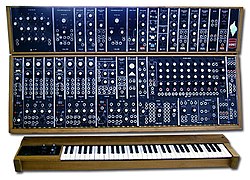
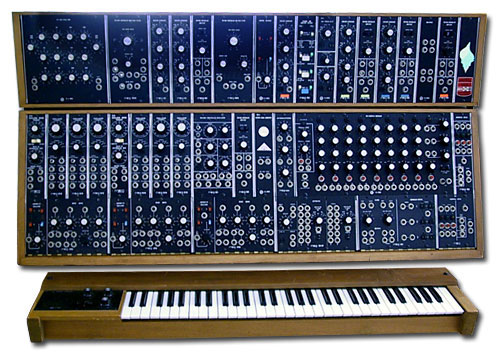
The Moog synthesizer consists of separate modules which create and shape sounds, which are connected via patch cords. Modules include voltage-controlled oscillators, amplifiers, filters, envelope generators, noise generators, ring modulators, triggers and mixers. The synthesizer can be played using controllers including keyboards, joysticks, pedals and ribbon controllers, or controlled with sequencers. Its oscillators produce waveforms, which can be modulated and filtered to shape their sounds (subtractive synthesis) or used to control other modules (low-frequency oscillation).
Moog developed the synthesizer in response to demand for more practical and affordable electronic music equipment, guided by suggestions and requests from composers including Herb Deutsch, Richard Teitelbaum, Vladimir Ussachevsky and Wendy Carlos. Moog's principal innovation was voltage control, which uses voltage to control pitch. He also introduced fundamental synthesizer concepts such as modularity and envelope generators.
The Moog synthesizer was brought to the mainstream by Switched-On Bach (1968), a bestselling album of Bach compositions arranged for Moog synthesizer by Wendy Carlos. Mort Garson used the Moog to soundtrack the televised Apollo 11 moonwalk, associating synthesizers with space in the popular imagination. In the late 1960s, it was adopted by rock and pop acts including the Doors, the Grateful Dead, the Rolling Stones and the Beatles. At its height of popularity, it was a staple of 1970s progressive rock, used by acts including Yes, Tangerine Dream and Emerson, Lake & Palmer. With its ability to imitate instruments such as strings and horns, it threatened the jobs of session musicians and was banned from use in commercial work for a period of time in the United States. In 1970, Moog Music released a portable, self-contained model, the Minimoog.
In the early 1960s, electronic music technology was impractical and used mainly by experimental composers to create music with little mainstream appeal. In 1963, the American engineer Robert Moog, a doctoral student at Cornell University who designed and sold theremins, met the composer Herb Deutsch at a New York State School Music Association trade fair in Rochester, New York. Deutsch had been making electronic music using a theremin, tape recorder, and single-pitch oscillator, a time-consuming process that involved splicing tape. Recognizing the need for more practical and sophisticated equipment, Moog and Deutsch discussed the notion of a "portable electronic music studio".
Moog received a grant of $16,000 from the New York State Small Business Association and began work in Trumansburg, New York, not far from the Cornell campus. At the time, synthesizer-like instruments filled rooms. Moog hoped to build a more compact instrument that would appeal to musicians. Learning from his experience building a prohibitively expensive guitar amplifier, he believed that practicality and affordability were the most important parameters.
Previous synthesizers, such as the RCA Mark II, had created sound from hundreds of vacuum tubes. Instead, Moog used newly available silicon transistors — specifically, transistors with an exponential relationship between input voltage and output current. With these, he created the voltage-controlled oscillator (VCO), which generated a waveform whose pitch could be adjusted by changing the voltage. Moog designed his synthesizer around a standard of one volt per octave, and used voltage to control loudness with voltage-controlled amplifiers (VCAs).
Moog developed a prototype with two VCOs and a VCA. As the VCOs could output voltage, one could be used to modulate the output of another, creating effects such as vibrato and tremolo. According to Moog, when Deutsch saw this, he became excited and immediately began making music with the prototype, attracting the interest of passersby: "They would stand there, they'd listen and they'd shake their heads ... What is this weird shit coming out of the basement?"
Moog synthesizer
The Moog synthesizer (/ˈmoʊɡ/ MOHG) is a modular synthesizer invented by the American engineer Robert Moog in 1964. Moog's company, R. A. Moog Co., produced numerous models from 1965 to 1981, and again from 2014. It was the first commercial synthesizer and established the analog synthesizer concept.
The Moog synthesizer consists of separate modules which create and shape sounds, which are connected via patch cords. Modules include voltage-controlled oscillators, amplifiers, filters, envelope generators, noise generators, ring modulators, triggers and mixers. The synthesizer can be played using controllers including keyboards, joysticks, pedals and ribbon controllers, or controlled with sequencers. Its oscillators produce waveforms, which can be modulated and filtered to shape their sounds (subtractive synthesis) or used to control other modules (low-frequency oscillation).
Moog developed the synthesizer in response to demand for more practical and affordable electronic music equipment, guided by suggestions and requests from composers including Herb Deutsch, Richard Teitelbaum, Vladimir Ussachevsky and Wendy Carlos. Moog's principal innovation was voltage control, which uses voltage to control pitch. He also introduced fundamental synthesizer concepts such as modularity and envelope generators.
The Moog synthesizer was brought to the mainstream by Switched-On Bach (1968), a bestselling album of Bach compositions arranged for Moog synthesizer by Wendy Carlos. Mort Garson used the Moog to soundtrack the televised Apollo 11 moonwalk, associating synthesizers with space in the popular imagination. In the late 1960s, it was adopted by rock and pop acts including the Doors, the Grateful Dead, the Rolling Stones and the Beatles. At its height of popularity, it was a staple of 1970s progressive rock, used by acts including Yes, Tangerine Dream and Emerson, Lake & Palmer. With its ability to imitate instruments such as strings and horns, it threatened the jobs of session musicians and was banned from use in commercial work for a period of time in the United States. In 1970, Moog Music released a portable, self-contained model, the Minimoog.
In the early 1960s, electronic music technology was impractical and used mainly by experimental composers to create music with little mainstream appeal. In 1963, the American engineer Robert Moog, a doctoral student at Cornell University who designed and sold theremins, met the composer Herb Deutsch at a New York State School Music Association trade fair in Rochester, New York. Deutsch had been making electronic music using a theremin, tape recorder, and single-pitch oscillator, a time-consuming process that involved splicing tape. Recognizing the need for more practical and sophisticated equipment, Moog and Deutsch discussed the notion of a "portable electronic music studio".
Moog received a grant of $16,000 from the New York State Small Business Association and began work in Trumansburg, New York, not far from the Cornell campus. At the time, synthesizer-like instruments filled rooms. Moog hoped to build a more compact instrument that would appeal to musicians. Learning from his experience building a prohibitively expensive guitar amplifier, he believed that practicality and affordability were the most important parameters.
Previous synthesizers, such as the RCA Mark II, had created sound from hundreds of vacuum tubes. Instead, Moog used newly available silicon transistors — specifically, transistors with an exponential relationship between input voltage and output current. With these, he created the voltage-controlled oscillator (VCO), which generated a waveform whose pitch could be adjusted by changing the voltage. Moog designed his synthesizer around a standard of one volt per octave, and used voltage to control loudness with voltage-controlled amplifiers (VCAs).
Moog developed a prototype with two VCOs and a VCA. As the VCOs could output voltage, one could be used to modulate the output of another, creating effects such as vibrato and tremolo. According to Moog, when Deutsch saw this, he became excited and immediately began making music with the prototype, attracting the interest of passersby: "They would stand there, they'd listen and they'd shake their heads ... What is this weird shit coming out of the basement?"
Recent media
Recent media