Hubbry Logo
Mount Buller, VictoriaMount Buller, VictoriaMain
Open search
Mount Buller, Victoria
Community hub
Mount Buller, Victoria
logo
8 pages, 0 posts
0 subscribers
Be the first to start a discussion here.
Mount Buller, Victoria
from Wikipedia

Mount Buller is primarily a resort town on the slopes of Mount Buller, within Mount Buller Alpine Resort, an unincorporated area of the Australian state of Victoria. It is located approximately 208 kilometres (129 mi) northeast of Melbourne.[5] It is popular with snowsports enthusiasts in winter due to its proximity to Melbourne. In the warmer months it is popular with visitors to the Victorian Alps and bike riders. At the 2016 census, Mount Buller had a population of 243.[3]

Key Information

Mount Buller village

[edit]
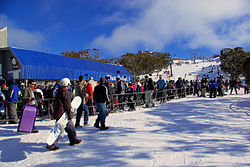
A view over the main part of the village.

The town has around 7000 beds available in accommodation facilities, the most of any Victorian ski resort. La Trobe University had a minor campus at Mount Buller. The campus facilities included a public cinema, gym and indoor sporting facilities. La Trobe has vacated the mountain, however the Resort Management Board is now using the building, better known as the Mount Buller Community Centre, as its home. All facilities are still operational, with the cinema, gym and sports hall open all year round. Mount Buller is also the home of the National Alpine Museum.

Mt. Buller Village Entrance at night

The area between Mount Buller and Mount Stirling is the primary catchment for the Delatite River.

Sports and recreation

[edit]

Mountain biking

[edit]

Mount Buller is home to a growing number of first class Cross Country and Downhill mountain bike tracks. Between 2009 and 2012 many trails have been added, modified and upgraded by WORLD TRAIL. The chairlift for the downhill tracks is only open during the summer from Boxing Day until the end of January, although trailer shuttles also run until the end of February. Mt Buller is working towards developing the mountain as a world class mountain bike venue in line with what has been achieved at Whistler (Canada) and Queenstown (New Zealand). Retail outlets exist in the mountain village to enable casual riders to hire pushbikes, and for bike owners to access service should the need arise. The Victorian Downhill State Series holds a race each year at Mt Buller, as does the MTBA National Series.

The International Mountain Bicycling Association has designated the mountain biking trails at Mount Buller as a bronze-level IMBA Ride Center.[6] Ride Centers are the IMBA's strongest endorsement of a trail experience.[7]

Road cycling

[edit]

Mount Buller is also a popular destination for road cyclists,[8] due to the challenging climb from the tollbooth in Mirimbah to the Mount Buller Village. The climb is 15.3 kilometres (9.5 mi) long and has an average gradient of 6.2%.[9] The final kilometre before the Village is the steepest part of the climb with several short sections of gradient 10%+.

Skiing, skateboarding, and hiking

[edit]

Comprising 300 hectares (740 acres), the Mount Buller Alpine Resort is a year-round facility with peak operation during winter months for alpine sports. In the summer months, the area is a popular location for alpine hiking.

Climate

[edit]

Under the Köppen climate classification scheme, Mount Buller has a very cold Oceanic / Subpolar oceanic climate (Cfb / Cfc) under the −3 °C (27 °F) isotherm, or a Humid continental / Subarctic climate (Dfb / Dfc) under the 0 °C (32 °F) isotherm, with cool summers and cold, very snowy winters. On average, Mount Buller receives 67.6 snowy days annually, the greatest figure for any mainland Australian site.[10]

Due to its far south-western location in the alpine region, Mount Buller is more susceptible to cold airmasses which allow it to record some of the lowest maximum temperatures and daytime readings in the country, despite being considerably lower in elevation than other mountain sites to the north-east. On 5 September 1995, a maximum temperature of just −6.2 °C (20.8 °F) was registered at Mount Buller; the same day at Thredbo Top Station saw a maximum of −6.0 °C (21.2 °F), some 250 metres (820 ft) higher than Buller. On 3 February 2023, at the height of summer, Mount Buller reached a top of just 0.9 °C (33.6 °F).[11]

Climate data for Mount Buller (1985–2022, rainfall to 1948); 1,707 m AMSL; 37.15° S, 146.44° E
Month Jan Feb Mar Apr May Jun Jul Aug Sep Oct Nov Dec Year
Record high °C (°F) 30.3
(86.5)
30.7
(87.3)
26.0
(78.8)
21.6
(70.9)
16.5
(61.7)
12.7
(54.9)
10.1
(50.2)
10.8
(51.4)
16.7
(62.1)
21.6
(70.9)
26.1
(79.0)
27.7
(81.9)
30.7
(87.3)
Mean daily maximum °C (°F) 17.6
(63.7)
17.1
(62.8)
14.2
(57.6)
9.9
(49.8)
6.1
(43.0)
3.2
(37.8)
1.4
(34.5)
2.0
(35.6)
4.9
(40.8)
8.7
(47.7)
12.3
(54.1)
14.7
(58.5)
9.3
(48.8)
Daily mean °C (°F) 13.4
(56.1)
13.0
(55.4)
10.5
(50.9)
6.8
(44.2)
3.6
(38.5)
1.0
(33.8)
−0.6
(30.9)
−0.3
(31.5)
2.1
(35.8)
5.1
(41.2)
8.5
(47.3)
10.6
(51.1)
6.1
(43.1)
Mean daily minimum °C (°F) 9.1
(48.4)
8.8
(47.8)
6.7
(44.1)
3.7
(38.7)
1.0
(33.8)
−1.3
(29.7)
−2.6
(27.3)
−2.5
(27.5)
−0.7
(30.7)
1.5
(34.7)
4.6
(40.3)
6.4
(43.5)
2.9
(37.2)
Record low °C (°F) −3.5
(25.7)
−2.6
(27.3)
−4.5
(23.9)
−6.9
(19.6)
−6.9
(19.6)
−9.1
(15.6)
−10.2
(13.6)
−8.7
(16.3)
−8.4
(16.9)
−7.6
(18.3)
−5.8
(21.6)
−5.1
(22.8)
−10.2
(13.6)
Average precipitation mm (inches) 79.7
(3.14)
73.2
(2.88)
81.6
(3.21)
111.2
(4.38)
141.4
(5.57)
155.6
(6.13)
165.8
(6.53)
161.7
(6.37)
144.0
(5.67)
145.0
(5.71)
126.8
(4.99)
100.1
(3.94)
1,486.1
(58.52)
Average precipitation days (≥ 0.2 mm) 7.7 6.9 8.4 10.5 13.7 14.9 17.0 17.2 14.4 14.2 11.5 9.4 145.8
Average afternoon relative humidity (%) 66 66 69 79 85 89 90 91 87 78 71 68 78
Average dew point °C (°F) 8.1
(46.6)
8.0
(46.4)
6.4
(43.5)
4.3
(39.7)
1.8
(35.2)
−0.2
(31.6)
−1.3
(29.7)
−0.4
(31.3)
1.3
(34.3)
2.6
(36.7)
4.6
(40.3)
6.2
(43.2)
3.5
(38.2)
Source: [12]

References

[edit]
Revisions and contributorsEdit on WikipediaRead on Wikipedia
from Grokipedia
Mount Buller is a prominent mountain and alpine resort in the of the , located in the Australian state of Victoria on the traditional lands of the people. Rising to an elevation of 1,805 metres at its summit, it offers over 300 hectares of skiable terrain across more than 80 runs, with approximately 20% beginner, 45% intermediate, and 35% advanced terrain, supported by a network of 19 lifts. The resort's history dates back to 1924, when the Ski Club of Victoria first pioneered on its slopes, marking nearly a century of development as of 2025 that transformed the area from an alpine cattle run into a leading Australian snow destination, including centennial celebrations in 2024. Today, Mount Buller operates primarily during the June to September snow season, enhanced by snowmaking coverage on 78 hectares and recent upgrades like the 2024 Snowfactory addition to ensure reliable conditions, while also hosting summer activities such as , , and events like the Gnome Roam . Notable features include night on select runs, three terrain parks with a , two toboggan parks, and environmental initiatives like sustainable resort management practices. The area also preserves its heritage through the National Alpine Museum, highlighting the innovators and pioneers who shaped its evolution.

Geography

Location and topography

Mount Buller is situated in the section of the in northeastern Victoria, , within the Australian Alps bioregion. The mountain's is located at coordinates 37°8′43″S 146°25′34″E. This alpine environment forms part of the broader , characterized by its rugged high-country terrain that supports diverse ecological communities. The summit of Mount Buller reaches an elevation of 1,805 metres (5,922 ft) above , while the adjacent village and ski fields are positioned between 1,400 and 1,800 metres. The topography features two easterly trending ridges bisected by the headwaters of the Delatite River, creating steep slopes ideal for and , as well as undulating plateaus and valleys. Sub-alpine woodlands, dominated by snow gum (), cover the high ridges and upper slopes at elevations from 1,400 to 1,700 metres, contributing to the area's scenic and ecological value. Mount Buller is bordered by prominent surrounding peaks, including the nearby Mount Stirling to the northeast, which shares similar alpine characteristics and forms part of the extended resort landscape. Geologically, Mount Buller is primarily composed of formations from the -age Mount Buller Intrusive Suite, including granodiorites, overlain by minor sedimentary and volcanic layers from , , and Upper periods. This igneous basement rock underpins the mountain's rugged structure, with additional features such as fluviatile sediments and localized around intrusive contacts. The -based geology contributes to the stability of the steep slopes while influencing soil development and vegetation patterns across the .

Access and transport

Mount Buller is primarily accessed via Mount Buller Road, which branches off the Mansfield-Woods Point Road approximately 35 kilometers east of . The resort lies about 248 kilometers northeast of , with the drive typically taking around three hours under normal conditions, following the Hume Freeway to Seymour, then via the Highway through Yea and . In summer, from late to early , the road remains fully open, allowing vehicles to drive directly to the village with free entry and parking available throughout the resort. During the winter snow season, typically from the King's Birthday long weekend in late May or early until late , a vehicle gate at Mirimbah—about 30 kilometers east of —closes to private cars to manage snow accumulation and ensure safety on the steep, winding ascent. Visitors park in designated lots at or near Mirimbah and proceed via oversnow options, including free shuttle buses operating daily from 8 a.m. to 6 p.m., paid ride-share services like snowcats for 2-4 kilometer transfers, or the Village Express coach from Mirimbah to the village. For those preferring non-motorized access year-round, the Klingsporn Bridle Track offers an 8-kilometer pedestrian or ski trail from Mirimbah village at the base to the Mount Buller summit, traversing snowgum woodlands and steep slopes through the surrounding state forest. includes daily bus services from 's CBD or Tullamarine to Mansfield and onward to Mirimbah or the village, operated by providers such as Mansfield-Mt Buller Bus Lines and BullerBus, with fares starting around AUD 135 return (as of 2025) and travel times of 3.5-4 hours from . Helicopter charters provide a premium alternative, with flights from Mansfield taking about 20 minutes or from around 45 minutes, often used for day trips, emergencies, or scenic tours at costs exceeding AUD 1,500 per person. The access routes are engineered to navigate the rugged topography of the , featuring sharp switchbacks and elevations rising over 1,000 meters from the valley floor, which can extend travel times during poor visibility or maintenance periods.

History

Indigenous and early European history

The lands surrounding Mount Buller have been traditionally occupied by the Yowung-illam balug clan of the people for thousands of years, with the area serving as a significant part of their known as Marnong (meaning 'hand'). The , also referred to as Daung wurrung, utilized the alpine region for seasonal hunting, gathering, and travel along established trails that connected the high plains to river valleys, reflecting their deep cultural and spiritual ties to the landscape. Archaeological evidence, including scarred trees indicative of tool-making and resource use, underscores this long-term presence and sustainable practices in the Mount Buller area. European exploration of the region began in the mid-19th century, with the mountain receiving its colonial name in 1836 from Major Sir Thomas Mitchell during his Australia Felix expedition. Mitchell, a British surveyor, bestowed the name Mount Buller in honor of Charles Buller, a British politician and acquaintance in the . The first recorded European ascent occurred in 1853, undertaken by Government Botanist as part of official surveys to document Victoria's alpine flora. Mueller's expedition highlighted the area's botanical richness, marking an early scientific engagement with the high plains. By the 1870s, European settlement expanded through pastoral activities, as graziers like the Klingsporn brothers secured a grazing lease encompassing the Mount Buller slopes. These early settlers drove cattle herds to the high plains for summer pasture, establishing a rudimentary presence with cowherds managing the livestock amid the challenging terrain. This grazing practice introduced sustained European land use to the area, predating later developments while altering traditional Indigenous access patterns.

Development as a resort

The development of Mount Buller as a began in the early , transitioning from rudimentary recreational use to organized alpine tourism. In July 1924, seven members of the newly formed Ski Club of Victoria pioneered on the mountain's slopes, marking the first recorded descent from the summit after a challenging hike. This event laid the foundation for Mount Buller's emergence as a ski destination, with the milestone celebrated in 2024 through a season-long series of events honoring 100 years of . Post-World War II, the resort experienced significant growth, driven by increased visitor interest and infrastructure investments. The Ski Club of Victoria constructed Australia's first ski tow—a rope tow on —in July 1949, enabling easier access to the slopes and boosting participation. Village expansion accelerated in the , with over 80 lodges and commercial establishments by 1962, supported by substantial investments totaling around £750,000. During the and , development was guided by government planning, including the 1984 Village Centre Redevelopment Plan and the 1987 Alpine Resorts Commission concept plan, which coordinated expansion to accommodate growing while addressing spatial constraints. The establishment of the Alpine Resorts Commission in 1984 marked a pivotal shift toward coordinated management of Victoria's alpine areas, including Mount Buller, to promote and investment. This body oversaw infrastructure upgrades and policy frameworks until the creation of the Mount Buller and Mount Stirling Alpine Resort Management Board in 1998, which assumed direct operational control under the Alpine Resorts (Management) Act 1997. In recent decades, emphasis has shifted to and diversification; the 2009 Environmental Management Plan outlined strategies for conserving , managing , and mitigating climate impacts across the resorts. Looking ahead, expansions announced in 2025 include $1.1 million in new infrastructure, adding five trails and 10 kilometers of single-track, alongside reactivation of the Northside Express for summer use, enhancing year-round appeal.

Village and infrastructure

Village layout and facilities

The village of Mount Buller is centered around Summit Road at an elevation of 1,600 meters, forming a compact alpine community designed for seamless access to and activities. The layout emphasizes pedestrian-friendly pathways, with much of the core area operating as a car-free zone during winter to enhance safety and enjoyment amid snow-covered streets. This organization supports over 300 hectares of skiable terrain, allowing visitors to navigate easily between amenities via short walks or free shuttle services. Key public facilities include the Buller Central retail precinct at 17 Village Square, which houses shops for equipment, clothing, and essentials, alongside the nearby Ski & Snowboard School building that provides instructional spaces and resources for learners. The Mt Buller Medical Centre offers and services during peak seasons, operating from 9:00 AM to 5:00 PM. Environmental sustainability is prioritized through initiatives like the Living Bin food waste system, introduced in 2010 by the Mt Buller Mt Resort Management Board to divert organics from landfills and process them into . Infrastructure supports efficient operations with 19 lifts, including 13 chairlifts (three high-speed detachables), two T-bars, and surface tows, facilitating access across the terrain. Extensive snowmaking systems cover key runs and areas, such as , Baldy, and the Magic Forest, ensuring reliable conditions on over 56 hectares. Emergency services are maintained by the Mount Buller Police Station, which operates seasonally to handle incidents and enforce regulations. The village experiences significant seasonal fluctuations, accommodating up to 8,000 visitors at winter peaks through its 7,000 on-mountain beds, all managed under guidelines from the Mt Buller Mt Resort Management Board to balance capacity and environmental impact.

Accommodation and services

Mount Buller offers a diverse array of accommodation options catering to various budgets and preferences, including , apartments, lodges, and , with over 7,000 on-mountain beds available—the highest capacity among Victorian resorts. Examples include the upscale Breathtaker & Spa, which provides luxury suites with spa facilities and an indoor pool, and self-contained apartments such as those at Kooroora, suitable for families seeking proximity to the village square. Lodges like the Mt Buller & Suites offer boutique experiences with amenities including saunas and hot tubs, while provide private, high-end retreats for groups. These accommodations are integrated into the village layout, ensuring easy access to slopes and facilities for both winter skiers and summer visitors. Dining choices at Mount Buller span from to casual fare, with over 30 bars, cafes, and restaurants concentrated in the village square. Establishments like the Kooroora Hotel serve pub-style meals and drinks in a relaxed atmosphere, appealing to a broad range of guests throughout the day. Casual eateries offer quick options such as burgers and pizzas, while supermarkets in the village provide groceries for self-catering stays, supporting the self-contained nature of many apartments and chalets. Visitor services emphasize convenience and year-round accessibility, with a strong winter focus on infrastructure. Equipment rentals for , snowboards, and accessories are widely available through outlets like Buller Sports and George's , offering gear for all skill levels. Childcare options include programs at the Buller Kids Centre, providing supervised activities and lessons for children from three months to 14 years, allowing parents time for recreation. Tour operators facilitate day trips from , including transport and optional , while ski passes—essential for winter access to lifts—are available for purchase online or on-site, with capacities supporting up to 40,000 people per hour via the resort's 19 lifts. Summer services shift toward gear rentals and guided walks, maintaining operational flexibility. These accommodation and service offerings play a key economic role by supporting local employment, particularly through seasonal positions in , rentals, and maintenance, driven by peaks in winter that attract around 450,000 visitors annually as of 2022. With approximately 30 commercial operators managing sites, the sector generates jobs that adapt to visitation patterns, from intensive winter staffing to lighter summer operations, fostering a resilient alpine workforce.

Recreation and tourism

Winter activities

Mount Buller serves as Victoria's premier destination for and during the June to September season, offering over 80 km of runs spread across 300 hectares of skiable terrain suitable for all skill levels. The resort features a balanced distribution of difficulty levels, with approximately 20% beginner (green) runs, 45% intermediate (blue) groomed trails, and 35% advanced (black) and expert options, enabling progression from gentle slopes like Burnt Hut Spur to challenging descents such as The Summit. Among these, Little Buller Spur stands as one of 's longest continuous runs at 2.5 km, providing sweeping carving opportunities from the summit down to the village base. The resort's reliable winter conditions are bolstered by an average snow depth of 1–2 meters and approximately 67.6 snowy days per year, the highest among mainland Australian sites, with natural snowfall averaging around 2.5 meters annually. Comprehensive snowmaking operations cover approximately 20% of the skiable terrain and marked trails, utilizing advanced systems across over 56 hectares; recent enhancements include the installation of a fifth Snowfactory in 2024, boosting production capacity. Specialized facilities enhance the experience for diverse pursuits, including three terrain parks—Koflers Park for beginners with small features, Skyline Park for intermediates, and Summit Park for experts with large jumps and rails—designed to foster freestyle and . enthusiasts can explore 9 km of groomed scenic trails winding through alpine meadows and forests, offering a low-impact workout with panoramic views. Night is available on select illuminated runs, such as the 0.6 km trail, operating weekends and holidays until 8:30 p.m. for extended evening sessions under lights. From beginners to experts, options abound with accredited ski schools like the Mt Buller Ski & Snowboard School providing group and private lessons, , and progression programs tailored to all ages and abilities. In 2024, the resort celebrated its 100-year skiing milestone—marking the first ascents in —with special events including torchlight descents and heritage-themed activities integrated into the winter program.

Summer activities

During the summer months from to , Mount Buller offers a range of outdoor activities that leverage its alpine terrain, providing alternatives to its renowned winter pursuits. The mountain's elevation and varied landscapes, including forested slopes and open ridges, create ideal conditions for non-snow-based recreation. is a highlight, with over 100 km of trails spanning Mount Buller and nearby Mount Stirling, catering to beginners through advanced riders via flow trails, cross-country routes, and technical single tracks. The network includes established paths like the intermediate Wombat Trail and the advanced 10 km Stonefly single-track. In 2025, five new trails totaling nearly 10 km will open progressively from through 2026, featuring beginner, intermediate, and advanced options connecting Corn Hill to the Delatite River Trail, extending Woollybutt, and linking Abom to Plough Shed; these additions enhance the existing network spanning Mount Buller and Mount Stirling. Hiking enthusiasts can explore a network of walking trails, from short village loops to more demanding alpine routes. The Summit Nature Walk, a 4.1 km return path from the Village Square, ascends to the 1,805 m summit with interpretive signs highlighting local flora and offering panoramic views of the surrounding ranges. Longer options include sections of the Australian Alps Walking Track, such as the challenging 19 km West Ridge Circuit, which traverses bushland and rocky inclines for multi-hour adventures. Road cycling routes provide strenuous climbs, notably the ascent from via Mirimbah, covering about 48 km with an elevation gain of around 1,300 m and gradients up to 13% in sections, rewarding riders with vistas of the High Country. In the village, a accommodates and casual biking for all skill levels. Other activities include guided horse riding on over 60 km of trails across Mount Stirling, suitable for beginners and experienced riders from to . Anglers can for in nearby streams like the Delatite and Rivers, known for their clear waters and accessible banks. Scenic rides on the Northside Express offer elevated views of the alpine scenery during select summer weekends.

Events and festivals

Mount Buller hosts a variety of annual events that attract participants and spectators, emphasizing competitive snowsports, , , and cultural fundraisers, thereby enhancing the resort's appeal as a year-round destination. In winter, the Australian Interschools Snowsport Championships draw thousands of school-aged skiers and snowboarders for competitions across disciplines like alpine, freestyle, and cross-country from September 2 to 7, 2025, fostering youth engagement in snowsports. The Victorian Intervarsity Games, held July 22–24, 2025, bring together university students from across Victoria for slopestyle, boardercross, and ski racing events, combining athletic competition with social gatherings. The Mt Buller CFA Cocktail Party Fundraiser on July 23, 2025, serves as a cultural highlight, featuring live , dining, and auctions to support the local volunteer fire brigade, marking its 27th year as a community staple. Summer events shift focus to endurance and adventure sports, with the Mt Buller Sky Run on December 7, 2025, offering four courses—ranging from a 5 km summit trail to a 45 km alpine challenge—showcasing the resort's trails and drawing runners for scenic high-country experiences. The 2025 GWM National Championships (held March 12–16) preceded the expansion of the resort's trail network, with five new single-track additions totaling nearly 10 km set to open progressively from late 2025 through April 2026, promoting downhill and cross-country racing amid the alpine terrain. In 2024, celebrations for the 100-year anniversary of skiing on Mount Buller included a torchlight by 100 skiers on July 6, honoring the first organized ski tour in 1924 and featuring community events throughout the season. These events, coordinated by the Mt Buller & Mt Stirling Alpine Resort Management Board, contribute to tourism growth by extending visitation beyond peak winter months, supporting an industry that generates $2.14 billion annually for Victoria's economy through direct visitor spending and related activities (as of 2024).

Climate and environment

Climate

Mount Buller features a cold classified under the Köppen system as Cfb, characterized by cool summers and cold, snowy winters influenced by its high of approximately 1,800 meters. The area experiences a mean annual of 1,491.5 mm, predominantly falling as during the winter months, with high winds often exceeding 20 km/h on average due to exposure to weather systems. fall is most reliable from to , when moist westerly winds bring frequent , enabling the region's winter activities. Winter temperatures average around 0 °C, with mean maximums of 1.5 °C and minimums of -2.6 °C in July, the coldest month; the record low was -11.4 °C on 26 August 1994. In contrast, summer conditions are milder but variable, with mean maximums reaching 17.6 °C in and a record high of 30.7 °C on 7 2009. The annual range spans a mean minimum of 2.9 °C to a mean maximum of 9.4 °C, reflecting the alpine environment's diurnal and seasonal fluctuations. Recent climate trends indicate shortening snow seasons at Mount Buller, driven by rising temperatures from anthropogenic . According to projections, the average snow season length could decrease by 20–55 days under a low emissions scenario or 30–80 days under a high emissions scenario by 2050, with maximum snow depths potentially declining by 40–80% under low emissions or 50–100% under high emissions compared to historical averages. For example, the 2025 snow season recorded a peak depth of 86 cm, below the long-term average of 107 cm. These changes are attributed to warmer winters reducing natural snowfall reliability, though snowmaking infrastructure helps mitigate impacts on .

Ecology and conservation

Mount Buller features sub-alpine woodlands dominated by Snow Gum () on higher ridges and alpine herbfields within sub-alpine treeless mosaics, supporting a diverse array of vegetation adapted to the harsh alpine conditions. These ecosystems host approximately 319 indigenous vascular and species, including rare such as the vulnerable Mt Buller Snow-gentian (Gentianella muelleriana subsp. willisiana), which is endemic to the region and thrives in alpine and subalpine grasslands and heathlands. Surveys have also documented around 270 and liverwort species in the broader bioregion encompassing Mount Buller, contributing to the area's diversity. The fauna of Mount Buller includes several notable species, such as the endangered Mountain Pygmy-possum (Burramys parvus), which inhabits alpine and subalpine boulder fields and rock screes, with local populations estimated at fewer than 100 individuals as of the early 2000s due to pressures. Subsequent genetic rescue and monitoring efforts have contributed to population recovery, though exact current local numbers remain low. Predatory birds like the (Aquila audax) are also present, utilizing the open alpine terrain for hunting and nesting. , including European red foxes ( vulpes), cats ( catus), and rabbits (Oryctolagus cuniculus), pose threats to native wildlife and are managed through targeted pest animal control programs aimed at reducing predation and competition. Conservation efforts at Mount Buller are guided by the 2009 Environmental Management Plan, which emphasizes protection through and mapping, monitoring, and waste initiatives to minimize landfill contributions, with ongoing updates including a 2020 recovery plan for the Mountain Pygmy-possum. The resort collaborates with institutions like La Trobe University's Research Centre for Applied Alpine Ecology and the on research, including genetic rescue programs for the Mountain Pygmy-possum to enhance population resilience. These partnerships also address climate adaptation by studying impacts on and , such as shifts in habitat suitability for alpine species. Tourism activities contribute to environmental pressures, including trail erosion that increases sediment loads and affects and critical habitats like those of the Mountain Pygmy-possum. Mitigation strategies involve measures, such as reducing bare earth exposure and conducting visitor capacity audits to limit trampling impacts. Water security projects, including the 2016 Sustainable Water Security initiative, incorporate ecological safeguards like habitat creation for affected species (e.g., Broad-toothed Rat and Alpine Bog Skink) and offsets totaling over 1.1 biodiversity equivalence units to compensate for vegetation removal during construction.

References

Add your contribution
Related Hubs
User Avatar
No comments yet.