Hubbry Logo
search
logo
1929706

Mount Thor

logo
Community Hub0 Subscribers
Read side by side
from Wikipedia

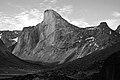
Mount Thor, officially gazetted as Thor Peak[2] (Inuktitut syllabics: ᙯᕐᓱᐊᓗᒃ, Inuktitut: Qaisualuk "huge bedrock",[3][4] or Kigutinnguaq "tooth-like"[3][5]), in Nunavut, Canada, is a mountain with an elevation of 1,675 m (5,495 ft) located in Auyuittuq National Park, on Baffin Island. The mountain is located 46 km (29 mi) northeast of Pangnirtung and features Earth's greatest vertical drop of 1,200 m (4,100 ft), with the cliff overhanging at an average angle of 105 degrees (15 degrees from vertical).[6] Despite its remoteness, this feature makes the mountain a popular rock climbing site. Camping is allowed, with several designated campsites located throughout the length of Akshayuk Pass. For climbers looking to scale Mount Thor, there is an established campsite a few kilometres north of its base, complete with windbreaks and emergency shelters.

Key Information

The English naming of the mountain originates from Thor, the Norse thunder god.[7]

Geography

[edit]

Mount Thor is part of the Baffin Mountains which in turn form part of the Arctic Cordillera mountain range.[1]

Geology

[edit]

This mountain consists of solid granite. The rock making up this formation have been metamorphosed multiple times through earth's history, causing this granitic layer to be pushed through other layers. The age of the rock ranges from 570 million years to 3.5 billion years (Precambrian), making it some of the oldest rock on earth.[8]

The peak and vertical drop itself are a product of glacial erosion, carved over millennia by seasonal glacial activity through the Akshayuk Pass, on the rim of which this mountain sits. Like other glacial channels, this pass has the characteristic U-shape which gives the mountain its vertical drop[9]

Ascents

[edit]

Donald Morton and Lyman Spitzer made the first recorded ascent of Mount Thor in 1965 during the Alpine Club of Canada expedition led by Pat Baird.[10]: 347 [11] Pat Baird also led the 1953 geophysical expedition during which Hans Weber, J. Rothlisberger and F. Schwarzenbach climbed the North Tower of Mount Asgard for the first time.

The first ascent of the west face was achieved by Earl Redfern, John Bagley, Eric Brand and Tom Bepler in 1985.[12] The first solo ascent of the West Face was made by Yasushi Yamanoi in 1988.[13] In 1998, Jason 'Singer' Smith made a second solo ascent of the West Face.[14] The first free climb of the Southwest Buttress was made in 2012 by Bill Borger and John Furneaux.[15][16]

[edit]

See also

[edit]

References

[edit]
[edit]
Revisions and contributorsEdit on WikipediaRead on Wikipedia
from Grokipedia
Mount Thor, officially designated as Thor Peak, is a prominent granite mountain in the Baffin Mountains of the Arctic Cordillera, situated within Auyuittuq National Park on Baffin Island, Nunavut, Canada, approximately 46 kilometers (29 miles) northeast of the community of Pangnirtung.[1][2] Rising to an elevation of 1,675 meters (5,495 feet) above sea level, it is named after the Norse god of thunder due to its dramatic, imposing form amid the surrounding glaciers and fjords.[1][3] The mountain's most defining feature is its west face, which boasts the world's greatest purely vertical drop of 1,250 meters (4,101 feet), exceeding even the sheer cliffs of Trango Towers in Pakistan, with an average overhang angle of 105 degrees that renders it steeper than vertical in places.[1][4] This geological marvel, sculpted by ancient glacial erosion from granite dating back up to 3.5 billion years, creates a freefall distance capable of lasting about 26 seconds at terminal velocity for a BASE jumper, though such activities are banned in the national park.[4][3] Exploration of Mount Thor began in the mid-20th century, with its first recorded summit ascent achieved in 1965 by American climbers Donald Morton and Lyman Spitzer as part of an Alpine Club of Canada expedition led by Pat Baird, approached via less technical routes.[2][3] The formidable west face remained unconquered until 1985, when a four-person team—John Bagley, Tom Bepler, Eric Brand, and Earl Redfern—completed the first ascent over 33 days via a 36-pitch aid climb, marking a significant milestone in big-wall mountaineering.[5][4] In 2006, the face saw the world's longest single rappel, further cementing its status among extreme adventurers, though access remains challenging due to the remote Arctic location and harsh weather.[1] Auyuittuq National Park, whose Inuit name translates to "the land that never melts," encompasses Mount Thor within a vast protected area of rugged terrain, polar bears, and ancient ice, highlighting its role in preserving one of Canada's most extreme natural landscapes.[4][3]

Geography

Location and Access

Mount Thor, officially known as Thor Peak, is situated in Auyuittuq National Park on the southeastern part of Baffin Island in Nunavut, Canada, at coordinates 66°32′N 65°19′W. This remote Arctic location places it within the Cumberland Peninsula, a rugged region characterized by steep fjords, glaciers, and towering granite peaks. The mountain lies approximately 46 km northeast of the Inuit community of Pangnirtung, serving as the nearest gateway for visitors.[3][2] Adjacent to Mount Asgard, another prominent peak in the park, Mount Thor forms part of the dramatic fjord system that includes the nearby Akshayuk Pass, a 97 km natural corridor popular for trekking. This positioning amid the Penny Ice Cap and surrounding valleys underscores the area's isolation, with no road access and reliance on marine or overland travel. The terrain's exposure to polar conditions, including high winds and unpredictable weather, amplifies the challenges of navigation in this uninhabited expanse.[6][7] Access to Mount Thor begins in Pangnirtung, where visitors arrange transport across Pangnirtung Fjord—typically a 30-50 km boat journey in summer (about 45 minutes, tide-dependent) or snowmobile traverse in winter when ice permits. Seasonal restrictions are stringent: boating is feasible from late June to early September, while overland options are limited by thawing ice and storms, often confining travel to guided groups. An established backcountry campsite, located 3-5 km north of the mountain's base, provides essential facilities including windbreaks and emergency shelters to mitigate harsh Arctic elements.[8][2][9][7] Entry into Auyuittuq National Park requires registration at Parks Canada offices in Pangnirtung or Qikiqtarjuaq, along with mandatory safety orientations covering bear awareness, weather hazards, and emergency protocols. While special permits (e.g., for research or business activities) must be obtained well in advance and may take up to 90 days to process, general backcountry access involves paying fees at the office. Due to the park's extreme remoteness, lack of rescue infrastructure, and environmental risks, unguided travel is discouraged for non-locals, with guided tours frequently mandated for backcountry activities to ensure compliance and safety. Fees apply for daily entry ($16.00 CAD per person as of 2025) and nightly backcountry camping ($12.25 CAD per person), payable at the park office.[10][11][12][13]

Physical Characteristics

Mount Thor stands at an elevation of 1,675 m (5,495 ft) above sea level, making it one of the prominent peaks in Auyuittuq National Park on Baffin Island, Nunavut, Canada.[3][14] Its defining physical attribute is the west face, which features the greatest vertical drop on Earth at 1,250 m (4,101 ft), including a 105-degree overhang that exceeds verticality.[15] This sheer cliff has been officially recognized by Guinness World Records as the tallest vertical rock face.[15] The mountain presents as a granite monolith rising from the base of a U-shaped glacial valley, characteristic of the park's glaciated terrain.[15][16] Its profile includes steep, near-vertical walls with an average slope exceeding 80 degrees, intensifying to the dramatic overhang on the west face.[3][17] Mount Thor towers over Weasel Valley, part of the broader Akshayuk Pass, and is clustered among other jagged peaks in the remote interior of Auyuittuq National Park, contributing to the area's rugged, high-relief landscape.[18][19] The peak endures harsh Arctic conditions, with perpetual snow capping higher elevations and frequent high winds averaging 15-20 km/h year-round, occasionally gusting to 100 km/h or more.[20] Even in summer, temperatures at altitude often remain below freezing, dropping below -10°C (14°F) due to elevation, wind chill, and sudden weather shifts in the polar marine climate.[21]

Geology

Rock Composition and Structure

Mount Thor's primary lithology consists of solid Precambrian granite and granitic gneiss, forming part of the ancient Canadian Shield that underlies much of eastern Baffin Island.[22][23] These rocks, dominated by quartz and feldspar minerals, exhibit high resistance to weathering, contributing to the mountain's enduring sheer cliffs and minimal talus accumulation at the base.[24] The age of these formations spans from approximately 3.5 billion years in the Archean basement gneisses to around 570 million years in the Proterozoic intrusions, reflecting the Shield's protracted geological evolution.[3] Specifically, the prominent peaks in the Auyuittuq area, including Mount Thor, are composed of the Paleoproterozoic Qikiqtarjuaq plutonic suite, featuring biotite-garnet granodiorite and monzogranite units intruded around 1.89 to 1.90 billion years ago.[25][26] The metamorphic history of Mount Thor's rocks involves multiple episodes of high-grade metamorphism, primarily under amphibolite-facies conditions, which have imparted foliation and banding to the gneiss layers.[27] These processes, occurring during the Precambrian orogenies, transformed protoliths into the current migmatitic orthogneisses and granitic bodies, with partial melting evident in some exposures.[28] On the west face, distinctive structural features include a prominent dike of red hematite, which cuts across the granite and serves as a key marker in the cliff's architecture.[29] This intrusion highlights later magmatic activity superimposed on the metamorphic framework. Structurally, the mountain's rock mass is characterized by systematic jointing and fracturing patterns, including vertical and subvertical planes that enhance the face's near-perpendicular quality and limit large-scale exfoliation.[30] These fractures, often spaced at intervals of several meters, result from cooling contractions in the plutonic rocks and subsequent tectonic stresses, yet the overall integrity remains high due to the coherent quartz-feldspar matrix.[24] Compared to surrounding Baffin Island peaks, such as those in the Asgard group, Mount Thor displays uniquely uniform massive granite blocks with fewer disrupted zones, owing to its position within the central plutonic belt.[25] Brief glacial overprinting has polished surfaces but not significantly altered the underlying structural patterns.[22]

Formation and Erosion

Mount Thor's geological foundations trace back to the Precambrian era, during the assembly of the Laurentia supercontinent around 1.8 billion years ago, when Archean and Paleoproterozoic crustal blocks of the Rae craton collided and stabilized. The mountain's core consists of granitic rocks that crystallized in extensive batholiths between approximately 2.7 and 1.8 billion years ago, forming part of the ancient Canadian Shield.[31][32][33] Following initial formation, these rocks were overlain by younger sediments during the Paleozoic era, which were gradually eroded away, exposing the underlying Precambrian basement. Tectonic processes further shaped the landscape through post-glacial isostatic rebound in the Holocene and earlier Cenozoic adjustments related to regional rifting, elevating the eastern edge of the Shield and setting the stage for Mount Thor's rugged topography.[31][34][35] The mountain's iconic vertical drop and sheer faces resulted largely from intense glacial modification during the Pleistocene epoch, spanning the past 2.6 million years, when repeated ice ages advanced across Baffin Island. The Laurentide Ice Sheet, reaching its maximum extent around 18,000 years ago, exerted powerful erosive forces through basal abrasion and quarrying, sculpting the 1,250-meter cliff and adjacent U-shaped valleys; deglaciation began around 15,000 years ago, with the region largely ice-free by the early Holocene approximately 10,000 years ago. Subsequent warming in the Holocene has progressively unveiled more of the glaciated rock surfaces, enhancing the peak's stark relief.[31][36][37] In the present day, Mount Thor experiences limited erosion owing to the Arctic's frigid temperatures and sparse precipitation, which slow chemical weathering and mass wasting. Nonetheless, anthropogenic climate change is thawing underlying permafrost, potentially hastening erosional processes by weakening rock stability, boosting runoff, and promoting slope failures in the coming decades.[38][39]

Naming and Cultural Significance

Etymology

Mount Thor, officially known as Thor Peak, was approved as the official name by the naming authority on May 17, 1965, with coordinates formalized at 66°32′N 65°19′W in Canadian geographical records.[40] The elevation of 1,675 m (5,495 ft) was also documented in official surveys around this period.[1] The name honors Thor, the Norse god of thunder, reflecting the mountain's imposing granite structure and sheer cliffs that evoke a sense of raw power and drama.[41] The mountain was named by Donald Morton in 1963, honoring the Norse god of thunder. This followed a broader convention in the region of drawing from Norse mythology, as seen with nearby peaks like Mount Asgard—named for the gods' realm—and Mount Odin, the chief deity, to highlight the area's mythical grandeur.[42] The 1965 decision came shortly after the first recorded ascent of the peak that year, solidifying its place in official gazetteers.[5][2] Occasionally, the mountain is distinguished as Baffin Thor in English usage to avoid confusion with other features bearing the name, such as Mount Thor in Alaska's Chugach Mountains, which was similarly named for the thunder god due to frequent avalanche sounds.[43]

Inuit Perspectives

In the Inuit language Inuktitut, Mount Thor is known as Qaiqsualuk, a term translating to "enormous bedrock," which underscores its massive and dominant presence in the Arctic terrain as perceived in traditional oral histories.[44][45] Within Inuit cultural narratives, Qaiqsualuk serves as a formidable landmark integral to stories of the land, embodying the harsh yet enduring spirit of the Qikiqtaaluk region on Baffin Island, where such features form part of the broader spiritual and historical landscape shaped by millennia of human occupation.[46][2] Inuit hunters have long relied on prominent mountains like Qaiqsualuk as key navigation references across the vast, featureless Arctic expanses, highlighting their practical role in survival and mobility traditions.[47] Efforts to revitalize indigenous nomenclature culminated in 2018 when Parks Canada incorporated Inuktitut place names, including Qaiqsualuk, into official maps of Auyuittuq National Park, aiming to honor Inuit heritage and counter the legacy of colonial-era Norse designations imposed during European exploration.[44][48]

Exploration and Climbing History

Early Exploration

Mount Thor and the surrounding Cumberland Peninsula on Baffin Island were first systematically explored and documented during the 1953 Baffin Island Expedition organized by the Arctic Institute of North America, led by glaciologist P.D. Baird. This geophysical and biological survey focused on the Pangnirtung Pass area, where the team conducted glaciological studies on the Penny Icecap and Highway Glacier, bedrock geology mapping, and geomorphological analysis of local corries and valleys. Eight peaks in the region were ascended to determine altitudes and collect data, resulting in 17 new geographical names approved by the Canadian Board on Geographical Names; although Mount Thor itself was not explicitly climbed, the expedition's work provided the initial detailed mapping of the area's dramatic granite peaks and fiords, highlighting the vertical topography near Pangnirtung Fiord.[49] In the 1950s, teams from the Geological Survey of Canada contributed to broader reconnaissance mapping across Baffin Island, including the Cumberland Peninsula, through helicopter-supported surveys that documented bedrock exposures and glacial features in remote eastern sectors. These efforts built on Baird's 1953 findings by establishing positional data for prominent landforms, though specific measurements for Mount Thor were limited to topographic sheets like National Topographic System Sheets 16 and 26. Baird continued his involvement in the region during the early 1960s, leading or supporting glaciological and mountaineering activities on the Cumberland Peninsula, including a 1963 Alpine Club of Canada climbing camp at the head of Pangnirtung Fiord that explored nearby peaks and passes. During this period, American climber Donald C. Morton conducted a solo reconnaissance of Mount Thor, attempting the north ridge but retreating short of the summit due to avalanche risks; he noted the peak's imposing 1,675 m height and observed the west face's extreme verticality, estimating it as slightly overhanging.[36][50] Early access to the Mount Thor area posed significant logistical challenges, primarily relying on floatplanes from Iqaluit (then Frobisher Bay) to Pangnirtung or Broughton Island, followed by boat transport along the fiords or dog sleds and snowmobiles in winter for overland travel from settlements like Pangnirtung, about 46 km southwest. These methods were essential for hauling supplies—often over a ton per party—across crevassed glaciers and soft snow, amid frequent fog, damp conditions, and ice-blocked routes, as reported in pre-1965 expeditions. The Alpine Club of Canada recognized Mount Thor's potential as a premier climbing objective in its early 1960s reports, citing its 1,250 m sheer west face (Earth's greatest vertical drop) and overhanging headwall as unparalleled challenges, based on aerial photos and Morton's 1963 observations that confirmed its unclimbed status and technical demands.[8][50]

First Ascent and Major Expeditions

The first recorded ascent of Mount Thor was made in 1965 by Lyman Spitzer and Donald Morton as part of an Alpine Club of Canada expedition led by Pat Baird. The pair followed the northeast face route, navigating 1,400 feet of mossy slopes, a crossing of the Forkbeard Glacier, 1,500 feet of moss-covered boulders, and a final section via a left-sloping crack and inside corner protected by pitons. Starting from a base camp near the glacier, the climb to the 1,675-meter summit took about 9 hours, with the full round trip, including five 75-foot rappels on descent, spanning 17 hours over mixed rock and ice terrain requiring ropes and aid techniques.[50] Major expeditions have since targeted the imposing west face, renowned for its 1,250-meter vertical drop and 105-degree average overhang. In 1985, a four-member American team—John Bagley, Tom Bepler, Eric Brand, and Earl Redfern—achieved the first direct ascent of this face over 33 days, fixing ropes in 600-foot increments across 36 pitches rated VII 5.10 A4, battling crumbly granite, rockfall, and a 1,600-foot headwall that demanded extensive aid climbing with pitons, bolts, and etriers. That same year, a Japanese team of Teruji Yonei, Yukio Terashima, Norio Hoshino, and Kazue Kumakura climbed a variation on the west face, fixing 450 meters of rope to bypass lower rock bands, traversing right to the north ridge to avoid the headwall, and reaching the summit after 8 days of technical progress on the upper sections.[5][51] Record-setting efforts highlight the peak's extreme profile. On July 23, 2006, an American team led by Brent Ayers—alongside Chuck Constable, Dirk Siron, and Joe Tredennick—executed the world's longest single-rope rappel, descending the full 1,250-meter west face drop after rigging from the summit, establishing a benchmark for big-wall descent techniques. In 1998, American climber Jason "Singer" Smith completed the first solo ascent of the west face via the Midgard Serpent route (VI A5), spending three weeks alone to free and aid climb its 1,200 meters, incorporating free solo elements on lower sections before aid on overhangs.[52][53] Post-2010 expeditions have emphasized big-wall skills on established lines, with most ascents relying on aid due to persistent overhangs. For instance, in 2019, a British team led by Jacob Cook ascended the south ridge route (5.8) in a day, scrambling 1,300 meters of mixed terrain as a warm-up for new routes nearby, highlighting the peak's role in training for Arctic granite challenges. Overall, documented successful summits remain limited due to Mount Thor's remoteness and technical demands.[54]

Notable Accidents

One of the earliest recorded accidents on Mount Thor occurred on June 8, 1979, during an attempt on the west face by a seven-member team from Japan's Shimizu Rock Climbing Club.[55] While retrieving fixed ropes at approximately 150 meters height, climber W. Yamazaki set up a rappel using a sling threaded through three bolts but fell fatally due to a likely improper connection or sling malfunction; the bolts and ropes remained intact, but the sling was not recovered.[55] The remote location complicated recovery, requiring a five-man team to transport the body 38 miles by skidoo and komatik, followed by 28 miles on foot and stretcher over 54 hours, with no helicopter support available.[55] In 1985, a second Japanese expedition successfully summited via the west face and north ridge, bypassing the overhanging headwall, but the climb ended tragically during the return journey.[5][51] Team member Kazue Kumakura drowned while crossing a stream near Pangnirtung, highlighting the perils of post-climb logistics in the rugged Arctic terrain.[51] A particularly devastating solo attempt unfolded in August 1998, when experienced Japanese climber Go Abe fell to his death while pursuing a new direct line up the central west face on his second try that season.[56] His body was discovered by Parks Canada rescue specialists at about two-thirds height on the 1,250-meter cliff, approximately 800 meters above the base, after he became overdue.[56] The incident occurred amid informal competition for the first solo ascent, with Abe racing against an American climber targeting a nearby route.[57] Mount Thor's extreme profile amplifies common hazards like rockfall, which has struck climbers during early pitches and forced tactical adjustments on multiple expeditions.[5] Hypothermia poses a severe risk due to the Arctic climate and prolonged exposure on overhanging terrain, while avalanches threaten approaches and descent routes in Auyuittuq National Park.[58] These factors underscore the peak's unforgiving nature, where even partial successes can turn fatal, as evidenced by the recovery efforts involving specialized Parks Canada teams.[56]

Significance and Conservation

Mountaineering Importance

Mount Thor holds the distinction of featuring the world's greatest purely vertical rock face, with a sheer drop of 1,250 meters (4,101 feet), unlike the nearly vertical east face of Great Trango Tower in Pakistan at 1,340 meters and surpassing El Capitan in the United States at approximately 900 meters (3,000 feet).[59][60] This record status positions the mountain as a premier destination for big wall and aid climbers pursuing extreme challenges, drawing adventurers who view its unrelenting granite wall as the ultimate test of endurance and technical proficiency.[2][17] The technical demands of ascending Mount Thor are formidable, necessitating advanced aid climbing techniques rated A4 to A5, which involve placing and relying on artificial protection in cracks and features while navigating the overhanging terrain.[5][61] Climbers must employ multi-day portaledge systems to bivouac on the face, enduring Arctic conditions that include high winds, subzero temperatures, and unpredictable weather, skills that also prepare teams for other remote Arctic routes.[2] The wall's average 105-degree overhang—15 degrees steeper than vertical—exemplifies its role as a global benchmark for overhang climbs, exceeding the steepness of Mount Asgard's southwest face and demanding precise route-finding amid sparse holds.[3][62] In climbing culture, Mount Thor serves as an iconic symbol of human limits, frequently referenced in mountaineering accounts for its audacious scale and isolation.[53] This prominence underscores its influence in adventure sports, inspiring training regimens and narratives that emphasize pushing boundaries in big wall climbing.[63]

Environmental Protection

Mount Thor is located within Auyuittuq National Park, established as a national park reserve on February 22, 1972, to protect a representative Arctic landscape on Baffin Island's Cumberland Peninsula.[64][65] The name "Auyuittuq" derives from Inuktitut, meaning "the land that never melts," reflecting its extensive ice fields and glaciers that cover much of the 21,471 km² protected area.[66][64] The park is managed cooperatively by Parks Canada and Inuit through the Joint Park Management Committee, established in 2001, ensuring Inuit involvement in decision-making to balance conservation with cultural values.[67] Park regulations emphasize minimal human impact to preserve the pristine environment, requiring all visitors, including climbers accessing Mount Thor, to obtain permits in advance from Parks Canada, with processing times up to 90 days for certain activities.[10] Climbing is permitted but must adhere to Leave No Trace principles, prohibiting permanent installations like fixed bolts to maintain the natural rock faces and wilderness character.[11] Seasonal area closures are enforced to protect wildlife, such as restrictions in fiords during narwhal presence from summer to freeze-up, and broader habitat safeguards for species like caribou during sensitive periods including calving.[68][69] Climate change poses significant threats to the park's stability, with Arctic temperatures rising approximately 3°C since the 1980s, accelerating glacial retreat—such as on the nearby Penny Ice Cap—and permafrost thaw since the early 2000s.[70][71] These changes, evident in events like the 2008 flash floods from melting permafrost and record heat, risk destabilizing steep features like Mount Thor's sheer faces through increased erosion and rockfall.[72][73] This warming contradicts the park's name, as year-round ice diminishes, altering ecosystems and contradicting the "never melts" legacy.[74] Conservation efforts are Inuit-led and collaborative, with monitoring programs tracking glacial and permafrost changes through Parks Canada initiatives and community-based wildlife observations supported by regional bodies like the Qikiqtaaluk Wildlife Board, which regulates harvesting and habitat protection in the Qikiqtani area.[75][76][77] In 2018, Parks Canada updated the park map to include traditional Inuktitut place names, developed through consultations with Inuit elders to honor cultural knowledge and aid conservation planning.[48] Ecotourism guidelines promote low-impact visitation, mandating trip registration, waste removal, and wildlife distancing to mitigate human disturbance on fragile Arctic terrain. In April 2025, a skier was injured in a polar bear attack in the park, underscoring ongoing wildlife management efforts.[78][11]

References

User Avatar
No comments yet.