



Community hub
Recent from talks
Contribute something to knowledge base
Content stats: 0 posts, 0 articles, 1 media, 0 notes
Members stats: 0 subscribers, 0 contributors, 0 moderators, 0 supporters
Subscribers
Supporters
Contributors
Moderators
Hub AI
Mridangam AI simulator
(@Mridangam_simulator)
Hub AI
Mridangam AI simulator
(@Mridangam_simulator)
Mridangam
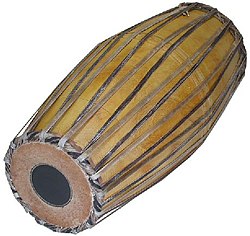
The mridangam is an ancient percussion instrument originating from the Indian subcontinent. It is a traditional royal instrument originating in the south Indian state of Kerala and is widely used in south Indian classical music, called Carnatic music, especially in its sangeetha kacherees. It is the primary rhythmic accompaniment in a Carnatic music ensemble. In dhrupad, a modified version, the pakhawaj, is the primary percussion instrument. A related instrument is the kendang, played in the Maritime Southeast Asia. It is a complex instrument to tune and involves a lot of mathematics to construct korvais.[clarification needed]
During a percussion ensemble, the mridangam is often accompanied by the ghatam, the kanjira, and the morsing.
The word "Mridangam" is formulated by the union (sandhi) of the two Sanskrit words mŗd (clay or earth) and anga (limb), as the earliest versions of the instrument were made of hardened clay. An Article in the Journal of the Madras Music Academy (Vol. XXIV P:135- 136) Dr V Raghavan opines that the Mridangam gets its name by applying the black paste which produces the specialised tone for the instrument. Eventhough the original version of Mrit and Anga is accepted by many, Dr V Raghavan opines that the black patch, which gives it a specialised and unique tone, is made out of the mud particles (including silicon, iron, manganese etc., sand dust) taken out of a stone called "Kittam Stone". Application of such a powder mixed with cooked rice and applied as concentric layers on the 2nd layer of the instrument produces its unique tone and hence called Mridanga.
In ancient Hindu sculpture, painting, and mythology, the mridangam is often depicted as the instrument of choice for a number of deities including Ganesha (the remover of obstacles) and Nandi, who is the vehicle and follower of Shiva. Nandi is said to have played the mridangam during Shiva's primordial tandava dance, causing a divine rhythm to resound across the heavens. The mridangam is thus also known as "deva vaadyam," or "Divine Instrument".[citation needed]
Over the years, the mridangam evolved and was made from different kinds of wood for increased durability, and today, its body is constructed from the wood of the jackfruit tree.[citation needed] It is widely believed that the tabla, the mridangam's Hindustani musical counterpart, was first constructed by splitting a mridangam in half. With the development of the mridangam came the tala (rhythm) system.
The mridangam has a large role in Newa music. One of the earliest Nepal Bhasa manuscripts on music is a treatise on this instrument called Mridanga anukaranam.
The range of its use has changed over the years. In the old days, percussionists were only employed to accompany the lead player, often the vocalist. Now its use is not restricted to accompaniment, and it is used for solo performances.
In Tamil culture, it is called a tannumai. The earliest mention of the mridangam in Tamil literature is found perhaps in the Sangam literature where the instrument is known as 'tannumai'. In later works, like the Silappadikaram, we find detailed references to it as in the Natyasastra. During the Sangam period, it was one of the principal percussion instruments used to sound the beginning of war, along with the murasu, tudi and parai, because it was believed that its holy sound would deflect enemy arrows and protect the King. During the post-Sangam period, as mentioned in the epic Silappadikaram, it formed a part of the antarakoṭṭu - a musical ensemble which performed at the beginning of dramatic performances, and that would later develop into Bharathanatyam. The player of this instrument held the title tannumai aruntozhil mutalvan.
Mridangam
The mridangam is an ancient percussion instrument originating from the Indian subcontinent. It is a traditional royal instrument originating in the south Indian state of Kerala and is widely used in south Indian classical music, called Carnatic music, especially in its sangeetha kacherees. It is the primary rhythmic accompaniment in a Carnatic music ensemble. In dhrupad, a modified version, the pakhawaj, is the primary percussion instrument. A related instrument is the kendang, played in the Maritime Southeast Asia. It is a complex instrument to tune and involves a lot of mathematics to construct korvais.[clarification needed]
During a percussion ensemble, the mridangam is often accompanied by the ghatam, the kanjira, and the morsing.
The word "Mridangam" is formulated by the union (sandhi) of the two Sanskrit words mŗd (clay or earth) and anga (limb), as the earliest versions of the instrument were made of hardened clay. An Article in the Journal of the Madras Music Academy (Vol. XXIV P:135- 136) Dr V Raghavan opines that the Mridangam gets its name by applying the black paste which produces the specialised tone for the instrument. Eventhough the original version of Mrit and Anga is accepted by many, Dr V Raghavan opines that the black patch, which gives it a specialised and unique tone, is made out of the mud particles (including silicon, iron, manganese etc., sand dust) taken out of a stone called "Kittam Stone". Application of such a powder mixed with cooked rice and applied as concentric layers on the 2nd layer of the instrument produces its unique tone and hence called Mridanga.
In ancient Hindu sculpture, painting, and mythology, the mridangam is often depicted as the instrument of choice for a number of deities including Ganesha (the remover of obstacles) and Nandi, who is the vehicle and follower of Shiva. Nandi is said to have played the mridangam during Shiva's primordial tandava dance, causing a divine rhythm to resound across the heavens. The mridangam is thus also known as "deva vaadyam," or "Divine Instrument".[citation needed]
Over the years, the mridangam evolved and was made from different kinds of wood for increased durability, and today, its body is constructed from the wood of the jackfruit tree.[citation needed] It is widely believed that the tabla, the mridangam's Hindustani musical counterpart, was first constructed by splitting a mridangam in half. With the development of the mridangam came the tala (rhythm) system.
The mridangam has a large role in Newa music. One of the earliest Nepal Bhasa manuscripts on music is a treatise on this instrument called Mridanga anukaranam.
The range of its use has changed over the years. In the old days, percussionists were only employed to accompany the lead player, often the vocalist. Now its use is not restricted to accompaniment, and it is used for solo performances.
In Tamil culture, it is called a tannumai. The earliest mention of the mridangam in Tamil literature is found perhaps in the Sangam literature where the instrument is known as 'tannumai'. In later works, like the Silappadikaram, we find detailed references to it as in the Natyasastra. During the Sangam period, it was one of the principal percussion instruments used to sound the beginning of war, along with the murasu, tudi and parai, because it was believed that its holy sound would deflect enemy arrows and protect the King. During the post-Sangam period, as mentioned in the epic Silappadikaram, it formed a part of the antarakoṭṭu - a musical ensemble which performed at the beginning of dramatic performances, and that would later develop into Bharathanatyam. The player of this instrument held the title tannumai aruntozhil mutalvan.
Recent media
Recent media