Hubbry Logo
GhatamGhatamMain
Open search
Ghatam
Community hub
Ghatam
logo
8 pages, 0 posts
0 subscribers
Be the first to start a discussion here.
Ghatam
Ghatam
from Wikipedia

Ghatam
Percussion instrument
Hornbostel–Sachs classification111.24
(Percussion vessels)
Developedancient
Related instruments
Botija, gharha

The ghaṭam (Sanskrit: घटm ghaṭ; Kannada: ಘಟ ghaṭa; Tamil: கடம் ghatam; Telugu: ఘటం ghataṃ; Malayalam: ഘടം ghataṃ) is a percussion instrument used in various repertoires across the Indian subcontinent, especially in Southern India . Its variant is played in Punjab and known as gharha as it is a part of Punjabi folk traditions. Its analogue in Rajasthan is known as the madga and pani mataqa ("water jug").

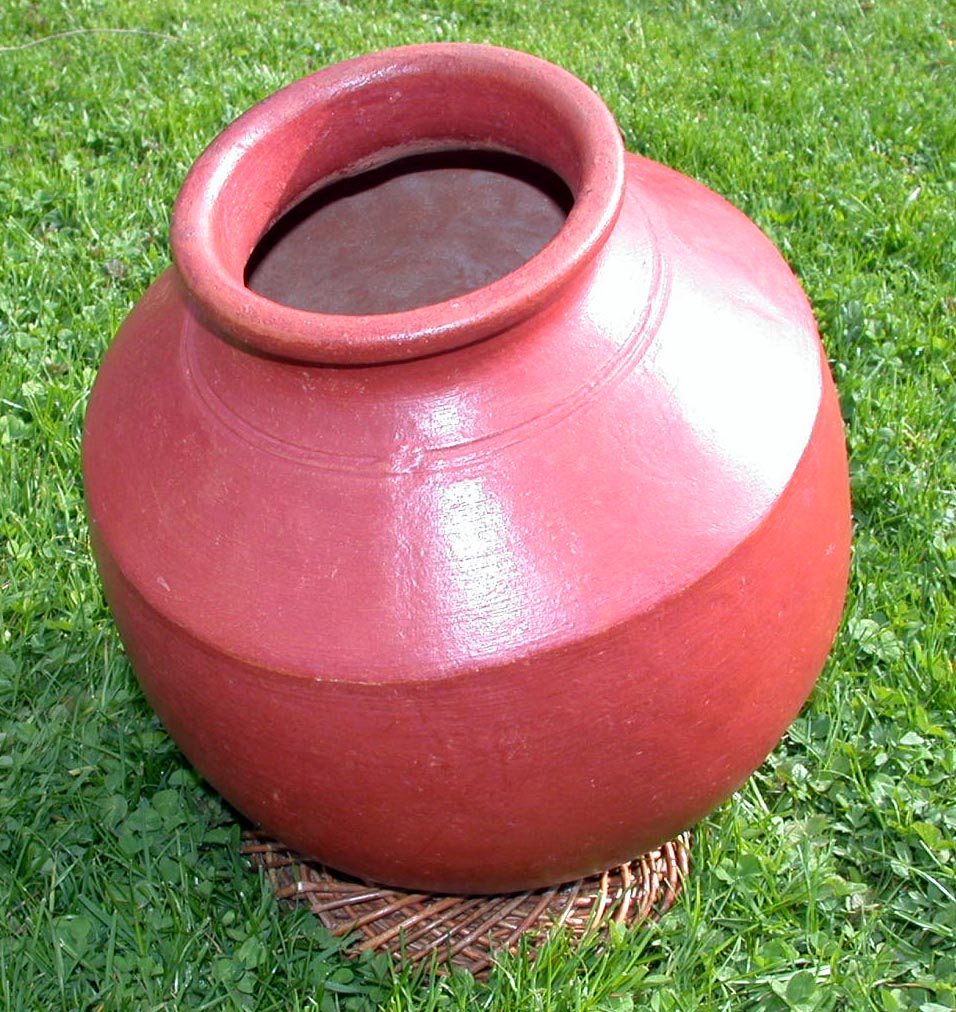
The ghatam is one of the most ancient percussion instruments in Pakistan and India. It is a clay pot with a narrow mouth. From the mouth, it slants outwards to form a ridge. Made mainly of clay baked with brass or copper filings with a small amount of iron filings, the pitch of the ghatam varies according to its size. The pitch can be slightly altered by the application of plasticine clay or water.[1][page needed]

Although the ghatam is the same shape as an ordinary Indian domestic clay pot, it is made specifically to be played as an instrument. The tone of the pot must be good and the walls should be of even thickness to produce an even tone and nice sound.

Ghatams are mostly manufactured in Manamadurai, a place near Madurai in Tamil Nadu. Though this instrument is manufactured in other places like Chennai and Bangalore, too, Manamadurai ghatams have special tonal quality. It is believed that the mud is of special quality. The Manamadurai ghaṭam is a heavy, thick pot with tiny shards of brass mixed into the clay. This type of ghaṭam is harder to play but produces a sharp metallic ringing sound which is favored by some players.

Playing

[edit]

It is played with the heel of the palms and the fingers, while held in the lap, the mouth facing the stomach of the musician. By changing the distance between the pot and the stomach, the musician can vary the tone of the instrument.[2]

The pot is usually placed on the lap of the performer, with the mouth of the instrument facing the belly of the performer. The performer uses their fingers, thumbs, palms, and heels of the hands to strike its outer surface to produce different sounds. Different tones can be produced by hitting areas of the pot with different parts of the hands. Sometimes the ghatam is turned around so that the mouth faces towards the audience and the performer plays on the neck of the instrument. The ghatam can be moved to multiple different positions while being played. Occasionally, the performer will, to the amusement of the audience, toss the instrument up in the air and catch it. The ghatam is ideal for playing rhythmic patterns in very fast tempo.[3]

The artist sits cross-legged on the floor and holds the Ghatam close to his [or her] body with the opening near the abdomen. The Bass effect is got by pressing and releasing the Ghatam to the abdomen and striking the body of the Ghatam by the lower parts of the wrists. For Treble sounds, fingers are used to strike the Ghatam at different parts to get different sounds. The bols are the same as for Mridangam. The Ghatam is used together with the Mridangam in concerts.[4]

Etymology

[edit]

The name ghaṭam is etymologically derived from the Sanskrit term ghaṭa (pot) and the related term, kuṇḍa (pitcher). The cognate term for pot in Tamil is kuḍam (water pot). It is noteworthy that in Tamil the term ghaṭam specifically carries the meaning of a percussive musical instrument, although in Sanskrit it is a generic word for a pot of any kind.

Similar instruments

[edit]

The madga is a north Indian version of the south Indian ghaṭam and is made from a very special clay. The maker sometimes adds some kind of metal or graphite dust to the clay which is responsible for the blue-gray appearance and for the special sound.

The madga can be played similarly to the ghaṭam. Loud bass tones can be produced if one hits with the flat hand the opening at the top of the instrument. The madga can be played with mallets (sticks) and there are many sounds which can be produced with this instrument. It is thinner than a ghaṭam but very stable and not as fragile as one might think.

In Gujarat and Rajasthan,

This clay pot is known as matka and features an almost perfectly round shape (tuned to C) and is made in many villages in and around Jaipur (Rajasthan) and Gujarat. The matka is used to store water and sometimes yogurt (curd) and can be used as a cooking vessel. When used as a musical instrument in folk music, it is known as ghaṛa and is played in a similar manner as the South Indian ghaṭam but the technique and rhythmic style is not as refined as that of Carnatic ghaṭam. Another difference is that the ghara is often traditionally played with metal rings on the thumbs, index, middle, and ring fingers of both hands (but players vary on how many rings and fingers are used). There are a few versions of this instrument. Some are made from a black clay that typically comes from a single area in Rajasthan while many others in Rajasthan and Gujarat are made from a reddish clay. A third version of the ghaṛa is made from reddish clay but features a much flatter, squat shape. Both of the red clay types can also be found highly decorated with colorfully painted designs while the black ones are usually plain and unfinished. The black ghaṛas are extremely light but very dense and have a huge sound. The shell tones ring in a bell-like fashion with much more of a sustain than the various South Indian ghaṭams (although the Mysore ghaṭam comes close). The bass tones of this instrument are very prominent. Since these instruments are fired at a much higher temperature for a longer time than South Indian ghaṭams, there is more consistency between instruments in terms of Western pitch. In other words, there is much less variation in the tuning when compared with ghaṭams from South India, which can range from a low B up to a high A chromatically. Ghaṛas/Matkas are usually found with a range from approximately C or C to D (or slightly higher) although there does not seem to be any indication that these instruments are constructed with tuning considerations. Other spellings for matka include mutkay and madga.[5]

See also

[edit]

References

[edit]
Revisions and contributorsEdit on WikipediaRead on Wikipedia
from Grokipedia
The ghatam is a traditional originating from , consisting of a narrow-mouthed pot made from resonant clay, used primarily to provide rhythmic in Carnatic classical music performances. As one of the world's oldest percussion instruments, it evolved from everyday clay water jugs and is mentioned in ancient texts like the as a time-keeping device. The instrument's construction involves baking clay mixed for durability, with renowned production centers in places like and , resulting in a pitcher-shaped form classified as an that produces a range of deep, resonant tones depending on the striking location and pot size. In performance, the ghatam is played by tapping its outer surface at varying points to produce different pitches, enabling complex rhythmic patterns. It integrates into ensemble settings with other instruments such as the , , and . Its role extends beyond concerts to temple rituals, bhajana parties, and classical dance forms like , where it enhances rhythmic complexity and supports improvisational solos called tani avartanam. The ghatam's enduring significance lies in its ability to evoke a spectrum of sounds from breathy lows to sharp highs, reflecting South India's rich percussive heritage rooted in texts like the Natyashastra.

History

Origins and Etymology

The term ghatam is derived from the word ghata, meaning "pot," and is related to kunda, denoting a or vessel; in Tamil, ghatam specifically refers to the clay pot adapted as a percussive instrument. This linguistic root reflects the instrument's fundamental form as an earthenware container, transformed through musical application in ancient traditions. It is mentioned in ancient texts such as the (, Chapter 10, Sloka 46), describing its sound in ceremonial contexts. The ghatam ranks among the most ancient percussion instruments in and , with origins traceable to ancient rituals where clay pots served as resonant tools in goddess and ceremonial practices. Its usage extended to religious ceremonies, folk music accompaniments, and early classical performances, particularly in southern Indian traditions and northern regions like , where variants known as ghata or gharha supported communal rhythms. These applications highlight its role as a versatile earthen , integral to both devotional and secular expressions dating back millennia. In cultural symbolism, the ghatam embodies the earth's resonance through its clay construction, evoking the primal vibrations of nature in performative contexts. As a pot form akin to the sacred purna ghata or kalasha, it signifies fertility and the rhythm of life in rituals, where filled vessels represent abundance, creation, and the womb-like generative force. This layered meaning underscores the instrument's deep ties to Indian cosmological and ritual frameworks, beyond mere percussion.

Development in Classical Music

The ghatam, originally a used in rural and temple traditions, began its integration into during the 19th century, marking a significant evolution from informal settings to structured concert performances. This transition elevated the clay pot from a rudimentary percussive tool to a sophisticated rhythmic companion, particularly through the innovations of early vidwans who adapted its earthy tones to the demands of classical talas and compositions. is recognized as one of the first to feature the ghatam in formal Carnatic concerts around the mid-1800s, laying the groundwork for its acceptance in urban music circles. A pivotal figure in this development was Palani Krishna Iyer in the late , credited with pioneering specialized patterns, phrases, and techniques tailored to the ghatam's unique sonority, which allowed for nuanced variations in pitch and timbre through precise strikes on its body. His contributions transformed the instrument's playing style, emphasizing korvais (rhythmic cadences) and intricate bols (syllabic mnemonics) that complemented the melodic framework of Carnatic ragas and krithis. This period saw the ghatam's shift solidify, as it moved beyond folk contexts to become an essential element in classical ensembles, often paired with the to provide layered rhythmic support during main pieces and improvisational segments. In the 20th century, the ghatam's prominence grew through the efforts of gurus like Dakshinamurthy Pillai (1875–1938), who, though renowned for and , initially honed his skills on the ghatam and trained numerous disciples in its classical application. Pillai's mentorship elevated the instrument's status in major concerts, fostering a generation of players who integrated it seamlessly into tani avartanam—the dedicated percussion solo section where ghatam artists showcase complex solos, korvais, and synchronized exchanges with other percussionists like the . This era cemented the ghatam's role as a dynamic force in , enabling it to contribute resonant bass tones and textural depth that enriched the overall laya (rhythm) architecture of performances.

Construction

Materials and Design

The ghatam is primarily made from clay, often sourced from regions like in , mixed with small amounts of , , or to improve , durability, and tonal quality. These metal additives create a distinctive metallic , while variations in the proportion of filings affect the instrument's pitch and overall sound characteristics. The clay is typically prepared with binding agents like to strengthen the structure and ensure uniform wall thickness, which is essential for consistent acoustics. In terms of design, the ghatam resembles a large pot with a narrow flaring outward to a wider base, enabling a broad range of resonant frequencies from deep bass at the bottom to sharper treble near the top. The , positioned toward the player's body when held, is pressed against the during performance to modulate pitch by altering the internal air cavity. Overall heights vary from about 25 to 40 cm, with the roughly 9-14 cm and the base expanding to 20-30 cm, allowing for ergonomic handling and sound projection. Size variations further tailor the ghatam's sonic profile: smaller instruments, around 25 cm in height, yield higher pitches suitable for performers like women or children seeking brighter tones, whereas larger models up to 40 cm deliver deeper bass for robust ensemble support. Regional styles, such as the heavier ghatam with metal-infused clay for enhanced projection or the lighter Madras version using purer clay for subtler resonance, exemplify how design choices optimize acoustic performance.

Manufacturing Process

The primary production hub for ghatams is in , where artisans source special clay from local riverbeds, particularly the , known for its and loamy soils rich in iron and manganese. Alternative centers, such as , produce commercial variants using similar but sometimes varied clay sources from regions like . The manufacturing process starts with preparing the clay by drying it for about two days, sieving it to remove impurities, and mixing it with sand from riverbeds along with metal filings such as , , iron, lead, and to enhance resonance and durability. The mixture is then kneaded by hand and foot for several hours to achieve a uniform consistency, often stamped to strengthen it before resting for another two days. Hand-shaping follows on a , where the wet clay is molded into a pot form with a narrow mouth and wider base, ensuring even initial wall thickness; the shaped pot is removed using a thread and set aside. After shaping, the ghatam undergoes in the shade for up to two weeks to prevent cracking, followed by brief sun exposure for about four hours to further stabilize it. It is then fired at low temperatures, typically in the range of 800–1000°C, in kilns for around 12 hours to create a semi-porous texture that allows for optimal without full . Post-firing, the exterior is beaten rhythmically with wooden spatulas and stones—often thousands of times—to refine the , reduce weight from approximately 16 kg to 5–8 kg, and even out wall thickness for tonal consistency. Tuning occurs primarily during the beating stage, where artisans strike the ghatam repeatedly to test pitch and adjust wall thickness as needed, ensuring across different notes; fine adjustments can also involve applying materials like inside to lower the pitch slightly. Quality variations exist between handmade artisanal ghatams, prized for their unique tonal qualities and produced in limited quantities (with only about 40% meeting performance standards), and more standardized commercial ones from larger centers, which prioritize consistency but may lack the nuanced of traditional pieces. Artisans test for pitch consistency by striking various points and refining through thickness adjustments, with ghatams noted for their heavier build and sharper metallic ring compared to lighter variants.

Playing Technique

Basic Methods

The ghatam is typically played by a musician seated cross-legged on the floor, with the instrument placed on the lap and its open mouth oriented toward the player's abdomen or stomach to optimize acoustic resonance and allow for tonal modulation by adjusting the distance between the pot and the body. The right hand primarily produces higher-pitched treble sounds near the narrow mouth, while the left hand generates lower bass tones on the broader body of the pot. This posture facilitates stable support and enables the use of both hands, wrists, fingers, and nails to strike the instrument effectively. Primary striking techniques involve varied contact with different parts of the hands to elicit core sounds. For bass tones, players deliver palm slaps or heel-of-the-palm strikes on the broader body, often while pressing the against the to deepen the . Treble sounds, like the "tha" bol, are created by or flicking the fingers and nails near or on the rim and narrow of the pot. These methods utilize the full range of hand surfaces—palms, knuckles, sides, and fingertips—to produce distinct timbres, with the left hand focusing on resonant bass and the right on crisp highs. Sound variations arise primarily from the striking position and proximity to the body. Higher pitches result from strikes closer to the , where the pot's shape amplifies sharper, metallic tones, while lower pitches emerge from impacts on the base or sides, yielding deeper, earthen resonances. Adjusting the ghatam's distance from the player's body further alters the fundamental pitch and , allowing basic rhythmic cycles in simple taals, such as Adi talam, to be executed with alternating bass and treble strokes for foundational patterns.

Advanced Patterns and Bols

Advanced patterns in ghatam performance build upon basic strikes to create intricate rhythmic compositions, employing a specialized set of bols, or vocalized syllables, that denote specific sounds and facilitate complex improvisations. Common bols include treble sounds like "tha," "thi," "ta," and "ti," produced through sharp finger strikes on the pot's upper areas, generating high-pitched tones. Bass sounds, like "thom," "na," and "kun," are achieved by palm or wrist strikes on the body, producing deeper resonances that anchor the rhythm. These bols are integral to solkattu, the rhythmic solfege system adapted for ghatam, allowing performers to vocalize and compose patterns that mirror the instrument's sonic palette. Combinations of these bols form advanced structures like korvais, rhythmic cadences repeated in sets of three to build tension and resolution, and teermanams, concluding phrases that synthesize the tala cycle with emphatic finality. For instance, a tisra-nadai korvai might sequence as "tha ki ta | tha ka thi na | tha thi ki tha thom," adapting konnakkol syllables to ghatam's percussive demands for layered polyrhythms across multiple speeds (kalas). These patterns demand precise coordination, often spanning 32 or more aksharas (beats) per cycle, to maintain alignment with the ensemble while showcasing improvisational depth. In solos, performers integrate ghatam-specific solkattu to explore variations in nadai (subdivisions), such as transitioning from chatusra (four beats) to khanda (five beats), enhancing rhythmic complexity without disrupting tonal purity. Advanced techniques elevate these patterns through nuanced manipulations, including rapid finger rolls that produce effects for sustained, shimmering textures, often executed on the pot's upper surface to simulate continuous vibration. Muffled strikes, delivered with the wrist or palm against the body, create bass notes that contrast sharp trebles, enabling abrupt dynamic shifts essential for teermanams. While traditional setups rely on hand techniques, modern performances blend ghatam in fusion contexts with other percussion. Challenges in execution include sustaining clarity at accelerated tempos—up to double speed (ati-druta kala)—where bols must remain distinguishable amid rapid sequences of 16 or more beats per cycle, demanding years of practice to preserve the instrument's resonant in solo expositions. Innovations in these areas, such as refined double-speed korvais, continue to expand the ghatam's expressive range within Carnatic frameworks.

Role in Music

In Carnatic Ensembles

In ensembles, the ghatam serves as a supporting , accompanying vocalists and instrumentalists during the rendition of krithis, ragas, and talas by providing rhythmic support that enhances the overall texture without overpowering the main performer. It typically enters prominently during the tani avartanam, a dedicated percussion solo section following the main composition, where it engages in intricate interplay with the and , showcasing improvisational patterns and rhythmic variations. The ghatam's interaction dynamics within the emphasize its role in complementing the , the primary , by offering a rhythmic foundation through its resonant clay tones while providing treble contrasts to the mridangam's deeper bass sounds, creating a balanced and layered sonic palette. In typical concerts, one ghatam is used. The ghatam player adapts creatively to follow the mridangam's lead, often incorporating finger strikes, palm slaps, and pot throws to build tension and resolution in the rhythmic dialogue. In the repertoire, the ghatam is commonly employed in talas such as Adi (8 beats), Rupaka (6 beats), and Misra Chapu (7 beats), where its crisp articulation supports the cyclical structure and allows for explorations in various gatis like chaturasra and tisra. Performances at sabhas like the frequently highlight the ghatam in varnams—elaborate opening pieces that demonstrate elaboration—and tillanas, rhythmic compositions concluding concerts, as seen in annual conferences where it accompanies vocal and instrumental solos in these forms.

In Folk and Fusion Contexts

In rural Tamil Nadu, the ghatam serves as a vital percussion instrument in folk music ensembles, providing resonant, earthy rhythms that accompany traditional dances and communal gatherings. Often played alongside the mridangam, it contributes to the layered tonal textures that define South Indian folk performances, drawing from its origins as a household clay pot adapted for musical use. In Punjab, a smaller variant known as the gharha fulfills a similar role in folk traditions, enhancing the energetic beats of dances like Bhangra during harvest celebrations. Historically, the ghatam has played a key part in harvest festivals such as Pongal in Tamil Nadu, where its soil-derived construction symbolizes a connection to the earth and agricultural cycles; January 14, designated as Global Ghatam Day, aligns with these festivities to honor the instrument's cultural ties. Its rhythms also support storytelling in ritual and temple festivals across South India, evoking narratives from ancient texts like the Ramayana through percussive accompaniment. In fusion contexts, the ghatam has been innovatively integrated into collaborations, blending its traditional tones with and rock elements to create dynamic cross-genre soundscapes. Pioneering ensembles like , formed in 1975 by guitarist John McLaughlin, tabla maestro Zakir Hussain, violinist , and ghatam player T.H. "Vikku" Vinayakram, exemplified this by fusing Indian percussion—including the ghatam's resonant bass—with Western and improvisational structures, influencing global perceptions of Indo-Western percussion hybrids. Contemporary Indian fusion bands often amplify the ghatam for larger venues or sample its sounds electronically, incorporating them into rock and electronic tracks to modernize folk-inspired rhythms while preserving their organic depth. The ghatam's global spread has been propelled through performances at international festivals, where it interacts with non-Indian percussion traditions. Shakti's appearances at the in 1976 and 1977 showcased the instrument's versatility alongside Western drums, captivating audiences with high-energy fusions that bridged cultural divides. Similarly, artists like Ramesh Shotham have featured the ghatam at events such as WOMEX, highlighting its role in showcases and inspiring adaptations in diverse percussion ensembles worldwide.

Notable Artists

Pioneers

Palani Krishna Iyer, active during the late 19th and early 20th centuries, is credited as the first to systematically develop rhythm patterns and playing techniques tailored specifically to the ghatam, transforming it from a folk accompaniment into a structured classical instrument. He created distinctive patterns and phrases suited to the ghatam's tonal qualities and established foundational techniques that formed the basis of its performance style in . Dakshinamurthy Pillai (1875–1936), a pioneering percussionist in early 20th-century , began his career adept in ghatam before specializing in and , thereby expanding the instrument's repertoire through innovative integrations in ensemble playing. He mentored future masters, providing systematic instruction that elevated the ghatam's role in concerts and bridged its folk origins with classical sophistication. These pioneers collectively codified essential bols (rhythmic syllables) and solo frameworks for the ghatam, fostering its transition into mainstream Carnatic ensembles despite its humble clay construction. With few surviving recordings from their era, their enduring impact stems primarily from the guru-shishya tradition, through which disciples perpetuated and refined their innovations.

Contemporary Performers

T. H. "Vikku" Vinayakram (born 1942), a pioneering percussionist often called the "God of Ghatam," has significantly globalized the instrument through his work with the fusion band , alongside John McLaughlin and Zakir Hussain, earning a Grammy Award in 1992 for the album Planet Drum as part of Mickey Hart's ensemble. His international tours since the 1970s, including performances in and the , introduced ghatam rhythms to global audiences, blending Carnatic traditions with and . Vinayakram has trained over 100 students at his academy, fostering a new generation of ghatam exponents and ensuring the instrument's technical evolution. Subhash Chandran (1946–2020) was renowned for his intricate ghatam solos and mastery of Carnatic rhythms, often performing complex konnakkol (vocal percussion) alongside his instrumental work, as showcased in his 2007 solo at the Percussive Arts Society International Convention (PASIC). He received the in 1982 for his contributions to classical percussion, highlighting his role in elevating ghatam within traditional ensembles. Ghatam Karthick, a contemporary with a PhD in and a master's in music, is celebrated for his elaborate solos that demonstrate profound Carnatic expertise, leading the Heartbeat Ensemble and composing works that integrate ghatam into modern compositions. His performances, such as those at Vrischikolsavam in , feature rhythmic improvisations drawing from ancient texts while appealing to diverse audiences. Women performers have broken longstanding gender barriers in ghatam playing, with Ramgopal emerging as India's first female maestro in the 1980s, trained under Vinayakram and founding the Sunaadam Trust to promote the instrument through workshops and concerts worldwide. Sumana Chandrashekar, another trailblazer, detailed her journey of overcoming societal resistance in her 2025 memoir Song of the Clay Pot: My Journey with the Ghatam, chronicling her apprenticeship with traditional pot makers and her fusion performances that blend Carnatic rhythms with personal narratives of resilience. Other notable women include those mentored by Ramgopal, expanding the instrument's accessibility. Among male contemporaries, Giridhar Udupa stands out for his dynamic solos and compositions, as seen in his 2024 Darbar Festival performance, while Umashankar innovates through cross-cultural fusions, recreating Japanese melodies on ghatam and collaborating with film composers like . These artists have amplified ghatam's global reach via festival appearances, such as Udupa's at the 2024 in and Chandrashekar's at international expos, alongside recordings that merge traditions—like Vinayakram's albums and Umashankar's Omkara band projects—fostering innovative blends of Carnatic precision with world rhythms.

Similar Clay Pots

The ghatam shares its fundamental design as a resonant clay pot with several regional variants across Indian musical traditions, particularly in folk and devotional contexts. In and , the matka (also known as in some areas) is a similar , typically larger than the Carnatic ghatam, which results in a lower-pitched suitable for accompanying ensemble rhythms. Crafted from local clay and often featuring a more rounded shape, the matka is played using hands, fingers, or sticks to produce deep, echoing tones that enhance the earthy quality of folk performances. It holds a prominent role in Manganiyar music, a traditional style from the region, where it provides rhythmic support to vocal and string instruments like the kamaicha during communal gatherings and celebrations. Further north, the madga represents a North Indian adaptation of the ghatam, emphasizing sustained tones derived from its cavity , which allows for drone-like effects in Hindustani musical settings. Unlike the purely clay of the ghatam, the madga incorporates variations in clay mixtures, sometimes with additives like metal dust to alter and sustain, distinguishing it for use in devotional and semi-classical repertoires. This hybrid approach in enables prolonged vibrations, making it ideal for layering subtle drones beneath melodic lines in genres such as bhajans or lighter ragas. The , a traditional Igbo from , is another clay pot similar to the ghatam. It features a bulbous body with a protruding side opening and is played by striking the clay surface with hands to produce a range of deep, resonant tones used in ceremonial and ritual music. Regional variants of the ghatam-like pot also appear in Punjabi folk traditions, where it is called gharha and is generally smaller than the Carnatic versions, facilitating portability and higher-pitched responses in dynamic accompaniments. All these instruments rely on the acoustic properties of their enclosed cavity for sound production, but they differ in mouth shape—wider and more uniform in folk pots for broader —and clay firing techniques, which influence pitch and durability. For instance, Punjabi gharha pots often use coarser local clays for a rustic tone, contrasting the finely tuned, iron-infused mixes of South Indian ghatams. These variations highlight the ghatam's adaptability across India's diverse cultural landscapes while maintaining a shared percussive essence rooted in everyday .

Comparisons with Other Percussion

The ghatam, as a clay pot , contrasts sharply with the , the primary double-headed drum in ensembles, in both sound production and rhythmic role. While the generates a broad spectrum of tones—from deep bass on its left head to sharp treble on the right—through its tunable animal-skin membranes stretched over wooden shells, the ghatam relies on the of its entire body to produce an earthy, resonant treble that emphasizes high-pitched clarity and subtle overtones. This complementary dynamic allows the ghatam to layer resonant echoes atop the 's foundational bass, enhancing rhythmic complexity without overlapping frequencies; however, unlike the , the ghatam lacks adjustable heads, fixing its pitch variations to the player's striking technique and body positioning. In comparison to the North Indian , a pair of hand drums with wooden cylindrical shells and tuned membrane heads, the ghatam highlights distinct acoustic principles rooted in its pot-shaped cavity. The 's bayan (left drum) produces variable bass tones through precise hand pressure and finger placement on its loaded head, enabling dynamic pitch bends and a focused, resonant sustain, whereas the ghatam's acoustics stem from the enclosed air cavity amplifying echoes and metallic overtones when struck on its rim, body, or neck. This cavity-driven resonance in the ghatam creates a hollow, reverberant quality suited to intricate Carnatic talas, contrasting the 's emphasis on articulated bols and pressure-modulated timbres in Hindustani rhythms. Globally, the ghatam shares material similarities with the botija, a clay vessel instrument, but diverges fundamentally in playing method and musical function. Both are crafted from pots that exploit cavity for sound, yet the botija functions as an , producing melodic bass notes by blowing across its openings like a jug, whereas the ghatam is strictly percussive, yielding rhythmic patterns through hand strikes that highlight its unique struck idiom in ensemble settings. This distinction underscores the ghatam's role as a non-melodic percussion support, unlike the botija's contributions in Afro-Caribbean traditions.

References

Add your contribution
Related Hubs
User Avatar
No comments yet.