Hubbry Logo
KendangKendangMain
Open search
Kendang
Community hub
Kendang
logo
8 pages, 0 posts
0 subscribers
Be the first to start a discussion here.
Kendang
Kendang
from Wikipedia

Kendhang
Javanese kendang in gamelan
Inventor(s)Indonesian (Javanese, Sundanese, Balinese, Makassarese, Bugis)[1][2][3]
DevelopedIndonesia[4][5]
Various Kendangs (top row) depicted on the 8th-century Borobudur temple in Central Java, Indonesia

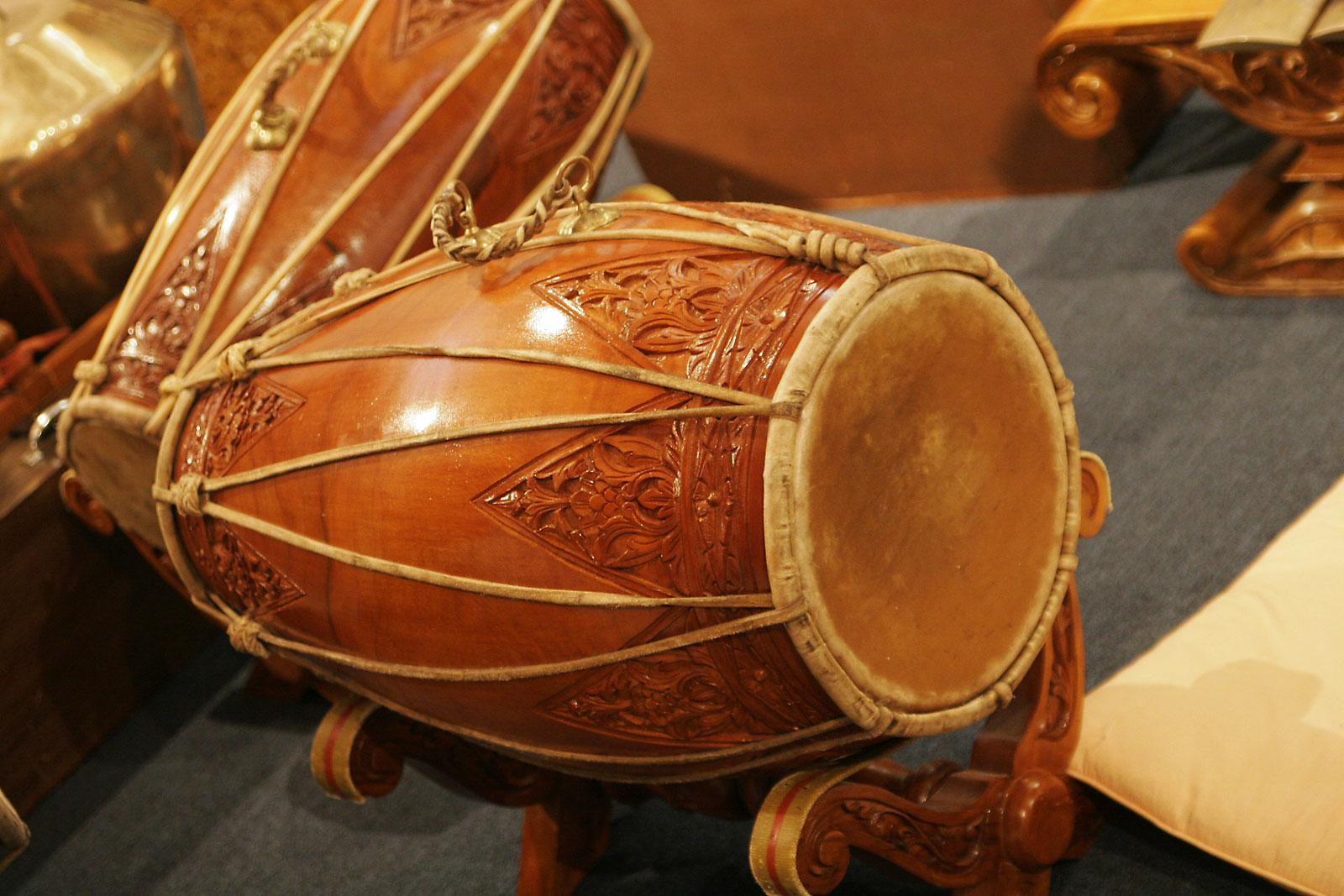
A kendang or gendang (Javanese: ꦏꦼꦤ꧀ꦝꦁ, romanized: kendhang, Sundanese: ᮊᮨᮔ᮪ᮓᮀ, romanized: kendang, Balinese: ᬓᬾᬦ᭄ᬤᬂ, romanized: kendang, Tausug/Bajau/Maranao: gandang, Bugis: gendrang and Makassar: gandrang or ganrang) is a two-headed drum used by people from the Indonesian Archipelago. The kendang is one of the primary instruments used in the gamelan ensembles of Javanese, Sundanese, and Balinese music. It is also used in various Kulintang ensembles in Indonesia, Brunei, Malaysia, Singapore, and the Philippines. It is constructed in a variety of ways by different ethnic groups. It is related to the Indian double-headed mridangam drum.

Overview

[edit]

The typical double-sided membrane drums are known throughout Maritime Southeast Asia and India. One of the oldest image of kendang can be found in ancient temples in Indonesia, especially the ninth century Borobudur and Prambanan temple.

Among the Javanese, Sundanese, and Balinese, the kendang has one side larger than the other, with the larger, lower-pitched side usually placed to the right, and the drums are usually placed on stands horizontally and hit with the hands on either side while seated on the floor. Amongst groups like the Balinese, Tausug, and Maranao, both sides are of equal size, and the drums are played on either one or both sides using a combination of hands and/or sticks.

In Gamelan music, the kendang is smaller than the bedug, which is placed inside a frame, hit with a beater, but used less frequently. The kendang usually has the function of keeping the tempo (laya) while changing the density (irama), and signaling some of the transitions (paralihan) to sections and the end of the piece (suwuk).

In the dance or wayang performance, the kendang player will follow the movements of the dancer, and communicate them to the other players in the ensemble. In West Java (Sundanese), kendang are used to keep the tempo of Gamelan Degung. Kendang are also used as main instrument for Jaipongan dances. In another composition called Rampak Kendang, a group of drummers play in harmony.

Among the Makassarese, the Ganrang (kendang) drums have much more importance, and they are considered the most sacred of all musical instruments, comparable to gongs in Java. This can be seen in local origin stories, accompaniments for local ceremonies, dances such as Ganrang Bulo, and martial arts. Even local government ceremonies are opened by the official sounding of a ganrang rather than the usual gong in Java. They are usually played alone with multiple drums playing different patterns creating syncopation. These traditions can be seen across lowland South Sulawesi with Bugis people also sharing similar reverence to the Gendrang.

Kendang making

[edit]

Good kendang instruments are said to be made from the wood of jackfruit, coconuts or cempedak. Buffalo hide is often used for the bam (inferior surface which emits low-pitch beats) while soft goatskin is used for the chang (superior surface which emits high-pitch beats).

The skin is stretched on y-shaped leather or rattan strings, which can be tightened to change the pitch of the heads. The thinner the leather the sharper the sound.

Accompaniments

[edit]

Javanese

[edit]

In Gamelan Reog, kendhang are used to accompany the Reog Ponorogo art, and the sound produced by Kendhang Reog is very distinctive with the beat of "dang thak dhak thung glhang". The existence of Kendang Reog is currently the largest in the world of the existing types of Kendhang.

In Gamelan Surakarta, four sizes of kendhang are used:[6]

  • Kendhang ageng, kendhang gede (krama/ngoko, similar to gong ageng in usage), or kendhang gendhing is the largest kendang, which usually has the deepest tone. It is played by itself in the kendhang satunggal (lit. "single drum") style, which is used for the most solemn or majestic pieces or parts of pieces. It is played with the kendhang ketipung for kendhang kalih (lit. "double drum") style, which is used in faster tempos and less solemn pieces.
  • Kendhang wayang is also medium-sized, and was traditionally used to accompany wayang performances, although now other drums can be used as well.
  • Kendhang batangan or kendhang ciblon[7] is a medium-sized drum, used for the most complex or lively rhythms. It is typically used for livelier sections within a piece. The word ciblon derives from a Javanese type of water-play, where people smack the water with different hand shapes to give different sounds and complex rhythms. The technique of this kendang, which is said to imitate the water-play,[8] is more difficult to learn than the other kendang styles.
  • Kendhang ketipung is the smallest kendang, used with the kendang ageng in kendhang kalih (double drum) style.

Sundanese

[edit]

In Sundanese Gamelan, a minimum set consists of three drums.[9]

  • Kendang Indung (large drum)
  • Kendang Kulanter, two (small drum). Kendang Kulanter is divided into two, namely the Katipung and the Kutiplak.

Many types of Sundanese Kendang are distinguished according to their function in accompaniment :

  • Kendang Kiliningan
  • Kendang Jaipongan
  • Kendang Ketuk Tilu
  • Kendang Keurseus
  • Kendang Penca
  • Kendang Bajidor
  • Kendang Sisingaan and others.

Each type of drums in Sundanese music has a difference in size, pattern, variety, and motif.

Balinese

[edit]

In Balinese Gamelan, there are two kendang:[10]

  • Kendang wadon, the "female" and lowest pitched.
  • Kendang lanang, the "male" and highest pitched.

Makassarese

[edit]

Ganrang (Makassarese kendangs) can be divided to three types:[11]

  • Ganrang Mangkasarak is the largest drums as a result it is also called Ganrang Lompo (largest drum in Makassarese language).These drums are usually used in important sacred ceremonies such as blessing for sultanate's heirlooms.
  • Ganrang Pakarena are usually smaller with diameters measuring in 30–40 cm, which are usually used for Pakarena dance, which used 2-4 drums with differing beats and symbolizes the men's strength and vitality.
  • Ganrang Pamancak are usually the smallest with diameters measuring in 20–25 cm, and used as martial arts accompaniments.

Buginese

[edit]

Among the Bugis Gendrang there are two types of playing techniques based on the position of the gendrang. if the gendrang is placed on the player's lap it is called mappalece gendrang. If the players are standing with the gendrangs tied with a shoulder strap it is called maggendrang tettong, this position are usually used for sacred ceremony, or for entertainment like beating of rice mortars or mappadendang. There are generally three types of beats pattern in gendrang playing:[12]

  • Pammulang patterns are usually the beginning as intro
  • Bali Sumange are played afterwards which are usually more energetic
  • Kanjara patterns are used afterward, as finale.
[edit]

See also

[edit]

Sources

[edit]
  1. ^ 10 Alat Musik Kendang: Asal-Usul, Jenis, dan Cara Memainkannya[1]
  2. ^ Kendang Sunda[2]
  3. ^ 1994[3]
  4. ^ "Kendang - Instruments of the world". www.instrumentsoftheworld.com.
  5. ^ Kartomi, Margaret J.; Heins, Ernst; Ornstein, Ruby (2001). "Kendang". Kendang. Grove Music Online. doi:10.1093/gmo/9781561592630.article.14877.
  6. ^ "Kendang".
  7. ^ https://omeka1.grinnell.edu/MusicalInstruments/exhibits/show/ens/item/82[dead link]
  8. ^ Lindsay, Jennifer (1992). Javanese Gamelan, p.22. ISBN 0-19-588582-1. "The technique of kendang ciblon is very difficult to acquire.[who?] Ciblon is the Javanese name for a type of water-play, popular in villages, where a group of people, through smacking the water with different hand-shapes, produce complex sounds and rhythmic patterns. These sounds are imitated on the dance drum."
  9. ^ Sunarto (2015). Kendang Sunda (in Indonesian). Penerbit Sunan Ambu Press, STSI Bandung. ISBN 978-979-8967-50-4.
  10. ^ "The Instruments for Gamelan Bali". Archived from the original on 2012-11-03. Retrieved 2019-10-20.
  11. ^ "Gandrang, Alat Musik Tradisional Makassar". 27 May 2015.
  12. ^ Rachmat, Rachmat; Sumaryanto, Totok; Sunarto, Sunarto (2020). "Klasifikasi Instrumen Gendang Bugis (Gendrang) Dalam Konteks Masyarakat Kabupaten Soppeng Sulawesi Selatan". Jurnal Pakarena. 3 (2): 40. doi:10.26858/p.v3i2.13064. S2CID 226030960.

Further reading

[edit]
[edit]
Revisions and contributorsEdit on WikipediaRead on Wikipedia
from Grokipedia
The kendang (also spelled kendhang or gendang) is a traditional two-headed drum central to the music of the Indonesian , particularly in Javanese and Balinese ensembles, where it serves as the primary rhythmic instrument played by hand to control , dynamics, and structural transitions. Typically constructed from a single piece of wood hollowed into an asymmetrical barrel or conical shape, it features heads of tanned buffalo or hide stretched over wooden or hoops and tensioned with laced rawhide in patterns such as a zigzag or "Y" configuration, allowing for tunable pitches between the larger bass head and smaller treble head. In Javanese gamelan, the kendang exists in several specialized forms, including the large kendhang gendhing or ageng for majestic orchestral pieces, the ciblon for lively dance accompaniments, the wayangan for shadow puppet theater (wayang kulit), and the smaller ketipung for faster tempos, often played in pairs by one or two musicians who improvise to guide the ensemble's irama (rhythmic density). The instrument's right head produces deeper tones struck with the full palm, while the left yields higher, sharper sounds via fingertips or knuckles, enabling expressive patterns that reflect emotional content in performances ranging from court rituals to contemporary concerts. Historically, depictions of kendang-like drums appear in 9th-century Borobudur temple reliefs and 14th-century Panataran temple carvings, with their integration into formalized gamelan ensembles traceable to the Mataram Kingdom (late 16th to mid-18th centuries), underscoring their enduring spiritual and cultural role as heirlooms (pusaka) in Indonesian society. Balinese variants of the kendang adapt to the island's dynamic gamelan styles, such as gong kebyar and angklung, where pairs of conical drums—the smaller kendang lanang (male, higher-pitched) and the larger kendang wadon (female, lower-pitched)—are struck with mallets on the bass head and hands on the treble to drive interlocking rhythms (metimpal) and explosive accents characteristic of ceremonial processions or modern theater. In these contexts, the kendang not only anchors the heterophonic texture but also facilitates improvisation, with drummers signaling cues to flutes, metallophones, and gongs, adapting from subdued ceremonial roles to vibrant leads in kebyar-influenced repertoire. Beyond gamelan, the kendang influences regional genres like Sundanese penca ensembles and popular dangdut music, highlighting its versatility across Indonesia's diverse ethnic traditions.

Introduction

Overview

The kendang, also known as gendang in regions such as , is a two-headed originating from the Indonesian Archipelago, constructed in asymmetrical barrel or conical shapes by various ethnic groups. It bears a relation to the ancient Indian double-headed , sharing structural and improvisational elements as a in percussion traditions. Physically, the kendang features two drumheads stretched over a wooden body, typically carved from wood with heads of tanned buffalo or hide, measuring 30–60 cm in length, with lacing systems such as hoops or rawhide that allow for tuning. It is played horizontally across the lap or vertically on a stand, using hands or mallets depending on the variant and context. In traditional ensembles, the kendang acts as the rhythmic core, directing and phrasing while serving as a timekeeper and leader for other musicians. It is essential in Javanese and Balinese orchestras, where it controls the temporal flow (irama).

Cultural Importance

The kendang holds a profound sacred status in Makassarese traditions of , where it is revered as the most important , often equated with bronze knobbed gongs in its spiritual potency and used to facilitate divine communication during . In performances like pakarena, a dance-drama, the kendang's pulsating rhythms create an exuberant sonic contrast to the restrained movements, symbolizing deeper cultural and spiritual dialogues that connect participants to ancestral and realms. This role underscores its function as a conduit for invoking higher powers in ceremonial contexts, reinforcing communal bonds with the divine. In Indonesian societies, particularly in , , and , the kendang influences social structures by serving as a vital element in communal events and festivals, where it leads ensembles to foster collective participation and ethnic identity. For instance, in Balinese temple odalan ceremonies and Javanese selamatan feasts, the kendang directs the and irama, enabling synchronized performances that strengthen community cohesion and express shared . In Sulawesi's Makassarese communities, its presence in cultural festivals like the annual Culture Week highlights ethnic pride and social unity, marking occasions that reaffirm group identity amid diverse influences. Symbolically, the kendang embodies balance and ancestral connections, most notably in Balinese through the wadon-lanang pair, where the lower-pitched wadon (female) and higher-pitched lanang (male) drums represent the duality of feminine and masculine energies essential for and creation. This pairing mirrors broader cosmological principles, linking performers to ancestral lineages by evoking the union that sustains both musical ensembles and societal continuity, as seen in ritual music that honors forebears. The kendang's impact extends across Southeast Asian , appearing as the gandang in ensembles of , , and the , where it provides rhythmic foundation for celebrations and rituals that preserve indigenous identities. In these traditions, the synchronizes gongs and other instruments during communal gatherings, symbolizing cultural resilience and regional interconnectedness in Austronesian heritage.

History and Origins

Ancient Depictions

The earliest archaeological evidence of kendang precursors appears in the 9th-century reliefs of , a in , where asymmetrical barrel-shaped drums are depicted among ensembles in ceremonial processions and ritual scenes. These carvings illustrate musicians playing double-headed drums alongside other instruments like flutes and lutes, suggesting their role in structured musical performances accompanying dances and worship activities. Similar drum depictions, including cylindrical and convex forms, are found in the contemporaneous Prambanan temple complex, a Hindu site nearby, where reliefs portray diverse percussion instruments integrated into narrative panels of epics and religious rites. Artifacts from the Hindu-Buddhist era (8th-10th centuries) in , such as those from and , link these early drums to Indian influences transmitted via maritime trade routes connecting the to . The double-headed drum design evident in the reliefs mirrors the ancient Indian , a barrel-shaped used in and rituals, indicating cultural exchange through merchants and missionaries who introduced Hindu and Buddhist practices. Iconographic analysis of these temple carvings reveals drums as central to ensemble music supporting dances, processions, and temple ceremonies, often held by figures in traditional attire, underscoring their symbolic importance in spiritual and communal events. Comparisons with ancient drums across , such as slit drums and hand-held membranophones in Khmer and Cham artifacts from the same period, highlight the kendang's indigenous evolution in while incorporating external inspirations from Indian models. These regional parallels confirm a shared tradition of percussion in ritual , adapted locally to fit Javanese precursors, as seen in the varied shapes and playing postures in Borobudur's Karmawibhangga panels. This blend of native innovation and imported elements establishes the kendang's foundational role in early Indonesian musical heritage.

Historical Development

The kendang's integration into Indonesian musical traditions accelerated during the 14th to 16th centuries with the expansion of Islamic sultanates in and , where it became a core element of court music ensembles. As spread through trade and conquest, pre-existing drum forms blended with orchestras in royal courts, such as those of Demak and Mataram in , adapting the kendang to accompany refined performances that balanced spiritual and secular themes. In , particularly among and communities under emerging Islamic rulers around the early 17th century, the kendang supported processional and ceremonial music, reflecting influences from Middle Eastern percussion while retaining local barrel-drum constructions. This period marked the kendang's shift from ritualistic uses to a directive role in layered textures, unifying melodic and rhythmic elements in palace settings. During the Dutch colonial era from the 17th to early 20th centuries, the kendang underwent adaptations in urban ensembles while facing suppression in certain ritual contexts due to colonial policies favoring economic exploitation over indigenous cultural practices. In , European drums and rhythms were occasionally incorporated into , creating hybrid forms like those in ronggeng , where the kendang provided rhythmic foundations amid Western influences such as diatonic scales and violins. Suppression occurred as Dutch authorities dismantled Javanese courts in the mid-19th century, relocating —including kendang—to village settings and limiting its use in anti-colonial rituals, though urban adaptations persisted in theaters and military bands. In and , Dutch preservation efforts post-1908 conquests allowed traditions to flourish in community clubs, mitigating some disruptions but fostering localized hybridizations. Key 19th-century ethnographies, such as those by Dutch scholars documenting Javanese music, first systematically recorded kendang patterns and tunings, laying groundwork for later studies. Following 's independence in , the kendang experienced a revival as part of broader cultural policies emphasizing national unity, with ensembles promoted through state institutions and exports symbolizing Indonesian identity. Conservatories like the Konservatori Karawitan Indonesia (established 1960) and Sekolah Tinggi Seni Indonesia (1967) integrated the kendang into formal curricula, standardizing its notation—such as the "notasi KOKAR" system—and teaching techniques via rote mnemonics and texts like Martopangrawit's Titilaras Kendangan (1972), which codified patterns for educational use. This era saw the kendang's role expand in national diplomacy, with sets exported to universities worldwide, reinforcing its status in post-colonial cultural revival. Building on ancient temple depictions as an early precursor, these developments ensured the kendang's enduring centrality in while adapting to modern contexts.

Construction

Materials

The body of a kendang drum is typically carved from a single block of dense, resonant wood to ensure optimal acoustic projection and structural integrity. Jackfruit wood (Artocarpus heterophyllus), known locally as nangka, is the most commonly used material due to its hardness, fine grain, and ability to produce a warm, sustained tone without excessive damping. Coconut wood (Cocos nucifera) and cempedak wood (Artocarpus integer) serve as alternatives in some traditions, valued for their similar density and availability in tropical regions, though jackfruit remains preferred in Javanese variants for its superior durability under repeated play. Regional preferences favor harder woods like jackfruit in Java to withstand the drum's asymmetrical, barrel-shaped form and the physical demands of performance. The drumheads, which determine the instrument's pitch and , are made from animal hides selected for their thickness and elasticity. The larger, low-pitched head (often called the bam) is covered with tanned buffalo hide ( bubalis), chosen for its thickness and lower that produces deep, booming tones essential for rhythmic foundation. In contrast, the smaller, high-pitched head (known as the chang) uses goatskin (Capra hircus), which is thinner and more responsive to tension, yielding sharp, articulate strikes suitable for melodic accents. Tuning elements consist of interlaced laces and rings that allow precise adjustment of head tension without disassembly. Traditional lacing employs rawhide thongs (janget) woven in a zigzag pattern around the body, often combined with hoops (blengker) to secure the heads, enabling pitch modulation by sliding small rawhide rings (suh) along the shell. In some variants, Y-shaped laces provide additional stability for the double-headed design. Sustainability practices emphasize local sourcing to preserve cultural authenticity, with woods harvested from managed tropical forests and hides obtained as byproducts of and . However, and ethical concerns over animal use have prompted modern adaptations, such as recycled PVC multiflex for bodies and synthetic heads, which offer weather resistance and reduce environmental impact while approximating traditional tones. These alternatives, including HDPE plastics, address scarcity issues but may produce a slightly muted compared to natural materials.

Assembly and Tuning

The assembly of a kendang begins with the selection and preparation of the wooden body, known as the ploncon. Artisans hand-carve and hollow out a solid block of wood, typically , to form an asymmetrical, bulging-conical or barrel-shaped shell that tapers toward one end. This process requires precise craftsmanship to achieve the desired and durability, with the interior hollowed to a thickness that allows for clear, projecting tones when played by hand. Once the shell is shaped, the drumheads, or tebokan, made from tanned animal hides—typically buffalo for the larger head and for the smaller—are prepared and attached. Each head is stretched taut over a hoop, called a blengker or wengku, with a slightly larger than the corresponding shell opening, or . The hoops are then positioned over the ends of the shell, and connected using a long rawhide lace, or janget, threaded in a pattern that makes approximately 10 passes between the two hoops. This lacing forms a characteristic repeating "Y" pattern, securing the heads without the use of glue in traditional constructions, and incorporates small rawhide rings known as suh positioned along the laces near the smaller head. Tuning the kendang involves adjusting the tension of the heads to produce distinct pitches and timbres, essential for its role in guiding ensemble rhythms. The primary method is mechanical: the suh rings are slid up or down the length of the shell, which tightens or loosens the lacing system, thereby altering the overall tension and pitch of the heads—the larger head typically tuned lower for bass tones and the smaller one higher for sharper accents. This indirect lacing allows performers or makers to fine-tune the drum on the fly, ensuring balanced resonance between the heads and harmony with the gamelan ensemble. Artisans in workshops test the assembled drum through hand-playing to verify even response and durability, with lacing techniques often transmitted orally across generations to maintain consistent quality.

Playing Techniques

Basic Methods

The kendang is played by seated performers who adopt a cross-legged posture known as sila to ensure stability and comfort during extended sessions. In the Javanese tradition, the asymmetrical drum is positioned horizontally on a low wooden stand, with the larger head oriented to the right and the smaller head to the left, allowing access by both hands without excessive reaching. In contrast, Balinese players hold the drum vertically on their lap, facilitating a more upright striking motion that suits the interlocking rhythms of their ensembles. While bare hands are the primary striking tools across traditions, padded sticks called panggul may be used in certain Balinese or Sundanese contexts for varied articulation, though hand techniques predominate to achieve nuanced tones. Basic strokes emphasize differentiation between the heads to produce core : the low bass tone, often rendered as "thung" or "dhah," results from open palm or strikes on the center or edge of the larger head using the right hand, creating a resonant boom. The higher treble tone, such as "tong" or "tak," is generated by slaps or closed palm hits on the smaller head with the left hand, producing sharper, muted accents; edge strikes with add crisp emphasis for rhythmic . These techniques rely on precise hand positioning—fingers slightly curved and wrists relaxed—to generate without unintended , while is modulated by strike force, from soft touches for subtle cues to forceful slaps for dynamic peaks. For beginners, ergonomic considerations are essential to prevent : hands should strike to the head surface with even pressure, avoiding locked elbows or overextended wrists, and the cross-legged sila posture promotes balanced weight distribution on the stand or lap. Maintaining basic involves steady, alternating strokes between heads to establish irama (temporal flow), starting slow to build coordination before integrating into timing.

Specialized Patterns

Specialized patterns in kendang performance extend beyond foundational strikes to incorporate complex rhythmic structures that enhance the ensemble's texture and drive. rhythms, often executed between paired , create intricate polyrhythmic layers by weaving complementary motifs that fit precisely together, such as in the combinatorial use of formulas across irama levels. These patterns are modulated through irama cycles, where the kendang player adjusts rhythmic density—ranging from fast (irama I) to slower subdivisions (irama II and beyond)—to propel the music's temporal framework while maintaining proportional relationships like 2:1 ratios in cycles. Additionally, rolls involve rapid successive strikes on the drumheads to build tension, while mutes—achieved by pressing the skin to dampen —allow for sharp accents and dynamic contrasts, enabling expressive variations in volume and . Improvisational elements form a core of advanced kendang technique, emphasizing interaction and adaptability within the . Call-and-response exchanges occur between the lead and supporting kendang, where one initiates a motif and the other replies with or syncopated counters, fostering a flow that mirrors cohesion. Tempo modulation, known as laya, is controlled by the kendang through subtle accelerations or decelerations, often cued by melodic phrases or performer signals, to heighten emotional intensity without disrupting the overall . These improvisations draw from pre-composed patterns but allow spontaneous elaboration, requiring keen to balance with structural . Kendang patterns are primarily transmitted orally rather than through written scores, relying on mnemonic syllables to encode and recall . Common syllables include "dhung" for a deep bass hit on the large head, "" for a sharp slap on the small head, "pak" for a muted press, and variations like "tung" or "dong" for open tones, which vocalize the drum's timbres and rhythms during . This system facilitates precise replication and variation, as players internalize sequences through repetition and auditory memory, adapting them fluidly in performance. Training for specialized kendang patterns typically occurs through in schools or under master teachers, emphasizing endurance for sustained playing and precision in timing. Students progress from basic coordination to mastering improvisational interplay, often in institutional programs that blend traditional with structured practice on ensemble cues. This hands-on approach cultivates the physical stamina and musical needed for dynamic expression in live settings.

Regional Variations

Javanese Kendang

The Javanese kendang, central to the ensembles of , features a barrel-shaped body carved from a single piece of wood, with two heads of unequal size covered in or buffalo skin, allowing for distinct pitches on each side. The larger head produces a deeper tone, while the smaller head yields a higher pitch, and both are tuned to specific notes within the (five-tone) or (seven-tone) scales of the , enabling subtle pitch variations through hand pressure during play. These are often used in sets of two or three, with the primary kendang directing the ensemble's and the secondary providing complementary patterns. Javanese kendang vary in size and function to suit different performance contexts, emphasizing the meditative and refined qualities of courtly music. The largest type, kendhang ageng (or gendhing), is employed in full orchestras for majestic pieces with expansive cycles. The medium-sized kendhang wayangan is specialized for shadow puppetry, providing rhythmic cues that align with narrative pacing. For dance accompaniments, the batangan or ciblon delivers lively yet controlled rhythms to mirror performers' movements. The smallest, ketipung, pairs with larger drums to articulate shorter cycles, enhancing textural depth without overpowering the ensemble. In performance, the Javanese kendang is positioned horizontally on a cushioned stand, played solely with the hands—the right hand striking the larger head for bass tones and the left handling the smaller for treble accents—to produce soft, nuanced dynamics that foster the introspective atmosphere of music. This hand-only technique allows for precise control over volume and , from gentle taps to restrained slaps, supporting the ensemble's irama (temporal density) and signaling shifts between soft (lancaran) and more animated sections. Unlike more forceful regional variants, the Javanese style prioritizes subtlety, integrating seamlessly with the colotomic framework where gongs and metallophones mark cycles, and the kendang subtly reinforces these structures to maintain harmonic equilibrium in or tunings.

Sundanese Kendang

The Sundanese kendang serves as a vital rhythmic foundation in West Java's traditional music, particularly within ensembles supporting vibrant dance traditions such as and ketuk tilu. Unlike more restrained styles in other Indonesian regions, the Sundanese variant emphasizes energetic propulsion, with drummers employing dynamic patterns to drive performances that encourage audience participation and . These drums regulate and rhythm, allowing for fluid adaptation to dancers' movements and fostering a lively, interactive atmosphere characteristic of Sundanese . In terms of types, the typically features the indung, the largest known as the "," which provides the foundational bass tones, paired with one or more kulanter, smaller "" that deliver higher-pitched accents. Sets for and ketuk tilu require at least three , often expanding to four or five in fuller configurations to layer rhythmic complexity, with the indung anchoring the group while kulanter add agility. This multi- setup distinguishes Sundanese practices from simpler pairings elsewhere, enabling richer polyrhythms essential to accompaniment. The design of the Sundanese kendang reflects its role in high-energy settings, featuring a cylindrical wooden body—often crafted from or wood—for optimal resonance, topped and bottomed with animal skin heads, predominantly goatskin or buffalo calfskin, stretched and tuned using ropes and laces. These heads are tensioned to produce louder, brighter tones aligned with pentatonic scales, such as la and da, which project clearly in open performance spaces and support the faster tempos of music. The perforated middle of the wooden shell enhances projection, making the instrument well-suited to the percussive demands of communal dances. Playing techniques prioritize expressiveness, with the drums positioned horizontally, lying straight from left to right for balanced access by the performer seated . Drummers primarily use open palms and middle fingers for and slapping to generate a range of tones, though sticks may assist on the indung and right-side kulanter for sharper attacks in certain styles, while the left kulanter relies on hand slaps for nuanced variation. Central to the style is an emphasis on —through patterns like tepak cycles that offbeat accents build tension—and , where the pengendang (drummer) responds in real-time to dancers, incorporating spontaneous elements to heighten engagement and maintain the music's pulsating drive in performances.

Balinese Kendang

In Balinese traditions, the kendang consists of two paired known as the wadon (female), which is larger and produces a lower pitch, and the lanang (male), which is smaller and higher-pitched, creating a contrasting timbral and rhythmic interplay essential to the ensemble's sound. These double-headed barrel-shaped are constructed to support explosive dynamic shifts, with the lanang often leading transitions in and intensity. The pairing embodies a symbolic duality, reflecting broader Balinese cultural concepts of balance and complementarity in performance. The wadon and lanang are typically held horizontally across the player's lap while seated, allowing for intricate hand and stick techniques that drive the 's momentum. The right hand strikes the larger head with a wooden called a panggul for resonant tones, while the left hand uses the palm or fingers on the smaller head to produce slaps and mutes, enabling a wide range of timbres and syncopated accents. In the dynamic style of gong kebyar, players execute rapid interlocking patterns between the two drums, emphasizing acceleration (kokar) to build tension and abrupt stops to punctuate phrases, which heighten the ensemble's dramatic expression. This rhythmic leadership from the kendang pair not only structures the but also cues dancers and other musicians in ceremonial contexts.

Other Traditions

In Makassarese traditions of , the ganrang represents a key variant of the kendang, characterized by its conical or cylindrical body, double-headed construction with goat hide membranes (thicker on the larger end and thinner on the smaller paja end), and tuning via metal strips or ligatures inserted between the heads. These drums are struck with a buffalo-horn beater (bakbalak) on the ulu head and fingers or palm on the paja for varied tones, and their spiritual potency is enhanced by ritually charged woods like cempaka and accompanying objects (syarak-syarak). Three primary types exist: the largest ganrang mangkasarak (also called ganrang lompo, with lengths exceeding 80 cm), used in ceremonial contexts such as royal regalia blessings and staged events like the "Bunting Mangkasara" representation; the medium-sized ganrang pakarena (diameter approximately 30-40 cm), which accompanies the pakarena dance with complex patterns like tunrung pappadang; and the smallest ganrang pamancak (diameter approximately 20-25 cm), employed for (akmancak) and war depictions, including performances evoking historical battles against the Dutch. Sacred ganrang, particularly the mangkasarak type, carry ritual taboos, such as prohibitions against stepping on the or allowing impurity during handling, underscoring their role in invoking spiritual power. Among the of , the gendrang (a local kendang form) features a cylindrical wooden body (60-70 cm long, often from or ) with or deer skin heads and a resonance hole, played using a wooden striker (patette) made from guava or similar. Two main techniques prevail: mappalece, where the player sits with the drum on their lap and strokes the membranes to "unify" body and instrument in a dialogic manner before striking; and maggendrang tettong, performed standing with the drum slung over the shoulder via a strap, common in dynamic settings. Characteristic patterns include pammulang (a slow introductory motif, notated as sequences like TTTTDT or TDTDTDT where T denotes a high tone and D a low); bali sumange (medium-tempo and energizing, e.g., TDTTDTD); and kanjara (fast and climactic, repeating TDTDTDT). Both Makassarese ganrang and Bugis gendrang feature prominently in shared Sulawesi rituals, such as bissu ceremonies led by transvestite shamans for life-cycle events like weddings, circumcisions, and healings, where multiple drums create polyrhythms to induce or invoke protection. They also accompany ship-launching rites, linking to maritime traditions akin to boat races in the . In contrast to the hourglass-shaped central Javanese kendang, these Sulawesi forms emphasize conical designs and ensemble roles in ritual potency. Further afield in the , underdeveloped traditions among the Tausug and Maranao incorporate the gandang—a two-headed cylindrical resembling the kendang—into ensembles for rhythmic foundation in melodic and ceremonial music.

Role in Performances

In Ensembles

In ensembles, the kendang serves as the primary rhythmic leader, coordinating the overall temporal structure and ensuring cohesive performance among the instruments. It regulates , known as laya, through variations in stroke density, typically divided into slow (andeg), medium (madu), and fast (cepat) settings, which guide the ensemble's pace without rigid metronomic precision. This control allows the kendang player to adapt the music's flow dynamically, influencing the speed at which other instruments, such as metallophones and gongs, articulate their parts. Beyond tempo, the kendang adjusts musical density, or irama, by layering rhythmic patterns that either thicken or thin the ensemble's texture. In slower laya settings, sparser strokes create a more expansive feel, while denser patterns in faster s intensify the sonic layering, allowing the ensemble to shift between sparse and intricate sections seamlessly. This manipulation of irama interacts closely with the cyclical framework of , where the kendang's rhythms interlock with the pulsating beats of instruments like the kempul and kenong to maintain structural integrity. The kendang also fulfills essential signaling functions, providing cues for section changes, instrument entrances, and the progression of gong cycles within the slendro or pelog tuning systems. These cues, often delivered through distinctive stroke combinations on the drumheads, alert players to transitions, such as the arrival of the large gong (gong ageng) that marks the end of a gongan cycle, ensuring synchronized phrasing across the ensemble. Interaction between the kendang and other instruments is bidirectional and integral to gamelan's improvisational nature. The kendang leads the s—such as and —by setting rhythmic foundations that these instruments elaborate upon, while responding to melodic cues from the (a smaller ) or the (a spiked ), which provide elaborative lines influencing shifts. This dialogue allows the kendang to anticipate and reinforce melodic developments, fostering a responsive dynamic where rhythmic leadership supports harmonic and melodic progression. Regional variations, such as in Javanese versus Balinese , may alter cue styles, but the core coordinative role remains consistent.

In Dance and Theater

In performances, the kendang provides subtle rhythmic accompaniment that mirrors the actions of the shadow puppets, with the drummer observing the screen to synchronize beats with movements such as battles or processions using specific patterns like those in gending Srepegan or Sampak. Pauses in the drumming occur when the dalang signals a diminuendo through percussive cues on the kotak, reducing the ensemble's volume to allow and to take precedence during key narrative moments. This integration supports the dramatic flow while maintaining coordination within the ensemble. The kendang synchronizes closely with dancers' footwork in forms like and , delivering rhythmic cues that align with steps and transitions; for instance, in , patterns such as Bongbang or Oray Welang match the intricate foot movements, while accents from tepak like Mincid Keureup emphasize turns and poses to heighten the performance's dynamic energy. In , the kendang follows the dancers' graceful gestures and poses, using varied stroke intensities to underscore expressive turns and maintain precise timing. In Balinese theater such as arja opera, the kendang drives the plot's through interlocking patterns that shape the narrative pacing, accelerating or decelerating to reflect scene developments. Specific drumming signals cue character entrances, ensuring seamless transitions that advance the story and engage the audience with the unfolding drama. Expressive techniques on the kendang include dynamic swells achieved through varying stroke volumes and speeds, building intensity to mark emotional peaks in dance-drama sequences, as seen in irama changes that heighten dramatic tension. Muted hand placements on the drumheads create subdued tones for moments of , particularly in ritual-infused theater where they evoke underlying tension before climactic releases.

Modern Developments

Contemporary Uses

In contemporary Indonesian music, the kendang has been integrated into fusion genres that blend traditional rhythms with modern styles, particularly since the late . In , a popular genre combining Malay, Indian, and influences with Indonesian elements, the kendang provides driving percussion patterns essential to its energetic beats, as seen in numerous recordings and live performances. Similarly, experimental composers like Slamet Abdul Sjukur, active from the 1980s, explored concepts like "" to maximize minimal traditional motifs in works. Groups like Krakatau have further fused kendang with and Western instruments, creating hybrid ensembles that highlight its rhythmic versatility in pop contexts. Preservation efforts for the kendang are supported through and institutional recognition, ensuring its transmission to younger generations. The 2021 UNESCO inscription of —encompassing the kendang as a core instrument—on the Representative List of the of Humanity has emphasized its role in Indonesian identity, promoting formal and programs that pass down playing techniques and construction methods. In schools across , such as , ensembles including kendang instruction are integrated into music curricula to foster cultural awareness and skill development. Artisan workshops, often family-run in regions like and , provide hands-on training for crafting kendang, combining traditional and skinning with modern business skills to sustain the craft. Technological adaptations have enabled the kendang's use in urban settings, where amplification enhances its projection during large-scale performances in cities like and . Synthetic drum heads, made from materials like , are increasingly employed on kendang to improve against and frequent play, offering consistent tension without the maintenance issues of traditional animal skins. Urbanization presents challenges to traditional kendang makers, including raw material shortages and economic pressures from competing modern industries, which have reduced the number of full-time artisans in rural areas. Countering this, cultural festivals and national events, such as performances during Independence Day celebrations and regional arts gatherings like those for Reyog Kendang in Tulungagung, showcase the instrument and attract tourism, helping to revitalize interest and support local craftsmen.

Global Influence

The kendang has been integral to Indonesian diaspora communities abroad, particularly within ensembles formed by migrant groups and academic institutions in the United States and since the . In the US, university programs played a pioneering role, with early efforts at the (UCLA) in the late 1950s evolving into broader initiatives by the that incorporated kendang as a core rhythmic element in Javanese and Balinese performances. Groups like Gamelan Sekar Jaya, established in 1978 in the by Indonesian expatriates and local enthusiasts, continue to feature kendang in public concerts and cultural preservation efforts, blending traditional techniques with community outreach. In , similar ensembles emerged through university ties, such as at , where kendang instruction supports intercultural music studies involving musicians. Beyond diaspora settings, the kendang has influenced fusions, appearing in collaborations between Indonesian traditions and Western artists. The , for instance, partnered with the Balinese-American ensemble Galak Tika in 2010 for a premiere at , integrating kendang rhythms into experimental compositions that combined textures with percussion, including electronic adaptations via the Gamelan Elektrika project. This collaboration highlighted the kendang's adaptability, with its interlocking beats providing a rhythmic foundation for hybrid pieces performed globally. Electronic have further extended its reach, as seen in projects like house-infused tracks sampling kendang patterns, such as "House Kendang Kempul," which merge Southeast Asian drumming with contemporary dance music genres. Academic study of the kendang has grown within , focusing on its technical and cultural roles in global contexts. Researchers at institutions like UCLA's Archive have documented kendang variants through photographic and audio collections, analyzing their construction and performance practices in transplanted traditions. Museum collections worldwide preserve examples, such as the Metropolitan Museum of Art's Gendang—a close Bornean relative of the kendang—crafted from wood and in the late , which illustrates regional adaptations now studied for cross-cultural influences. These efforts underscore the instrument's migration and evolution outside . Despite these developments, gaps persist in documentation, particularly for Philippine variants like the Tausug gandang, a double-headed used in kulintangan ensembles among the Tausug of , where detailed ethnomusicological records remain sparse compared to Indonesian traditions. This limited coverage points to untapped potential for further research into the kendang's broader Austronesian dispersal.

References

Add your contribution
Related Hubs
User Avatar
No comments yet.