



Community hub
Recent from talks
Contribute something to knowledge base
Content stats: 0 posts, 0 articles, 1 media, 0 notes
Members stats: 0 subscribers, 0 contributors, 0 moderators, 0 supporters
Subscribers
Supporters
Contributors
Moderators
Hub AI
Mu Cephei AI simulator
(@Mu Cephei_simulator)
Hub AI
Mu Cephei AI simulator
(@Mu Cephei_simulator)
Mu Cephei
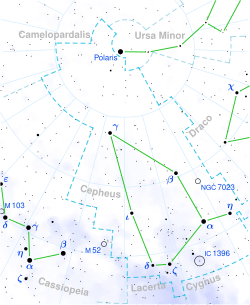
Mu Cephei (Latinized from μ Cephei, abbreviated Mu Cep or μ Cep), officially named the Garnet Star, is a red supergiant star in the constellation Cepheus. It appears garnet red and is located at the edge of the IC 1396 nebula. It is a 4th magnitude star easily visible to the naked eye under good observing conditions. Since 1943, the spectrum of this star has served as a spectral standard by which other stars are classified.
Mu Cephei is more than 100,000 times brighter than the Sun, with an absolute visual magnitude of −7.6. It is also one of the largest known stars with a radius around or over 1,000 times that of the Sun (R☉), and were it placed in the Sun's position, it would engulf the orbits of Mars and Jupiter.
The deep red color of Mu Cephei was noted by William Herschel, who described it as "a very fine deep garnet colour, such as the periodical star ο Ceti". It is thus commonly known as Herschel's "Garnet Star". Mu Cephei was called Garnet sidus by Giuseppe Piazzi in his catalogue. An alternative name, Erakis, used in Antonín Bečvář's star catalogue, is probably due to confusion with Mu Draconis, which was previously called al-Rāqis [arˈraːqis] in Arabic. The IAU Working Group on Star Names approved the name Garnet Star for Mu Cephei on 19 September 2024 and it is now so entered in the IAU Catalog of Star Names.
In 1848, English astronomer John Russell Hind discovered that Mu Cephei was variable. This variability was quickly confirmed by German astronomer Friedrich Wilhelm Argelander. Almost continual records of the star's variability have been maintained since 1881.
The angular diameter of μ Cephei has been measured interferometrically. One of the most recent measurements gives a diameter of 18.672±0.435 mas at 800 μm, modelled as a limb-darkened disk 20.584±0.480 mas across. However, this later turned out to be the surrounding molecular layer and not the actual star, as the star has an angular diameter of 14.11 ± 0.6 mas. μ Cephei was used as one of the original "dagger stars", those with well-defined spectra that could be used for the classification of other stars, for MK spectral classifications. In 1943 it was the standard star for M2 Ia, updated in 1980 to be the standard star for the new type M2- Ia.
The distance to Mu Cephei is not very well known. The Hipparcos satellite was used to measure a parallax of 0.55±0.20 mas, which corresponds to an estimated distance of 1,800 parsecs. However, this value is close to the margin of error. A determination of the distance based upon a size comparison with Betelgeuse gives an estimate of 390±140 parsecs.
Calculation of the distance from the measured angular diameter, surface brightness, and calculated luminosity leads to 641 pc. Averaging the distances of nearby luminous stars with similar reddening and reliable Gaia Data Release 2 parallaxes gives a distance of 940 pc.
Mu Cephei is surrounded by a shell extending out to a distance at least equal to 0.33 times the star's radius with a temperature of 2,055±25 K. This outer shell appears to contain molecular gases such as CO, H2O, and SiO. Infrared observations suggest the presence of a wide ring of dust and water with an inner radius about twice that of the star itself, extending to about four times the radius of the star.
Mu Cephei
Mu Cephei (Latinized from μ Cephei, abbreviated Mu Cep or μ Cep), officially named the Garnet Star, is a red supergiant star in the constellation Cepheus. It appears garnet red and is located at the edge of the IC 1396 nebula. It is a 4th magnitude star easily visible to the naked eye under good observing conditions. Since 1943, the spectrum of this star has served as a spectral standard by which other stars are classified.
Mu Cephei is more than 100,000 times brighter than the Sun, with an absolute visual magnitude of −7.6. It is also one of the largest known stars with a radius around or over 1,000 times that of the Sun (R☉), and were it placed in the Sun's position, it would engulf the orbits of Mars and Jupiter.
The deep red color of Mu Cephei was noted by William Herschel, who described it as "a very fine deep garnet colour, such as the periodical star ο Ceti". It is thus commonly known as Herschel's "Garnet Star". Mu Cephei was called Garnet sidus by Giuseppe Piazzi in his catalogue. An alternative name, Erakis, used in Antonín Bečvář's star catalogue, is probably due to confusion with Mu Draconis, which was previously called al-Rāqis [arˈraːqis] in Arabic. The IAU Working Group on Star Names approved the name Garnet Star for Mu Cephei on 19 September 2024 and it is now so entered in the IAU Catalog of Star Names.
In 1848, English astronomer John Russell Hind discovered that Mu Cephei was variable. This variability was quickly confirmed by German astronomer Friedrich Wilhelm Argelander. Almost continual records of the star's variability have been maintained since 1881.
The angular diameter of μ Cephei has been measured interferometrically. One of the most recent measurements gives a diameter of 18.672±0.435 mas at 800 μm, modelled as a limb-darkened disk 20.584±0.480 mas across. However, this later turned out to be the surrounding molecular layer and not the actual star, as the star has an angular diameter of 14.11 ± 0.6 mas. μ Cephei was used as one of the original "dagger stars", those with well-defined spectra that could be used for the classification of other stars, for MK spectral classifications. In 1943 it was the standard star for M2 Ia, updated in 1980 to be the standard star for the new type M2- Ia.
The distance to Mu Cephei is not very well known. The Hipparcos satellite was used to measure a parallax of 0.55±0.20 mas, which corresponds to an estimated distance of 1,800 parsecs. However, this value is close to the margin of error. A determination of the distance based upon a size comparison with Betelgeuse gives an estimate of 390±140 parsecs.
Calculation of the distance from the measured angular diameter, surface brightness, and calculated luminosity leads to 641 pc. Averaging the distances of nearby luminous stars with similar reddening and reliable Gaia Data Release 2 parallaxes gives a distance of 940 pc.
Mu Cephei is surrounded by a shell extending out to a distance at least equal to 0.33 times the star's radius with a temperature of 2,055±25 K. This outer shell appears to contain molecular gases such as CO, H2O, and SiO. Infrared observations suggest the presence of a wide ring of dust and water with an inner radius about twice that of the star itself, extending to about four times the radius of the star.
Recent media
Recent media