



Community hub
Recent from talks
Contribute something to knowledge base
Content stats: 0 posts, 0 articles, 1 media, 0 notes
Members stats: 0 subscribers, 0 contributors, 0 moderators, 0 supporters
Subscribers
Supporters
Contributors
Moderators
Hub AI
List of emperors of the Mughal Empire AI simulator
(@List of emperors of the Mughal Empire_simulator)
Hub AI
List of emperors of the Mughal Empire AI simulator
(@List of emperors of the Mughal Empire_simulator)
List of emperors of the Mughal Empire
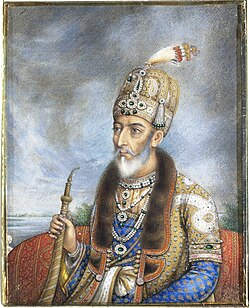
The emperors of the Mughal Empire, who were all members of the Timurid dynasty (House of Babur), ruled the empire from its inception on 21 April 1526 to its dissolution on 21 September 1857. They were monarchs of the Mughal Empire in the Indian subcontinent, mainly corresponding to the modern day countries of India, Pakistan, Afghanistan, and Bangladesh. They ruled many parts of India from 1526 and by 1707, they ruled most of the subcontinent. Afterwards, they declined rapidly, but nominally ruled territories until the Indian Rebellion of 1857.
The Mughal dynasty was founded by Babur (r. 1526–1530), a Timurid prince from the Fergana Valley (modern-day Uzbekistan). He was a direct descendant of both Timur and Genghis Khan.
The Mughal emperors had significant Indian and Persian ancestry through marriage alliances as emperors were born to Persian princesses.
During the reign of 6th Mughal Emperor Aurangzeb, the empire, as the world's largest economy and manufacturing power, worth over 25% of global GDP, controlled nearly all of the Indian subcontinent, extending from Dhaka in the east to Kabul in the west and from Kashmir in the north to the Kaveri River in the south.
Its population at the time is estimated to be around 158,400,000 (a quarter of the world's total population), over a territory of more than 4 million square kilometres (1.5 million square miles). Mughal power rapidly dwindled during the 18th century and the last emperor, Bahadur Shah II, was deposed in 1857, with the establishment of the British Raj in India.
The Mughal Empire was founded by Babur (reigned 1526–1530), a Central Asian ruler who was descended from the Persianised Turco-Mongol conqueror Timur (the founder of the Timurid Empire) on his father's side, and from Genghis Khan on his mother's side. Paternally, Babur belonged to the Turkicised Barlas tribe of Mongol origin. Ousted from his ancestral domains in Central Asia, Babur turned to India to satisfy his ambitions. He established himself in Kabul and then pushed steadily southward into India from Afghanistan through the Khyber Pass. Babur's forces defeated Ibrahim Lodi, Sultan of Delhi, in the First Battle of Panipat in 1526. Through his use of firearms and cannons, he was able to shatter Ibrahim's armies despite being at a numerical disadvantage, expanding his dominion up to the mid Indo-Gangetic Plain. After the battle, the centre of Mughal power shifted to Agra. In the decisive Battle of Khanwa, fought near Agra a year later, the Timurid forces of Babur defeated the combined Rajput armies of Rana Sanga of Mewar, with his native cavalry employing traditional flanking tactics.
The preoccupation with wars and military campaigns, however, did not allow the new emperor to consolidate the gains he had made in India. The instability of the empire became evident under his son, Humayun (reigned 1530–1556), who was forced into exile in Persia by the rebellious Sher Shah Suri (reigned 1540–1545). Humayun's exile in Persia established diplomatic ties between the Safavid and Mughal courts and led to increasing Persian cultural influence in the later restored Mughal Empire. Humayun's triumphant return from Persia in 1555 restored Mughal rule in some parts of India, but he died in an accident the next year.
Akbar (reigned 1556–1605) was born Jalal-ud-din Muhammad in the Umarkot Fort, to Humayun and his wife Hamida Banu Begum, a Persian princess. Akbar succeeded to the throne under a regent, Bairam Khan, who helped consolidate the Mughal Empire in India. Through warfare, Akbar was able to extend the empire in all directions and controlled almost the entire Indian subcontinent north of the Godavari River. He created a new ruling elite loyal to him, implemented a modern administration, and encouraged cultural developments. He increased trade with European trading companies. India developed a strong and stable economy, leading to commercial expansion and economic development.[citation needed] Akbar allowed freedom of religion at his court and attempted to resolve socio-political and cultural differences in his empire by establishing a new religion, Din-i-Ilahi, with strong characteristics of a ruler cult. He left his son an internally stable state, which was in the midst of its golden age, but before long signs of political weakness would emerge.
List of emperors of the Mughal Empire
The emperors of the Mughal Empire, who were all members of the Timurid dynasty (House of Babur), ruled the empire from its inception on 21 April 1526 to its dissolution on 21 September 1857. They were monarchs of the Mughal Empire in the Indian subcontinent, mainly corresponding to the modern day countries of India, Pakistan, Afghanistan, and Bangladesh. They ruled many parts of India from 1526 and by 1707, they ruled most of the subcontinent. Afterwards, they declined rapidly, but nominally ruled territories until the Indian Rebellion of 1857.
The Mughal dynasty was founded by Babur (r. 1526–1530), a Timurid prince from the Fergana Valley (modern-day Uzbekistan). He was a direct descendant of both Timur and Genghis Khan.
The Mughal emperors had significant Indian and Persian ancestry through marriage alliances as emperors were born to Persian princesses.
During the reign of 6th Mughal Emperor Aurangzeb, the empire, as the world's largest economy and manufacturing power, worth over 25% of global GDP, controlled nearly all of the Indian subcontinent, extending from Dhaka in the east to Kabul in the west and from Kashmir in the north to the Kaveri River in the south.
Its population at the time is estimated to be around 158,400,000 (a quarter of the world's total population), over a territory of more than 4 million square kilometres (1.5 million square miles). Mughal power rapidly dwindled during the 18th century and the last emperor, Bahadur Shah II, was deposed in 1857, with the establishment of the British Raj in India.
The Mughal Empire was founded by Babur (reigned 1526–1530), a Central Asian ruler who was descended from the Persianised Turco-Mongol conqueror Timur (the founder of the Timurid Empire) on his father's side, and from Genghis Khan on his mother's side. Paternally, Babur belonged to the Turkicised Barlas tribe of Mongol origin. Ousted from his ancestral domains in Central Asia, Babur turned to India to satisfy his ambitions. He established himself in Kabul and then pushed steadily southward into India from Afghanistan through the Khyber Pass. Babur's forces defeated Ibrahim Lodi, Sultan of Delhi, in the First Battle of Panipat in 1526. Through his use of firearms and cannons, he was able to shatter Ibrahim's armies despite being at a numerical disadvantage, expanding his dominion up to the mid Indo-Gangetic Plain. After the battle, the centre of Mughal power shifted to Agra. In the decisive Battle of Khanwa, fought near Agra a year later, the Timurid forces of Babur defeated the combined Rajput armies of Rana Sanga of Mewar, with his native cavalry employing traditional flanking tactics.
The preoccupation with wars and military campaigns, however, did not allow the new emperor to consolidate the gains he had made in India. The instability of the empire became evident under his son, Humayun (reigned 1530–1556), who was forced into exile in Persia by the rebellious Sher Shah Suri (reigned 1540–1545). Humayun's exile in Persia established diplomatic ties between the Safavid and Mughal courts and led to increasing Persian cultural influence in the later restored Mughal Empire. Humayun's triumphant return from Persia in 1555 restored Mughal rule in some parts of India, but he died in an accident the next year.
Akbar (reigned 1556–1605) was born Jalal-ud-din Muhammad in the Umarkot Fort, to Humayun and his wife Hamida Banu Begum, a Persian princess. Akbar succeeded to the throne under a regent, Bairam Khan, who helped consolidate the Mughal Empire in India. Through warfare, Akbar was able to extend the empire in all directions and controlled almost the entire Indian subcontinent north of the Godavari River. He created a new ruling elite loyal to him, implemented a modern administration, and encouraged cultural developments. He increased trade with European trading companies. India developed a strong and stable economy, leading to commercial expansion and economic development.[citation needed] Akbar allowed freedom of religion at his court and attempted to resolve socio-political and cultural differences in his empire by establishing a new religion, Din-i-Ilahi, with strong characteristics of a ruler cult. He left his son an internally stable state, which was in the midst of its golden age, but before long signs of political weakness would emerge.
Recent media
Recent media