Hubbry Logo
Multiple edgesMultiple edgesMain
Open search
Multiple edges
Community hub
Multiple edges
logo
8 pages, 0 posts
0 subscribers
Be the first to start a discussion here.
Multiple edges
Multiple edges
from Wikipedia
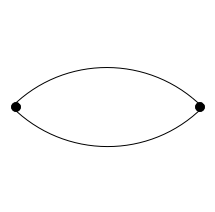
Multiple edges joining two vertices.

In graph theory, multiple edges (also called parallel edges or a multi-edge), are, in an undirected graph, two or more edges that are incident to the same two vertices, or in a directed graph, two or more edges with both the same tail vertex and the same head vertex. A simple graph has no multiple edges and no loops.

Depending on the context, a graph may be defined so as to either allow or disallow the presence of multiple edges (often in concert with allowing or disallowing loops):

  • Where graphs are defined so as to allow multiple edges and loops, a graph without loops or multiple edges is often distinguished from other graphs by calling it a simple graph.[1]
  • Where graphs are defined so as to disallow multiple edges and loops, a multigraph or a pseudograph is often defined to mean a "graph" which can have multiple edges.[2]

Multiple edges are, for example, useful in the consideration of electrical networks, from a graph theoretical point of view.[3] Additionally, they constitute the core differentiating feature of multidimensional networks.

A planar graph remains planar if an edge is added between two vertices already joined by an edge; thus, adding multiple edges preserves planarity.[4]

A dipole graph is a graph with two vertices, in which all edges are parallel to each other.

Notes

[edit]

References

[edit]
Revisions and contributorsEdit on WikipediaRead on Wikipedia
from Grokipedia
In , multiple edges, also known as parallel edges, refer to two or more edges that connect the same pair of vertices in a graph, distinguishing multigraphs from simple graphs that permit at most one undirected edge between any two distinct vertices. This structure allows for the representation of repeated or weighted connections without relying on edge labels or weights alone. Multiple edges can exist in both undirected and directed graphs, where in the directed case, they represent multiple arcs from one vertex to another. Multigraphs incorporating multiple edges are essential for modeling real-world scenarios involving multiplicity, such as multiple transportation routes between cities or multiple types of interactions in social networks. In incidence matrices, the multiplicity dijd_{ij} between vertices ii and jj is recorded as an integer greater than 1, influencing properties like vertex degrees, which sum all incident edges including multiples. Loops, which are edges from a vertex to itself, are sometimes treated separately but can also exhibit multiplicity in pseudographs, a subtype of multigraphs. The study of multiple edges impacts graph algorithms and theorems, such as , where the chromatic index may equal the maximum degree or maximum multiplicity plus the maximum degree in certain cases, with applications in scheduling and . techniques simplify multigraphs by reducing multiple edges to single edges, aiding analysis while preserving connectivity. Overall, multiple edges extend the expressive power of graphs beyond simple structures, enabling more accurate representations in fields like , , and network analysis.

Definitions and Basic Concepts

Undirected multiple edges

In undirected graphs, multiple edges, also known as parallel edges, consist of two or more edges that connect the same of vertices without any specified direction. This configuration distinguishes them from simple graphs, where at most one edge is allowed between any two vertices. Such edges are fundamental in modeling real-world systems where repeated connections between entities are meaningful, such as multiple pathways in a transportation network or redundant links in communication systems. For example, consider an undirected graph with vertices labeled A and B connected by three distinct edges; this setup can represent three parallel bus routes between two cities, highlighting capacity or backup options in the network. In graphical depictions, multiple edges between a pair of vertices are typically illustrated as several distinct lines or curved arcs linking the two points, often positioned parallel to one another and occasionally labeled (e.g., with numbers or identifiers) to differentiate them visually. This representation aids in distinguishing the multiplicity while maintaining clarity in the diagram, assuming familiarity with basic undirected graphs comprising vertices and single edges.

Directed multiple edges

In graph theory, directed multiple edges, also known as multiple arcs, refer to the presence of two or more directed edges sharing the same ordered pair of vertices, from an initial vertex uu to a terminal vertex vv. This structure extends the concept of multigraphs to directed graphs, where arcs explicitly encode orientation. Unlike their undirected counterparts, which treat edges as symmetric and non-oriented, directed multiple arcs distinguish between directions, permitting multiples solely from uu to vv, or bidirectionally if arcs exist in both orientations between the pair. Formally, a directed multigraph allowing multiple arcs is defined as an (V,E)(V, E) consisting of a vertex set VV and an edge set EE, together with an incidence function f:EV×Vf: E \to V \times V that maps each arc to an (u,v)(u, v); arcs e1e_1 and e2e_2 are multiple if f(e1)=f(e2)=(u,v)f(e_1) = f(e_2) = (u, v). The multiplicity of such an arc pair is simply the number of distinct edges mapped to that . A representative application appears in flow networks, where multiple arcs from a source vertex SS to a sink vertex TT model parallel transportation paths, each with its own capacity constraint to represent distinct routes or resources. For instance, in a capacitated network, two arcs from SS to TT might carry capacities of 5 and 3 units, respectively, allowing the total flow to aggregate up to 8 units along that direct connection while respecting individual limits. This setup is crucial for optimizing in transportation or communication systems.

Multigraphs and Graph Types

Definition of multigraphs

In , a is formally defined as an ordered triple G=(V(G),E(G),ψG)G = (V(G), E(G), \psi_G), where V(G)V(G) is a nonempty of vertices, E(G)E(G) is a of edges disjoint from V(G)V(G), and ψG:E(G)(V(G)2){{v}vV(G)}\psi_G: E(G) \to \binom{V(G)}{2} \cup \{ \{v\} \mid v \in V(G) \} is an incidence function that maps each edge to an of vertices (possibly the same vertex, allowing loops) or a single vertex for loops. This structure permits multiple edges, known as parallel edges, between the same pair of vertices, distinguishing it from simpler graph forms. Variants of multigraphs include simple multigraphs, which prohibit loops but allow multiple edges between distinct vertices, and pseudographs, which extend this by explicitly permitting both multiple edges and loops. Multigraphs can also be undirected, using unordered pairs for edge endpoints, or directed (digraphs or multidigraphs), where the incidence function maps edges to ordered pairs (u,v)(u, v) with u,vV(G)u, v \in V(G), allowing multiple directed edges from one vertex to another. Multigraphs generalize simple graphs by relaxing the restriction of at most one edge between any pair of vertices, enabling more flexible modeling of relationships in combinatorial structures.

Distinction from simple graphs

A simple graph is defined as an undirected graph with no loops and at most one edge connecting any pair of distinct vertices. This structure assumes unique connections between vertices, prohibiting both self-loops and parallel edges. The primary distinction lies in the allowance of multiple edges: simple graphs strictly forbid them, along with loops, to maintain a sparse and unique adjacency model, whereas multigraphs explicitly permit multiple edges between the same pair of vertices (and often loops) to capture repeated or parallel relationships. This flexibility in multigraphs addresses limitations in simple graphs, where modeling scenarios with redundancy—such as multiple pathways in transportation networks or duplicate links in communication systems—requires either artificial weights or approximations that obscure distinct interactions. Simple graphs excel in theoretical analyses focused on connectivity and basic structural properties, as their constraints simplify proofs and computations without loss of essential uniqueness. However, they fall short in applications demanding explicit representation of multiplicity, like parallel capacities in flow networks or redundant edges in reliability models, where multigraphs offer a more precise and direct encoding. To bridge this gap, multigraphs can be converted to simple graphs conceptually by techniques such as removing loops and retaining a single representative edge per pair, or through edge contraction to consolidate parallels into weighted or merged structures, though such transformations may alter original multiplicities and require careful interpretation. Labeling parallel edges with identifiers provides another approach to embed multiplicity within a simple graph framework for algorithmic compatibility.

Properties and Measures

Edge multiplicity

In , the multiplicity of an edge, denoted m(u,v)m(u,v), is defined as the number of edges connecting two distinct vertices uu and vv in an undirected , or the number of directed arcs from uu to vv in a directed . This measure quantifies the extent to which multiple edges exist between a specific pair of vertices, distinguishing from simple graphs where multiplicity is at most 1. The total number of edges E|E| in an undirected is given by the formula E={u,v}V,uvm(u,v)+uVm(u,u),|E| = \sum_{\{u,v\} \subseteq V, \, u \neq v} m(u,v) + \sum_{u \in V} m(u,u), where the first sum is over all unordered pairs of distinct vertices and the second accounts for loops if permitted, with each loop at vertex uu contributing to m(u,u)m(u,u). In a directed , the total number of arcs is instead E=(u,v)V×Vm(u,v),|E| = \sum_{(u,v) \in V \times V} m(u,v), summing over all ordered pairs, including possible loops where u=vu = v. These formulas encapsulate how multiplicity aggregates to the overall edge count in multigraphs, where multiplicity exceeds 1 for pairs with parallel connections. For example, if m(u,v)=0m(u,v) = 0, no edge exists between uu and vv, indicating an absent connection; whereas m(u,v)>1m(u,v) > 1 signifies the presence of multiple parallel edges, such as two or more arcs from uu to vv in a directed case. A special case arises with loops, where the multiplicity m(u,u)m(u,u) represents the number of self-connecting edges at vertex uu, allowed in some definitions to model reflexive relations.

Degree in the presence of multiple edges

In multigraphs, the degree of a vertex accounts for the presence of multiple edges and loops by summing the incidences with multiplicity. For an undirected without loops, the degree of a vertex vv, denoted deg(v)\deg(v), is given by deg(v)=uV,uvm(v,u)\deg(v) = \sum_{u \in V, u \neq v} m(v,u), where m(v,u)m(v,u) is the multiplicity of edges between vv and uu, and VV is the vertex set. When loops are permitted, each loop at vv contributes 2 to deg(v)\deg(v), reflecting its two endpoints at the same vertex, so the full degree is deg(v)=uV,uvm(v,u)+2l(v)\deg(v) = \sum_{u \in V, u \neq v} m(v,u) + 2 \cdot l(v), where l(v)l(v) is the number of loops at vv. For example, consider an undirected multigraph where vertex vv has two edges connecting it to another vertex uu (so m(v,u)=2m(v,u) = 2) and one loop at vv (so l(v)=1l(v) = 1). The degree is then deg(v)=2+21=4\deg(v) = 2 + 2 \cdot 1 = 4. In directed multigraphs, degrees are separated into in-degree and out-degree to reflect edge directions. The out-degree of vv is deg+(v)=uVm+(v,u)\deg^+(v) = \sum_{u \in V} m^+(v,u), where m+(v,u)m^+(v,u) counts directed edges from vv to uu, including loops where u=vu = v and each loop (or multiplicity m+(v,v)m^+(v,v)) contributes m+(v,v)m^+(v,v) to the out-degree. Similarly, the in-degree deg(v)=uVm(u,v)\deg^-(v) = \sum_{u \in V} m^-(u,v) sums multiplicities of incoming edges, with loops contributing m(v,v)m^-(v,v) to the in-degree. The total degree is deg(v)=deg+(v)+deg(v)\deg(v) = \deg^+(v) + \deg^-(v). The extends naturally to , maintaining its fundamental relation: in any undirected , the sum of all vertex degrees equals twice the number of edges, vVdeg(v)=2E\sum_{v \in V} \deg(v) = 2 |E|, where E|E| counts edges with multiplicity and each loop as one edge. This holds because each non-loop edge contributes 1 to two degrees and each loop contributes 2 to one degree. For directed , the sum of out-degrees equals the sum of in-degrees, both equaling the total number of directed edges E|E|.

Representations and Data Structures

Adjacency matrix adaptations

In the adjacency matrix representation of a multigraph, the standard adaptation replaces the binary 0/1 entries of a simple graph's matrix with the multiplicity of edges between vertices. Specifically, for an undirected multigraph GG with vertex set V={v1,v2,,vn}V = \{v_1, v_2, \dots, v_n\}, the AG=(aij)A_G = (a_{ij}) is an n×nn \times n matrix where aija_{ij} denotes the number of edges joining viv_i and vjv_j. This matrix is symmetric (AG=AGTA_G = A_G^T) because the multiplicity is undirected. For loops, each loop at vertex viv_i contributes 2 to the diagonal entry aiia_{ii}, reflecting its effect on the degree of viv_i. For directed multigraphs (or multidigraphs), the adjacency matrix is non-symmetric, with aija_{ij} representing the number of directed edges (arcs) from viv_i to vjv_j. Loops in this case contribute 1 to the diagonal entry aiia_{ii}, as they are treated as arcs from a vertex to itself without the degree-doubling convention of undirected graphs. Consider an undirected multigraph with vertices labeled A, B, and C, where there are two edges between A and B, and one edge between B and C (no other edges or loops). The , with rows and columns ordered A, B, C, is: (020201010)\begin{pmatrix} 0 & 2 & 0 \\ 2 & 0 & 1 \\ 0 & 1 & 0 \end{pmatrix}
Add your contribution
Related Hubs
User Avatar
No comments yet.