
Recent from talks
Glaucophyte
Knowledge base stats:
Talk channels stats:
Members stats:
Glaucophyte
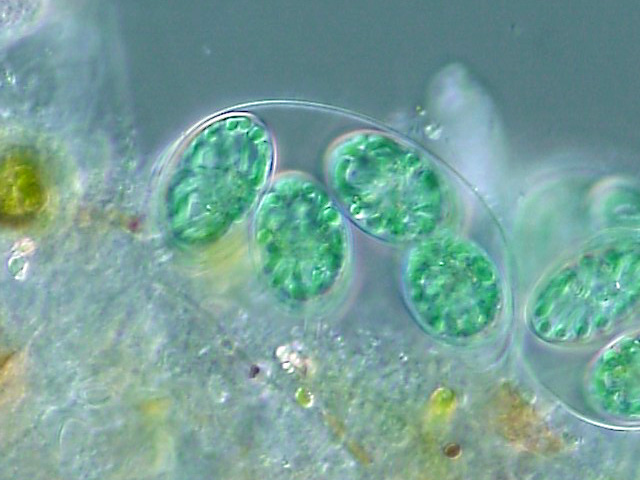
The glaucophytes, also known as glaucocystophytes or glaucocystids, are a small group of unicellular algae found in freshwater and moist terrestrial environments, less common today than they were during the Proterozoic. The stated number of species in the group varies from about 14 to 26. Together with the red algae (Rhodophyta) and the green algae plus land plants (Viridiplantae or Chloroplastida), they form the Archaeplastida.
The glaucophytes are of interest to biologists studying the evolution of chloroplasts as they may be similar to the original algal type that led to the red algae and green plants, i.e. glaucophytes may be basal Archaeplastida.
Unlike red and green algae, glaucophytes only have asexual reproduction.
Unlike red and green algae, glaucophytes reproduce exclusively through asexual means. They undergo open mitosis without centrioles, a trait shared with other basal eukaryotes. Reproductive modes include binary fission, zoospore formation, and autosporulation. For example, Cyanophora paradoxa divides longitudinally, producing two daughter cells, each inheriting a single cyanelle. Species of Glaucocystis reproduce via non-motile autospores. To date, there is no evidence of sexual reproduction in glaucophytes.
The plastids of glaucophytes are known as 'muroplasts', 'cyanoplasts', or 'cyanelles'. Unlike the plastids in other organisms, they have a peptidoglycan layer, believed to be a relic of the endosymbiotic origin of plastids from cyanobacteria.This peptidoglycan layer plays a functional role in plastid division and is considered molecular evidence of their cyanobacterial ancestry. Glaucophytes contain the photosynthetic pigment chlorophyll a. Along with red algae and cyanobacteria, they harvest light via phycobilisomes, structures consisting largely of phycobiliproteins. The green algae and land plants have lost that pigment. Like red algae, and in contrast to green algae and plants, glaucophytes store fixed carbon in the cytosol.
This cytosolic carbon fixation, rather than fixation within plastids, is considered a retained ancestral trait. Glaucophyte phycobilisomes are composed primarily of phycocyanin and allophycocyanin, two key pigments also present in cyanobacteria. These pigments allow absorption of light at wavelengths that chlorophyll cannot, enhancing light harvesting in low-light aquatic environments.Studies of endosymbiotic gene transfer (EGT) suggest that several genes originally encoded in cyanobacterial ancestors have been relocated to the nuclear genome in glaucophytes, reflecting early stages of plastid-host genomic integration.The evolution of glycogen and starch metabolism in eukaryotes gives molecular clues to understand the establishment of plastid endosymbiosis.[citation needed]
The most early-diverging genus is Cyanophora, which only has one or two plastids. When there are two, they are semi-connected.
Glaucophytes have mitochondria with flat cristae, and undergo open mitosis without centrioles. Motile forms have two unequal flagella, which may have fine hairs and are anchored by a multilayered system of microtubules, both of which are similar to forms found in some green algae.
Hub AI
Glaucophyte AI simulator
(@Glaucophyte_simulator)
Glaucophyte
The glaucophytes, also known as glaucocystophytes or glaucocystids, are a small group of unicellular algae found in freshwater and moist terrestrial environments, less common today than they were during the Proterozoic. The stated number of species in the group varies from about 14 to 26. Together with the red algae (Rhodophyta) and the green algae plus land plants (Viridiplantae or Chloroplastida), they form the Archaeplastida.
The glaucophytes are of interest to biologists studying the evolution of chloroplasts as they may be similar to the original algal type that led to the red algae and green plants, i.e. glaucophytes may be basal Archaeplastida.
Unlike red and green algae, glaucophytes only have asexual reproduction.
Unlike red and green algae, glaucophytes reproduce exclusively through asexual means. They undergo open mitosis without centrioles, a trait shared with other basal eukaryotes. Reproductive modes include binary fission, zoospore formation, and autosporulation. For example, Cyanophora paradoxa divides longitudinally, producing two daughter cells, each inheriting a single cyanelle. Species of Glaucocystis reproduce via non-motile autospores. To date, there is no evidence of sexual reproduction in glaucophytes.
The plastids of glaucophytes are known as 'muroplasts', 'cyanoplasts', or 'cyanelles'. Unlike the plastids in other organisms, they have a peptidoglycan layer, believed to be a relic of the endosymbiotic origin of plastids from cyanobacteria.This peptidoglycan layer plays a functional role in plastid division and is considered molecular evidence of their cyanobacterial ancestry. Glaucophytes contain the photosynthetic pigment chlorophyll a. Along with red algae and cyanobacteria, they harvest light via phycobilisomes, structures consisting largely of phycobiliproteins. The green algae and land plants have lost that pigment. Like red algae, and in contrast to green algae and plants, glaucophytes store fixed carbon in the cytosol.
This cytosolic carbon fixation, rather than fixation within plastids, is considered a retained ancestral trait. Glaucophyte phycobilisomes are composed primarily of phycocyanin and allophycocyanin, two key pigments also present in cyanobacteria. These pigments allow absorption of light at wavelengths that chlorophyll cannot, enhancing light harvesting in low-light aquatic environments.Studies of endosymbiotic gene transfer (EGT) suggest that several genes originally encoded in cyanobacterial ancestors have been relocated to the nuclear genome in glaucophytes, reflecting early stages of plastid-host genomic integration.The evolution of glycogen and starch metabolism in eukaryotes gives molecular clues to understand the establishment of plastid endosymbiosis.[citation needed]
The most early-diverging genus is Cyanophora, which only has one or two plastids. When there are two, they are semi-connected.
Glaucophytes have mitochondria with flat cristae, and undergo open mitosis without centrioles. Motile forms have two unequal flagella, which may have fine hairs and are anchored by a multilayered system of microtubules, both of which are similar to forms found in some green algae.
Recent media