


Community hub
Recent from talks
Contribute something
Nothing was collected or created yet.
Mon Homme
View on Wikipedia | This article needs additional citations for verification. (July 2018) |

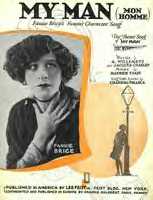
"Mon Homme" (French pronunciation: [mɔ̃n‿ɔm]), also known by its English translation, "My Man", is a popular song first published in 1920. The song was originally composed by Maurice Yvain with French lyrics by Jacques-Charles (Jacques Mardochée Charles) and Albert Willemetz. The English lyrics were written by Channing Pollock.[1]
History
[edit]"Mon Homme" was copyrighted in France by Maurice Yvain, Albert Willemetz and Jacques-Charles (Jacques Mardochée Charles) in 1920 and was introduced to Parisian audiences in the revue Paris qui Jazz at the Casino de Paris.[2] The song was performed by revue star Mistinguett and her stage partner American dancer Harry Pilcer.
Although the song originated in France –where it was a hit for Mistinguett– it was popularized in the English-speaking world in the 1920s with the 1921 recording by Ziegfeld Follies singer Fanny Brice.[2] The song was a hit, and the record eventually earned a Grammy Hall of Fame Award for Brice in 1999. Brice also sang the song during one of the sound sequences of the part-talkie film My Man (1928).
Alice Faye sang it in the musical film Rose of Washington Square (1939), a thinly veiled biography of Fanny Brice.[3][a]
The ballad version recorded by Brice was modified by Billie Holiday, who introduced a jazz/blues recording of "My Man" in 1937. Holiday's version was also successful,[4] although the song continued to be associated with Brice. Over the years, other artists from both the United States and abroad covered the song, though none of the artists achieved as much success as Brice and Holiday. Holiday's version of the song was added to the Grammy Hall of Fame in 2018.[5]
Notable cover versions
[edit]- Peggy Lee recorded the song for her 1959 album I Like Men!. Her arrangement is very minimalistic, with the drums predominant in the mix. This version peaked at #81 on the US Hot 100.[6][2]
- In 1965, the song was covered by Barbra Streisand on her album My Name Is Barbra and in the film adaptation of Funny Girl (1968), a loosely based biography of Fanny Brice.[2] Her rendition of "My Man", sung during the film's finale, drew additional critical praise to an already lauded performance that earned her the Oscar for Best Actress at the 41st Academy Awards.[7][b]
- French singer Mireille Mathieu recorded the song in both French and in English. This was one of her concert songs in international tours, and she also performed the song at various concerts in Paris.[citation needed]
- Diana Ross performed the song in her final concert appearance as a Supreme at the Frontier Hotel in Las Vegas, Nevada, on January 14, 1970. Her performance was recorded and later released on the 1970 live album Farewell. Ross adopted Holiday's jazz and blues version rather than the Brice or Streisand version. In 1972, Ross recorded "My Man" again for the soundtrack for the film Lady Sings the Blues, in which she portrayed Billie Holiday.[2] The soundtrack album peaked at #1 on Billboard's Pop albums chart, reportedly selling over 300,000 copies during its first eight days of release. Ross' performance in the film received critical acclaim and Golden Globe and Academy Award nominations for Best Actress; she won the Golden Globe award for "Most Promising Newcomer." Ross' second version of the song was a revival of Holiday's jazz/blues reading. Ross gave one of her most critically hailed performances of the song in 1979 at Caesars Palace in Las Vegas, Nevada, which was recorded for an HBO concert special during her "The Boss" world tour. Ross also included a recording on Blue (recorded in 1973, unreleased until 2006).[9]
- In 1958, Spanish singer/actress Sara Montiel performed the song in the film The Violet Seller with Spanish lyrics by Jesús María de Arozamena and José Juan Cadenas, and it was released under the title "Es mi hombre" in the film's soundtrack album.[10]
- In 1971, Spanish singer Maruja Garrido also recorded a cover of the Spanish version, for a Televisión Española special featuring Salvador Dalí.[11]
- Whitney Houston covered the song, giving it a jazz-pop approach in a medley with "All the Man That I Need" at the 1991 Billboard Music Awards. Houston also performed the song as part of the set list during her I'm Your Baby Tonight Tour.
- Etta James recorded the song for her album Blue Gardenia (2001).[2]
- Lea Michele covered the song in the Glee episode "Funeral". Prior to the episode's airing, she sang the song at MusiCares 2011, where Streisand was honored as Person of the Year. She also performed it as an encore for the closing night of the Broadway revival of Funny Girl.
- Regina Spektor covered the song for the Boardwalk Empire soundtrack in 2011 (featured in the end credits of "A Dangerous Maid").
- The X Factor (UK) contestant Rebecca Ferguson covered the song on her album Lady Sings the Blues, a cover album of songs made famous by Billie Holiday.
- Chilean-Mexican singer Mon Laferte adapted the song to Spanish ("Mi Hombre") in an updated contemporary context for her album Femme Fatale (2025).[12]
Notes
[edit]- ^ Fanny Brice sued Twentieth Century Fox for using her life story for Rose of Washington Square without her permission. The studio settled out of court for an undisclosed amount.
- ^ Streisand's win for Best Actress was a tie with Katharine Hepburn for The Lion in Winter.[8]
References
[edit]- ^ "Song: My Man written by Channing Pollock | SecondHandSongs". secondhandsongs.com. Retrieved 2025-12-02.
- ^ a b c d e f Morgenroth, David Jonathan (2015). Collaborative Crossover: Identifying Classical Vocal Collaborative Piano Practices in Jazz Vocal Accompanying (Doctoral Dissertation). University of North Texas. pp. 53–54.
- ^ "My Man" sung by Alice Faye in Rose of Washington Square (1939) on YouTube (audio only)
- ^ Whitburn, Joel (1986). Joel Whitburn's Pop Memories 1890-1954. Menomonee Falls, Wisconsin: Record Research Inc. p. 215. ISBN 0-89820-083-0.
- ^ "GRAMMY Hall Of Fame | Hall of Fame Artists | GRAMMY.com". grammy.com. Retrieved 2025-12-02.
- ^ Whitburn, Joel (2013). Joel Whitburn's Top Pop Singles, 14th Edition: 1955-2012. Record Research. p. 491.
- ^ Barbra Streisand at Oscars.org
- ^ The Lion in Winter (1968) - Awards at IMDb
- ^ "www.allmusic.com". www.allmusic.com. Retrieved June 19, 2024.
- ^ Veganzones, Cristina (19 August 2016). "Sexist Scenes and Songs that Went Unnoticed at Their Time and Today Scandalize Us". ABC (in Spanish). Retrieved August 1, 2020.
- ^ "Es mi hombre" - Maruja Garrido ft. Salvador Dalí on YouTube
- ^ Contreras, Marcelo (1 November 2025). "Crítica de discos: de la mujer fatal de Mon Laferte, a un disco de ruptura de Lily Allen a un clásico de Kiss". La Tercera (in Spanish). Retrieved 8 November 2025.

Mon Homme
View on GrokipediaOrigins and Composition
Creation and Debut
"Mon Homme" was composed by Maurice Yvain with French lyrics written by Albert Willemetz and Jacques-Charles (real name Jacques Mardochée Charles). The song was copyrighted in France in 1920 by its creators.[9][10] It premiered on October 6, 1920, in the revue Paris qui Jazz at the Casino de Paris, where it was performed as a duet by the revue star Mistinguett (born Jeanne Bourgeois) and her stage partner, American dancer Harry Pilcer.[10] This debut occurred amid the exuberant post-World War I Parisian cabaret scene, which embraced American jazz influences to infuse nightlife with rhythmic vitality and escapism from wartime scars.[11][12] Mistinguett's charismatic delivery established "Mon Homme" as her signature piece, propelling it to immediate success across French music halls and cementing its place in the era's revue tradition.[9][10]Musical Structure and Lyrics
"Mon Homme," composed by Maurice Yvain with lyrics by Albert Willemetz and Jacques-Charles, follows a strophic verse-chorus form common to early 20th-century popular songs, featuring repeating verses that build emotional intensity leading into a refrain. The piece is written in 4/4 time, evoking a foxtrot rhythm that lends a rhythmic, danceable quality while maintaining a melancholic tone suitable for cabaret settings. The vocal line accommodates a mezzo-soprano or alto range, spanning approximately B3 to C5, with piano accompaniment or small orchestral support that incorporates revue influences such as subtle tango-like phrasing for added sensuality. Chord progressions are straightforward, relying on I-IV-V patterns in a major key (often G major in arrangements) interspersed with minor chords to heighten the pathos of the narrative.[13])[14] The lyrics center on themes of obsessive, unconditional devotion to a flawed lover, portraying a woman's inescapable attachment despite abuse and hardship, blending wry humor, emotional vulnerability, and sensual undertones. This perspective, sometimes interpreted as that of a cabaret performer enduring a turbulent romance, underscores the song's exploration of love's irrational power and the suffering it entails. The refrain emphasizes the protagonist's total surrender—"Je l'ai tellement dans la peau" (I have him so under my skin)—capturing the blend of ecstasy and torment.[15] Below is the full original French lyrics:Sur cette terre, ma seule joie, mon seul bonheurFor reference, a full English translation follows, preserving the structure and tone:
C'est mon homme.
J'ai donné tout ce que j'ai, mon amour et tout mon cœur
À mon homme
Et même la nuit,
Quand je rêve, c'est de lui,
De mon homme.
Ce n'est pas qu'il est beau, qu'il est riche ni costaud
Mais je l'aime, c'est idiot,
Il me fout des coups
Il me prend mes sous,
Je suis à bout
Mais malgré tout
Que voulez-vous
Je l'ai tellement dans la peau
Que j'en deviens marteau,
Dès qu'il s'approche c'est fini
Je suis à lui
Quand ses yeux sur moi se posent
Ça me rend toute chose
Je l'ai tellement dans la peau
Qu'au moindre mot
Je me ferais faire n'importe quoi
Je tuerais, ma foi
Je sens qu'il me rendrait infâme
Mais je ne suis qu'une femme
Et, je l'ai tellement dans la peau... Pour le quitter c'est fou ce que m'ont offert
D'autres hommes.
Entre nous, voyez-vous ils ne valent pas très cher
Tous les hommes
La femme à vrai dire
N'est faite que pour souffrir
Par les hommes.
Dans les bals, j'ai couru, afin de l'oublier j'ai bu
Rien à faire, j'ai pas pu
Quand il me dit : "Viens"
Je suis comme un chien
Y a pas moyen
C'est comme un lien
Qui me retient.
Je l'ai tellement dans la peau
Que j'en suis dingo.
Que celle qui n'a pas aussi
Connu ceci
Ose venir la première
Me jeter la pierre.
En avoir un dans la peau
C'est le pire des maux
Mais c'est connaître l'amour
Sous son vrai jour
Et je dis qu'il faut qu'on pardonne
Quand une femme se donne
À l'homme qu'elle a dans la peau...[15]
On this earth, my only joy, my only happiness
Is my man.
I've given everything I have, my love and all my heart
To my man.
And even at night,
When I dream, it's of him,
Of my man.
It's not that he's handsome, that he's rich or strong
But I love him, it's stupid,
He hits me
He takes my money,
I'm at the end
But despite everything
What do you want
I have him so under my skin
That I go crazy,
As soon as he approaches it's over
I am his
When his eyes rest on me
It makes me all weak
I have him so under my skin
That at the slightest word
I'd do anything
I'd kill, my faith
I feel he would make me infamous
But I'm just a woman
And I have him so under my skin... To leave him, it's crazy what they've offered me
Other men.
Between us, you see, they aren't worth much
All the men
Woman, to tell the truth
Is made only to suffer
From men.
In the dances, I ran, to forget him I drank
Nothing doing, I couldn't
When he says to me: "Come"
I'm like a dog
No way
It's like a bond
That holds me.
I have him so under my skin
That I'm nuts.
Let she who hasn't also
Known this
Dare to be the first
To throw the stone at me.
To have one under your skin
Is the worst of ills
But it's to know love
In its true light
And I say we must forgive
When a woman gives herself
To the man she has under her skin...[16]