



Community hub
Recent from talks
Contribute something
Nothing was collected or created yet.
NASCAR 99
View on Wikipedia| NASCAR '99 | |
|---|---|
 North American PlayStation cover art featuring the cars of Dale Earnhardt, Mark Martin, Terry Labonte, and Kyle Petty | |
| Developer | Stormfront Studios |
| Publisher | EA Sports |
| Series | EA Sports NASCAR |
| Platforms | Nintendo 64, PlayStation |
| Release | Nintendo 64 PlayStation |
| Genre | Racing |
| Modes | Single Player, Multiplayer |
NASCAR '99 is a racing simulator video game developed by Stormfront Studios and published by EA Sports. It was released for Nintendo 64 on September 10, 1998,[1] and for the PlayStation on September 22.[3] NASCAR '99 was the second game in the EA Sports NASCAR series of video games.
Features
[edit]NASCAR '99 is the second game relating in EA Sports NASCAR series of video games. The game features thirty-one of the drivers from the 1998 Winston Cup Series season and six legendary drivers.[4] The game also includes seventeen different NASCAR race tracks, including Atlanta Motor Speedway, Sears Point, and Michigan International Speedway.[4] Furthermore, the game includes instructions from a crew chief, such as when to make a pit stop or when cars are around the player.[4]
Development
[edit]EA confirmed the game's existence in April 1998.[5]
Reception
[edit]| Aggregator | Score | |
|---|---|---|
| N64 | PS | |
| GameRankings | 66%[6] | 70%[7] |
| Publication | Score | |
|---|---|---|
| N64 | PS | |
| CNET Gamecenter | 7/10[8] | 8/10[9] |
| Electronic Gaming Monthly | 6.875/10[10][a] | 5.875/10[11][b] |
| EP Daily | 4/10[12] | 5.5/10[13] |
| Game Informer | 7.25/10[14] | 8.25/10[15] |
| GameRevolution | C[16] | C[17] |
| GameSpot | 6.9/10[18] | 6.3/10[4] |
| IGN | 7/10[19] | 7.1/10[20] |
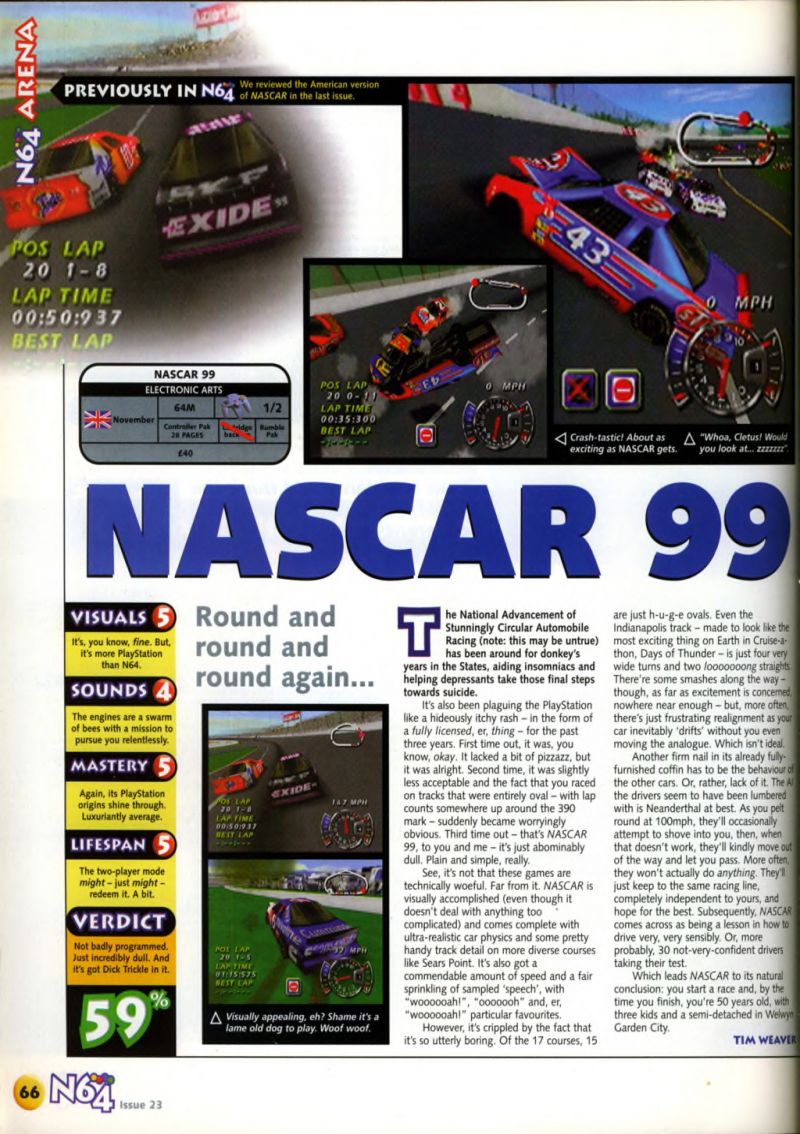
| N64 Magazine | 59%[21][22] | N/A |
| Next Generation | N/A |   [23] [23] |
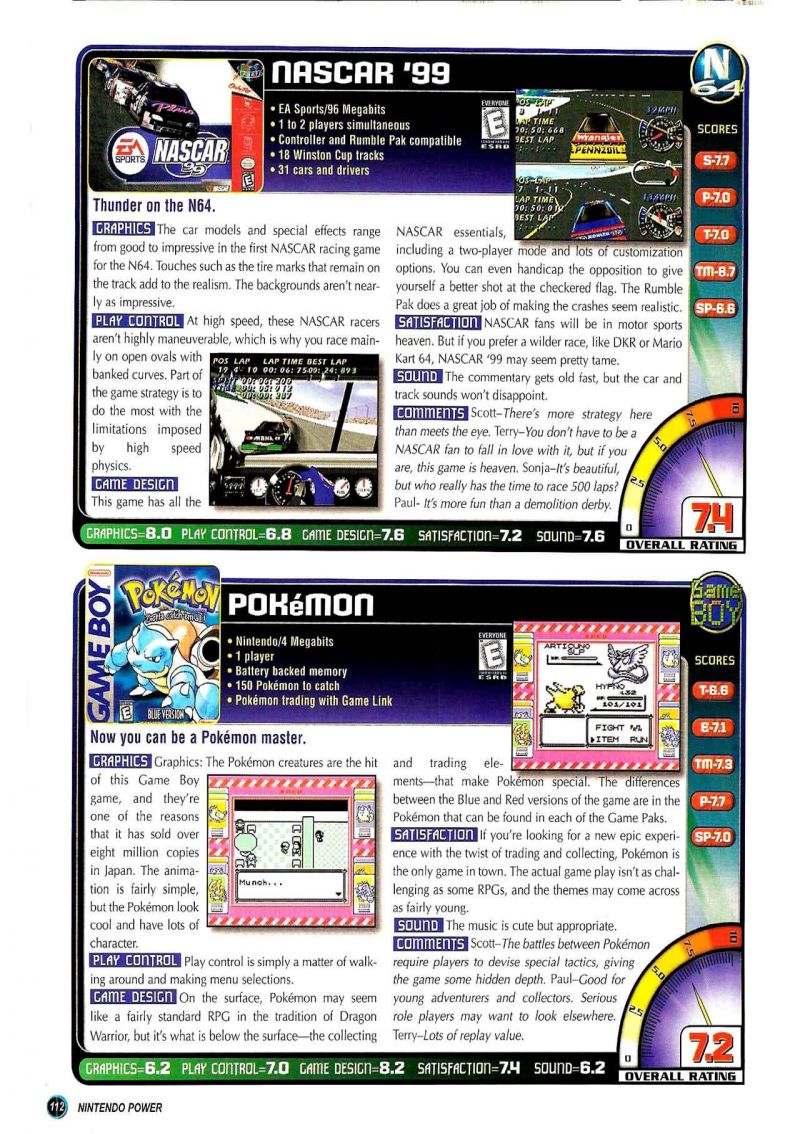
| Nintendo Power | 7.4/10[24] | N/A |
| Official U.S. PlayStation Magazine | N/A | [25] |
The game received average reviews on both platforms according to the review aggregation website GameRankings.[6][7] The game was praised for its authenticity, although critics felt that the graphics and sound effects were not improved from the previous game, NASCAR '98. Also, critics stated that the player would become "tired" of the game if they were a "racing-game fan".[4] Next Generation said of the PlayStation version, "While not a huge improvement over NASCAR 98, it is a better game, and makes it a worthy upgrade if only for the Dual Shock [sic] support."[23] Air Hendrix of GamePro said in the October 1998 issue that the Nintendo 64 version "redlines the thrills with quality stock-car action. Rookies will delight in the wild, bumper-grinding arcade side, while pros who dig sim racing will face off against tough CPU cars that block passing lanes and take you into the wall."[26][c] An issue later, Hendrix stated, "If you're choosing between the PlayStation and N64 versions, the PlayStation game easily takes the pole – though not by a huge margin. All told, race fans in general and NASCAR fans in particular won't go wrong peeling out of pit row with this title."[27][d]
Notes
[edit]- ^ In Electronic Gaming Monthly's review of the Nintendo 64 version, one critic gave it 8.5/10, another gave it 5/10, and the rest gave it each a score of 7/10.
- ^ In Electronic Gaming Monthly's review of the PlayStation version, one critic gave it 7/10, two others gave it each a score of 5/10, and another gave it 6.5/10.
- ^ GamePro gave the Nintendo 64 version all 4/5 scores for graphics, sound, control and fun factor.
- ^ GamePro gave the PlayStation version three 4.5/5 scores for graphics, control, and fun factor, and 4/5 for sound.
References
[edit]- ^ a b "Electronic Arts Ships NASCAR 99 for the Nintendo 64; 1997's Best-Selling PlayStation Racing Video Game Poised to Repeat Success with Next Generation of Game on the Nintendo 64". Business Wire. Gale. September 10, 1998. Archived from the original on July 1, 2013. Retrieved November 3, 2022 – via The Free Library.
- ^ "PlayStation DataCenter - PAL List". psxdatacenter.com. Retrieved 2025-08-30.
- ^ "PSN News Story". 2001-02-25. Archived from the original on 2001-02-25. Retrieved 2023-11-22.
- ^ a b c d e Ryan MacDonald (October 19, 1998). "NASCAR 99 Review (PS)". GameSpot. Fandom. Archived from the original on January 5, 2005. Retrieved August 30, 2023.
- ^ Ryan MacDonald (April 23, 1998). "EA Confirms NASCAR '99 and Untitled Boxer". GameSpot. Fandom. Archived from the original on October 17, 2000. Retrieved August 30, 2023.
- ^ a b "NASCAR 99 for Nintendo 64". GameRankings. CBS Interactive. Archived from the original on May 12, 2019. Retrieved August 30, 2023.
- ^ a b "NASCAR 99 for PlayStation". GameRankings. CBS Interactive. Archived from the original on May 1, 2019. Retrieved August 30, 2023.
- ^ Andy Mahood (October 13, 1998). "NASCAR 99 (N64)". Gamecenter. CNET. Archived from the original on August 23, 2000. Retrieved August 31, 2023.
- ^ Andy Mahood (September 25, 1998). "NASCAR 99 (PS)". Gamecenter. CNET. Archived from the original on August 16, 2000. Retrieved August 31, 2023.
- ^ Dean Hager; Crispin Boyer; John Davison; John Ricciardi (October 1998). "NASCAR 99 (N64)" (PDF). Electronic Gaming Monthly. No. 111. Ziff Davis. p. 258. Archived (PDF) from the original on July 5, 2023. Retrieved August 31, 2023.
- ^ Dean Hager; Crispin Boyer; John Davison; John Ricciardi (November 1998). "NASCAR 99 (PS)" (PDF). Electronic Gaming Monthly. No. 112. Ziff Davis. p. 250. Archived (PDF) from the original on May 19, 2023. Retrieved August 31, 2023.
- ^ Jules Grant (November 5, 1998). "NASCAR 99 (N64)". The Electric Playground. Greedy Productions Ltd. Archived from the original on September 6, 2002. Retrieved August 31, 2023.
- ^ Jules Grant (November 5, 1998). "NASCAR 99 (PSX)". The Electric Playground. Greedy Productions Ltd. Archived from the original on July 17, 2002. Retrieved August 31, 2023.
- ^ Andy McNamara; Paul Anderson; Jon Storm (October 1998). "NASCAR 99". Game Informer. No. 66. FuncoLand. p. 42. Retrieved August 30, 2023.
- ^ Andy McNamara; Paul Anderson; Jon Storm (November 1998). "NASCAR 99 (PS)". Game Informer. No. 67. FuncoLand. p. 53.
- ^ Tim Hsu (October 1998). "Nascar '99 [sic] - N64 Review". GameRevolution. CraveOnline. Archived from the original on February 22, 2004. Retrieved August 31, 2023.
- ^ Jason Zimring (October 1998). "Nascar99 [sic] Review (PS)". GameRevolution. CraveOnline. Archived from the original on April 21, 2016. Retrieved August 31, 2023.
- ^ Ryan MacDonald (October 7, 1998). "NASCAR 99 Review (N64)". GameSpot. Fandom. Archived from the original on January 4, 2005. Retrieved August 30, 2023.
- ^ Peer Schneider (October 21, 1998). "NASCAR 99 (N64)". IGN. Ziff Davis. Archived from the original on August 19, 2023. Retrieved August 30, 2023.
- ^ Craig Harris (September 30, 1998). "NASCAR 99 (PS)". IGN. Ziff Davis. Archived from the original on August 18, 2023. Retrieved August 30, 2023.
- ^ Mark Green (December 1998). "NASCAR '99 (US Import)". N64 Magazine. No. 22. Future Publishing. pp. 94–95.
- ^ Tim Weaver (Christmas 1998). "NASCAR 99". N64 Magazine. No. 23. Future Publishing. p. 66. Archived from the original on August 31, 2023. Retrieved August 31, 2023.
- ^ a b "NASCAR 99 (PS)". Next Generation. No. 49. Imagine Media. January 1999. p. 105. Retrieved August 30, 2023.
- ^ "NASCAR '99". Nintendo Power. Vol. 113. Nintendo of America. October 1998. p. 112. Archived from the original on August 31, 2023. Retrieved August 31, 2023.
- ^ Kraig Kujawa (November 1998). "NASCAR 99". Official U.S. PlayStation Magazine. Vol. 2, no. 2. Ziff Davis. p. 106. Retrieved August 31, 2023.
- ^ Air Hendrix (October 1998). "NASCAR '99 Qualifies Near the Front of the N64 Pack". GamePro. No. 121. IDG. p. 186. Retrieved August 31, 2023.
- ^ Air Hendrix (November 1998). "NASCAR '99 Qualifies for a Top-Five Finish" (PDF). GamePro. No. 122. IDG. p. 200. Archived (PDF) from the original on December 18, 2022. Retrieved August 31, 2023.


External links
[edit]NASCAR 99
View on GrokipediaGameplay
Core Mechanics
NASCAR 99 simulates the handling of NASCAR stock cars through a physics model that emphasizes realistic vehicle dynamics on oval tracks, allowing players to adjust settings for arcade-style ease or full simulation realism. The game's physics include speed-sensitive steering, where higher settings make control more challenging at elevated speeds, and car balance adjustments to counteract oversteer (loose handling) or understeer (tight suspension push). Drafting mechanics enable players to drive in the aerodynamic wake of leading cars, reducing drag for increased speed and fuel efficiency, with a "slingshot" pass technique involving precise positioning behind a competitor before accelerating to overtake.[7] Tire wear and fuel management add strategic depth to races, as higher tire pressure improves cornering grip but accelerates degradation, prompting timely pit stops signaled by the crew chief's audio alerts for worn tires or low fuel levels. Players must balance these resources over long races, where drafting conserves fuel by minimizing engine load in the slipstream of other vehicles, while aggressive driving hastens consumption and tire breakdown. Car setup options, such as gear ratios for acceleration versus top speed and wedge adjustments for weight distribution across corners, further influence handling and endurance.[7] The pit stop system integrates crew chief voice instructions to guide adjustments, with players selecting services like tire changes, fuel top-offs, or chassis tweaks (e.g., downforce for stability or wedge for corner balance) via an in-race menu during stops. These stops simulate real NASCAR procedures, where efficient execution can gain positions, and the crew chief provides audible cues on optimal timing based on race conditions, such as notifying players of impending cautions or resource needs.[7] Audio features enhance immersion with authentic engine sounds that vary by viewpoint, such as intensifying in the cockpit perspective, and these were recorded directly from actual races for realism. The game includes TV-style announcer commentary drawn from the 1998 Winston Cup Series season, featuring broadcasters Bob Jenkins for play-by-play and Benny Parsons for analysis, alongside spotter and crew chief voices offering real-time race advice.[9][10][7] Graphically, NASCAR 99 employs 3D polygonal models for cars and tracks, rendering high-resolution vehicles and 17 licensed circuits with night racing options at select venues like Charlotte Motor Speedway. Weather effects are absent, confining races to dry conditions for consistent simulation of standard NASCAR environments.[7]Tracks and Drivers
NASCAR 99 features a roster of 31 drivers from the 1998 Winston Cup Series, capturing the authenticity of that season's competition with licensed representations of their cars and teams.[11] Prominent examples include Jeff Gordon driving the #24 DuPont Chevrolet for Hendrick Motorsports, Dale Earnhardt in the #3 Goodwrench Chevrolet for Richard Childress Racing, and Mark Martin piloting the #6 Valvoline Ford for Roush Racing.[11] These drivers are depicted with accurate vehicle models and team affiliations, allowing players to select from a field that mirrors the real-world lineup, including other stars like Rusty Wallace (#2 Miller Lite Ford, Penske Racing) and Terry Labonte (#5 Kellogg's Chevrolet, Hendrick Motorsports).[11] In addition to the contemporary roster, the game includes six legendary drivers as unlockable content, earned through strong performances in Championship mode, such as finishing in the top five at specific races.[12] These icons—Richard Petty, Cale Yarborough, Bobby Allison, David Pearson, Neil Bonnett, and Davey Allison—represent NASCAR's storied history and can be raced with classic car liveries once unlocked.[13][14] The game incorporates 17 tracks from the 1998 NASCAR schedule, emphasizing realistic layouts and environmental details to replicate professional racing conditions.[12] Key venues include Atlanta Motor Speedway, Daytona International Speedway, and Sonoma Raceway (formerly Sears Point Raceway), along with others like Charlotte Motor Speedway and Michigan International Speedway.[15] These circuits support various race formats, contributing to the game's fidelity to the season's calendar.[15] Car customization in NASCAR 99 is restricted to authentic paint schemes associated with the licensed teams and drivers, ensuring visual accuracy without allowing player-created designs.[11] For instance, selections from Hendrick Motorsports feature the signature DuPont or Kellogg's schemes, while Roush Racing options display Valvoline branding, maintaining the integrity of official NASCAR aesthetics across all vehicles.[11]Game Modes
NASCAR 99 offers a range of single-player and multiplayer modes designed to replicate the excitement of Winston Cup racing, allowing players to engage in everything from casual races to full-season campaigns with up to 24 cars on-screen. The game's modes emphasize progression through points-based competition and customizable experiences, supporting both simulation-focused play and quick sessions.[7] The core single-player career mode, known as Season or Championship mode, simulates a complete Winston Cup season where players accumulate points across multiple races to vie for the title. Players can create a new season or load a saved one, participating in a full schedule of events that includes qualifying, practice sessions, and main races, with points awarded based on finishing positions—such as 175 for first place and 134 for tenth. Progression is tracked via season standings, info summaries, and record books, and the mode supports saving progress using the Nintendo 64's Controller Pak or equivalent on PlayStation; finishing in the top five in Championship mode races of 50% or greater length unlocks legendary drivers for use in other modes.[7][11] For more immediate racing, Quick Race mode launches players into a single event with default settings, featuring Dale Earnhardt as the driver on the Atlanta track, though random selection of drivers and tracks is available by pressing the R button for variety. Single Race mode expands on this by providing extensive customization options, including choices for race type (main event, qualifying, practice, or Happy Hour final practice), track and driver selection from the roster of 37 real NASCAR drivers, and adjustments to car setup parameters like transmission, rear spoiler, wedge, tire pressure, and gear ratios. NASCAR-specific options allow toggling rules for realism, such as damage, breakdowns, yellow flags, and pit strategies, enabling tailored individual events without long-term commitment.[7][9] Time Trial mode focuses on individual performance, challenging players to set the fastest single lap time on any selected track in a solo session, with results displayed relative to the best possible lap to gauge skill. This mode serves as a practice tool for honing lap times and is integral to qualifying in other modes, where the recorded time determines starting grid position. Complementing this, a dedicated Practice mode offers unlimited laps on chosen tracks to experiment with car setups and driving lines, free from competitive pressure.[7] Multiplayer support in NASCAR 99 is limited to two-player split-screen head-to-head racing on both the PlayStation and Nintendo 64 platforms, where participants start from the back of the field without qualifying. Options include enabling Speed Comp for performance boosts and adding computer-controlled cars to fill an 8-car grid, fostering competitive duels that maintain the game's simulation depth while accommodating local play.[7][11]Development
Production Team
NASCAR 99 was developed by Stormfront Studios, a video game developer founded in 1988 and based in San Rafael, California.[16] The studio was led by Don Daglow, who served as president, CEO, and executive in charge of production for the project.[17] Daglow brought extensive experience in sports simulations, having previously directed the development of the Tony La Russa Baseball series at Stormfront, which emphasized realistic gameplay mechanics and strategic depth in sports titles.[18] The core development team at Stormfront included designers, programmers, and artists focused primarily on adapting the game for console platforms such as the PlayStation and Nintendo 64.[17] Key contributors included François Bertrand and William R. Moore on design and programming, James Larsen and William M. Sullivan on art direction, and additional support from Masami Yamada as development executive.[17] This team built upon the foundation of the prior entry, NASCAR 98, to enhance console-specific features like split-screen multiplayer and analog control support. Published by EA Sports, NASCAR 99 represented the continuation of their official NASCAR racing series following the 1997 release of NASCAR 98.[19] EA announced the game's development in April 1998, confirming its production alongside other upcoming titles.[19] Co-development efforts involved securing official licensing from NASCAR, which enabled the inclusion of authentic audio elements such as commentary by broadcasters Bob Jenkins and Benny Parsons, as well as crew chief assistance features.[20]Design Choices
The development team at Stormfront Studios opted to retain the core engine from the previous year's NASCAR 98, originally derived from Andretti Racing, to accelerate production timelines and leverage established technology for console ports.[3] This choice resulted in graphics and sound design that closely mirrored the predecessor, with smooth 3D rendering of tracks and vehicles but limited advancements in visual fidelity or audio depth due to the shared framework.[21] Sound effects like engine roars and crowd noise provided immersive feedback, with improvements including added mainstream rock tracks, while prioritizing stability over major innovation in a competitive annual release cycle.[22] To broaden appeal on console platforms, the game emphasized an arcade-simulation hybrid approach, blending realistic NASCAR physics—such as drafting and tire wear—with accessible controls and forgiving handling to suit casual players.[23] This balance distinguished EA Sports' version from Papyrus Design Group's more hardcore PC simulations, allowing newcomers to enjoy high-speed oval racing without steep learning curves while offering tunable options like damage models for simulation enthusiasts.[24] A notable upgrade for the PlayStation version was the integration of DualShock controller support, enabling vibration feedback to simulate road rumble, collisions, and speed sensations, enhancing immersion beyond the standard analog controls.[22] This feature addressed a key limitation of NASCAR 98 and aligned with Sony's hardware push, though it was absent on the Nintendo 64 due to the platform's lack of native vibration capability.[25] Nintendo 64 hardware constraints, including limited RAM and processing power, necessitated simplifications in multiplayer functionality, restricting it to two-player split-screen mode without online connectivity—a standard for the era but a missed opportunity compared to emerging PC features.[11] In split-screen play, frame rates dipped slightly and environmental details were reduced to maintain playability, reflecting the cartridge-based system's challenges in handling simultaneous views.[9]Release
Platform Versions
NASCAR 99 was released on two platforms: the Nintendo 64 and the PlayStation. The Nintendo 64 version launched first in North America on September 11, 1998, followed by a European release in November 1998.[26] This version utilized the console's cartridge format, with a ROM size of 96 Mbit (12 MB).[27] In contrast, the PlayStation version arrived in North America on September 22, 1998, and in Europe on October 23, 1998.[28] It employed the standard CD-ROM format, which provided greater storage capacity and enabled enhancements such as cleaner audio quality and slightly better controls compared to the N64 edition.[9]| Platform | North America | Europe |
|---|---|---|
| Nintendo 64 | September 11, 1998 | November 1998 |
| PlayStation | September 22, 1998 | October 23, 1998 |