


Community hub
Recent from talks
Contribute something
Nothing was collected or created yet.
Honda NR500
View on Wikipedia | This article needs additional citations for verification. (November 2015) |
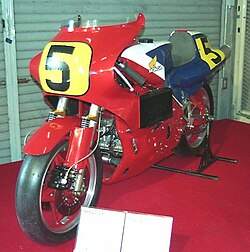
 Honda NR500 (1979, Takazumi Katayama) | |
| Manufacturer | Honda Racing Corporation |
|---|---|
| Production | 1979–1981 |
| Successor | Honda NS500 |
| Engine | 499 cc 4-stroke 100° V4 oval-piston Individual gear driven cam banks per cylinder. |
| Bore / stroke | 93.4 mm / 41 mm × 36 mm (3.7 in / 1.6 in × 1.4 in) |
| Power | 1979: 100 hp (74.6 kW) @ 16,000 rpm 1983: 130 hp (96.9 kW) @ 19,500 rpm |
| Transmission | 1980-83 used a 6 Speed Transmission First Slipper clutch implemented on a motorcycle, known as a back torque limiter. |
| Rake, trail | , |
| Related | 1979 Unibody frame construction 1980-83 use a tube frame construction |
NR500 was a racing motorcycle developed by Honda HRC in 1979 to compete in Grand Prix motorcycle racing. "NR" stands for "New Racing".[1]
Model history
[edit]The motivation behind the NR500 was company founder Soichiro Honda's desire to compete using four-stroke engine technology since the majority of motorcycles manufactured by Honda used four-stroke engines. When the FIM announced new regulations for the 1968 Grand Prix motorcycle racing season that limited the 500 cc engines to four cylinders, this gave an advantage to teams using two-stroke machinery. Honda decided to withdraw from motorcycle racing to concentrate on its automobile division.[2]
In November 1977 Honda announced it would be returning to motorcycle Grand Prix racing using four-stroke technology.[2] Even though two-stroke engines dominated motorcycle Grand Prix racing in the late 1970s, Honda felt compelled to race what they sold and thus competed using a high-technology, four-stroke race bike.[3] Since a conventional four-stroke, four-cylinder engine could not produce the same power as its two-stroke rivals, Honda increased its valve area to be competitive.[4]

The rules at the time allowed up to four combustion chambers, so Honda designed a 32-valve V8 with four pairs of linked combustion chambers. This then evolved into an engine with four oval-shaped cylinders. The oval cylinders allowed room for 32 valves and eight spark plugs, the same as that of an eight-cylinder engine while staying within the four-cylinder rules limit. Another innovation used on the NR500 was its monocoque body which wrapped around the engine like a cocoon and helped reduce weight.[5] In an effort to reduce drag, lower the center of gravity, and to lower gyroscopic forces, the bike used 16-inch Comstar wheels instead of the mainstream 18-inch versions that were commonplace at the time.[6]
Honda overcame significant manufacturing problems to develop its oval cylinder technology and by late-1979 the bike made its debut at the British Grand Prix ridden by Mick Grant and Takazumi Katayama. Both bikes retired, Grant crashing on the first turn after the bike spilled oil onto his rear tire, sliding along with the bike showering sparks, requiring rapid application of powder fire retardant from the race marshal. Katayama retired on the seventh lap due to ignition problems when running second-last.[7][8] Honda persevered for two more seasons, but never made the bike competitive.[9] The monocoque frame had to be abandoned because it made it too difficult for mechanics to work on the engine during races. The 16-inch wheels also had to be abandoned for 18-inch wheels.[10] American Freddie Spencer was able to reach fifth place at the 1981 British Grand Prix before the bike broke down. The NR500 never won a Grand Prix. A thirteenth place by Katayama at the 1981 Austrian Grand Prix was its best showing.
Honda abandoned the project and designed the NS500 two-stroke bike to compete in the 1982 season.[11] Spencer would ride the NS500 to Honda's first 500 cc world championship in 1983. Ultimately, what doomed the NR500 project was that Honda had tried to develop too many technologies at one time. The NR500 did experience a few successes: Freddie Spencer rode the NR500 to a heat race victory at Laguna Seca in 1981 and Kengo Kiyama won the Suzuka 200 kilometer race that same year.[12]
See also
[edit]References
[edit]- ^ http://world.honda.com Part 3
- ^ a b http://world.honda.com Part 2
- ^ http://world.honda.com Part 4
- ^ http://world.honda.com Part 5
- ^ http://world.honda.com Part 7
- ^ Aaron P. Frank (28 May 2003). Honda Motorcycles. MotorBooks International. p. 105. ISBN 978-0760310779.
- ^ Motor Cycle News 15 August 1979, p.4 British Grand Prix race report Accessed and added 12 February 2015
- ^ http://world.honda.com Part 8
- ^ Mick Walker's Japanese Grand Prix Racing Motorcycles, by Mick Walker, Publisher Redline Books, 2002 ISBN 0-9531311-8-1 ISBN 978-0-9531311-8-1
- ^ http://world.honda.com Part 9
- ^ http://world.honda.com Part 11
- ^ http://world.honda.com Part 10
Honda NR500
View on GrokipediaDevelopment
Origins and Goals
In the mid-1960s, two-stroke engines began dominating Grand Prix motorcycle racing, challenging the multi-cylinder four-stroke designs that Honda had championed since entering the sport in 1959. Honda withdrew from Grand Prix competition at the end of the 1967 season, having secured 138 victories and numerous world championships, primarily to redirect resources toward expanding its automobile production business. This hiatus lasted over a decade, during which two-stroke machines from rivals like Yamaha and Suzuki continued to lead the 500 cc class with superior power-to-weight ratios and simpler designs.[4][5][6] Company founder Soichiro Honda, a staunch advocate for four-stroke technology, viewed two-strokes as inferior due to their noisy operation and environmental impact, often derisively calling them "bamboo tubes." Motivated by a personal desire to revive four-stroke innovation in racing and demonstrate its potential, Soichiro directed the company to re-enter Grand Prix competition using advanced four-stroke engineering. This initiative reflected his lifelong philosophy of challenging conventional limits through mechanical ingenuity, even as he had stepped back from daily operations.[7][8] In November 1977, Honda publicly announced the NR500 project, signaling its return to the 500 cc Grand Prix class for the 1979 season with a four-stroke racer. The project was launched as a direct response to Fédération Internationale de Motocyclisme (FIM) regulations that capped 500 cc engines at four cylinders, prompting Honda engineers to pursue extreme RPMs—targeting up to 23,000—to generate competitive power without exceeding displacement limits. The primary objective was to develop a 500 cc V4 four-stroke engine producing approximately 130 horsepower, enabling it to rival the 110-120 hp outputs of contemporary two-stroke competitors while adhering to the era's rules for production-derived racing machines. To oversee this effort, Honda established the New Racing (NR) division within its Asaka R&D Center, allocating significant resources including an annual budget of around 3 billion yen and a dedicated team of about 100 engineers.[9][1][10][8][3][11][2]Design Process and Challenges
The development of the Honda NR500 began as a secretive initiative within Honda's Asaka R&D Center in early 1978, driven by the need to create a competitive four-stroke engine for the 500cc Grand Prix class dominated by two-strokes.[5] The project, codenamed NR, was led by engineer Shoichiro Irimajiri, who proposed the innovative oval-piston concept to accommodate eight valves per cylinder—totaling 32 valves—while adhering to displacement limits.[2] Initial work focused on single-cylinder prototypes, with the first 125cc test unit (K00) completed in July 1978, followed by an eight-valve single-cylinder version (K0) in October 1978 and a full four-cylinder prototype (0X) by April 1979.[5] This rapid progression culminated in the NR500's racing debut at the British Grand Prix in August 1979, after bench testing began in April 1979 and on-track evaluations at facilities like Yatabe Proving Ground in May 1979.[2] A primary engineering challenge was integrating the high valve count within the cylinder constraints, which the oval-piston design addressed by effectively doubling the valvetrain capacity per cylinder, but this introduced severe friction and sealing issues due to the non-circular piston shape.[1] The oval pistons, measuring approximately 93mm by 41mm, required two connecting rods each to prevent rocking, yet achieving precise machining for piston rings proved difficult, leading to seal loss, lubrication problems, and connecting rod twisting above 10,000 rpm.[12] Additionally, the complexity of the V-four engine, with dual overhead cams and eight spark plugs, imposed weight penalties— the machine ended up about 20 kg heavier than intended—exacerbating handling and acceleration challenges, including excessive engine braking.[5] These obstacles were compounded by the need to balance high-revving performance targets of 23,000 rpm with durability, as valve spring failures and cooling inefficiencies emerged during testing.[2] To counter these issues, the team employed lightweight materials such as titanium and magnesium for components like the exhaust system and frame elements, while adopting an early aluminum monocoque chassis to offset the engine's mass.[5] An integrated slipper clutch was introduced to mitigate engine braking and improve throttle response, a novel solution at the time that addressed power delivery "bang" on acceleration.[2] Prototypes underwent iterative refinements through extensive dyno and track testing at sites including Suzuka Circuit and Tochigi, involving key contributors like project manager Koichi Yanase and engine specialist Takeo Fukui, who focused on performance tuning.[5] Despite these efforts, the simultaneous development of multiple radical technologies ultimately strained reliability, leading to ongoing adjustments through the 1X, 2X, and 3X engine iterations by 1983.[2]Design and Technology
Engine Innovations
The Honda NR500 featured a groundbreaking 499 cc liquid-cooled, DOHC V4 four-stroke engine with oval pistons, initially using a 100° V-bank angle that was revised to 90° starting with the 1X version in 1980, designed to push the boundaries of four-cylinder Grand Prix racing regulations by effectively mimicking the valve area of an eight-cylinder engine.[3][1] Each oval piston measured 93.4 mm in width by 41 mm in height, paired with a short 36 mm stroke, yielding an effective bore equivalent of 89 mm to maximize displacement within the 500 cc limit while accommodating larger valves.[3] The engine employed dual connecting rods per cylinder to handle the asymmetric loads from the oval shape, along with a dry sump lubrication system to support high-revving operation and reduce oil drag.[1] A key innovation was the valve train, consisting of 32 valves—eight per cylinder (four intake and four exhaust)—actuated by twin overhead cams with individual gear-driven cam banks for each cylinder to ensure precise timing at extreme speeds.[1] This setup, combined with eight spark plugs enabling dual ignition per cylinder, aimed to enhance combustion efficiency and power delivery in a compact package.[2] To minimize friction in the oval design, engineers incorporated honeycomb-patterned seals on the piston rings, which helped maintain compression while addressing the challenges of non-circular motion.[2] Performance targets for the engine were ambitious, with the initial 1979 0X prototypes delivering approximately 100 hp at 16,000 rpm, evolving through versions like the 1X (120 hp at 18,000 rpm), 2X (135 hp), and 3X (130 hp at 19,500 rpm) by 1983 via refinements in valve timing, materials, and layout.[1] The design sought a rev limit of up to 20,000 rpm—or even 23,000 rpm in theoretical calculations—to rival dominant two-stroke engines, prioritizing high rotational speed over torque for superior top-end power.[8] These specs contributed to a competitive power-to-weight ratio when integrated with the lightweight chassis.[13] Despite its ingenuity, the engine suffered from significant reliability challenges, particularly piston ring wear and loss of seal at speeds above 10,000 rpm due to the oval geometry's uneven pressures and high thermal loads.[2] Overheating exacerbated these issues, causing deformation and frequent rebuilds, while early prototypes experienced connecting rod twisting, valve spring failures, and gear train damage during dyno testing.[1] These problems necessitated ongoing iterations, including rubber dampers for the cam gears, but ultimately limited the engine's race durability.[1]Chassis and Components
The Honda NR500's chassis debuted with an innovative aluminum monocoque frame in 1979, the first of its kind for a Grand Prix motorcycle, constructed from thin aluminum pressings that formed the fairing sides and integrated the steering head structure. This "shrimp shell" design weighed just 5 kg—half the weight of a typical tubular steel frame—and encased the engine in a cassette-style mounting secured by 18 six-millimeter bolts, promoting structural rigidity while minimizing unsprung mass.[5][14] Subsequent iterations evolved the chassis to a conventional steel-tube configuration for enhanced durability and quicker engine access during race weekends, though it retained aluminum elements for weight savings. The frame's design prioritized compactness and aerodynamic efficiency, with the integrated fairing reducing drag by streamlining airflow around the rider and machine.[2] The front suspension consisted of telescopic forks equipped with a mechanical anti-dive mechanism, where brake application pulled the caliper forward via linkage to compress air in the fork legs and limit dive under hard braking. At the rear, the NR500 introduced Honda's Pro-Link system—a rising-rate single-shock setup derived from motocross engineering—with the swingarm pivot and drive sprocket aligned on the same axis to eliminate chain slack and ensure consistent traction.[15][5][16] Braking was handled by dual front disc brakes with four-piston calipers integrated into the anti-dive system and a single rear disc, providing progressive stopping power suited to the bike's high-revving nature; later prototypes pioneered carbon composite discs for reduced weight and fade resistance. Wheels started as 16-inch cast alloy units to shave approximately 4 kg from unsprung mass and lower the center of gravity, but shifted to 18-inch sizes in 1980 for compatibility with wider racing tires, eventually incorporating magnesium alloys in advanced versions.[2][17][5] Key dimensions included a wheelbase of 1,400 mm, a rake angle of 25 degrees, and trail of 100 mm, contributing to agile handling despite the engine's mass. The dry weight settled at around 145 kg in refined 1980-1981 models, a figure influenced by the powertrain's heft but offset by the lightweight chassis innovations. The drivetrain featured a six-speed cassette transmission paired with the first slipper clutch in motorcycle racing, which mitigated rear-wheel hop during aggressive downshifts by limiting back-torque.[18][2][5]Racing Career
1979 Debut Season
The Honda NR500 made its racing debut at the 1979 British Grand Prix held at Silverstone on August 12, marking the manufacturer's return to the 500 cc class of World Grand Prix motorcycle racing after a 12-year absence since 1967.[5] The team fielded two machines ridden by British rider Mick Grant and Japanese rider Takazumi Katayama, with preparation limited by the bikes' completion in July 1979 following bench testing that began in April and initial track tests in May.[1] At this stage, the NR500's four-stroke V4 engine produced 100 horsepower at 16,000 rpm, underpowered compared to the dominant two-stroke rivals like the Yamaha TZ500 and Suzuki RG500, which delivered around 120 horsepower.[1] In the race, both NR500s suffered early retirements, highlighting the machine's reliability challenges under race conditions. Grant crashed out on the first turn after oil from a gearbox breather issue spilled onto the rear tire, causing loss of traction. Katayama managed several laps before retiring due to engine trouble, likely related to the oval-piston design's sealing and thermal expansion issues.[1] These failures stemmed from insufficient pre-race development, as the engines had not been fully stressed in dynamic testing equivalent to Grand Prix demands. Following the Silverstone disappointment, Honda engineers quickly addressed some shortcomings, boosting power to 110 horsepower for the subsequent German Grand Prix at Hockenheim.[17] However, reliability remained a persistent problem, with issues such as piston failures continuing to plague the NR500 throughout the remainder of the 1979 season and preventing competitive results against the two-stroke opposition.[2]1980-1981 Seasons and Results
In the 1980 season, Honda reduced its entries for the NR500 due to persistent reliability issues, participating in only three Grand Prix events with limited success. Takazumi Katayama, the primary rider, achieved finishes of 12th and 15th, but the team scored no championship points as the machine struggled with mechanical failures and overheating.[19] These challenges highlighted the NR500's ongoing development needs, with the focus shifting toward testing and refinement rather than competitive results.[3] The 1981 season saw incremental improvements to the NR500, including engine refinements that boosted power output to approximately 120 horsepower at around 19,000 rpm, though durability remained a concern. Honda entered six Grand Prix races, with Katayama securing the machine's best result of 13th place at the Austrian Grand Prix, the season opener at the Salzburgring.[14][8] Subsequent outings were marred by retirements, including Katayama's brake failure in Germany and a crash at the British Grand Prix due to oil on the track. Freddie Spencer joined as a rider for select events, climbing to fifth place at the British Grand Prix at Silverstone before a mechanical breakdown forced his retirement.[15] The team, supported by Honda Racing Corporation (HRC), also tested with riders like Randy Mamola in preparation, but no points were scored overall.[3] Beyond Grand Prix, the NR500 showed promise in non-championship events. At a June international test race at Suzuka Circuit, test rider Kengo Kiyama won on the NR500, defeating Yamaha's Keiji Kenoshita and Suzuki's Hiroyuki Kawasaki, while another NR500 finished fourth—this marked the model's strongest performance to date. Later that year, Spencer secured a heat race victory at the Laguna Seca non-GP event, outperforming 500cc Grand Prix champion Kenny Roberts. An adapted NR500 also contributed to Kiyama's win in the 1981 Suzuka 500-kilometer race.[20][21][22] Across its career, the NR500 made around 20 Grand Prix starts but achieved zero podiums. Chronic issues plagued the NR500 throughout 1980 and 1981, including frequent overheating from the complex oval-piston V4 engine and breakdowns under race conditions, preventing it from challenging dominant two-stroke rivals like Yamaha and Suzuki. Chassis modifications for improved handling were attempted, but these could not overcome the power delivery limitations and reliability shortfalls.[15][19]Legacy and Impact
Project Abandonment
The Honda NR500 project was effectively halted at the conclusion of the 1981 racing season, with the final competitive outings occurring in late 1981, and the official discontinuation announced in 1982 as Honda pivoted to alternative designs.[2][1] Despite incremental improvements, such as the 2X engine variant achieving 135 horsepower in 1981, the motorcycle's persistent shortcomings rendered further investment untenable.[2][8] Key factors driving the abandonment included chronic unreliability, exemplified by frequent did-not-finish (DNF) results stemming from issues like piston breakage, valve spring failures, oil leakage, and erratic throttle response.[2][14] Development costs were exorbitant, encompassing a five-year intensive effort that logged over 10,000 test hours, yet the NR500 failed to achieve the power-to-weight parity of contemporary two-stroke rivals despite innovations like high-revving oval-piston technology targeting up to 23,000 rpm.[14][2] Competitively, two-stroke engines dominated Grand Prix racing through simpler designs and regulatory advantages under FIM rules, which permitted their use until a 2002 mandate shifted to four-strokes, exacerbating the NR500's 60-pound weight disadvantage and limiting it to just one non-championship victory at the 1981 Suzuka 500-Kilometer Race.[1][2] At the corporate level, Honda's leadership, influenced by founder Soichiro Honda's longstanding preference for four-strokes—which he derisively called two-strokes "bamboo tubes"—reluctantly accepted the project's failure by late 1981, approving the NS500 three-cylinder two-stroke as its successor for the 1982 season to align with prevailing market and regulatory trends.[1][2] This transition marked a pragmatic departure from the NR500's ambitious engineering, with the unproven 3X engine variant (130 horsepower at 19,000 rpm) shelved without racing by 1983.[1] In the aftermath, no production version of the NR500 was ever realized, though surviving prototypes have been preserved in museums, including examples at the Honda Collection Hall in Twin Ring Motegi, Japan, serving as artifacts of the era's bold experimentation.[1][23]Technological Influence
The Honda NR500's development of a slipper clutch, designed to mitigate rear-wheel hop during engine braking, marked a significant advancement in motorcycle transmission technology and became a standard feature in modern sportbikes, including subsequent Honda racing and production models.[2] This back-torque limiter, evolved from the NR500's engineering efforts, was later integrated into mass-production Honda motorcycles to enhance rider control and stability under deceleration.[1] Similarly, the NR500's aluminum semi-monocoque frame pioneered lightweight structural rigidity in Grand Prix racing, influencing the design of later Honda GP machines such as the RC series.[2] Its DOHC V4 configuration, aimed at high-revving performance, served as a precursor to the V4 engines in Honda's production lineup, including the VF750 Sabre Magna in 1982 and the VFR750F in 1986.[24] The NR500's technological refinements directly contributed to the success of its successor, the NS500, which adopted the NR500's innovative chassis design developed by Honda's young engineers, enabling better handling and durability in competition.[25] Powered by a two-stroke V3 engine but benefiting from these structural lessons, the NS500 secured the 1983 500cc World Championship with rider Freddie Spencer, marking Honda's return to dominance in the class and paving the way for the NSR series' subsequent MotoGP successes through the 1980s and 1990s.[26] By demonstrating the viability of four-stroke engines capable of outputs exceeding 130 horsepower at high RPMs, the NR500 underscored their potential against dominant two-strokes.[2] Although the project was ultimately abandoned after limited racing success, the NR500's oval-piston concept echoed in experimental engine designs and found commercial expression in the limited-production NR750 of 1992, which incorporated elliptical pistons, 32 valves, and advanced materials like carbon fiber for its V4 powerplant.[1] These elements influenced contemporary Honda V4 MotoGP engines, emphasizing compact, high-revving architectures for superior power delivery.[24] Culturally, the NR500 is regarded as a bold engineering endeavor despite its racing shortcomings, preserved as part of Honda Racing Corporation's heritage collection and documented in official Honda publications highlighting its innovative spirit.[1]References
- https://commons.wikimedia.org/wiki/File:Honda_NR500_honda_collection_hall.JPG