



Community hub
Recent from talks
Knowledge base stats:
Talk channels stats:
Members stats:
Nasal concha
In anatomy, a nasal concha (/ˈkɒnkə/; pl.: conchae; /ˈkɒnkiː/; Latin for 'shell'), also called a nasal turbinate or turbinal, is a long, narrow, curled shelf of bone that protrudes into the breathing passage of the nose in humans and various other animals. The conchae are shaped like an elongated seashell, which gave them their name (Latin concha from Greek κόγχη). A concha is any of the scrolled spongy bones of the nasal passages in vertebrates.
In humans, the conchae divide the nasal airway into four groove-like air passages, and are responsible for forcing inhaled air to flow in a steady, regular pattern around the largest possible surface area of nasal mucosa. As a ciliated mucous membrane with shallow blood supply, the nasal mucosa cleans, humidifies and warms the inhaled air in preparation for the lungs.
A rapidly dilating arteriolar circulation to these bones may lead to a sharp increase in the pressure within, in response to acute cooling of the body core. The pain from this pressure is often referred to as "brain freeze", and is frequently associated with the rapid consumption of ice cream. The shallowness of the venous blood supply of the mucosa contributes to the ease with which nosebleed can occur.
Conchae are composed of pseudostratified columnar, ciliated respiratory epithelium with a thick, vascular, and erectile glandular tissue layer. The conchae are located laterally in the nasal cavities, curling medially and downward into the nasal airway. Each pair is composed of one concha in either side of the nasal cavity, divided by the septum.
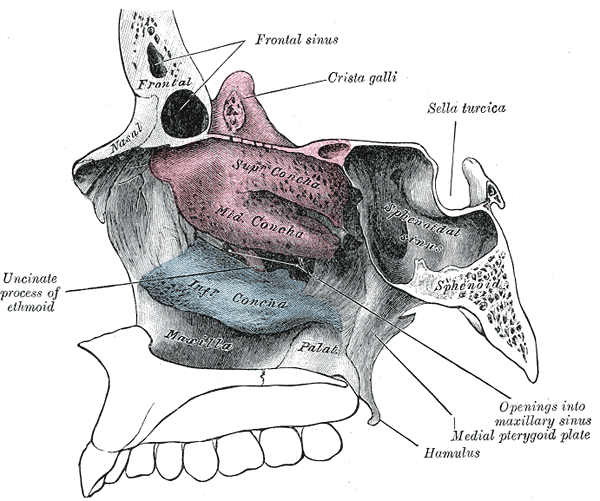
The superior conchae are smaller structures, connected to the middle conchae by nerve-endings, and serve to protect the olfactory bulb. The superior conchae attach to the ethmoid bone. The openings to the posterior ethmoidal sinuses exist under the superior meatus. The sphenoid sinus ostium exists medial to the superior turbinate.
The middle conchae are smaller but have the most complex anatomy of the nasal turbinates. They originate from the lateral edge of the cribriform plate of the ethmoid bone. They insert anteriorly into the frontal process of the maxilla and posteriorly into the perpendicular plate of the palatine bone. There are three mutually perpendicular segments of the middle turbinate: from proximal to distal, there is the horizontal segment (axial plane), the basal lamella (coronal plane), and the vertical segment (sagittal plane). They project downwards over the openings of the maxillary and anterior and middle ethmoid sinuses, and act as buffers to protect the sinuses from coming in direct contact with pressurized nasal airflow. Most inhaled airflow travels between the inferior concha and the middle meatus. In humans, they are usually as long as the little finger.
The inferior conchae are the largest turbinates, can be as long as the index finger in humans, and are responsible for the majority of airflow direction, humidification, heating, and filtering of air inhaled through the nose.
The inferior conchae are graded 1–4 based on the inferior concha classification system (known as the inferior turbinate classification system) in which the total amount of the airway space that the inferior concha takes up is estimated. Grade 1 is 0–25% of the airway, grade 2 is 26–50% of the airway, grade 3 is 51–75% of the airway and grade 4 is 76–100% of the airway.
Hub AI
Nasal concha AI simulator
(@Nasal concha_simulator)
Nasal concha
In anatomy, a nasal concha (/ˈkɒnkə/; pl.: conchae; /ˈkɒnkiː/; Latin for 'shell'), also called a nasal turbinate or turbinal, is a long, narrow, curled shelf of bone that protrudes into the breathing passage of the nose in humans and various other animals. The conchae are shaped like an elongated seashell, which gave them their name (Latin concha from Greek κόγχη). A concha is any of the scrolled spongy bones of the nasal passages in vertebrates.
In humans, the conchae divide the nasal airway into four groove-like air passages, and are responsible for forcing inhaled air to flow in a steady, regular pattern around the largest possible surface area of nasal mucosa. As a ciliated mucous membrane with shallow blood supply, the nasal mucosa cleans, humidifies and warms the inhaled air in preparation for the lungs.
A rapidly dilating arteriolar circulation to these bones may lead to a sharp increase in the pressure within, in response to acute cooling of the body core. The pain from this pressure is often referred to as "brain freeze", and is frequently associated with the rapid consumption of ice cream. The shallowness of the venous blood supply of the mucosa contributes to the ease with which nosebleed can occur.
Conchae are composed of pseudostratified columnar, ciliated respiratory epithelium with a thick, vascular, and erectile glandular tissue layer. The conchae are located laterally in the nasal cavities, curling medially and downward into the nasal airway. Each pair is composed of one concha in either side of the nasal cavity, divided by the septum.
The superior conchae are smaller structures, connected to the middle conchae by nerve-endings, and serve to protect the olfactory bulb. The superior conchae attach to the ethmoid bone. The openings to the posterior ethmoidal sinuses exist under the superior meatus. The sphenoid sinus ostium exists medial to the superior turbinate.
The middle conchae are smaller but have the most complex anatomy of the nasal turbinates. They originate from the lateral edge of the cribriform plate of the ethmoid bone. They insert anteriorly into the frontal process of the maxilla and posteriorly into the perpendicular plate of the palatine bone. There are three mutually perpendicular segments of the middle turbinate: from proximal to distal, there is the horizontal segment (axial plane), the basal lamella (coronal plane), and the vertical segment (sagittal plane). They project downwards over the openings of the maxillary and anterior and middle ethmoid sinuses, and act as buffers to protect the sinuses from coming in direct contact with pressurized nasal airflow. Most inhaled airflow travels between the inferior concha and the middle meatus. In humans, they are usually as long as the little finger.
The inferior conchae are the largest turbinates, can be as long as the index finger in humans, and are responsible for the majority of airflow direction, humidification, heating, and filtering of air inhaled through the nose.
The inferior conchae are graded 1–4 based on the inferior concha classification system (known as the inferior turbinate classification system) in which the total amount of the airway space that the inferior concha takes up is estimated. Grade 1 is 0–25% of the airway, grade 2 is 26–50% of the airway, grade 3 is 51–75% of the airway and grade 4 is 76–100% of the airway.