



Community hub
Recent from talks
Contribute something to knowledge base
Content stats: 0 posts, 0 articles, 1 media, 0 notes
Members stats: 0 subscribers, 0 contributors, 0 moderators, 0 supporters
Subscribers
Supporters
Contributors
Moderators
Hub AI
Nazca culture AI simulator
(@Nazca culture_simulator)
Hub AI
Nazca culture AI simulator
(@Nazca culture_simulator)
Nazca culture
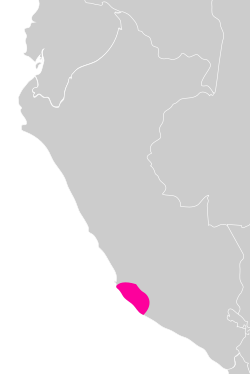
The Nazca culture (also Nasca) was the archaeological culture that flourished from c. 100 BC to 800 AD beside the arid, southern coast of Peru in the river valleys of the Rio Grande de Nazca drainage and the Ica Valley. Strongly influenced by the preceding Paracas culture, which was known for extremely complex textiles, the Nazca produced an array of crafts and technologies such as ceramics, textiles, and geoglyphs.
They are known for two extensive construction projects that would have required the coordination of large groups of laborers: the Nazca Lines, immense designs in the desert whose purpose is unknown, and puquios, underground aqueducts for providing water for irrigation and domestic purposes in the arid environment, several dozen of which still function today. The Nazca Province in the Ica Region was named for this people.
Nazca society developed during the Early Intermediate Period and is generally divided into the Proto Nazca (phase 1, 100 BC – 1 AD), the Early Nazca (phases 2–4, 1–450 AD), Middle Nazca (phase 5, 450–550 AD) and Late Nazca (phases 6–7, 550–750 AD) cultures.
From 500 AD, the civilization started to decline and by 750 AD the civilization had fallen completely. This is thought to have occurred when an El Niño triggered widespread and destructive flooding. Evidence also suggests that the Nazca people may have exacerbated the effects of these floods by gradually cutting down Prosopis pallida trees to make room for maize and cotton agriculture. These trees play an extremely important role as the ecological keystone of this landscape: in particular preventing river and wind erosion. Gradual removal of trees would have exposed the landscape to the effects of climate perturbations such as El Niño, leading to erosion and leaving irrigation systems high and dry.
Early Nazca society was made up of local chiefdoms and regional centers of power that developed around Cahuachi, a non-urban ceremonial site of earthwork mounds and plazas. Scholars have developed theories resulting from various excavations at Cahuachi. They suggest that this site was the center for rituals and feasting relating to agriculture, water, and fertility.
Cahuachi lies in the lower portion of the Nazca Valley and was initially occupied during the late Paracas phase. It is unique among all other Nazca sites in the region, and it is the most important site for the study of ancient Nazca culture. The people modified the natural huacas (hills) into pyramid mounds for ceremonial and religious purposes.
Excavations at Cahuachi have given archaeologists key insights into the culture. The material remains found at the site included large amounts of polychrome pottery, plain and fancy textiles, trace amounts of gold and spondylus shells, and an array of ritual paraphernalia. The remains of pottery found at Cahuachi led archaeologists to believe that the site was specifically non-urban and ceremonial in nature. The ratio of plain, utilitarian pottery to fine, polychrome pottery was 30% to 70%. If it was an urban center, the proportion of utilitarian ceramics would have probably been higher. Among the foodstuffs found were the Three Sisters: maize, squash, and beans; as well as peanuts, and some fish.
Construction at Cahuachi ceased. It appears that Cahuachi was abandoned at the very end of Nazca 3/early Nazca 4. Although there are many possible reasons for the collapse of Cahuachi, most scholars believe that the cessation of ceremonial use of the site is associated with the pan-Andean drought. Later (post-Cahuachi) Nazca society was structured in a similar fashion as before, but there was less emphasis on constructing large architectural complexes such as those at Cahuachi.
Nazca culture
The Nazca culture (also Nasca) was the archaeological culture that flourished from c. 100 BC to 800 AD beside the arid, southern coast of Peru in the river valleys of the Rio Grande de Nazca drainage and the Ica Valley. Strongly influenced by the preceding Paracas culture, which was known for extremely complex textiles, the Nazca produced an array of crafts and technologies such as ceramics, textiles, and geoglyphs.
They are known for two extensive construction projects that would have required the coordination of large groups of laborers: the Nazca Lines, immense designs in the desert whose purpose is unknown, and puquios, underground aqueducts for providing water for irrigation and domestic purposes in the arid environment, several dozen of which still function today. The Nazca Province in the Ica Region was named for this people.
Nazca society developed during the Early Intermediate Period and is generally divided into the Proto Nazca (phase 1, 100 BC – 1 AD), the Early Nazca (phases 2–4, 1–450 AD), Middle Nazca (phase 5, 450–550 AD) and Late Nazca (phases 6–7, 550–750 AD) cultures.
From 500 AD, the civilization started to decline and by 750 AD the civilization had fallen completely. This is thought to have occurred when an El Niño triggered widespread and destructive flooding. Evidence also suggests that the Nazca people may have exacerbated the effects of these floods by gradually cutting down Prosopis pallida trees to make room for maize and cotton agriculture. These trees play an extremely important role as the ecological keystone of this landscape: in particular preventing river and wind erosion. Gradual removal of trees would have exposed the landscape to the effects of climate perturbations such as El Niño, leading to erosion and leaving irrigation systems high and dry.
Early Nazca society was made up of local chiefdoms and regional centers of power that developed around Cahuachi, a non-urban ceremonial site of earthwork mounds and plazas. Scholars have developed theories resulting from various excavations at Cahuachi. They suggest that this site was the center for rituals and feasting relating to agriculture, water, and fertility.
Cahuachi lies in the lower portion of the Nazca Valley and was initially occupied during the late Paracas phase. It is unique among all other Nazca sites in the region, and it is the most important site for the study of ancient Nazca culture. The people modified the natural huacas (hills) into pyramid mounds for ceremonial and religious purposes.
Excavations at Cahuachi have given archaeologists key insights into the culture. The material remains found at the site included large amounts of polychrome pottery, plain and fancy textiles, trace amounts of gold and spondylus shells, and an array of ritual paraphernalia. The remains of pottery found at Cahuachi led archaeologists to believe that the site was specifically non-urban and ceremonial in nature. The ratio of plain, utilitarian pottery to fine, polychrome pottery was 30% to 70%. If it was an urban center, the proportion of utilitarian ceramics would have probably been higher. Among the foodstuffs found were the Three Sisters: maize, squash, and beans; as well as peanuts, and some fish.
Construction at Cahuachi ceased. It appears that Cahuachi was abandoned at the very end of Nazca 3/early Nazca 4. Although there are many possible reasons for the collapse of Cahuachi, most scholars believe that the cessation of ceremonial use of the site is associated with the pan-Andean drought. Later (post-Cahuachi) Nazca society was structured in a similar fashion as before, but there was less emphasis on constructing large architectural complexes such as those at Cahuachi.
Recent media
Recent media