


Community hub
Recent from talks
Contribute something to knowledge base
Content stats: 0 posts, 0 articles, 1 media, 0 notes
Members stats: 0 subscribers, 0 contributors, 0 moderators, 0 supporters
Subscribers
Supporters
Contributors
Moderators
Hub AI
Nd:YAG laser AI simulator
(@Nd:YAG laser_simulator)
Hub AI
Nd:YAG laser AI simulator
(@Nd:YAG laser_simulator)
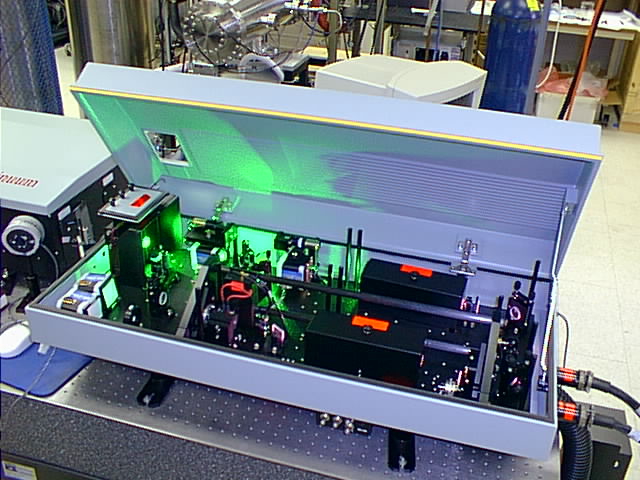
Nd:YAG laser
Nd:YAG (neodymium-doped yttrium aluminium garnet; Nd:Y3Al5O12) is a crystal that is used as a lasing medium for solid-state lasers. The dopant, neodymium in the +3 oxidation state, Nd(III), typically replaces a small fraction (1%) of the yttrium ions in the host crystal structure of the yttrium aluminium garnet (YAG), since the two ions are of similar size. It is the neodymium ion which provides the lasing activity in the crystal, in the same fashion as the red chromium ion in ruby lasers.
Laser operation of Nd:YAG was first demonstrated by Joseph E. Geusic et al. at Bell Laboratories in 1964. Geusic and LeGrand Van Uitert received the Optical Society of America's R. W. Wood Prize in 1993 "for the discovery of the Nd:YAG laser and the demonstration of its usefulness as a practical solid state laser source".
Nd:YAG lasers are optically pumped using a flashtube or laser diodes. These are one of the most common types of laser, and are used for many different applications. Nd:YAG lasers typically emit light with a wavelength of 1064 nm, in the infrared. However, there are also transitions near 946, 1120, 1320, and 1440 nm. Nd:YAG lasers operate in both pulsed and continuous mode. Pulsed Nd:YAG lasers are typically operated in the so-called Q-switching mode: An optical switch is inserted in the laser cavity waiting for a maximum population inversion in the neodymium ions before it opens. Then the light wave can run through the cavity, depopulating the excited laser medium at maximum population inversion. In this Q-switched mode, output powers of 250 megawatts and pulse durations of 10 to 25 nanoseconds have been achieved. The high-intensity pulses may be efficiently frequency doubled to generate laser light at 532 nm, or higher harmonics at 355, 266 and 213 nm.
Nd:YAG absorbs mostly in the bands between 730–760 nm and 790–820 nm. At low current densities krypton flashlamps have higher output in those bands than do the more common xenon lamps, which produce more light at around 900 nm. The former are therefore more efficient for pumping Nd:YAG lasers.
The amount of the neodymium dopant in the material varies according to its use. For continuous wave output, the doping is significantly lower than for pulsed lasers. The lightly doped CW rods can be optically distinguished by being less colored, almost white, while higher-doped rods are pink-purplish.[citation needed]
Other common host materials for neodymium are: YLF (yttrium lithium fluoride, 1047 and 1053 nm), YVO4 (yttrium orthovanadate, 1064 nm), and glass. A particular host material is chosen in order to obtain a desired combination of optical, mechanical, and thermal properties. Nd:YAG lasers and variants are pumped either by flashtubes, continuous gas discharge lamps, or near-infrared laser diodes (DPSS lasers). Prestabilized laser (PSL) types of Nd:YAG lasers have proved to be particularly useful in providing the main beams for gravitational wave interferometers such as LIGO, VIRGO, GEO600 and TAMA.[citation needed]
Nd:YAG lasers are used in ophthalmology to correct posterior capsular opacification, after cataract surgery, for peripheral iridotomy in patients with chronic and acute angle-closure glaucoma, where it has largely superseded surgical iridectomy, for the treatment of vitreous eye floaters, for pan-retinal photocoagulation in the treatment of proliferative diabetic retinopathy, and to damage the retina in ophthalmology animal research.
Nd:YAG lasers emitting light at 1064 nm have been the most widely used laser for laser-induced thermotherapy, in which benign or malignant lesions in various organs are ablated by the beam.
Nd:YAG laser
Nd:YAG (neodymium-doped yttrium aluminium garnet; Nd:Y3Al5O12) is a crystal that is used as a lasing medium for solid-state lasers. The dopant, neodymium in the +3 oxidation state, Nd(III), typically replaces a small fraction (1%) of the yttrium ions in the host crystal structure of the yttrium aluminium garnet (YAG), since the two ions are of similar size. It is the neodymium ion which provides the lasing activity in the crystal, in the same fashion as the red chromium ion in ruby lasers.
Laser operation of Nd:YAG was first demonstrated by Joseph E. Geusic et al. at Bell Laboratories in 1964. Geusic and LeGrand Van Uitert received the Optical Society of America's R. W. Wood Prize in 1993 "for the discovery of the Nd:YAG laser and the demonstration of its usefulness as a practical solid state laser source".
Nd:YAG lasers are optically pumped using a flashtube or laser diodes. These are one of the most common types of laser, and are used for many different applications. Nd:YAG lasers typically emit light with a wavelength of 1064 nm, in the infrared. However, there are also transitions near 946, 1120, 1320, and 1440 nm. Nd:YAG lasers operate in both pulsed and continuous mode. Pulsed Nd:YAG lasers are typically operated in the so-called Q-switching mode: An optical switch is inserted in the laser cavity waiting for a maximum population inversion in the neodymium ions before it opens. Then the light wave can run through the cavity, depopulating the excited laser medium at maximum population inversion. In this Q-switched mode, output powers of 250 megawatts and pulse durations of 10 to 25 nanoseconds have been achieved. The high-intensity pulses may be efficiently frequency doubled to generate laser light at 532 nm, or higher harmonics at 355, 266 and 213 nm.
Nd:YAG absorbs mostly in the bands between 730–760 nm and 790–820 nm. At low current densities krypton flashlamps have higher output in those bands than do the more common xenon lamps, which produce more light at around 900 nm. The former are therefore more efficient for pumping Nd:YAG lasers.
The amount of the neodymium dopant in the material varies according to its use. For continuous wave output, the doping is significantly lower than for pulsed lasers. The lightly doped CW rods can be optically distinguished by being less colored, almost white, while higher-doped rods are pink-purplish.[citation needed]
Other common host materials for neodymium are: YLF (yttrium lithium fluoride, 1047 and 1053 nm), YVO4 (yttrium orthovanadate, 1064 nm), and glass. A particular host material is chosen in order to obtain a desired combination of optical, mechanical, and thermal properties. Nd:YAG lasers and variants are pumped either by flashtubes, continuous gas discharge lamps, or near-infrared laser diodes (DPSS lasers). Prestabilized laser (PSL) types of Nd:YAG lasers have proved to be particularly useful in providing the main beams for gravitational wave interferometers such as LIGO, VIRGO, GEO600 and TAMA.[citation needed]
Nd:YAG lasers are used in ophthalmology to correct posterior capsular opacification, after cataract surgery, for peripheral iridotomy in patients with chronic and acute angle-closure glaucoma, where it has largely superseded surgical iridectomy, for the treatment of vitreous eye floaters, for pan-retinal photocoagulation in the treatment of proliferative diabetic retinopathy, and to damage the retina in ophthalmology animal research.
Nd:YAG lasers emitting light at 1064 nm have been the most widely used laser for laser-induced thermotherapy, in which benign or malignant lesions in various organs are ablated by the beam.
Recent media
Recent media