
Hubbry Logo
Population inversionPopulation inversionMain
Open search
Population inversion
Community hub
Population inversion
logo
7 pages, 0 posts
0 subscribers
Be the first to start a discussion here.
Population inversion
from Wikipedia

In physics, specifically statistical mechanics, a population inversion occurs when a system (such as a group of atoms or molecules) exists in a state in which more members of the system are in higher, excited states than in lower, unexcited energy states. It is called an "inversion" because in many familiar and commonly encountered physical systems in thermal equilibrium, this is not possible. This concept is of fundamental importance in laser science because the production of a population inversion is a necessary step in the workings of a standard laser.

Condition

[edit]

To understand the concept of a population inversion, it is necessary to understand some thermodynamics and the way that light interacts with matter. To do so, it is useful to consider a very simple assembly of atoms forming a laser medium.

Assume there is a group of N atoms, each of which is capable of being in one of two energy states: either

  1. The ground state, with energy E1; or
  2. The excited state, with energy E2, with E2 > E1.

The number of these atoms which are in the ground state is given by N1, and the number in the excited state N2. Since there are N atoms in total,

The energy difference between the two states, given by

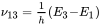
determines the characteristic frequency of light which will interact with the atoms; This is given by the relation


h being the Planck constant.

If the group of atoms is in thermal equilibrium, it can be shown from Maxwell–Boltzmann statistics that the ratio of the number of atoms in each state is given by the ratio of two Boltzmann distributions, the Boltzmann factor:

where T is the thermodynamic temperature of the group of atoms, k is the Boltzmann constant and g1 and g2 are the degeneracies of each state.

Calculable is the ratio of the populations of the two states at room temperature (T ≈ 300 K) for an energy difference ΔE that corresponds to light of a frequency corresponding to visible light (ν ≈ 5×10¹⁴ Hz). In this case ΔE = E2E1 ≈ 2.07 eV, and kT ≈ 0.026 eV. Since E2E1kT, it follows that the argument of the exponential in the equation above is a large negative number, and as such N2/N1 is vanishingly small; i.e., there are almost no atoms in the excited state. When in thermal equilibrium, then, it is seen that the lower energy state is more populated than the higher energy state, and this is the normal state of the system. As T increases, the number of electrons in the high-energy state (N2) increases, but N2 never exceeds N1 for a system at thermal equilibrium; rather, at infinite temperature, the populations N2 and N1 become equal. In other words, a population inversion (N2/N1 > 1) can never exist for a system at thermal equilibrium. To achieve population inversion therefore requires pushing the system into a non-equilibrated state.

Interaction of light with matter

[edit]

There are three types of possible interactions between a system of atoms and light that are of interest:

Absorption

[edit]

If light (photons) of frequency ν12 passes through the group of atoms, there is a possibility of the light being absorbed by electrons which are in the ground state, which will cause them to be excited to the higher energy state. The rate of absorption is proportional to the radiation density of the light, and also to the number of atoms currently in the ground state, N1.

Spontaneous emission

[edit]

If atoms are in the excited state, spontaneous decay events to the ground state will occur at a rate proportional to N2, the number of atoms in the excited state. The energy difference between the two states ΔE21 is emitted from the atom as a photon of frequency ν21 as given by the frequency-energy relation above.

The photons are emitted stochastically, and there is no fixed phase relationship between photons emitted from a group of excited atoms; in other words, spontaneous emission is incoherent. In the absence of other processes, the number of atoms in the excited state at time t, is given by
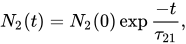
where N2(0) is the number of excited atoms at time t = 0, and τ21 is the mean lifetime of the transition between the two states.

Stimulated emission

[edit]

If an atom is already in the excited state, it may be agitated by the passage of a photon that has a frequency ν21 corresponding to the energy gap ΔE of the excited state to ground state transition. In this case, the excited atom relaxes to the ground state, and it produces a second photon of frequency ν21. The original photon is not absorbed by the atom, and so the result is two photons of the same frequency. This process is known as stimulated emission.

Specifically, an excited atom will act like a small electric dipole which will oscillate with the external field provided. One of the consequences of this oscillation is that it encourages electrons to decay to the lowest energy state. When this happens due to the presence of the electromagnetic field from a photon, a photon is released in the same phase and direction as the "stimulating" photon, and is called stimulated emission.

The rate at which stimulated emission occurs is proportional to the number of atoms N2 in the excited state, and the radiation density of the light. The base probability of a photon causing stimulated emission in a single excited atom was shown by Albert Einstein to be exactly equal to the probability of a photon being absorbed by an atom in the ground state. Therefore, when the numbers of atoms in the ground and excited states are equal, the rate of stimulated emission is equal to the rate of absorption for a given radiation density.

The critical detail of stimulated emission is that the induced photon has the same frequency and phase as the incident photon. In other words, the two photons are coherent. It is this property that allows optical amplification, and the production of a laser system. During the operation of a laser, all three light-matter interactions described above are taking place. Initially, atoms are energized from the ground state to the excited state by a process called pumping, described below. Some of these atoms decay via spontaneous emission, releasing incoherent light as photons of frequency, ν. These photons are fed back into the laser medium, usually by an optical resonator. Some of these photons are absorbed by the atoms in the ground state, and the photons are lost to the laser process. However, some photons cause stimulated emission in excited-state atoms, releasing another coherent photon. In effect, this results in optical amplification.

If the number of photons being amplified per unit time is greater than the number of photons being absorbed, then the net result is a continuously increasing number of photons being produced; the laser medium is said to have a gain of greater than unity.

Recall from the descriptions of absorption and stimulated emission above that the rates of these two processes are proportional to the number of atoms in the ground and excited states, N1 and N2, respectively. If the ground state has a higher population than the excited state (N1 > N2), then the absorption process dominates, and there is a net attenuation of photons. If the populations of the two states are the same (N1 = N2), the rate of absorption of light exactly balances the rate of emission; the medium is then said to be optically transparent.

If the higher energy state has a greater population than the lower energy state (N1 < N2), then the emission process dominates, and light in the system undergoes a net increase in intensity. It is thus clear that to produce a faster rate of stimulated emissions than absorptions, it is required that the ratio of the populations of the two states is such that N2/N1 > 1; In other words, a population inversion is required for laser operation.

Selection rules

[edit]

Many transitions involving electromagnetic radiation are strictly forbidden under quantum mechanics. The allowed transitions are described by so-called selection rules, which describe the conditions under which a radiative transition is allowed. For instance, transitions are only allowed if ΔS = 0, S being the total spin angular momentum of the system. In real materials, other effects, such as interactions with the crystal lattice, intervene to circumvent the formal rules by providing alternate mechanisms. In these systems, the forbidden transitions can occur, but usually at slower rates than allowed transitions. A classic example is phosphorescence where a material has a ground state with S = 0, an excited state with S = 0, and an intermediate state with S = 1. The transition from the intermediate state to the ground state by emission of light is slow because of the selection rules. Thus emission may continue after the external illumination is removed. In contrast fluorescence in materials is characterized by emission which ceases when the external illumination is removed.

Transitions that do not involve the absorption or emission of radiation are not affected by selection rules. The radiationless transition between levels, such as between the excited S = 0 and S = 1 states, may proceed quickly enough to siphon off a portion of the S = 0 population before it spontaneously returns to the ground state.

The existence of intermediate states in materials is essential to the technique of optical pumping of lasers (see below).

Creation

[edit]

A population inversion is required for laser operation, but cannot be achieved in the above theoretical group of atoms with two energy-levels when they are in thermal equilibrium. In fact, any method by which the atoms are directly and continuously excited from the ground state to the excited state (such as optical absorption) will eventually reach equilibrium with the de-exciting processes of spontaneous and stimulated emission. At best, an equal population of the two states, N1 = N2 = N/2, can be achieved, resulting in optical transparency but no net optical gain. To achieve lasting non-equilibrium conditions, an indirect method of populating the excited state must be used.

In laser

[edit]

In three-level laser

[edit]

A three-level laser energy diagram.

A three-level laser may achieve population inversion. It consists of a group of N atoms, with each atom able to exist in any of three energy states, levels 1, 2 and 3, with energies E1, E2, and E3, and populations N1, N2, and N3, respectively. E1 < E2 < E3; that is, the energy of level 2 lies between that of level 1 and level 3. The level 1 is also referred to as the ground state.

Initially, the system of atoms is at thermal equilibrium, and the majority of the atoms will be in the ground state, i.e., N1N, N2N3 ≈ 0. The atoms can be excited from level 1 to level 3 and this act is called pumping. It can happen when the atoms are subjected to light of a frequency , the process of optical absorption will excite electrons from level 1 to level 3. There are also methods not directly involving light absorption; such as electrical discharge or chemical reactions. The level 3 is sometimes referred to as the pump level or pump band, and the energy transition E1E3 as the pump transition (labeled transition P in the diagram on the right).
Upon pumping the medium, an appreciable number of atoms will transition to level 3, such that N3 > 0. To have a medium suitable for laser operation, it is necessary that these excited atoms quickly decay to level 2. The energy released in this transition may be emitted as a photon (spontaneous emission). However, in practice, the 3 → 2 transition is usually non-radiative (labeled transition R in the diagram), with the energy being transferred to vibrational motion (heat) of the host material surrounding the atoms, without the generation of a photon. This phenomenon is called the Auger effect.

An electron in level 2 may decay by spontaneous emission to level 1, releasing a photon of frequency ν12 (given by E2E1 = 12), which is called the laser transitions (labelled transition L in the diagram). If the lifetime of this transition, τ21 is much longer than the lifetime of the non-radiative 3 → 2 transition τ32 (if τ21τ32, known as a favourable lifetime ratio), the population of the E3 will be essentially zero (N3 ≈ 0) and a population of excited state atoms will accumulate in level 2 (N2 > 0). If over half the N atoms can be accumulated in this state, this will exceed the population of the ground state N1. A population inversion (N2 > N1 ) has thus been achieved between level 1 and 2, and optical amplification at the frequency ν21 can be obtained.

Because at least half the population of atoms must be excited from the ground state to obtain a population inversion, the laser medium must be very strongly pumped. This makes three-level lasers rather inefficient, despite being the first type of laser to be discovered (based on a ruby laser medium, by Theodore Maiman in 1960). A three-level system could also have a radiative transition between level 3 and 2, and a non-radiative transition between 2 and 1. In this case, the pumping requirements are weaker. In practice, most lasers are four-level lasers, described below.

In four-level laser

[edit]

A four-level laser energy diagram.

In a four-level laser, there are four energy levels, levels 1, 2, 3, 4, with energies E1, E2, E3, E4, and populations N1, N2, N3, N4, respectively. The energies of each level are such that E1 < E2 < E3 < E4.

In this system, the pumping transition P excites the atoms from level 1 to level 4 (the pump level). From level 4, the atoms decay by a fast, non-radiative transition Ra into the level 3. Since the lifetime of the laser transition L is long compared to that of Ra (τ32τ43), a population accumulates in level 3 (the upper laser level), which may relax by spontaneous or stimulated emission into level 2 (the lower laser level). This level likewise has a fast, non-radiative decay Rb into level 1.

As in three-level laser, the presence of a fast, non-radiative decay transition results in the population of the pump band being quickly depleted (N4 ≈ 0). In a four-level system, any atom in level 2 (the lower laser level) is also quickly de-excited, leading to a negligible population in that state (N2 ≈ 0). This is important, since any appreciable population accumulating in level 3 (the upper laser level) will form a population inversion with respect to level 2. That is, as long as N3 > 0, then N3 > N2, and a population inversion is achieved. Thus optical amplification, and laser operation, can take place at a frequency of ν32 (E3E2 = 32).

Since only a few atoms must be excited into the upper laser level to form a population inversion[why?], a four-level laser is much more efficient than a three-level one, and most practical lasers are of this type. In reality, many more than four energy levels may be involved in the laser process, with complex excitation and relaxation processes involved between these levels. In particular, the pump band may consist of several distinct energy levels, or a continuum of levels, which allow optical pumping of the medium over a wide range of wavelengths.

Properties

[edit]

Note that in both three- and four-level lasers, the energy of the pumping transition is greater than that of the laser transition. This means that, if the laser is optically pumped, the frequency of the pumping light must be greater than that of the resulting laser light. In other words, the pump wavelength is shorter than the laser wavelength. It is possible in some media to use multiple photon absorptions between multiple lower-energy transitions to reach the pump level; such lasers are called up-conversion lasers.

While in many lasers the laser process involves the transition of atoms between different electronic energy states, as described in the model above, this is not the only mechanism that can result in laser action. For example, there are many common lasers (e.g., dye lasers, carbon dioxide lasers) where the laser medium consists of complete molecules, and energy states correspond to vibrational and rotational modes of oscillation of the molecules. This is the case with water masers, that occur in nature.

In some media it is possible, by imposing an additional optical or microwave field, to use quantum coherence effects to reduce the likelihood of a ground-state to excited-state transition. This technique, known as lasing without inversion, allows optical amplification to take place without producing a population inversion between the two states.

In maser

[edit]

Stimulated emission was first observed in the microwave region of the electromagnetic spectrum, giving rise to the acronym MASER for Microwave Amplification by Stimulated Emission of Radiation. In the microwave region, the Boltzmann distribution of molecules among energy states is such that, at room temperature, all states are populated almost equally.

To create a population inversion under these conditions, it is necessary to selectively remove some atoms or molecules from the system based on differences in properties. For instance, in a hydrogen maser, the well-known 21cm wave transition in atomic hydrogen, where the lone electron flips its spin state from parallel to the nuclear spin to antiparallel, can be used to create a population inversion because the parallel state has a magnetic moment and the antiparallel state does not. A strong inhomogeneous magnetic field will separate atoms in the higher energy state from a beam of mixed-state atoms. The separated population represents a population inversion that can exhibit stimulated emissions.

See also

[edit]

References

[edit]
Revisions and contributorsEdit on WikipediaRead on Wikipedia
from Grokipedia
Population inversion is a non-equilibrium condition in a quantum mechanical system, such as a collection of atoms or molecules, where the of particles occupying a higher-energy exceeds that of a lower-energy state, defying the natural tendency described by the in . This phenomenon is fundamentally non-thermal and requires external energy input, known as pumping, to elevate more particles to the upper state than the lower one. Achieving population inversion is essential for the amplification of in devices like lasers and masers, as it enables the process of to dominate over absorption, leading to coherent output. In a typical two-level system, population inversion is unstable and difficult to maintain because the rates of absorption and are equal (via the Einstein B s), while rapidly depopulates the upper state (via the Einstein A ); thus, practical implementations often rely on three- or four-level schemes to sustain the inversion efficiently. Common pumping methods include , where intense excites atoms from the to higher levels, or electrical discharge in gas lasers. The concept underpins modern and , enabling applications from medical lasers for to via fiber-optic amplifiers. While lasing without inversion has been theoretically explored to bypass some limitations, traditional population inversion remains the cornerstone for most coherent light sources.

Fundamentals

Definition and Condition

Population inversion refers to a non-equilibrium state in an atomic or molecular where the number of particles occupying a higher exceeds the number in a lower , contrary to the natural tendency described by the in . In such a state, denoted mathematically for a simple two-level as N2>N1N_2 > N_1, where N2N_2 is the population of the upper and N1N_1 is the population of the lower level, the deviates from the equilibrium condition where N1>N2N_1 > N_2. This concept was first theoretically proposed by in 1917 as part of his analysis of and the interaction between matter and radiation, highlighting its potential for light amplification. Practical realization of population inversion occurred in the 1950s, with early demonstrations including the work of Edward Purcell and Robert Pound in 1950 using lithium fluoride crystals under a . The significance of population inversion lies in its enablement of net over absorption, allowing for the coherent amplification of and serving as the foundational for the development of lasers and masers.

Thermal Equilibrium Contrast

In , the populations of atomic or molecular levels follow the , given by the ratio N2/N1=(g2/g1)exp(ΔE/kT)N_2 / N_1 = (g_2 / g_1) \exp(-\Delta E / kT), where N1N_1 and N2N_2 are the populations of the lower and upper levels, respectively, g1g_1 and g2g_2 are the respective degeneracies, ΔE\Delta E is the difference between the levels, kk is the , and TT is the absolute . This distribution inherently favors lower states, ensuring that N2<N1N_2 < N_1 for ΔE>0\Delta E > 0, as the exponential term diminishes with increasing but never inverts the population ratio under positive temperatures. Consequently, systems in exhibit net absorption rather than amplification for transitions between such levels. Population inversion, characterized by N2>N1N_2 > N_1, starkly contrasts with this equilibrium state and cannot persist without external intervention, as it corresponds to a negative in the Boltzmann framework, rendering it thermodynamically unstable. The primary mechanisms driving the system back to equilibrium are , where excited atoms decay radiatively to lower states, and collisional processes that redistribute through interactions, both of which deplete the upper level faster than it can be sustained. These relaxation pathways ensure that any transient inversion decays exponentially, with lifetimes typically on the order of nanoseconds to microseconds depending on the transition. Maintaining population inversion requires continuous energy input, such as through optical or electrical pumping, to counteract the entropic drive toward lower energy configurations and replenish the upper level against ongoing losses. This non-equilibrium condition increases the system's free energy, necessitating a steady to achieve and sustain the inverted distribution, as the second of prohibits stable negative temperatures in isolated systems. Experimentally, population inversion is often verified by observing the inversion of the lineshape in absorption measurements: in , a probe beam experiences net absorption, manifesting as a dip in transmission spectra, whereas under inversion, the medium exhibits optical gain, appearing as a peak or emission-like feature in the . This transition from absorption to gain signatures confirms the achievement of N2>N1N_2 > N_1 and is a hallmark diagnostic in development.

Light-Matter Interactions

Absorption

Absorption is a fundamental light-matter interaction in which an atom or in a lower state, typically the denoted as level 1 with E1E_1, absorbs a of precise hν=E2E1h\nu = E_2 - E_1 to transition to a higher , level 2 with E2E_2. This process requires the photon's ν\nu to match the energy difference between the levels, ensuring for efficient energy transfer. The rate of absorption for a single atom is governed by the Einstein coefficient B12B_{12}, which quantifies the transition probability per unit spectral energy density of the radiation field; the overall absorption rate in a medium is thus proportional to both the incident light intensity (via the radiation density ρ(ν)\rho(\nu)) and the population N1N_1 of atoms in the ground state. In practice, absorption does not occur at a single frequency but over a broadened spectral lineshape, primarily due to Doppler broadening from the thermal motion of atoms, which shifts frequencies according to their velocities, and pressure broadening from collisional interruptions that perturb the energy levels during the transition. In media without population inversion, where the population N1N_1 exceeds that of the N2N_2, absorption dominates other processes, resulting in net of the propagating light intensity as photons are continuously absorbed by the atoms. This reversal of dominance occurs under population inversion, enabling optical gain instead of loss.

Spontaneous Emission

Spontaneous emission occurs when an atom or molecule in an excited upper state E2E_2 decays to a lower state E1E_1, releasing a with hν=E2E1h\nu = E_2 - E_1, where the emitted 's direction, phase, and polarization are random and isotropic. This process is characterized by the excited state's lifetime τ=1/A21\tau = 1/A_{21}, with A21A_{21} representing the Einstein that quantifies the average rate per atom in photons per second. Unlike stimulated processes, the rate of spontaneous emission remains constant and independent of any external radiation field, arising instead from interactions with the zero-point quantum vacuum fluctuations of the electromagnetic field. These fluctuations effectively "stimulate" the decay, ensuring that spontaneous emission proceeds even in the absence of photons at the transition frequency. In the context of population inversion, spontaneous emission serves as a primary loss mechanism by continuously depleting the upper-level population N2N_2 through random downward transitions, which disrupts the condition N2>N1N_2 > N_1. To sustain inversion, excitation or pumping must therefore occur at a rate exceeding the spontaneous decay rate A21N2A_{21} N_2, preventing rapid thermalization back to equilibrium. Representative examples of spontaneous emission include the fluorescence observed in organic dye molecules, such as , where excited states decay to produce visible emission, and in atomic gases like sodium vapor, exhibiting characteristic spectral lines from upper-to-lower state transitions.

Stimulated Emission

Stimulated emission occurs when an incoming of frequency ν\nu and hνh\nu interacts with an atom or molecule in an , prompting the system to transition to a lower state while emitting a second that is identical to the incident one in frequency, phase, polarization, and propagation direction. This process produces coherent , distinguishing it from , and was theoretically predicted by in his 1917 paper on the quantum theory of radiation. The rate of stimulated emission, expressed as the number of transitions per unit volume per unit time, is given by R21=B21N2ρ(ν)R_{21} = B_{21} N_2 \rho(\nu), where B21B_{21} is the Einstein for stimulated emission, N2N_2 is the of atoms in the upper , and ρ(ν)\rho(\nu) is the spectral energy density of the radiation field at frequency ν\nu. Similarly, the rate of absorption is R12=B12N1ρ(ν)R_{12} = B_{12} N_1 \rho(\nu), with B12B_{12} the Einstein for absorption and N1N_1 the of the lower level. These coefficients are linked by the Einstein relation B21=g1g2B12B_{21} = \frac{g_1}{g_2} B_{12}, where g1g_1 and g2g_2 are the degeneracies of the lower and upper levels, respectively; this relation ensures consistency with and the Planck distribution for . In a medium exhibiting population inversion, where N2>N1g2g1N_2 > N_1 \frac{g_2}{g_1}, the rate surpasses the absorption rate, resulting in net amplification of the . For a propagating beam, the intensity II grows along the medium length LL according to the gain factor G=exp[(B21N2B12N1)Lc],G = \exp\left[ (B_{21} N_2 - B_{12} N_1) \frac{L}{c} \right], where cc is the ; this exponential form derives from the for intensity propagation, dIdz=(B21N2B12N1)Ic\frac{dI}{dz} = (B_{21} N_2 - B_{12} N_1) \frac{I}{c}. Population inversion is essential for positive gain, as without it, absorption dominates and the medium attenuates the . This amplification mechanism underpins the operation of devices relying on coherent light generation, with the threshold for net gain directly tied to achieving and maintaining the inverted population.

Selection Rules and Transitions

Atomic Selection Rules

Atomic selection rules govern the allowed transitions between quantum states in atoms, determining the probability of light-matter interactions such as absorption, , and . These rules arise from the symmetries of the quantum mechanical operators involved in the transitions, particularly the electric operator, which dominates radiative processes due to its strength. For electric (E1) transitions, which are the strongest and most relevant for efficient population inversion, specific changes in quantum numbers are permitted. In single-electron atoms, such as hydrogen-like ions, the electric dipole selection rules require a change in the orbital angular momentum quantum number by Δl=±1\Delta l = \pm 1 and in the magnetic quantum number by Δm=0,±1\Delta m = 0, \pm 1, with no change in the spin magnetic quantum number (Δms=0\Delta m_s = 0). These rules stem from the angular momentum carried by the photon and the parity of the dipole operator, which necessitates a parity change (from even to odd or vice versa) for the transition to occur. In multi-electron atoms under LS (Russell-Saunders) coupling, the rules extend to the total angular momentum: ΔL=0,±1\Delta L = 0, \pm 1 (but not 0 ↔ 0), ΔS=0\Delta S = 0 (conserving total spin), and ΔJ=0,±1\Delta J = 0, \pm 1 (but not 0 ↔ 0), again with a required parity change. The spin rule ensures that transitions between states of different multiplicity (e.g., singlet to triplet) are forbidden in the electric dipole approximation, though weak violations can occur in certain cases. Transitions violating these electric dipole rules are termed forbidden and proceed through weaker mechanisms, such as (M1) or electric (E2) interactions. For M1 transitions, parity remains unchanged, Δl=0\Delta l = 0, and ΔS=0\Delta S = 0, while E2 allows Δl=0,±2\Delta l = 0, \pm 2 with no parity change. These forbidden processes have Einstein A coefficients that are typically orders of magnitude smaller than those for allowed E1 transitions—often by factors of 10310^3 to 10810^8—resulting in much longer radiative and lower emission efficiencies. Consequently, atomic selection rules dictate which upper and lower pairs are viable for achieving and sustaining population inversion, as only allowed transitions provide the necessary transition rates for practical amplification and lasing.

Implications for Inversion

In media, non-radiative decay processes mediated by phonons enable fast relaxation from higher pumped levels to metastable upper laser levels, effectively bypassing selection rules that would otherwise prohibit certain radiative pathways and thereby aiding the establishment of population inversion. For instance, in neodymium-doped aluminum garnet (Nd:YAG), multiphonon relaxation rapidly populates the long-lived ^4F_{3/2} upper level from broader pumped manifolds, with rates exceeding 10^12 s^{-1} for intermediate steps, ensuring efficient inversion despite the intra-configurational nature of the lasing transition. This phonon-assisted mechanism is crucial for practical operation, as it decouples pumping efficiency from the strict dipole selection rules applicable to direct radiative transitions. Achieving and maintaining population inversion requires the upper laser level to have a substantially longer lifetime than the lower level, a condition influenced directly by selection rules that determine transition probabilities. Weakly allowed or forbidden transitions, governed by rules such as ΔJ ≤ 6 for electric intra-4f processes in rare-earth ions, yield extended upper-level lifetimes typically ranging from 0.1 to 1 ms, far exceeding those of lower levels that often decay via faster allowed channels. These 4f-4f transitions in ions like Nd^{3+} or Er^{3+} are particularly favored in solid-state lasers, as the partial shielding of 4f electrons by outer shells minimizes crystal field perturbations, preserving long lifetimes essential for sustained inversion and low threshold operation. In systems where lifetimes are mismatched, such as in two-level schemes with comparable decay rates, inversion becomes transient and inefficient. Selection rules also dictate the polarization of stimulated emission, impacting the design and performance of laser devices by constraining the orientation of the electric field vector relative to the atomic or molecular axis. For atomic transitions, the Δm = 0 rule corresponds to π-polarized emission (parallel to the quantization axis), while Δm = ±1 allows σ-polarized light (perpendicular), requiring careful alignment of magnetic fields or cavity modes to optimize output polarization. In practical devices, such as vector lasers or those integrated with polarizing optics, these rules necessitate tailored resonator configurations to suppress unwanted polarizations, enhancing efficiency in applications like precision spectroscopy where linear or circular polarization is mandatory. In gaseous laser media, the lack of phonon-mediated relaxation enforces stricter adherence to electric dipole selection rules, limiting population inversion to discrete transitions with specific wavelengths determined by allowed Δl = ±1 and ΔJ = 0, ±1 criteria. This confinement restricts operational wavelengths to narrow atomic lines, such as the 632.8 nm neon transition in He-Ne lasers, where inversion is viable only for permitted pathways without solid-state broadening or non-radiative shortcuts. Consequently, gas lasers exhibit challenges in wavelength versatility, often requiring precise discharge conditions to selectively populate allowed upper states while avoiding forbidden routes that hinder inversion.

Methods of Creation

Optical Pumping

is a fundamental technique for achieving population inversion in a gain medium, where high-intensity light from an external source, such as a flashlamp or another , is absorbed by atoms or ions to excite them from lower to higher energy levels. This process selectively populates the upper laser levels, creating a non-equilibrium distribution where the population of the exceeds that of the lower state, enabling to dominate over absorption. The absorption typically occurs via direct or indirect transitions, often involving intermediate states to facilitate efficient excitation without requiring exact at the lasing wavelength. The dynamics of population inversion under can be described using rate equations for a simplified two-level system. The rate of change of the in the upper level N2N_2 is given by dN2dt=B12ρN1A21N2,\frac{dN_2}{dt} = B_{12} \rho N_1 - A_{21} N_2, where B12B_{12} is the Einstein for stimulated absorption, ρ\rho is the density of the pump light, N1N_1 is the of the lower level, and A21A_{21} is the Einstein for from the upper to the lower level. In , setting dN2/dt=0dN_2/dt = 0 yields N2=(B12ρN1)/A21N_2 = (B_{12} \rho N_1)/A_{21}, implying that inversion (N2>N1N_2 > N_1) requires the pumping rate B12ρB_{12} \rho to exceed the decay rate A21A_{21}, assuming total conservation and neglecting at the pump frequency. This condition highlights the need for sufficiently intense pump light to overcome . The efficiency of optical pumping is quantified by the quantum yield ϕ\phi, defined as the ratio of the number of atoms or ions excited to the upper per absorbed, ϕ=(N2 created)/([photons](/page/Photon) absorbed)\phi = (N_2 \text{ created})/(\text{[photons](/page/Photon) absorbed}). Losses arise from unwanted transitions, such as non-radiative relaxation or absorption to non-lasing levels, which reduce ϕ\phi below unity and limit overall energy conversion. High efficiency demands strong overlap between the pump spectrum and absorption bands, often achieved through broadband sources like flashlamps for solid-state media. Historically, the first demonstration of population inversion was achieved in the maser developed by and colleagues in 1954, using a molecular beam apparatus with inhomogeneous electric fields to selectively focus excited-state molecules into the resonant cavity while deflecting ground-state molecules, thereby creating the inversion for amplification. Optical pumping with visible or ultraviolet light became the dominant method for achieving inversion in visible and near-infrared lasers, as exemplified by the demonstrated by in 1960 using flashlamp excitation of chromium ions.

Three-Level Systems

In three-level systems, population inversion is realized through a scheme involving three levels: the (denoted as level 1), a metastable upper (level 2), and a higher-energy pump level (level 3). Atoms or ions are excited from level 1 to level 3 via , after which they undergo rapid non-radiative decay to level 2 due to its intermediate and favorable interactions in the host material. The extended lifetime of level 2 compared to level 3 enables the accumulation of a significant in level 2, facilitating transitions back to the (level 1). To achieve and maintain population inversion (N2>N1N_2 > N_1), the total pump rate RR (atoms excited per unit time) must satisfy R>Ntotal2τ2R > \frac{N_{\text{total}}}{2 \tau_2}, where NtotalN_{\text{total}} is the total number of active atoms and τ2\tau_2 is the lifetime of the upper level. This condition arises from steady-state rate equations, where the pumping must overcome the decay from level 2 while populating more than half the atoms in level 2, as N30N_3 \approx 0 due to fast relaxation and NtotalN1+N2N_{\text{total}} \approx N_1 + N_2. The threshold pump rate is inherently higher than in systems without ground-state depletion, as extracting over 50% of the population from level 1 requires intense pumping to compensate for the large initial ground-state occupancy. A canonical example is the , employing trivalent chromium ions (Cr³⁺) doped into an aluminum oxide (Al₂O₃) crystal host at low concentrations (approximately 0.05% by weight). This system was the first to demonstrate laser action, achieved by Theodore H. Maiman in 1960 using flashlamp to produce at 694.3 nm. Despite their historical significance, three-level systems exhibit drawbacks including elevated pump thresholds, which demand high-intensity sources for efficient operation, and substantial thermal heating arising from ground-state involvement in pumping and non-radiative relaxation processes that dissipate energy as phonons.

Four-Level Systems

In four-level laser systems, the energy level structure consists of a (level 1), a lower (level 3), an upper (level 2), and a pump level (level 4). Rapid non-radiative decays from level 4 to level 2 and from level 3 to level 1 ensure that the population of the lower remains negligible (N30N_3 \approx 0), while nearly all atoms reside in the (N1NtotalN_1 \approx N_\text{total}). This configuration facilitates population inversion between levels 2 and 3, as even a small population in the upper (N2>N3N_2 > N_3) suffices to achieve net . The condition for population inversion in these systems requires the pumping rate RR to exceed the spontaneous emission rate from the upper level, approximately R>A21N2R > A_{21} N_2, where A21A_{21} is the Einstein for the transition from level 2 to 3. This leads to a significantly lower threshold compared to systems where the lower laser level is the , since N3N1N_3 \ll N_1 minimizes competition from absorption and allows inversion with minimal depletion of the population. A key advantage of four-level systems is the ability to sustain (CW) operation, as the fast relaxation of level 3 prevents thermal buildup and enables steady-state inversion without excessive pumping. The neodymium-doped aluminum garnet (Nd:YAG) laser exemplifies this, first demonstrated in 1964 by J. E. Geusic, H. M. Marcos, and L. G. Van Uitert at Bell Laboratories, and now widely used in industrial applications such as cutting, welding, and medical procedures due to its reliability and versatility. These systems can achieve slope efficiencies up to 50% with respect to absorbed pump power, attributed to the efficient recycling of the population and reduced reabsorption losses.

Applications in Devices

Lasers

A laser operates by placing a population-inverted gain medium within an optical resonator, typically formed by two highly reflective mirrors, where stimulated emission amplifies light through multiple passes, producing a coherent output beam that exits via a partially reflective mirror. The process relies on the non-equilibrium condition of population inversion to achieve net optical gain, enabling the light to build up intensity as photons bounce back and forth, selectively amplifying those matching the medium's transition frequency, phase, and polarization. Laser oscillation begins only above a threshold power, where the gain coefficient equals the total losses in the cavity, given by the condition gth=α+12Lln1R1R2g_{\text{th}} = \alpha + \frac{1}{2L} \ln \frac{1}{R_1 R_2}, with gthg_{\text{th}} the threshold small-signal gain, α\alpha the internal loss coefficient, LL the cavity length, and R1,R2R_1, R_2 the mirror reflectivities. Below threshold, dominates and no coherent output occurs; above it, sustains , with output power scaling linearly with excess power. The spectral and spatial properties of laser output are determined by cavity modes, which arise from the boundary conditions of standing waves. Longitudinal modes, spaced by Δν=c2nL\Delta \nu = \frac{c}{2 n L} (where nn is the and cc the ), result from the cavity length and select frequencies within the gain bandwidth, often leading to multi-mode operation unless the inversion is spectrally narrow. Transverse modes, characterized by indices mm and nn (e.g., the fundamental TEM00_{00} Gaussian mode), depend on the cavity's transverse dimensions and the uniformity of the population inversion, influencing beam quality and divergence. Various laser types exploit population inversion for coherent optical emission, including solid-state lasers (e.g., Nd:YAG, using crystal hosts doped with rare-earth ions), gas lasers (e.g., He-Ne, employing electrical discharge in low-pressure mixtures), and semiconductor lasers (e.g., diode lasers, based on p-n junctions in materials like GaAs). All configurations maintain inversion to overcome losses and achieve phase-locked output, differing primarily in their gain media and excitation methods but unified by the need for dominance.

Masers and Amplifiers

Population inversion is fundamental to the operation of , which function as the analog of lasers by achieving amplification through in the frequency range. The first , constructed in by James P. Gordon, Herbert J. Zeiger, and , utilized a beam of molecules to create population inversion between the upper and lower states of the molecule's inversion transition in its rotational , enabling coherent emission at approximately 24 GHz. This device demonstrated sustained oscillation by directing excited molecules through a resonant cavity, where the inversion amplified signals without external feedback. The , developed by Norman F. Ramsey and his collaborators in 1960, achieves continuous population inversion through an atomic beam technique that selects atoms in the higher-energy hyperfine state of the ground level. In this setup, hydrogen atoms are dissociated from molecular hydrogen, formed into a beam, and passed through a state selector—typically a sextupole magnet—that filters atoms into the excited F=1 state, creating an effective inversion relative to the F=0 state upon storage in a Teflon-coated bulb. This continuous inversion sustains oscillation at the 1.42 GHz hyperfine transition , providing exceptional stability and serving as a cornerstone for atomic clocks in precision timekeeping applications, such as those used in global navigation systems. Beyond oscillating s, population inversion enables non-lasing amplifiers that boost weak signals without generating , as seen in traveling-wave designs. These amplifiers propagate the signal through an inverted medium, such as (chromium-doped ), where the three-level system allows pumping to an intermediate state followed by inversion between the upper lasing level and , yielding net gain while avoiding cavity feedback. For instance, early traveling-wave s achieved gains of over 20 dB at frequencies with bandwidths around 25 MHz, and the inversion minimizes added noise by reducing contributions to the output. Population inversion also underpins optical amplifiers, such as erbium-doped fiber amplifiers (EDFAs), which use to invert erbium ions in silica fibers, providing gain at 1550 nm for amplifying signals in systems without converting to electrical form. In modern , population inversion underpins low-noise amplifiers that approach the of added , essential for detecting weak quantum signals. Diamond-based quantum amplifiers, for example, exploit electron spins in nitrogen-vacancy or P1 centers, where pumping creates inversion between spin sublevels, enabling phase-preserving amplification with internal as low as the even at temperatures above (77 K). These devices, demonstrated with gains as high as 30 dB and noise temperatures near the standard of hν/2kBh\nu / 2 k_B (where hh is Planck's constant, ν\nu the frequency, and kBk_B Boltzmann's constant), find applications in readouts and sensitive detection. Such amplifiers highlight how inversion maintains in quantum-limited regimes, contrasting with classical amplifiers that introduce excess thermal .

References

Add your contribution
Related Hubs
User Avatar
No comments yet.