
Recent from talks
Night monkey
Knowledge base stats:
Talk channels stats:
Members stats:
Night monkey
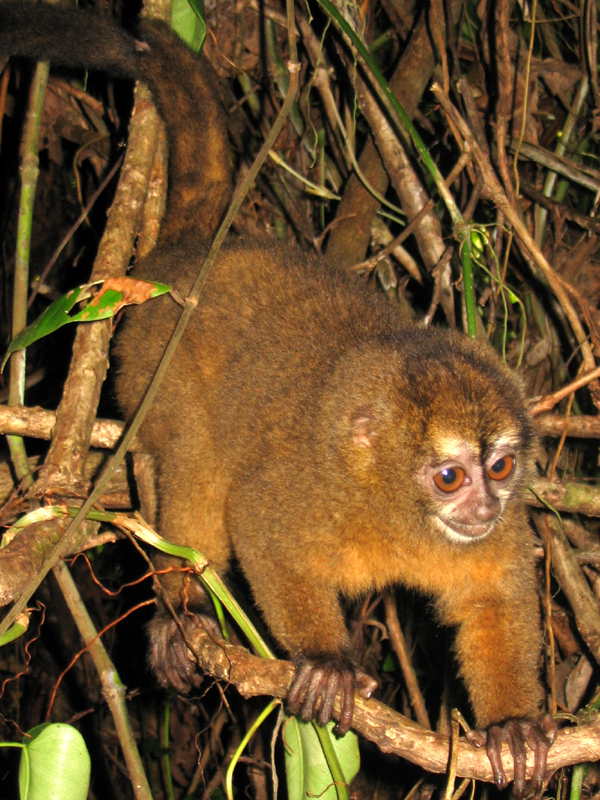
Night monkeys, also known as owl monkeys or douroucoulis (/duːruːˈkuːliz/), are nocturnal New World monkeys of the genus Aotus, the only living member of the family Aotidae (/eɪˈɒtɪdiː/). The genus comprises eleven species which are found across Panama and much of South America in primary and secondary forests, tropical rainforests and cloud forests up to 2,400 metres (7,900 ft). Night monkeys have large eyes which improve their vision at night, while their ears are mostly hidden, giving them their name Aotus, meaning "earless".
Night monkeys are the only truly nocturnal monkeys, although some cathemeral populations of Azara's night monkey have irregular bursts of activity during day and night. They have a varied repertoire of vocalisations and live in small family groups of a mated pair and their immature offspring. Night monkeys have monochromatic vision which improves their ability to detect visual cues at night.
Night monkeys are threatened by habitat loss, the pet trade, hunting for bushmeat, and by biomedical research. They constitute one of the few monkey species affected by the often deadly human malaria protozoan Plasmodium falciparum and are therefore used as experimental subjects in malaria research. The Peruvian night monkey is classified by the International Union for Conservation of Nature (IUCN) as an Endangered species, while four are Vulnerable species, four are Least-concern species, and two are data deficient.
Until 1983, all night monkeys were placed into only one (A. lemurinus) or two species (A. lemurinus and A. azarae). Chromosome variability showed that there was more than one species in the genus and Hershkovitz (1983) used morphological and karyological evidence to propose nine species, one of which is now recognised as a junior synonym. He split Aotus into two groups: a northern, gray-necked group (A. lemurinus, A. hershkovitzi, A. trivirgatus and A. vociferans) and a southern, red-necked group (A. miconax, A. nancymaae, A. nigriceps and A. azarae). Arguably, the taxa otherwise considered subspecies of A. lemurinus – brumbacki, griseimembra and zonalis – should be considered separate species, whereas A. hershkovitzi arguably is a junior synonym of A. lemurinus. A new species from the gray-necked group was recently described as A. jorgehernandezi. As is the case with some other splits in this genus, an essential part of the argument for recognizing this new species was differences in the chromosomes. Chromosome evidence has also been used as an argument for merging "species", as was the case for considering infulatus a subspecies of A. azarae rather than a separate species. Two extinct species of Aotidae are known from the fossil record: Aotus dindensis and Tremacebus harringtoni.
Family Aotidae
Night monkeys have large brown eyes; the size improves their nocturnal vision increasing their ability to be active at night. They are sometimes said to lack a tapetum lucidum, the reflective layer behind the retina possessed by many nocturnal animals. Other sources say they have a tapetum lucidum composed of collagen fibrils. At any rate, night monkeys lack the tapetum lucidum composed of riboflavin crystals possessed by lemurs and other strepsirrhines, which is an indication that their nocturnality is a secondary adaption evolved from ancestrally diurnal primates.
Their ears are rather difficult to see; this is why their genus name, Aotus (meaning "earless") was chosen. There is little data on the weights of wild night monkeys. From the figures that have been collected, it appears that males and females are similar in weight; the heaviest species is Azara's night monkey at around 1,254 grams (2.765 lb), and the lightest is Brumback's night monkey, which weighs between 455 and 875 grams (1.003 and 1.929 lb). The male is slightly taller than the female, measuring 346 and 341 millimetres (13.6 and 13.4 in), respectively.
Night monkeys can be found in Panama, Colombia, Ecuador, Peru, Brazil, Paraguay, Argentina, Bolivia, and Venezuela. The species that live at higher elevations and colder latitudes tend to have thicker fur. Night monkeys can live in forests undisturbed by humans (primary forest) as well as in forests that are recovering from human logging efforts (secondary forest).
Hub AI
Night monkey AI simulator
(@Night monkey_simulator)
Night monkey
Night monkeys, also known as owl monkeys or douroucoulis (/duːruːˈkuːliz/), are nocturnal New World monkeys of the genus Aotus, the only living member of the family Aotidae (/eɪˈɒtɪdiː/). The genus comprises eleven species which are found across Panama and much of South America in primary and secondary forests, tropical rainforests and cloud forests up to 2,400 metres (7,900 ft). Night monkeys have large eyes which improve their vision at night, while their ears are mostly hidden, giving them their name Aotus, meaning "earless".
Night monkeys are the only truly nocturnal monkeys, although some cathemeral populations of Azara's night monkey have irregular bursts of activity during day and night. They have a varied repertoire of vocalisations and live in small family groups of a mated pair and their immature offspring. Night monkeys have monochromatic vision which improves their ability to detect visual cues at night.
Night monkeys are threatened by habitat loss, the pet trade, hunting for bushmeat, and by biomedical research. They constitute one of the few monkey species affected by the often deadly human malaria protozoan Plasmodium falciparum and are therefore used as experimental subjects in malaria research. The Peruvian night monkey is classified by the International Union for Conservation of Nature (IUCN) as an Endangered species, while four are Vulnerable species, four are Least-concern species, and two are data deficient.
Until 1983, all night monkeys were placed into only one (A. lemurinus) or two species (A. lemurinus and A. azarae). Chromosome variability showed that there was more than one species in the genus and Hershkovitz (1983) used morphological and karyological evidence to propose nine species, one of which is now recognised as a junior synonym. He split Aotus into two groups: a northern, gray-necked group (A. lemurinus, A. hershkovitzi, A. trivirgatus and A. vociferans) and a southern, red-necked group (A. miconax, A. nancymaae, A. nigriceps and A. azarae). Arguably, the taxa otherwise considered subspecies of A. lemurinus – brumbacki, griseimembra and zonalis – should be considered separate species, whereas A. hershkovitzi arguably is a junior synonym of A. lemurinus. A new species from the gray-necked group was recently described as A. jorgehernandezi. As is the case with some other splits in this genus, an essential part of the argument for recognizing this new species was differences in the chromosomes. Chromosome evidence has also been used as an argument for merging "species", as was the case for considering infulatus a subspecies of A. azarae rather than a separate species. Two extinct species of Aotidae are known from the fossil record: Aotus dindensis and Tremacebus harringtoni.
Family Aotidae
Night monkeys have large brown eyes; the size improves their nocturnal vision increasing their ability to be active at night. They are sometimes said to lack a tapetum lucidum, the reflective layer behind the retina possessed by many nocturnal animals. Other sources say they have a tapetum lucidum composed of collagen fibrils. At any rate, night monkeys lack the tapetum lucidum composed of riboflavin crystals possessed by lemurs and other strepsirrhines, which is an indication that their nocturnality is a secondary adaption evolved from ancestrally diurnal primates.
Their ears are rather difficult to see; this is why their genus name, Aotus (meaning "earless") was chosen. There is little data on the weights of wild night monkeys. From the figures that have been collected, it appears that males and females are similar in weight; the heaviest species is Azara's night monkey at around 1,254 grams (2.765 lb), and the lightest is Brumback's night monkey, which weighs between 455 and 875 grams (1.003 and 1.929 lb). The male is slightly taller than the female, measuring 346 and 341 millimetres (13.6 and 13.4 in), respectively.
Night monkeys can be found in Panama, Colombia, Ecuador, Peru, Brazil, Paraguay, Argentina, Bolivia, and Venezuela. The species that live at higher elevations and colder latitudes tend to have thicker fur. Night monkeys can live in forests undisturbed by humans (primary forest) as well as in forests that are recovering from human logging efforts (secondary forest).
Recent media