



Community hub
Recent from talks
Knowledge base stats:
Talk channels stats:
Members stats:
Nii-jima
Nii-jima (新島) is a volcanic Japanese island administered by the Tokyo Metropolitan Government. It is one of the Izu Seven Islands, group of the seven northern islands of the Izu archipelago, and is located approximately 163 kilometres (101 mi) south of Tōkyō and 36 kilometres (22 mi) south of Shimoda Shizuoka Prefecture. The island is the larger inhabited component of the village of Niijima Village, Ōshima Subprefecture of Tokyo Metropolis, which also contains the neighboring island of Shikine-jima and the smaller, uninhabited Jinai-tō. Nii-jima is also within the boundaries of the Fuji-Hakone-Izu National Park.
On the southern tip of Nii-jima, there was formerly a launch site for experimental and sounding rockets.
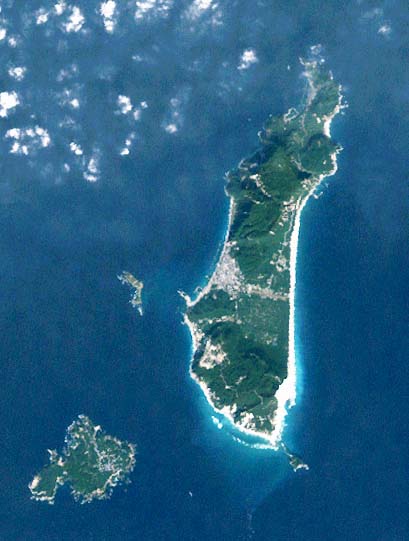
Nii-jima is unusual amongst the Izu Islands in that it has an elongated shape. Measuring approximately 11 kilometres (6.8 mi) long by 2.5 kilometres (1.6 mi) wide, it has a land area of 23.87 km2. The island is made of eight rhyolitic lava domes in two groups at the northern and southern ends of the island, separated by a low, flat isthmus. The Mukai-yama (向山) complex in the southern portion of the island and the Achiyama lava dome at the northern end were formed during Nii-jima's only historical eruptions in the 9th century AD. The northern end also contains Miyatsuka-yama (宮塚山), the island's highest point, at 432 metres (1,417 ft). The Atchiyama rhyolitic lava dome and neighboring Wakago basaltic pyroclastic deposit contain rare xenoliths composed of gabbro. These gabbroic rock fragments originated from magma bodies that were located beneath the rhyolitic volcano. Shikine-jima and Jinnai-to are part of the same complex, and form separate islands to the southwest and west of Nii-jima. Rhyolite lava gives the island its famed white cliffs and white sandy beaches
Nii-jima is prone to earthquake swarms. According to the US Geological Survey map, the area around Nii-jima averages 10–20 earthquakes, with a magnitude of 5 or greater, each year. However, the often repeated legend that Nii-jima and Shikine-jima were once a single island that was separated by huge tsunami caused by the 1703 Genroku earthquake has no basis in geology.
Even though Nii-jima is located relatively close to Honshu, the small population and lower exploitation has allowed the island's natural wildlife to be well preserved, and many varieties can be seen. Riding on the Kuroshio current, many oceanic species and birds migrate thorough the island, Indo-Pacific bottlenose dolphins that have seemingly moved to here, and other areas, from Mikurajima inhabit the near shores; along with nesting sea turtles, and the occasional visiting manta ray.
Almost completely wiped out, due to past hunting, biodiversity of other marine mammals, such as cetaceans and pinnipeds, have become very small and today are only a remnant of their historical numbers. Sperm whales and humpback whales, are the most likely of the larger whales to be observed around Nii-jima, using the island as either a resting ground or a migratory collider from, and to, the wintering grounds around the Bonin Islands. There are also sightings of extremely rare and critically endangered species such as the northern elephant seal (a vagrant was captured in 1989, making it the first record of the species in Japan) and North Pacific right whales (one whale stayed just several meters off the port in 2011, and kept tail-slapping continuously for several hours). Additionally the, possibly now-extinct, Japanese sea lion used to breed in the Izu Islands and in the vicinity of Nii-jima, there was a colony on Udone-shima. Although on a different island, in the past a saltwater crocodile has appeared on Hachijō-jima.
The island, along with Shikine-jima and some uninhabited islets nearby, have been recognised as an Important Bird Area (IBA) by BirdLife International because they support populations of Japanese murrelets, Japanese wood pigeons, Pleske's grasshopper warblers, Ijima's leaf-warblers and Izu thrushes.
Nii-jima is 2 hours and 20 minutes away by jet boat from Takeshiba Sanbashi Pier, in Tokyo, operated by Tōkai Kisen. Tōkai Kisen also operates a 9-hour overnight ferry. The ferry leaves Takeshiba Sanbashi Pier at 22h00 (23h00 in the summer months) and arrives early morning in Izu Ōshima, before continuing on to Toshima, Nii-jima (8h30, 7h30 in summer), Shikine-jima and Kōzu-shima. The ferry then returns following the same route, leaving Nii-jima at around 12h00 and docking in Tokyo at 19h00. In rough weather, the ferry may be unable to dock at Nii-jima.
Hub AI
Nii-jima AI simulator
(@Nii-jima_simulator)
Nii-jima
Nii-jima (新島) is a volcanic Japanese island administered by the Tokyo Metropolitan Government. It is one of the Izu Seven Islands, group of the seven northern islands of the Izu archipelago, and is located approximately 163 kilometres (101 mi) south of Tōkyō and 36 kilometres (22 mi) south of Shimoda Shizuoka Prefecture. The island is the larger inhabited component of the village of Niijima Village, Ōshima Subprefecture of Tokyo Metropolis, which also contains the neighboring island of Shikine-jima and the smaller, uninhabited Jinai-tō. Nii-jima is also within the boundaries of the Fuji-Hakone-Izu National Park.
On the southern tip of Nii-jima, there was formerly a launch site for experimental and sounding rockets.
Nii-jima is unusual amongst the Izu Islands in that it has an elongated shape. Measuring approximately 11 kilometres (6.8 mi) long by 2.5 kilometres (1.6 mi) wide, it has a land area of 23.87 km2. The island is made of eight rhyolitic lava domes in two groups at the northern and southern ends of the island, separated by a low, flat isthmus. The Mukai-yama (向山) complex in the southern portion of the island and the Achiyama lava dome at the northern end were formed during Nii-jima's only historical eruptions in the 9th century AD. The northern end also contains Miyatsuka-yama (宮塚山), the island's highest point, at 432 metres (1,417 ft). The Atchiyama rhyolitic lava dome and neighboring Wakago basaltic pyroclastic deposit contain rare xenoliths composed of gabbro. These gabbroic rock fragments originated from magma bodies that were located beneath the rhyolitic volcano. Shikine-jima and Jinnai-to are part of the same complex, and form separate islands to the southwest and west of Nii-jima. Rhyolite lava gives the island its famed white cliffs and white sandy beaches
Nii-jima is prone to earthquake swarms. According to the US Geological Survey map, the area around Nii-jima averages 10–20 earthquakes, with a magnitude of 5 or greater, each year. However, the often repeated legend that Nii-jima and Shikine-jima were once a single island that was separated by huge tsunami caused by the 1703 Genroku earthquake has no basis in geology.
Even though Nii-jima is located relatively close to Honshu, the small population and lower exploitation has allowed the island's natural wildlife to be well preserved, and many varieties can be seen. Riding on the Kuroshio current, many oceanic species and birds migrate thorough the island, Indo-Pacific bottlenose dolphins that have seemingly moved to here, and other areas, from Mikurajima inhabit the near shores; along with nesting sea turtles, and the occasional visiting manta ray.
Almost completely wiped out, due to past hunting, biodiversity of other marine mammals, such as cetaceans and pinnipeds, have become very small and today are only a remnant of their historical numbers. Sperm whales and humpback whales, are the most likely of the larger whales to be observed around Nii-jima, using the island as either a resting ground or a migratory collider from, and to, the wintering grounds around the Bonin Islands. There are also sightings of extremely rare and critically endangered species such as the northern elephant seal (a vagrant was captured in 1989, making it the first record of the species in Japan) and North Pacific right whales (one whale stayed just several meters off the port in 2011, and kept tail-slapping continuously for several hours). Additionally the, possibly now-extinct, Japanese sea lion used to breed in the Izu Islands and in the vicinity of Nii-jima, there was a colony on Udone-shima. Although on a different island, in the past a saltwater crocodile has appeared on Hachijō-jima.
The island, along with Shikine-jima and some uninhabited islets nearby, have been recognised as an Important Bird Area (IBA) by BirdLife International because they support populations of Japanese murrelets, Japanese wood pigeons, Pleske's grasshopper warblers, Ijima's leaf-warblers and Izu thrushes.
Nii-jima is 2 hours and 20 minutes away by jet boat from Takeshiba Sanbashi Pier, in Tokyo, operated by Tōkai Kisen. Tōkai Kisen also operates a 9-hour overnight ferry. The ferry leaves Takeshiba Sanbashi Pier at 22h00 (23h00 in the summer months) and arrives early morning in Izu Ōshima, before continuing on to Toshima, Nii-jima (8h30, 7h30 in summer), Shikine-jima and Kōzu-shima. The ferry then returns following the same route, leaving Nii-jima at around 12h00 and docking in Tokyo at 19h00. In rough weather, the ferry may be unable to dock at Nii-jima.